
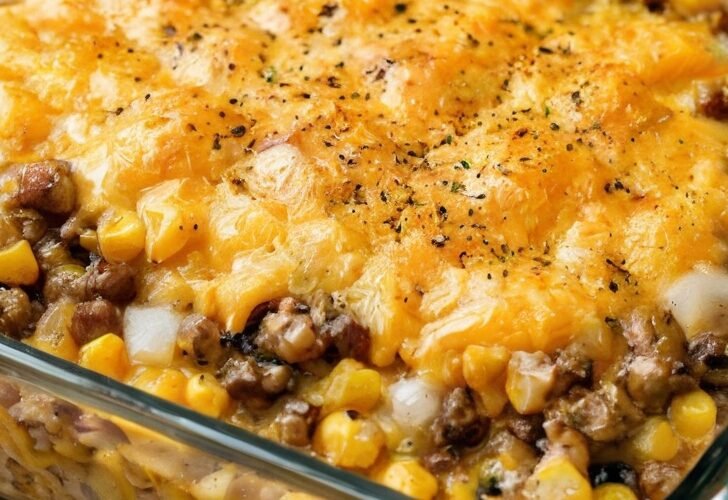
Cheap Beef and Corn Casserole: The 5-Ingredient Oven Bake That Feeds Four
I want to be honest about how this one entered my kitchen, because it was not a decision. It was a Tuesday. I had nothing planned, nothing thawed, and about eleven dollars left in the grocery budget for the week, which is a specific kind of pressure that does not inspire anybody to be creative. I opened the pantry, I found a can of creamed corn, and I found a pound of ground beef I had bought on a sale and frozen for a day I never got around to. So I thawed it, crumbled it raw into a glass dish, poured the corn over the top, added cheese, and put it in the oven, mostly because there was nowhere else for any of it to go. That was several years and about a hundred times ago now, and I have made this cheap beef and corn casserole more often than any other single recipe on this site. Not because it is impressive. It is the least impressive thing I cook. It is five ingredients, there is no browning step, there is no technique to speak of, and it comes out of a dish that I did not have to wash afterward. What it has, and what almost nothing else in my kitchen has, is the specific ability to be a completely decent dinner on a night when I have nothing left to give. It also, and I did not expect this, quietly does something I did not plan for. A pound of ground beef divided four ways is about thirty-five grams of protein per serving, which makes this one of the higher-protein dinners I make on a regular basis without ever once thinking about it as a high-protein meal. There is a whole pound of meat in this dish. That is what makes it filling, and it is also why I can feed a hungry family of four for three dollars a head without anyone at my table feeling like they got the short end of the deal. It is Midwest comfort food in the most literal sense. It is the thing that shows up on a church potluck table in a foil-covered dish, and it is the thing your grandmother made when she was not in the mood for anything more complicated than opening a can. If you want the whole thing with the swaps and the mistakes and the honest cost math, keep reading. If you just want to make it tonight, the recipe card is at the bottom and it is going to take you about an hour, most of which the oven does without you.
Why You'll Love This Cheap Beef and Corn Casserole
- Five ingredients, and three of them are from a can or a tub. Beef, creamed corn, cheddar, sour cream, salt. If you keep a pound of ground beef in the freezer and a couple of cans of corn in the pantry, you are essentially always ready to make this.
- About three dollars a serving for four people. A twelve dollar fifty cent casserole that produces four honest servings is a genuinely good deal, and it is the reason this is in our rotation rather than the occasion rotation.
- No browning, no fussing, no mise en place. You crumble raw beef into a dish. That is the entire technique. There is nothing to sear and nothing to time precisely.
- About thirty-five grams of protein per serving. There is a full pound of ground beef in here. If you have been trying to eat more protein without spending more money, this is a very efficient way to do it.
- One dish, one pan, almost no cleanup. You mix the corn in a bowl, pour it, and bake. There is no colander, no saucepot, and no second baking sheet.
- It reheats and freezes well. This is a high-protein ground beef dinner that keeps for four days and freezes for a couple of months, which makes it genuinely useful for a month when you are already behind.
Why This Cheap Beef and Corn Casserole Works Every Time
The reason this recipe works is that it is not doing anything clever, and the cleverness you would normally add is the thing that usually breaks it. Start with the raw beef. You are not browning it, and you are not supposed to. Dropping ground beef straight into a baking dish and baking it sounds careless, and in a dry pan it would be. What makes it work here is that the beef is buried under a thick, wet, fatty layer of creamed corn and sour cream, and the first thirty minutes happen under foil. That combination turns the oven into a gentle steamer. The beef cooks slowly in its own rendered fat and in the moisture coming up off the corn, with the cheese above it acting as a lid, and it comes out browned and well done without you ever turning on a burner. This is an old technique, not a hack, and it is the entire reason the dish exists. The creamed corn and sour cream mixture is the sauce, and this is the part that people most often get wrong. Stir them together until they are genuinely smooth and pourable before they go over the meat, and pour it over so the beef is covered. That layer does three jobs at once. It seasons the beef from above, it stops the top of the meat from drying out, and it is what turns the bottom of the dish into something you can scoop with bread. If you leave patches of beef exposed, those patches dry and brown, and you end up with hot spots in the middle of the casserole. The cheese goes on before the foil, not after. This matters. Cheddar under foil melts into the corn mixture and becomes part of the sauce, which is where the actual flavor lives. Cheddar added in the last fifteen minutes sits on top, browns, and gets a little crisp around the edges, which is nice but is a different thing. The version you want is cheese melted into the sauce first, then a fresh layer melted over the top at the end, and that is why this recipe does both. And the two-stage bake is not a formality. Thirty minutes covered is what cooks a full pound of raw ground beef through, gently, all the way to safe. Fifteen to twenty uncovered is what thickens the sauce, sets the middle, and gets the top bubbling and lightly golden. Do the whole thing covered and you get a hot, soupy, watery dish. Do the whole thing uncovered and you get a dry, tight one with rubbery beef. The two stages are doing two different jobs and you need both.
Ingredient Breakdown
Five ingredients, and here is the honest math on what they actually cost. Prices are typical US grocery range prices for a budget shop in 2026 and will vary by store and by sale cycle, but the total is close enough to plan around.
- 1 lb ground beef, 80 to 90% lean — about $5.49. This is roughly half the cost of the whole dish and it is where the protein comes from. Eighty-twenty is the flavor winner; ninety-ten is the budget winner and works fine as long as it stays covered for the full first thirty minutes.
- 2 cans (14.75 oz each) creamed corn — about $2.38. Two large cans is the size that actually covers a pound of beef in a 9x13, which is why this recipe does not work with one. Store brand is fine and saves about forty cents a can.
- 1 cup (about 4 oz) shredded cheddar — about $2.29. Shred it yourself off the block and you come out ahead, though the cost difference here is small enough that convenience is a legitimate reason to buy it bagged.
- 1 cup sour cream — about $1.29. Buy the smallest tub you can find, or use a leftover half cup of a bigger one. This is the ingredient people most often have to buy a whole container for, which is annoying if you are only using a cup.
- Kosher salt and black pepper — about $0.05. The creamed corn is already salted, so go in light and taste after baking. This is one of the few things in this recipe where overshooting is easy to fix and hard to undo.
That is about $12.50 total, which across four servings is about $3.10 a serving. I will put it in context honestly: a drive-through meal for a family of four with drinks is somewhere in the range of twenty-two to twenty-six dollars. This is a pound of real beef, a full serving of vegetables, and a third of a bag of cheese for less than the price of two sandwiches. It is not a health food, but on a value basis it is very hard to argue with.
Kitchen Equipment
This is a low-equipment recipe on purpose. You need almost nothing.
- A 9x13-inch glass baking dish. Glass is genuinely better than metal here, because it heats evenly and gives you that slow, gentle cook on the bottom that the raw beef method depends on. Do not substitute a deep casserole dish; you need that shallow depth for the creamy layer to cover the meat.
- A medium mixing bowl and a spoon or spatula for the corn mixture.
- A sheet of aluminum foil for the covered stage. Do not skip this and do not substitute a lid, because the foil is what traps the steam that cooks the beef.
- Your hands, which is the only tool this recipe actually requires.
What you do not need: a skillet, a colander, a thermometer if you are comfortable without one, or anything else. If you own a glass dish and a roll of foil, you can make this tonight.
Step-by-Step Instructions
Step 1: Preheat the oven to 375°F and grease the dish. Set the oven now so it is fully preheated by the time you finish assembling. Lightly spray or wipe a 9x13 glass dish with a little oil or butter. You want the cheese to release from the corners when it is done, and a greased dish is the difference between serving and scrubbing. Step 2: Crumble the raw ground beef into the bottom of the dish. Break it up with your fingers into smallish clumps and spread it into a roughly even layer. Do not pack it down and do not press it smooth. You want a loose, crumbly layer with air in it, because the steam needs somewhere to move. If you compress it into a solid slab, the center of that slab will stay pale and wet while the edges overcook. Sprinkle the salt and the black pepper evenly over the top of the raw meat now. Step 3: Mix the creamed corn with the sour cream. In a medium bowl, stir the two cans of creamed corn with the cup of sour cream until it is completely smooth and pourable, with no lumps of sour cream still sitting in it. Scrape the bottom of the bowl. If it is thicker than you expect, that is fine; if it is so thick it will not pour, stir in a tablespoon or two of water or milk. Step 4: Pour the mixture over the beef and spread it. Pour it evenly over the raw beef and use the back of your spoon to spread it out so the meat is covered as completely as you can manage. It should look like a thick, creamy layer sitting on the meat, not corn poured in patches. Every bit of exposed beef is a bit of beef that dries out and browns instead of cooking gently. Step 5: Add the cheese, then cover tightly. Scatter the shredded cheddar evenly over the top, right to the edges of the dish. Then cover the dish tightly with foil, pressing it down onto the contents so it seals. This is the step that cooks your beef, and a loose tent of foil will not do it. Step 6: Bake covered for thirty minutes. Put it in the preheated oven and let it cook thirty minutes, undisturbed. This is the gentle steaming stage. The beef is cooking in the trapped moisture from the corn and sour cream, and the cheese under the foil is melting into the sauce. Do not peek, and do not stir. Thirty minutes is what gets a full pound of raw ground beef through. Step 7: Uncover and bake fifteen to twenty more minutes. Pull the dish out carefully, because a cloud of steam comes off the foil, and pull the foil straight back rather than letting it fall into the food. Bake uncovered until it is bubbling around the edges and the cheese on top is melted and lightly golden, fifteen to twenty minutes. The sauce will thicken noticeably in this stage, and this is where the dish goes from watery to cohesive. Step 8: Verify the beef is fully cooked. Push a spoon into the center and look. The beef should be uniformly brown with no pink anywhere, and the juices should run clear. If you see pink or the juices are still cloudy, put it back for another five to ten minutes and check again. If you want certainty rather than eyeballing, a thermometer in the center should read 160°F. There is no rushing this part; a full pound of raw beef needs to come all the way through. Step 9: Rest for five to ten minutes, then serve. Let it sit so the sauce sets slightly and it stops being molten in the middle. Scoop it into bowls and serve it hot, with something green next to it if you can manage it.
Expert Tips
- Do not pack the beef down. A loose, crumbly layer lets steam move through it. A packed slab cooks unevenly, and the middle stays pale. This is the single most important thing you do with the raw meat.
- Cover completely and press the foil down. Loose foil is not a seal. You are creating a steam chamber, and if the steam escapes you are back to a dry bake with a raw center.
- Let the corn and sour cream mix until truly smooth. No lumps of sour cream left in it. Those lumps stay white and distinct in the finished dish instead of melting into the sauce.
- Buy ninety-ten beef if you are watching the budget, and keep the foil on for the full thirty. Lean beef gives up less fat, so it needs more of the covered stage to stay tender. Eighty-twenty is more forgiving.
- Season after, not just before. The creamed corn and the cheese are both salty, and you can overshoot. Taste it as it comes out of the oven and add a pinch of salt to the whole dish if it needs it, rather than trying to predict it in advance.
- Let it rest the full ten minutes if you are serving it to people who do not like messy food. The sauce tightens noticeably during the rest and it is the difference between a casserole and a bowl of soup.
- Use glass, and do not go deeper than 9x13. A deeper dish means a thicker corn layer, which means less steam reaching the meat and an uneven cook.
- Assemble it unbaked the night before. Everything except the cheese, covered in the fridge, covered with foil when you bake. From cold it needs five to ten extra minutes on the covered stage.
Common Mistakes to Avoid
- Packing the raw beef into a solid layer. Uneven cooking, pale center, dry edges. Crumble it loosely with your fingers.
- Not covering the beef completely with the corn mixture. Exposed meat browns and dries out instead of steaming, and you get hot spots in the middle of the dish.
- Loose foil. If it is not sealed down onto the dish, the steam escapes and the beef does not cook through in thirty minutes. This is the mistake that produces raw beef in the middle, so it is the one to watch.
- Baking the whole time uncovered. The first thirty minutes covered are not optional. Uncovered from the start means a dry, tight dish with overcooked edges.
- Under-salting the beef layer. The corn and cheese are both salty, so the bottom of the dish can end up bland while the top is fine. Season the meat lightly, then taste and correct the whole dish at the end.
- Skipping the doneness check. Spoons in, look, confirm. Not the juices, not color guesswork, an actual look into the center of the dish.
- Serving it straight from the oven. The sauce needs those five to ten minutes to set. Scooping it immediately gives you hot liquid in a bowl rather than a cohesive casserole.
- Using only one can of corn. Two is what actually covers a pound of beef in a 9x13. One can leaves half the meat exposed and the bake is uneven.
Ingredient Substitutions
- Gluten-free: This can be made gluten-free, but you have to read the label on the creamed corn. Most brands use milk and modified cornstarch rather than wheat, so they are naturally gluten-free, and sour cream, beef, and cheddar are fine. A few brands use a wheat-based thickener, so check. If you buy a certified gluten-free creamed corn, this whole dish is gluten-free as written, and it is a genuinely useful thing to know for a dish this cheap.
- Ground beef: Ninety-ten for budget, eighty-twenty for flavor, both fine. Ground turkey works, but it is leaner, so keep the foil on for the full thirty minutes and consider a tablespoon of olive oil in the corn mixture. A turkey and beef blend is the best of both and usually costs less than all beef.
- Cheese: Cheddar is the default. Colby Jack is milder and melts smoother, Monterey Jack is stretchier, and a Mexican blend turns this into a completely different but equally cheap casserole. Sharp cheddar gives you the most flavor and is what I buy.
- Creamed corn: Regular creamed corn is the whole point here, because the cream is what makes the sauce. If you use plain whole kernel corn, stir the sour cream into it more heavily and add a tablespoon of milk or cream, and it will still work. Sweet corn only works if you dial the salt back.
- Sour cream: Plain, not Greek. Greek sour cream is much lower in fat and noticeably tangier, and this dish already has enough going on without the extra sharpness. Light sour cream is fine and costs the same.
- Salt: Halve it. The creamed corn and the cheddar together bring a lot of salt, and you can always add at the end.
Variations
- Mexican Beef and Corn Casserole: Add a teaspoon of cumin and a half teaspoon of chili powder to the corn mixture, use a Mexican cheese blend, and top with crushed tortilla chips in the last five minutes. Serve with sour cream and salsa. This is the most-requested version at my house and it costs about the same.
- Shepherd's Pie Version: Skip the corn layer. Top the raw seasoned beef with instant mashed potatoes, dot with butter, and bake. Same dish, different shape, same thirty minutes covered.
- Buffalo Chicken and Corn: Swap the beef for shredded rotisserie chicken, add a quarter cup of buffalo sauce to the corn and sour cream, and use mozzarella or a Buffalo-flavored cheddar. Cheap, fast, and genuinely good.
- Corn Casserole with Egg Noodles: Spread cooked egg noodles in the dish, then layer the raw beef, then the corn mixture on top. It becomes a noodle casserole with a corn crust and it is unreasonably comforting.
- Hashbrown Version: Scatter a layer of frozen shredded potatoes on top instead of cheddar, and drizzle with melted butter. Bake uncovered for the last fifteen minutes. You get a crisp potato lid over the same base.
- Loaded Version: Add a cup of frozen mixed vegetables over the raw beef before the corn goes on, and finish the top with a sprinkle of green onion and a few crushed potato chips. It looks like a restaurant side dish and it is still one dish.
- Breakfast Version: Use breakfast sausage instead of ground beef and top with a mixture of eggs and milk poured over the corn layer. Bake the same way. This is a genuinely good Sunday breakfast.
Make It Healthier
I want to be straight about what this is. This is a sour cream and cheddar casserole. It is high in sodium, it is not low calorie, and it is not a diet food, and I am not going to dress it up as one. What I can do is tell you where the real wins are, because there are some genuine ones here.
- You already have thirty-five grams of protein per serving. That is not a marketing number, it is what a pound of ground beef divided four ways gives you. Most people trying to eat more protein per dollar get there with chicken, and this gets there with a pound of beef for five dollars. That is a real nutritional advantage and it is worth saying out loud.
- You are eating a full serving of vegetables. Two cans of creamed corn is not a side dish over here, it is a layer, and you are getting a meaningful amount of corn in every serving. Adding a cup of frozen broccoli or mixed vegetables over the beef before the corn goes on raises that considerably for about thirty cents.
- Use ninety-ten beef and it gets lighter. You will cut a meaningful amount of fat and save a little money. The tradeoff is that lean beef needs the full thirty minutes covered to stay tender, so do not shortcut that stage.
- Use light sour cream. It is the same price and the difference is modest, but it is a real one and it costs you nothing to make.
- Add vegetables rather than subtracting food. A cup of frozen spinach or broccoli over the raw beef before the corn layer is the single best change here, because it improves the dish rather than diluting it.
- Watch the portions, honestly. Four servings from this dish is a real serving each, and this is about five hundred seventy-five calories per serving. That is a reasonable dinner. Three of these is a lot of dinner, and I say that with love, because I have done it.
Meal Prep Tips
This is a good prep-ahead recipe, with one specific arrangement that works better than most.
- Assemble raw, refrigerate, bake with foil. Put the beef in, season it, pour the corn mixture on, cover the dish, and refrigerate for up to twenty-four hours. Add the cheese right before it goes in the oven, then bake from cold with five to ten extra minutes on the covered stage. This is the version I make when I know tomorrow is going to be a long day.
- Brown the beef ahead for a better result. This is the one deviation from the recipe that actually improves it. If you have fifteen minutes, browning the beef in a skillet first, then breaking it up into the dish, gives you more browning flavor and drains off a lot of grease. The dish is slightly less effortless and noticeably better.
- Double it and bake two dishes. One for this week, one in the freezer. Do not try to cram a double batch into one 9x13; you will get a deep, uneven, undercooked casserole and the raw beef risk goes up with it.
- Portion the leftovers into single servings before they cool. Scooping cold casserole into containers is a miserable job. Scooping it warm into the containers you actually want to eat from takes two minutes and saves you ten.
- Grate the cheese the night before. This is a small thing that makes assembly fast, and it is the one step in this recipe that takes real time.
Storage
Refrigerate leftovers in an airtight container for up to four days, and get them into the fridge within two hours of baking. This is a ground beef and dairy dish, so four days is a real limit rather than a suggestion, and three days is where I would aim to be finished. I would not leave this on a counter overnight, even covered, because there is meat and sour cream in it. Let it cool uncovered for about twenty minutes before you seal the container, or the condensation will make the cheese top soft and slightly weepy. If you have a lot left, cut it into squares and store them in a single layer rather than stacking, because the top layer keeps its browned cheese crust and the ones underneath turn into squares of hot cheese sauce. Reheated in the oven, the top re-crisps; reheated in a microwave, it turns into a hot bowl of beef and corn, which is still a perfectly good Tuesday dinner.
Freezing
This freezes well and this is one of the better reasons to make a double batch. The dairy and the creamed corn both freeze without real drama, which is unusual and pleasant to discover. The best method is to freeze it unbaked, because the sauce texture stays smoother and you get to top it with fresh cheese: assemble the beef, the corn mixture, and even the cheese, cover the dish with foil, and freeze for up to two months. To cook from frozen, move it to the refrigerator twenty-four hours ahead to thaw, then bake at 375°F with the foil back on for forty minutes and uncovered for twenty. The thirty-minute covered stage stretches because you are starting from solid, and that is the stage you absolutely cannot skip. You can also freeze baked portions in a freezer-safe container with parchment between the layers for up to two months; thaw them overnight in the fridge and bake at 350°F for twenty-five minutes, or transfer from freezer to oven and add five minutes. The top crust softens in the freezer, so if crisp cheese matters to you, freeze unbaked and add the cheese fresh. I would not freeze this in a glass dish you care about; move it to a foil-covered or plastic-lidded container if it is going straight into the freezer.
Reheating
Oven, and it is not close. Set it to 350°F, cover loosely with a small piece of foil so the cheese does not scorch, and heat for fifteen to twenty minutes until the center is hot all the way through. Take the foil off for the last five minutes and the top will re-crisp and the sauce will tighten back up instead of going watery. If you are reheating a single square, a toaster oven at 350°F for ten to twelve minutes does a better job than a microwave, because the thing you want back is the browned top, and a microwave cannot do that. For a microwave, cover loosely with a paper towel, heat at half power in ninety-second intervals, stir between rounds, and let it sit two minutes. You will get hot, creamy, uniformly soft casserole, which is a completely legitimate result and not worth apologizing for. One thing worth knowing: this reheats better than most casseroles and it is genuinely good cold, straight from the container, standing at the counter at eleven at night, which I realize is not a recommendation I should be making in a recipe post but is entirely true.
What to Serve With It
This is a rich, creamy, salty casserole, so what goes next to it should be cool, green, sharp, or crunchy. Anything heavy doubles down and you will need a nap afterward.
- A simple green salad with a sharp vinaigrette. The most reliable pairing, and the one that keeps the meal from feeling like one long beige event.
- Steamed or skillet green beans with a squeeze of lemon and a pinch of red pepper. Quick, cheap, and the acidity cuts the richness.
- Cornbread or warm dinner rolls, for the sauce. This is not a health recommendation, it is a practical one, and I would not apologize for putting bread on the table with a casserole.
- Buttered toast, if that is what you have. It works exactly as well as cornbread and it takes one minute.
- A bowl of pickles, pickled onions, or banana peppers. Acid on the plate makes a rich dish taste lighter and this costs about two dollars.
- Spoon it over mashed potatoes, cooked rice, or egg noodles to stretch it. This is how it becomes eight servings instead of four, and for a family that is a genuinely useful trick.
- Hot sauce on the side, for anyone at the table who wants a little more than they are going to get from the dish itself.
Beverage Pairings
The rule is cold, slightly bitter, and not sweet. A sweet drink next to this is too much, and anything warm makes the sour cream feel heavier.
- Cold lager or pilsner is what this was built for. The bitterness cuts the fat and the carbonation scrubs the creamy sauce off your palate between bites.
- A light-bodied red if you want to stay in wine, a chilled Pinot Noir or a Gamay. Skip the big oaked reds, which are too much for a dish this creamy.
- Sweet tea over ice, which is extremely southern and extremely correct with a beef and corn casserole.
- Lemonade, sparkling water with lemon, or iced tea with a squeeze of lime for the people at the table who are not drinking beer.
- Cold brew or iced coffee afterward, because this is the kind of dinner that gets followed by something sweet.
FAQ
How Do You Make Beef and Corn Casserole?
Five ingredients and one dish. Preheat the oven to 375°F and grease a 9x13 glass baking dish. Crumble one pound of raw ground beef loosely into the bottom of the dish, season it with salt and pepper, and do not pack it down. Stir two cans of creamed corn with one cup of sour cream until smooth, pour it over the beef so the meat is completely covered, and scatter a cup of shredded cheddar on top. Cover tightly with foil and bake thirty minutes, then uncover and bake fifteen to twenty minutes more until it is bubbling at the edges and the cheese is melted and lightly golden. Check the center for pink before you serve it, then let it rest five to ten minutes so the sauce sets.
Do You Have to Brown the Ground Beef First?
No, and not browning is the whole point of the method. The raw beef cooks gently under a wet, fatty layer of creamed corn and sour cream with foil on top, which turns the oven into a steamer and cooks the meat through without browning. It comes out well done and workable, not pink or tough. That said, if you have fifteen spare minutes, browning the beef in a skillet first, breaking it up, and then spreading it in the dish gives you noticeably more flavor and drains off a lot of grease. The dish is slightly less effortless that way and slightly better, so it is entirely your call.
How Long Do You Bake Beef and Corn Casserole at 375 Degrees?
Thirty minutes covered with foil, then fifteen to twenty minutes uncovered, for a total of forty-five to fifty minutes. The covered stage is what cooks a full pound of raw ground beef through gently, and it is the part people skip and then wonder why the middle is still pink. The uncovered stage thickens the sauce, sets the middle, and gets the cheese bubbling and lightly golden. If you are starting from a cold assembled dish out of the fridge, add five to ten minutes to the covered stage. If you want to be certain rather than guessing, push a spoon into the center and confirm there is no pink and the juices run clear, or use a thermometer and read 160°F.
Is Beef and Corn Casserole Gluten-Free?
It can be, and this is a dish worth knowing that about, because it costs three dollars a serving. The beef, sour cream, and cheddar are all naturally gluten-free. The variable is the creamed corn, because most brands thicken with milk and modified cornstarch rather than wheat, which makes them gluten-free, but a few use a wheat-based thickener. Read the label. If you buy a can that lists no wheat, the entire dish is gluten-free as written, with no substitutions and no specialty shopping. If the brand does use wheat, a gluten-free creamed corn swaps in directly and nothing else in the recipe needs to change.
Is This a High Protein Dinner?
It genuinely is, and I did not expect it. There is a full pound of ground beef in this dish, which divided across four servings works out to roughly thirty-five grams of protein per serving. That is more protein than most people get from a chicken dinner that costs twice as much, and it happens here without anybody thinking about protein at all. It is worth naming this one because a high-protein dinner is usually expensive, and this one is about three dollars a head. It is a high-sodium dish, though, and the creamed corn and cheddar together bring a lot of salt, so if sodium is a concern for you, halve the added salt and use the ninety-ten beef.
Can I Make This Casserole Ahead of Time?
Yes, and it is one of the better make-ahead recipes because almost nothing can go wrong. Assemble the beef, the corn mixture, and the seasoning in the dish, cover it, and refrigerate for up to twenty-four hours. Add the cheese right before baking, cover tightly with foil, and bake from cold with five to ten extra minutes on the covered stage. You can also bake it fully a day ahead, refrigerate, and reheat, though a freshly baked top is a better reason to look forward to dinner. Do not assemble it more than a day ahead, because raw ground beef should not sit in the fridge longer than that.
Can I Freeze Beef and Corn Casserole?
Yes, for up to two months, and the unbaked version freezes better than the baked one because the sauce stays smoother. Assemble the casserole, wrap the dish in foil, and freeze it. Thaw it in the refrigerator twenty-four hours ahead, then bake at 375°F with the foil on for forty minutes and uncovered for twenty, since you are starting from solid and the covered stage is not optional. Baked portions also freeze in an airtight container with parchment between the layers; thaw overnight and bake at 350°F for twenty-five minutes. The cheese crust softens in the freezer, so if that matters to you, freeze unbaked and add fresh cheese when you bake.
What Can I Serve With Beef and Corn Casserole?
Something green, something sharp, or something to mop the sauce up with. A simple green salad with a sharp vinaigrette is the most reliable answer, and steamed green beans with lemon is almost as good and takes ten minutes. Cornbread and warm dinner rolls are the traditional move and the sauce genuinely needs something to soak up. Pickles, pickled onions, or a bowl of banana peppers on the table will cut the richness for about two dollars. And to stretch the meal from four servings to eight, spoon it over mashed potatoes, cooked rice, or egg noodles, which is a trick I use more than I ever admit to in public.
Nutrition Information
These figures are estimates for one serving, calculated as roughly one quarter of the finished dish using typical values for 80/20 ground beef, canned creamed corn, sharp cheddar, and sour cream. They are not laboratory-tested, and they will vary with the brands you buy and whether you use eighty-twenty or ninety-ten beef, so treat them as a guide rather than a precise record. Per serving, approximately 575 calories, 35 g protein, 28 g carbohydrate, 35 g fat, 14 g saturated fat, 2 g fiber, 8 g sugar, and roughly 980 mg sodium. The dish makes 4 servings. Using ninety-ten beef and light sour cream brings the fat down noticeably and the total to roughly 520 calories. I want to be straightforward about the character of this meal. It is a sour cream and cheddar casserole and it is not a light dish. The sodium figure is high, and that comes from the creamed corn, the cheese, and the salt, not from anything unusual in the method. What it is, though, is a real pound of beef delivering about thirty-five grams of protein per serving, a full serving of corn, and four honest portions for about three dollars a head. That is a genuinely good deal on a meal, and I would rather tell you exactly what you are getting than pretend it is something it is not.
Final Thoughts
I have never once made this dish for a reason. There is no occasion. Nobody asked for it. It is not impressive, it is not a project, and on a plate it is not going to win anybody a compliment, because it is a can of corn on top of some beef in a glass dish. What it does is show up on the hardest nights and do the job without requiring anything from me, which after having a daughter and a husband and a job is a harder thing to find than it used to be. Roughly three dollars a head, about thirty-five grams of protein each, one pan, and twenty-five minutes of work that the oven mostly does for you. There are recipes I make because they are good. This is one I make because it is kind. So tell me what you do with yours, because I have clearly been making the plain version and I am slightly bored of it. Do you add vegetables, do you swap the cheese, do you turn it into something with a crust on top? I am looking for the version that is not just mine, and if you have one that works I would genuinely like to hear about it. Also, if you make it and it does not turn out right, tell me what happened, because I have had about four of these go wrong in ten years and I would love to know what your version of the failure looks like.
Budget Dinner · 5 Ingredients · High Protein
Cheap Beef and Corn Casserole
Raw crumbled ground beef, two cans of creamed corn, sour cream, and cheddar, baked in one glass dish. No browning, no technique, about 35 grams of protein per serving.
Ingredients
Method
- Preheat to 375°F and grease a 9x13 glass dish. Set the oven now. Greasing is what gets the cheese off the corners later.
- Crumble the raw beef into the dish, loosely. Break it into small clumps with your fingers and spread it into an even layer. Do not pack it down. Season with salt and pepper.
- Stir the creamed corn with the sour cream until smooth. No lumps left. If it will not pour, loosen it with a splash of water or milk.
- Pour it over the beef and spread it out. Every bit of exposed meat dries out and browns instead of steaming. Cover the meat completely.
- Scatter the cheese on top, then seal with foil. Press the foil down onto the dish. Loose foil is not a seal, and this is the step that cooks the beef.
- Bake covered 30 minutes. Do not peek or stir. This is the gentle steaming stage that gets the raw beef through.
- Uncover and bake 15 to 20 minutes more. Pull the foil straight back and watch for steam. Bake until bubbling at the edges and the top cheese is melted and lightly golden.
- Confirm it is fully cooked, then rest. Push a spoon into the center: no pink anywhere, juices run clear, or 160°F on a thermometer. Rest 5 to 10 minutes so the sauce sets, then scoop into bowls.
Notes, Cost & Tips
- $12.50Estimated total
- $3.10Cost per serving
- 35 gProtein per serving
- 4Honest servings
- Cheap family dinner tip: the whole dish is about $12.50, or $3.10 a head, and a drive-through meal for four with drinks runs $22 to $26. To feed eight, spoon it over mashed potatoes, rice, or egg noodles, which costs almost nothing and stretches it.
- High protein without the high price tag: a full pound of ground beef across 4 servings is about 35 g protein per serving, more than most chicken dinners costing twice as much. Sodium is high though, so halve the added salt and use 90/10 if that matters to you.
- Gluten-free check, one can: most creamed corn thickens with milk and modified cornstarch, not wheat, so it is naturally gluten-free. A few brands use a wheat thickener, so read the label. Beef, sour cream, and cheddar are always fine.
Estimated Nutrition (per serving)
Nutrition values are estimates for one serving, calculated as roughly one quarter of the finished dish using typical values for 80/20 ground beef, canned creamed corn, sharp cheddar, and sour cream. They are not laboratory-tested and will vary with brands and with the leanness of the beef. Using 90/10 beef and light sour cream brings the total to roughly 520 calories. This is a sour cream and cheddar casserole and it is not a light dish; no medical or weight-loss claims are made for it.