
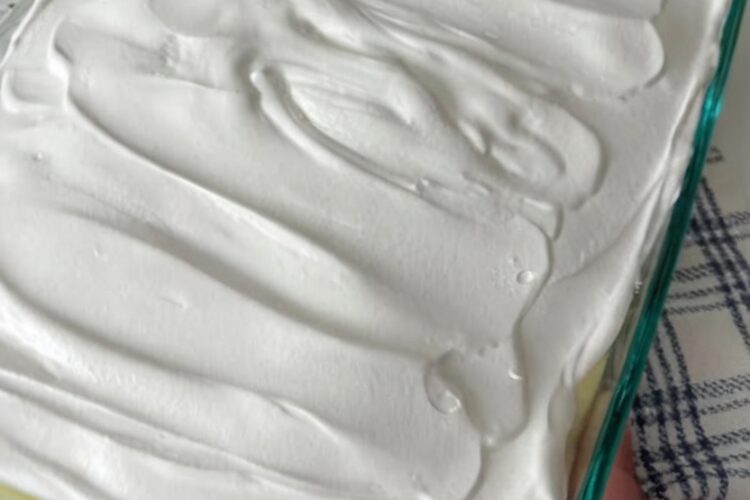
Classic Church Cake: The Make-Ahead Dessert That Feeds a Crowd for Less Than a Dollar a Slice
The first church cake I ever ate was at my grandmother's church, in a foil pan that had been through the dishwasher about four hundred times, sitting on a table next to a casserole dish with a rubber band on the lid. Somebody's mother had made it. Somebody always had. I did not know for years that I was eating the same dessert at three different church functions in three different counties, and that every single one of those women made it from the back of a box of muffin mix.
That is the whole story of this recipe, and it is a better story than most. There is nothing to hide behind. No scratch cake, no from-scratch frosting, no ingredient list that requires a trip to a second store. Two boxes of banana muffin mix, a can of pineapple, a block of cream cheese, a box of pudding, a tub of whipped topping. And out of that comes something that feeds twelve people, chills for three days, and travels to a potluck in one dish.
My version adds one thing to what my grandmother made, and I will get to it. Hers had shredded coconut sprinkled on top, and hers was wonderful. Mine has a layer of toast-free, soggy-prone, never-the-less-crucial drained crushed pineapple in the middle, and that one layer is the reason people ask for the recipe every single time I bring it.
I make this four or five times a year now. Easter, graduation, the Fourth of July, and twice at Christmas. It is the dessert that gets eaten after the main course, quietly, standing up, while people are still working through the savory food. It disappears faster than anything else on a potluck table and it is almost never the thing people compliment, until they are on their third slice asking what it is.
Why You'll Love This Classic Church Cake
It feeds twelve and it costs about eighty-six cents a slice. That is the first thing to say about this recipe, because a dessert that crowds out the rest of your menu budget is not a gift. This one costs under eleven dollars all in and it leaves room for the main course, which is what a potluck dessert is actually for.
It is genuinely no-cook after the base. Two boxes of mix, one pan, and then the rest of it is a fridge job. No oven, no stovetop, no thermometer. That matters more than it sounds, because potluck desserts get made the day of, usually by somebody who is already cooking three other things, and this is the one that hands you forty-five minutes of free hands.
It gets better overnight, which is the opposite of most cakes. Overnight, the pudding layer sets properly into something closer to a custard, the pineapple softens into the cake instead of sitting on it, and the whole thing becomes a single coherent thing rather than four layers in a truce.
It slices clean, and I mean that specifically. A sheet cake that sags when you pick up a square will not travel and will not impress anybody. This one holds a firm edge, which is why it survives the drive across town and the hour on the table before anybody cuts into it.
And it does not feel like the cheap thing it honestly partly is. It is banana, pineapple, cream cheese, and vanilla. It tastes like summer and childhood and a fellowship hall with the air conditioning off, and there is not a single person who eats this and thinks, well, that is probably not worth the ingredients.
Why This Church Cake Recipe Works (And What It Honestly Is Not)
Four layers, and each one is doing a specific job. The banana cake base is structure and warmth. The pineapple is sweet-tartness and moisture. The cream cheese and pudding layer is the richness and the custard. The whipped topping is what makes it light enough to eat after a heavy meal. Take any one of them out and you have a different, worse dessert.
The pineapple layer is the one people question, and it is the one I would defend hardest. Drained crushed pineapple, spread directly on the cool cake, forms a thin moist layer that does something no amount of frosting can: it cuts the sweetness of the banana and the cream cheese with a little acid. A cake with no pineapple in it is just a very sweet banana pudding cake. The pineapple is what makes it taste balanced rather than merely rich.
But it only works if you drain it properly, and this is the step that gets skipped. Press crushed pineapple through a fine mesh sieve until you have forced out essentially all the free liquid. Undrained pineapple releases water into the cake and you get a soggy bottom layer that turns the whole thing into a pudding that will not hold a square. Ten minutes with a sieve is the whole difference.
Then the pudding and the cream cheese have to be combined separately before they meet. Beat the cream cheese alone until it is completely smooth, whip the pudding with cold milk until it has thickened, and only then fold them together. Add them together cold and unmixed and you will spend five minutes picking cream cheese lumps out of pudding, and the texture will never be quite silky no matter how long you beat.
And the two-hour chill is not a serving suggestion. It is what turns four separate layers into a dessert that holds a knife-cut edge. Two hours gets you sliceable. Overnight gets you bakery.
Now the honest part. This is not a gluten-free recipe. Jiffy mix is wheat flour, and there is no gluten-free version of this that I would bother publishing, because it is a different dessert pretending to be this one. It is not keto and not low-carb either, at roughly 47 grams of carbohydrate and 46 grams of net carbs per slice, and roughly 34 of those grams are sugar. It is a sweet potluck dessert and I am not going to dress it up as anything other than what it is.
What it honestly is: the cheapest reliable way I know to feed twelve people a dessert that tastes like somebody cared, without spending an evening on it.
Ingredient Breakdown: What Each Thing Is Doing
Two boxes Jiffy banana muffin mix. The structure, and the reason this recipe exists. Two boxes is roughly the amount that fills a 9x13 to a proper depth, and banana is the correct flavor, not a shortcut you are stuck with. It provides a sturdy, faintly sweet, slightly dense base that will hold three layers on top of it without collapsing. Do not substitute a plain yellow cake mix unless you have to, because you will lose the banana note that everything else is built against.
Four large eggs. Binding and structure for the cake base. Use them straight from the fridge, which actually helps the batter mix more smoothly into the mix. Room-temperature eggs incorporate more air, which in a dessert like this you do not want, because you want density.
Two-thirds cup milk. Just enough to bring the batter to a spreadable consistency. If you add more you get a thin cake that cracks when you cut it, and if you add less the mix sits in streaks. Follow the package amount and do not adjust it on the assumption that it needs more.
One large can crushed pineapple, drained thoroughly. The layer that makes this a church cake rather than a banana pudding cake. Buy crushed rather than tidbits, because crushed spreads evenly and tidbits leave bald spots. Draining is the entire labor of this component: press it through a fine mesh sieve until barely any liquid comes out. You will be surprised how much comes out.
Eight ounces full-fat cream cheese, softened. The richness and the tang that makes the middle layer taste like more than pudding. Full-fat brick, not the whipped tub kind, because whipped cream cheese has air in it and you will get a lighter but less cohesive layer. Soften it properly, thirty minutes on the counter, and beat it alone first.
One package instant vanilla pudding mix, plus one cup of cold milk. This is what thickens and stabilizes the creamy layer, and it is the reason the dessert can sit for three days without weeping. The milk must be cold, because instant pudding sets by temperature as well as by mixing, and warm milk gives you a thin layer that never firms. Vanilla, not butter, because vanilla matches the pineapple. This is roughly a quarter of a standard box, so buy the small one.
Eight ounces whipped topping, thawed. The finish, and the reason this is a summer dessert rather than a heavy one. Thaw it in the refrigerator overnight, not on the counter, because it goes weepy fast. Eight ounces is exactly enough to cover a 9x13 in a thin even layer, and more than that is a lot of dessert.
Toasted pecans, shredded coconut, or maraschino cherries. Optional, added in the last minute, and all of them are good. Toasted coconut is the traditional finish and my grandmother's version. Pecans add crunch against the soft layers. Cherries add color. Do not add them more than a few hours ahead or they go soft and bleed color into the white topping.
Kitchen Equipment You Need
A 9x13 inch glass baking dish. Glass for two reasons: it distributes heat evenly so you do not get a dark bottom with a raw middle, and it goes straight from the oven into the refrigerator, which saves you one dish to wash.
A fine mesh strainer, and this one is not optional. A slotted spoon will not catch the liquid. You need something with a weave fine enough to hold crushed pineapple back while the syrup goes through, and you need to press it with the back of a spoon. A regular colander will let half the pineapple through the holes.
An electric mixer, hand or stand. The cream cheese needs real beating to go from a block to fluffy and smooth, and a wooden spoon gets you there eventually but not convincingly.
Two mixing bowls and a rubber spatula. You need both bowls because the pudding and the cream cheese get combined separately first, and one small bowl if you are trying to save washing up.
A wire cooling rack. The cake has to be completely cool before the pineapple goes on, and a9x13 takes a long time to cool in the pan. Ten minutes in the pan, then out onto a rack, and it is maybe an hour. Do not rush this and do not try to layer it warm.
Real refrigerator space. A 9x13 with layers on it needs a flat shelf, not a door, and it needs to stay flat while it chills for two hours or overnight.
Step-by-Step Instructions
Start with the cake base. Preheat the oven to 350°F and grease a 9x13 inch glass baking dish generously.
Mix the batter. In a large bowl, combine both boxes of banana muffin mix, the four eggs, and two-thirds cup of milk. Stir until smooth with no dry streaks of flour visible, which takes longer than you would think. Scrape the bottom and sides once more.
Bake it. Pour the batter into the prepared dish and bake at 350°F for 30 to 35 minutes, until a toothpick inserted in the center comes out clean. Do not follow the muffin box timing, which is written for cupcakes and runs about 375°F. A full sheet pan at 350°F needs longer than a single cupcake, and underbaking here gives you a dense, gummy base that will not hold a layer. Start checking at 28.
Cool it completely. Ten minutes in the pan, then turn it out onto a wire rack and let it cool all the way, about an hour. This is not optional and it is not a step you can shorten by putting the pan in the refrigerator, which gives you a warm cake with a cool top that tears when you cut it.
Drain the pineapple properly. Press the crushed pineapple through a fine mesh strainer set over a bowl, working it with the back of a spoon until the liquid stops running. You should get an alarming amount of syrup out of this can. Save nothing from it. Set the drained pineapple aside.
Layer the pineapple. Spread the drained pineapple evenly across the entire surface of the cool cake, right to the edges, about an eighth of an inch thick. Press it down gently so it adheres. It will look sparse and that is correct, because the point is a thin even layer, not a pile.
Beat the cream cheese alone first. In your large bowl, beat the softened cream cheese on medium-high for two to three minutes until completely smooth, fluffy, and with no lumps anywhere.
Whip the pudding. In a separate bowl, whisk the vanilla pudding mix with the one cup of cold milk for a full two minutes, until it is thick and holds a peak. Cold milk, not room temperature. Then fold the pudding into the cream cheese gently with a spatula until it is silky and completely lump-free.
Spread the creamy layer. Spoon the cream cheese and pudding mixture over the pineapple and spread it to the edges with the back of your spatula, about a quarter inch thick. Push it into any low spots so the layers are even, because an uneven layer sets unevenly and slides when you cut.
Add the topping. Spread the thawed whipped topping over the surface in an even layer. Smoothing it with an offset spatula, or the back of a wet spoon, gives you the polished look that makes it read as a potluck centerpiece rather than a bowl spread with a spoon.
Chill it. Cover and refrigerate at least 2 hours, and overnight is better. Then garnish in the last hour or so with toasted coconut, pecans, or cherries, so they stay crisp and visible rather than sinking and weeping into the white.
Expert Tips From a Bunch of Soggy Pans
Drain the pineapple until it looks dry. Not until the liquid slows down. Until pressing it produces basically nothing. This is the number one difference between a church cake that holds a square and one that does not, and it is worth doing it on the stovetop in the ten minutes while the cake cools.
Do not use the muffin box bake time. The box directions are for cupcakes at 375°F, and a 9x13 at 350°F needs 30 to 35 minutes. If you use the box time you will underbake the center and get a raw, gummy layer that nobody will enjoy, and you will not find out until the cake is already cut.
Combine the pudding and the cream cheese separately. Beat the cream cheese alone, whip the pudding alone, then fold. Together, unmixed, they will never be fully smooth no matter how long you beat them, and you will end up with texture that is slightly grainy in spots.
Use cold milk for the pudding. Instant pudding thickens by temperature as well as by stirring, and warm milk gives you a layer that stays soft and eventually weeps into the cake. Cold, straight from the refrigerator.
Full-fat brick cream cheese. Not light, not whipped. Whipped cream cheese contains air and stabilizers and gives you a lighter layer that will not hold a clean cut, and reduced-fat brick goes grainy when it sits for two days.
Chill overnight when you can. Two hours gets you sliceable, which is the requirement. Overnight gets you the layers melded into one dessert, which is the reward. This is the single best make-ahead dessert I make precisely because it does not get worse while it waits.
Garnish late. Coconut, pecans, and cherries all go on in the last hour, not the night before. Left overnight they go soggy, bleed color, and sink out of sight.
Level your layers. Use a spatula to level the top of the cake before you add anything. A domed cake base means the creamy layer pools on one side and slides off on the other when you cut.
Common Mistakes to Avoid
Undrained pineapple. The most common failure and the worst one. It releases syrup into the cake, softens the base, and you get a dessert that slumps when you pick up a square and will not survive the drive to a potluck. Press it through a fine mesh sieve until it is dry.
Using the muffin box bake time. A sheet pan at 350°F takes 30 to 35 minutes, not the 9 to 11 minutes on a cupcake box. Underbaking gives you a dense gummy center that nobody notices until it is sliced.
Layering a warm cake. Warm cake plus pineapple plus cream cheese is a soggy mess that slides off in sheets. The cake has to be completely cool, which takes about an hour on a rack, and there is no shortcut.
Combining the cream cheese and pudding all at once. You will get lumps and you will not be able to beat them out. Beat each one smooth first, then fold.
Using room temperature milk for the pudding. The layer will be thin and will not set, and it will eventually seep into the cake. Cold milk from the refrigerator.
Skipping or shortening the two-hour chill. This is not a firming step you can shortcut. Two hours is what makes it hold a knife-cut edge, and serving it after an hour means the first slice arrives to the table as a puddle.
Garnishing the night before. Coconut goes soft and yellow, cherries bleed red streaks down into the topping, and pecans go stale. Last hour only.
Adding the whipped topping too thick. A heavy layer of Cool Whip on top reads as a pile of frosting rather than a light finish. Spread an even thin layer to the edges and let the shape of the pan do the work.
Ingredient Substitutions
Banana cake mix for banana muffin mix. If you can find the Jiffy cake line rather than the muffin line, use it and follow the same amounts. The result is slightly more tender and a little less sweet, which some people prefer. Plain yellow cake mix also works and costs the same, but you lose the banana entirely, so add a teaspoon of banana extract to the batter. It is not the same dessert.
Fresh pineapple, canned chunks, or mango. Fresh pineapple has to be cooked first to be soft enough for this layer, which is an extra step. Canned tidbits work but leave gaps. Drained mango is genuinely good and lower in acid. Do not use fresh berries, because they release water and make the layer weep.
Banana cream pudding mix. A swap that deepens the banana and is the one variation I make most often. It is sweeter, so pull back a quarter cup of the whipped topping and leave that layer thinner. Do not use chocolate or pistachio, which will fight the pineapple.
Gelatin in place of pudding. One envelope of unflavored gelatin with the cold milk, bloomed and set, will stabilize the creamy layer just as well, and it is neutral so the pineapple is the only fruit note. This is the better move if you are avoiding pudding mix ingredients.
Greek yogurt for part of the cream cheese. Half-and-half works and cuts the fat a little while staying smooth. Plain Greek yogurt goes grainy after two days of chilling, so it is not a good substitute in a make-ahead dessert. Full-fat cream cheese is the right call here.
Homemade whipped cream instead of Cool Whip. It tastes better and it will not hold for three days, so use it only if you are serving within a few hours. If you go this way, stabilize it with a tablespoon of gelatin or a little cream cheese, and add it closer to serving.
Any fresh or dried fruit on top. Strawberries, blueberries, and raspberries all work if added within the hour, but they bleed color into the white topping as they sit. Frozen berries are worse for this, because they thaw wet.
Variations Worth Making
Coconut church cake. My grandmother's version. Toasted shredded coconut over the whipped topping, added in the last hour. Toasting it dry in a skillet for two minutes before sprinkling makes a real difference, because raw coconut on a cold dessert tastes like nothing.
Nutty banana pineapple cake. Toasted pecans or walnuts on top, added late. The crunch against the soft layers is genuinely good, and this is the version I make for people who do not like coconut.
Strawberry church cake. Fresh sliced strawberries between the cake and the pineapple, added no more than an hour before serving so they do not bleed. This is the version I make in June, and it turns the whole dessert toward summer.
Chocolate church cake. One layer of chocolate pudding instead of vanilla, and chocolate wafer crumbs in place of half the topping. It is heavier and much less Southern, and my grandmother would have had opinions about it.
Orange church cake. The zest of one orange in the cream cheese layer and a little orange juice in the pudding milk. This is unusual, it is very good, and it is the version I make for people who find pineapple cloying.
Caramel church cake. A thin drizzle of caramel sauce over the topping just before serving, and a scattering of toffee bits. Do not do this more than a couple of hours ahead or the caramel softens into the topping.
Caramelized banana top. Thinly sliced bananas tossed with a little brown sugar, broiled for two or three minutes until they bubble and caramelize, laid on just before serving. This turns a make-ahead dessert into something that has to happen last minute, and it is the best version of all of them if you are willing to do it that way.
Make It Healthier, Honestly
This is a sheet dessert with cream cheese, pudding, whipped topping, and pineapple. It is not a health food and there is no version of this recipe that is going to be one. I would rather say that than dress it up.
What is true: at about 375 calories and 47 grams of carbohydrate per slice, a square of this is a reasonable portion, and this is a twelve-serving dessert you eat a slice of, not a thing you eat by itself. That is genuinely different from a recipe that makes eight enormous servings and gets picked at until it is gone.
The levers, if you want them. Light whipped topping instead of full saves about 15 calories and a bit of fat, and nobody can tell. Reduced-fat cream cheese saves roughly 40, and it is the one I would actually be willing to do because nobody notices in a dessert this heavily flavored. Reducing the pudding to three-quarters of the packet gives a slightly softer set and a little less sugar. And using a reduced-sugar or no-sugar-added pineapple cuts several grams of sugar per slice with no real change in the recipe.
Skip the garnish sugar entirely and use only toasted pecans for texture, which is the one garnish that adds something other than sweetness. There is no low-sugar route through this recipe that I would recommend publishing, and pretending otherwise would be dishonest.
What I would not do is skip the pineapple on the assumption it is the unhealthy part. It is the layer that cuts the overall sweetness of the dish and makes a slice taste balanced rather than just rich, so removing it makes the dessert sweeter and less satisfying, not lighter in any way that matters.
Meal Prep Tips
This is the best make-ahead dessert I make, and I make it constantly, so the process is well worn.
The ideal schedule is two days out. Bake the cake, cool it, drain the pineapple, make the creamy layer, assemble, garnish, and refrigerate. On the day of the event you do nothing but take it out of the refrigerator about twenty minutes before you want to serve it.
You can do it one day out and it will be good. Two days out is when the layers have fully melded and the creamy layer has set into a proper custard, and that is the version that gets people asking.
Assemble it in the dish you will carry it in, or in the dish you will serve it from, and cover it loosely rather than tightly. A tight wrap of plastic against whipped topping leaves a wet film on it that dulls the surface and makes the garnish slide off. Cake dome, plastic wrap with a corner vented, or a large bowl inverted over the pan.
Keep the garnish in a separate container and add it at the venue. This is the one piece of the process that survives transport, and it is worth doing because the first thing people see when they walk over to the table matters.
If you are transporting it more than thirty minutes, go cold. Not in a car with the heat on, and not sitting on a dashboard. A 9x13 cold weighs almost nothing to carry and it is genuinely portable, which is a property that very few decorated layer cakes have.
For a larger gathering, make this and a second dessert rather than one enormous thing, because a single 9x13 is already twelve servings and a table with two desserts gets picked at more evenly than a table with one.
Storage: How Long It Lasts in the Fridge
Four days refrigerated, covered loosely. This is one of the few homemade desserts that genuinely does last, because there is no egg or baked custard in it that is going to turn, and the pudding layer actually firms up further over the first day or two.
The best day is the second. Day one is fine, day two is the peak, and days three and four are still good. Some people prefer it on day four, which I find alarming but respect.
Cover it loosely and keep it flat on a refrigerator shelf. The door of a refrigerator is the warmest part and the one that opens constantly, so neither of those things helps you.
Do not freeze it. The cream cheese and pudding layer separates and goes grainy when it thaws, and there is no way to bring it back. This is the one dessert I make regularly that I will tell you plainly cannot be frozen, rather than pretending a freezer bag solves it.
Take it out about twenty minutes before serving. Straight from a forty-degree refrigerator it is firm and the topping does not cut cleanly, and twenty minutes gets it to the temperature where a knife goes through without dragging.
Freezing
Not recommended, and this is a real answer rather than a brush-off.
The cream cheese and pudding layer emulsifies and does not re-emulsify. When it thaws, you get a watery layer sitting on a dense one, with a grainy, split texture through the middle. I have tried it once on a small portion and it confirmed what I have read.
If you have an overabundance, the components can be frozen separately, though this is a project. The cake base alone freezes well wrapped in foil for up to three months. Freeze the drained pineapple separately, and freeze whipped topping separately in an airtight container. Reassemble from frozen components the night before and chill overnight, and you will get something close to the original. It is a lot of work for a dessert nobody will know you did anything special to.
Do not freeze
Do not freeze the assembled cake. It will not come back.
Freezing also ruins the whipped topping texture, going from smooth and light to a dense, slightly grainy layer once thawed, and there is no way to re-whip it in the pan. Freezing the base and the topping separately works as described above, and you get a slightly looser layered cake than the original, but it is a project.
Better plan for an overabundance: cut it into squares and refrigerate the extras for another two days. A church cake is very unlikely to survive four days in your own kitchen, but if it somehow does, the Pudding layer will have set even firmer and it will be entirely edible.
Reheating
You do not reheat this, and I want to say that plainly rather than give you a method you should not use. This is a chilled dessert. It comes out of the refrigerator and goes on the table.
The one adjustment that matters is temperature. Straight out of the refrigerator it is firm enough that a knife drags through the whipped topping instead of cutting cleanly, so take it out about twenty minutes before you want to serve it. That is the whole technique and it is the only one that matters.
Do not microwave it. Thirty seconds on high will melt the whipped topping into a puddle, split the pudding layer, and warm the cake base, and none of that reverses. If you have already made the mistake, let it sit on the counter for the length of a phone call and it will mostly recover, but you will have a soft, weepy surface.
If it has been sitting out at a potluck for more than two hours, food safety takes over from texture. This is a dairy dessert with fresh whipped topping, so above forty degrees for a long period it needs to go in the bin, not back in the refrigerator. That is a real answer and I would rather give it than have somebody find out at two in the morning.
One exception worth naming: if you made the caramelized banana version and want to do it last minute, that brief broil happens on the bananas only, before they go on the cake. Never put the assembled cake under a broiler.
What to Serve With This Classic Church Cake
Coffee, and it is the correct answer, because this is a dessert with banana and pineapple and vanilla and it wants something roasted and slightly bitter next to it. Regular drip, French press, or cold brew all work. This is the single most common thing on the table beside it at every potluck I have ever attended.
Sweet tea, iced, in a glass pitcher with ice and lemon. This is the Southern answer and it is not wrong. The sweetness matches the dessert and the cold cuts through the cream cheese layer.
Fresh fruit on the side rather than on top. A bowl of whole strawberries, or pineapple wedges, or melon in summer. This is not decoration, it is the thing that gives people who do not want another sweet bite something to eat, and it makes the table feel thought about rather than just loaded.
A small bowl of chopped pecans or walnuts for people who want crunch on their plate. Also solves the problem of somebody who wants texture and will not eat coconut.
Serve this last, after the main course is cleared. Church cake shows up at potlucks standing up, eaten in the last twenty minutes while people are working through pie and leftovers. That is how it is meant to be eaten, and it is why it is such a reliable choice for a crowd you are not sure will be hungry for dessert.
For an Easter or spring table, put it out with the eggs and the ham and let it be the cold sweet thing at the end. For a summer cookout, keep it in an ice chest until serving because a warm kitchen will soften the topping faster than you expect.
Beverage Pairings
Coffee, again, and I am listing it first because it is correct and I am aware that nobody asked me to be varied. Regular coffee, dark roast, French press. It handles banana, vanilla, and pineapple better than anything else I have tried.
Cold brew, for a summer afternoon. Sweeter and lower in acidity than hot coffee, which works with the pineapple, and it does not need any reheating as the potluck runs long.
Iced tea with lemon, and sweet tea if that is what your people drink. Unsweetened iced tea is the more balanced pairing, but I am not going to pretend sweet tea is wrong.
Milk, for the children and for anyone who does not drink coffee. Nonfat or whole, it does not matter here. It is the least sophisticated pairing on this list and probably the one that empties fastest.
A dry sparkling wine, if the occasion calls for it. Brut, with no residual sugar. The bubbles cut the cream cheese and the acidity balances the pineapple, which is the same reason it works with the cranberry dip. Avoid anything sweet, because this dessert is already sweet enough that a dessert wine on top of it is too much.
One to avoid: heavy red wine. Banana and vanilla plus tannic red is a genuinely unpleasant combination and the dessert will make the wine taste worse and the wine will make the dessert taste sour.
Frequently Asked Questions
How long should church cake chill before serving? At least two hours, and four hours or overnight is better. The two-hour minimum is what makes it firm enough to hold a clean knife-cut edge, which is the actual requirement. Overnight lets the pudding and cream cheese layer set into a proper custard and the pineapple soften into the cake rather than sitting on it. Day two is the best day, and I will not be taking arguments on that.
Why are my church cake layers sloppy? Almost always undrained pineapple. Press the crushed pineapple through a fine mesh sieve until it is genuinely dry, not just until the liquid slows down, and you will remove far more syrup than you expect. Undrained pineapple releases water into the cake and you get a soft base and a sliding layer. Draining it properly is the whole fix.
Can I make a church cake the day before? Yes, and it is better for it. Assemble it fully, cover it loosely, and refrigerate. Twenty-four hours ahead is the sweet spot and forty-eight hours still works. The layers meld, the pudding firms, and the whole dessert tastes more like one thing than four layers in a truce. Do not add the whipped topping garnish until the last hour, because coconut and cherries go soggy and bleed overnight.
What is the difference between church cake and banana pudding cake? The pineapple layer and the sheet-pan format. A traditional banana pudding is built in individual cups with vanilla wafers and sliced bananas, while a church cake is baked in a 9x13 with a cake base, a drained crushed pineapple layer, and cream cheese pudding. The pineapple is what cuts the sweetness of the banana and cream cheese and keeps the dessert from being just rich.
Do I have to follow the muffin mix bake time? No, and you should not. The box directions are written for cupcakes at 375°F. A full 9x13 sheet pan at 350°F needs 30 to 35 minutes, and using the box time underbakes the center into a dense gummy layer that you will not notice until the cake is cut. Start checking at 28 minutes with a toothpick.
Can I make church cake with fresh pineapple? You can, but it has to be cooked first to be soft enough for this layer, and that is an extra step that removes the reason for using canned. Canned crushed drained is correct here. Canned tidbits work but leave gaps in the layer. Fresh berries should not go in, because they release water and make the creamy layer weep.
Can I freeze a church cake? No, and this is a real answer. The cream cheese and pudding layer separates and goes grainy when thawed, and the whipped topping goes dense and cannot be re-whipped in the pan. The cake base and the topping can be frozen separately and reassembled, but that is a project and the result is looser than the original. Refrigerate it instead, where it keeps well for four days.
How many does a9x13 church cake serve? Twelve generously, cut in three rows of four, which is the yield the nutrition and cost figures on this page are based on. Twenty-four smaller squares also works if you want a fuller dessert table, in which case the calories and cost per piece both roughly halve. It does not scale up well beyond one pan, so if you are feeding more, make a second dessert alongside it rather than trying to build one enormous pan.
Nutrition Information
These are estimates, calculated from ingredient weights for the full batch and reported per serving. The yield assumption is twelve servings from a single 9x13 pan cut in three rows of four, which is the standard cut for this dessert, and everything on this page is derived from that number. If you cut twenty-four smaller squares, halve every figure below.
Per serving: approximately 375 calories, 6 grams of protein, 15 grams of total fat, 47 grams of carbohydrate, 46 grams of net carbs, under a gram of fiber, about 32 grams of sugar, and roughly 250 milligrams of sodium. The batch total comes to approximately 4,500 calories.
Where the carbohydrate comes from: the cake base supplies the large majority, roughly 36 grams of the 47, and the pudding mix and pineapple supply most of the remainder. This is why there is not a lower-carbohydrate version of this recipe worth publishing. It is a sweet sheet dessert and I am giving you the number rather than a label.
Where the sugar comes from: roughly 32 of the 47 grams. About two-thirds of it is from the muffin mix and pudding powder, which are sweetened products, and the rest is the pineapple and the whipped topping. The cream cheese layer contributes essentially none, so if you are looking for a way to reduce sugar in this recipe, there is not a clean one.
On net carbs, about 46 grams per serving. This is not a keto recipe and it is not low-carb, and I would rather say so directly than let the word creamy imply otherwise. Nothing in the ingredient list is swapped or substituted to make it fit a low-carbohydrate pattern, because doing that would produce a different dessert.
Where the fat comes from: the cream cheese layer contributes about 9 grams per serving, the whipped topping about 5, and the cake base about 4. Reduced-fat cream cheese is the largest available reduction, and light whipped topping is the second, and neither one is noticeable in a dessert this heavily flavored.
Allergens in the base recipe: milk and dairy, from the cream cheese, the milk, the pudding mix, and the whipped topping. Wheat and gluten, from the banana muffin mix. Eggs, from the cake base and from the pudding mix. Many instant pudding mixes also contain milk solids, so it is in there twice for anyone avoiding it.
Food safety: this is a no-bake cream cheese and dairy dessert that gets assembled cool and stays refrigerated, so there is no internal temperature to monitor. Keep it at or below 40°F and do not leave it at room temperature for more than two hours at a party. If it has been out longer than that, do not save the leftovers.
Finally, the thing most recipes on this topic will not tell you: the calorie count is a direct function of how you cut it, and this is a dessert where the serving size is genuinely ambiguous. Twelve servings is a normal generous slice. Six servings is half a cake and is a lot. Twenty-four is a small square and is entirely reasonable before a meal. Know which one you are serving, and do it on purpose.
Final Thoughts
What I like most about a church cake is that nobody involved in it thinks of it as a recipe. There is no authority behind it. It is not from a magazine or a test kitchen or a grandmother who was careful about it. It is just what somebody's mother made, written on an index card, passed down the way index cards get passed down, which is that a version of it survives.
My grandmother's card has her handwriting on it and I have not been able to read it clearly since about2004, and I still make it her way, coconut on top, because that is what it is supposed to be. The pineapple came from my mother, who added it at some point in the eighties for reasons she never explained to me, and it is the best thing about it. Between the two of them there is now a card in a drawer and a version in a kitchen in another state and neither one is quite right.
It is also the answer to a problem I get asked about constantly, which is what do you bring to something where forty people are coming and you do not want to be standing in a kitchen for six hours. You make this. It costs eleven dollars, it feeds twelve, it is done a day early, it travels cold, and it sits on the table for two hours without collapsing. That is the whole pitch and it has never once failed me.
And it tastes like something. That is the last thing to say about it and it is the most important one. There is a whole category of feed-the-crowd dessert that is technically successful and completely forgettable, and this is not in that category. It is banana and pineapple and vanilla and cream, and it tastes like somebody's church, and that is worth more than the eleven dollars.
So here is my question, and it is the one I get every time. Do you put the whipped topping on in a thick layer and smooth it flat like you are frosting a cake, or do you spread it thin and uneven so you can see the creamy layer underneath? My grandmother did the thick and flat version and I do the thin and uneven one, and I have been told on more than one occasion that mine looks like it was finished in a hurry.
Thick and flat, or thin and uneven, in your kitchen?
Make Ahead, Feeds 12
Classic Church Cake
Banana sheet cake with pineapple, cream cheese pudding, and whipped topping
Ingredients
Cake Base
- 2 boxes banana muffin mix
- 4 large eggs
- 2/3 cup milk
Pineapple Layer
- 1 large can crushed pineapple, 20 ounces, drained thoroughly
Creamy Layer
- 1 package full-fat cream cheese, 8 ounces, softened
- 1 package instant vanilla pudding mix, about 3.4 ounces
- 1 cup cold milk
Topping
- 1 container whipped topping, 8 ounces, thawed
- Toasted shredded coconut, chopped pecans, or maraschino cherries, optional
Step-by-Step Instructions
- Preheat the oven to 350 degrees F and grease a 9x13 inch glass baking dish generously.
- Mix both boxes of banana muffin mix, the 4 eggs, and two-thirds cup of milk until completely smooth with no dry streaks. Scrape the bottom and sides once more.
- Bake at 350 degrees F for 30 to 35 minutes, until a toothpick in the center comes out clean. Do not follow the box cupcake time. Start checking at 28 minutes.
- Cool 10 minutes in the pan, then turn out onto a wire rack and cool completely, about an hour.
- Press the crushed pineapple through a fine mesh strainer with the back of a spoon until dry. Set aside.
- Spread the drained pineapple evenly over the cool cake, right to the edges, and press down gently.
- Beat the cream cheese alone for 2 to 3 minutes until smooth and fluffy. Separately, whisk the pudding mix with the cup of cold milk for 2 minutes until thick. Fold together until silky.
- Spread the cream cheese mixture evenly over the pineapple, about a quarter inch thick, pushing into any low spots.
- Spread the thawed whipped topping to the edges in an even layer. Smooth with an offset spatula or the back of a wet spoon.
- Cover and refrigerate at least 2 hours, or overnight. Add the toasted coconut, pecans, or cherries in the last hour so they stay crisp.
Cook's Notes
Cost is about 80 cents a slice, roughly 9.65 for the whole pan serving twelve. Two hours is the minimum chill for clean slicing, and overnight is measurably better. Day two is the best day.
Drain the pineapple until it looks dry, not just until the liquid slows. Pressing crushed pineapple through a fine mesh sieve removes far more syrup than you expect, and that drainage is the whole difference between a cake that holds a square and one that slumps.
Bake the cake30 to 35 minutes at 350, not the time on the muffin box. Those directions are for cupcakes at 375, and a full sheet pan needs longer or you get a gummy center.
Beat the cream cheese alone first, whip the pudding with cold milk separately, then fold. Combined cold and unmixed, they never go fully silky no matter how long you beat them.
Not gluten-free and not keto, at about 46 grams of net carbs per slice. No low-sugar version of this is worth publishing, and the pineapple is not the part to cut, since it is what balances the sweetness. Contains milk, dairy, wheat, gluten, and eggs. Refrigerate, keep under 40 degrees, and do not leave it out over two hours.
Nutrition Per Serving
Estimates, 12 servings per 9x13 pan.
Classic church cake, serves 12, about 80 cents per slice. Chill 4 hours or overnight before serving.