
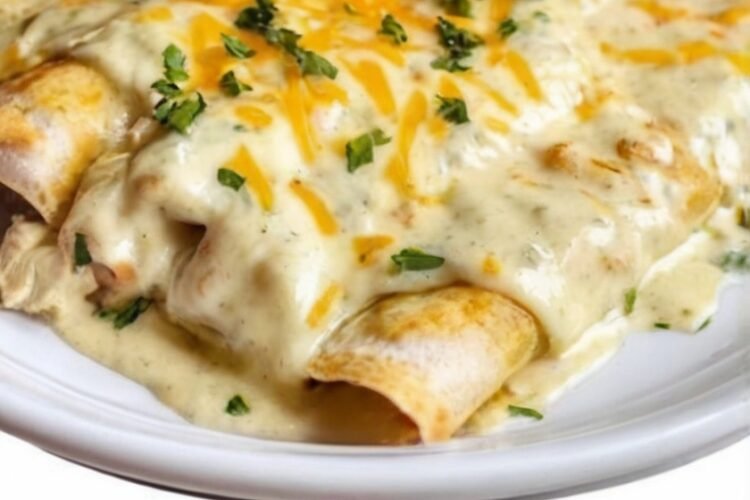
Creamy Chicken Enchiladas: An Oven-Baked Version With a Sour Cream Sauce That Soaks Into Every Tortilla
My mom used to make these on Sunday nights when nobody felt like doing dishes. She'd pull out one baking dish, layer everything in, and we'd fight over who got the corner pieces with all that bubbly cheese. I made them last week and my husband ate three before I could even sit down. There is something about that creamy sauce soaking into the tortillas while they bake, the way it gets all golden on top but stays soft and velvety underneath, and the cheese melts into every single bite. If you're like me you add a little extra on top, because why not.
These are the kind of creamy chicken enchiladas that disappear fast. No fancy ingredients, no complicated steps, no rolling tortillas that tear. Just real comfort food that tastes like somebody put actual love into it, which in this case was mostly my mother standing at the counter on a Sunday with a can of soup and a tub of sour cream.
I like this version because the sauce does the work instead of you. There is no browning, no roux, no thirty-minute simmer that you have to babysit. You mix four things in a bowl, you roll eight tortillas, you pour, you cover with foil, and the oven takes care of the rest. Forty minutes from the start of the prep to the table, and most of that is the oven doing something you would otherwise be standing over.
I am not going to tell you these are authentic Mexican enchiladas, because they are not, and I would rather be straight about it than let anybody think otherwise. This is the American casserole-style chicken enchilada, the one built for a Sunday with a TV on and people coming back for seconds. That is a legitimate recipe and it does not need defending. What it is not is a dish from Mexico, and calling it that would be a cheap way to borrow credibility.
Why You'll Love These Creamy Chicken Enchiladas
Because the sauce is a five-minute mix. Sour cream, a can of cream of chicken soup, broth, and garlic powder. No roux, no browning, no reduction. The soup is doing the thickening and the sour cream is doing the richness and you are just combining them.
Because the tortillas soften instead of turning to shells. That is the whole point of the cream sauce and the foil cover. Tortillas baked dry go crisp and brittle, and tortillas baked in sauce with steam trapped under foil come out velvety. It is the single biggest difference between good enchiladas and bad ones.
Because you use canned soup and nobody cares. Cream of chicken soup is the reason this is a forty-minute weeknight recipe instead of a project, and the sodium hits a lot of people as a concern when they read it. More on that below, but the honest answer is it is a good ingredient doing a real job.
Because one dish, start to finish. Nine by thirteen, foil on, foil off. No skillet of filling to brown first, no separate sauce to reduce, nothing to wash but the one pan and a bowl.
Because it feeds six and it reheats well, which makes it the right call for a weeknight when you are also trying not to cook twice.
Because the corner pieces are genuinely the best part and your mother was right to let you fight for them. The sauce pools in the corners and the cheese catches on the edges and goes crisp in a way the middle never does.
And because you can make it ahead. Assemble it in the morning, bake it whenever you are ready. It also freezes, which is unusual for a sour cream dish and is the reason this one shows up in my freezer more than it probably should.
Why This Creamy Chicken Enchiladas Recipe Works
Four things are doing the work here, and once you can see them you can fix this dish when it goes wrong.
First, the sauce has to be thick enough to stay where you put it. The cream of chicken soup is the thickener and it is doing a job that a roux usually does. If your sauce runs thin when you pour it, the tortillas will soak it up instead of sitting in it, and you will have dry patches in the bottom of the dish with the filling congealed in the middle. You cannot add flour later, but you can add a tablespoon more soup or a bit more broth depending on what you need.
Second, the foil is doing structural work, not just keeping things warm. Twenty-five minutes covered traps steam inside the dish. That steam is what softens the tortillas all the way through and what keeps the sauce from reducing to a glaze on the bottom. Uncover for the last ten minutes to get the top golden and the cheese bubbling. Covered the whole time and you get a pale top. Uncovered the whole time and the sauce reduces, the edges go dry, and the tortillas crisp before the filling is hot.
Third, seam-side down is not a detail. Rolling the tortillas with the seam underneath keeps them closed while they bake and keeps the filling from pushing out the ends. If a tortilla springs open in the dish, push it back down with a spatula before it bakes. Every one that opens is a filling that dries out in the open.
Fourth, the shredded chicken must be shredded, not cubed. This is less obvious than it sounds. Cubed or chunky chicken gives you distinct hot and cold spots in the filling, and the sauce does not coat chunks evenly, so some bites are dry and others are swimming. Shredded chicken has surface area, which means the sauce clings to it. It also means the filling stays moist through the bake.
One note about the sour cream. It is the richness and the tang that make this taste like a real sauce rather than melted cheese, and it goes into a hot pan for35 minutes, so there is a real risk of it breaking and separating slightly at the edges. It does not ruin the dish and the acid in the salsa at the table fixes most of it, but it is worth knowing why you are seeing a slight graininess in the sauce at the corners after the bake.
Ingredient Breakdown
2 cups cooked chicken breast, shredded. This is the filling and it is the one place where quality actually shows. Shred it yourself from rotisserie chicken or poached breast rather than using canned, because canned chicken is wet, faintly rubbery, and will make the filling taste like the can. If you are starting from raw, poach or bake the breast first, cool it, then shred with two forks. Two cups shredded is roughly 10 to 12 ounces cooked.
2 cups shredded cheddar cheese, plus more for the top. Cheddar is the right choice and it is also the best flavor. Monterey Jack melts smoother and is what I use about half the time, and a cheddar-Monterey Jack blend is genuinely better than either alone because you get flavor from the cheddar and melt from the Jack. Sharp cheddar gives the most flavor but melts less smoothly, so if you go sharp, grate it yourself. The topping amount is not specified in most versions of this recipe because it is a matter of taste, and 1 to 2 cups extra is a reasonable range.
8 flour tortillas. Eight 8-inch flour tortillas, not corn. Corn tortillas need softening and are a different dish entirely. Flour tortillas are soft, they roll without splitting, and they absorb the sauce. Look for ones that are soft and pliable straight from the bag, not stiff and dry. If they crack when you roll them, they are too old or too dry and the filling will escape.
1/2 cup chicken broth. This loosens the sauce just enough to pour evenly. It is the most adjustable ingredient in the recipe, which is useful because it is how you fix a sauce that is thicker than you want. Use low-sodium if you are watching salt, which matters in this recipe for reasons I will get to.
1 teaspoon garlic powder. A single teaspoon, which sounds small and is correct. The sauce is already rich and the sour cream has a tang, so a heavy garlic flavor fights both of those. This is the background note, not the lead. Fresh garlic does not work well here, because it needs cooking time and there is no cooking time.
1 and 1/2 cups sour cream. Or plain Greek yogurt, which works and is what several people make it with. Full-fat sour cream is what gives the sauce its body and richness, and it is the version I write the nutrition for. Greek yogurt works, it is tangier, and you will probably want a touch less salt. Do not use reduced-fat, which is thin and watery and will not thicken the sauce properly.
1 can 10-ounce cream of chicken soup. This is the thickener and it is doing the job a roux does in a traditional sauce. It is also the highest-sodium ingredient in the recipe by a wide margin, and I am not going to pretend otherwise. Low-sodium cream of chicken soup works and is what I buy. This is the ingredient people most often skip when they make the recipe, and skipping it means a thin sauce that never sets up.
Salt and pepper to taste. Season at the sauce stage, not at the end, and go lighter than you think because the cheese and the soup are both already salty. The cheese in particular is unpredictable by brand, so taste the sauce before it goes in the dish.
Kitchen Equipment
A 9x13-inch baking dish. This is specified because it holds8 tortillas side by side in two rows of four, which is what makes this a single-layer casserole rather than a stacked mess. A larger dish means the tortillas sit apart and the sauce spreads thin. A round casserole works but you will not fit all8 in one layer.
A large mixing bowl for mixing the sauce and a second one for the chicken and cheese if you like to keep them separate.
A grater, or pre-shredded cheese if you are in a hurry. Grating it yourself is worth the two minutes because pre-shredded cheese has anti-caking powder on it that will not melt smoothly under the cheese topping and gives a slightly grainy surface.
A rubber spatula for spreading the sauce and for pushing any tortillas that spring open back down.
Aluminum foil. Covering and uncovering is the entire baking technique in this dish, so you need a sheet large enough to cover the whole dish.
A Dutch oven or a large bowl and a second sheet of foil if your9x13 has no lid. A covered dish for the first twenty-five minutes is not optional.
Step-by-Step Instructions
Step 1: Preheat and grease the dish. Heat the oven to 350°F. Lightly grease a 9x13-inch baking dish. If your tortillas spring open during assembly, grease the dish more generously than you think you need to.
Step 2: Mix the sauce. In a bowl, combine the sour cream, the cream of chicken soup, the chicken broth, and the garlic powder. Stir until completely smooth and creamy with no lumps of soup remaining. Taste it and season with salt and pepper here, remembering that the cheese and the soup are both already salty, so go light.
Step 3: Mix the filling. In a separate bowl, combine the shredded chicken with about 1 cup of the shredded cheese. Mixing a little cheese into the filling rather than putting it all on top gives you cheese in every bite instead of a cheese crust with plain filling underneath.
Step 4: Spread the sauce base. Spoon about 1/2 cup of the sauce across the bottom of the dish and spread it to cover the entire floor. This is what the tortillas sit on, and without it the bottom ones bake onto bare metal and tear when you try to lift them out.
Step 5: Fill and roll the tortillas. Lay a tortilla flat, add a small handful of shredded chicken and cheese filling down the center, leaving about an inch clear at each end. Fold the ends in slightly, then roll it up snugly and place it seam-side down in the dish. Repeat with the remaining tortillas, working in rows to keep them tight. As you go, tuck any that spring open back down with your fingers.
Step 6: Pour the remaining sauce. Spoon or pour the rest of the sauce evenly over the top, moving around the dish so every tortilla gets covered. Do not just dump it in the center. Use your spatula to spread it and get sauce into the gaps between the rolls, because those gaps are where it will thicken into the creamy consistency you are aiming for.
Step 7: Add the cheese topping. Scatter the remaining cheese evenly over the entire surface. Get it into the seams between the tortillas, not just on the rounded tops, because those seams are where the sauce bubbles up during the covered portion of the bake.
Step 8: Cover and bake 25 minutes. Cover the dish tightly with foil and bake for 25 minutes. This is the phase where the steam softens the tortillas and the sauce thickens. Keep it covered for the whole twenty-five minutes, and do not peek.
Step 9: Uncover and bake 10 minutes. Take off the foil and bake for another 10 minutes, until the cheese is fully melted and bubbling at the edges. Watch the edges in the last few minutes, because the sauce near the dish walls reduces faster and the cheese there browns earlier than it looks like it should.
Step 10: Rest, then serve. Let the dish sit 5 minutes before serving. This firms the sauce just enough that the enchiladas hold together when you lift them, and it takes the boiling edge off the cheese so you do not burn your mouth on the first bite.
Expert Tips
Shred the chicken yourself, and shred it fine. Cubed or chunky chicken gives you hot and cold spots and the sauce does not coat chunks evenly. Shredded chicken has the surface area the sauce needs to cling to.
Use low-sodium cream of chicken soup. This recipe is genuinely salty as written and the soup is the main reason. Low-sodium cuts a meaningful amount and nobody can taste the difference once the cheese and the garlic powder are in there.
Mix cheese into the filling, not just on top. About 1 cup in the filling means every bite has cheese in it rather than finding a cheese crust with plain chicken underneath.
Keep the foil on for the full 25 minutes. The steam under the foil is what softens the tortillas all the way through. This is the most common mistake, and it is why so many versions of this recipe have chewy, dry tortillas.
Seat the tortillas tightly. Push them close together so they support each other. If they are spaced apart the sauce spreads thin and the ones at the edge dry out.
Roll seam-side down, and tuck any that pop open back under. Every tortilla that springs open lets filling dry out exposed to the heat.
Add the sauce to the seams with your spatula, not just the tops. Those gaps are where it bubbles and thickens during the covered bake, and that is the creamy texture people are looking for.
Grate your own cheese for the top. Pre-shredded cheese has anti-caking powder that will not melt smoothly and the surface comes out grainy rather than glossy.
Season the sauce lightly and taste it before it goes in. Both the cheese and the soup are already salted and brands vary a lot, so the amount of salt you need is genuinely unpredictable.
Rest 5 minutes before serving. Fresh out of the oven the sauce is loose enough that a lifted enchilada will not hold together.
Let the dish sit a minute or two after the foil comes off before you look at the edges. The sauce keeps bubbling for about a minute after the oven, and that is when it is loosest.
Use Greek yogurt if you want it lighter, and expect a tangier, thinner sauce. Same recipe, different result, both good.
Common Mistakes to Avoid
Taking the foil off too early. The most common failure. Uncovered the whole time, the sauce reduces, the edges dry out, and the tortillas turn brittle instead of soft. The foil for the first25 minutes is what makes this work.
Using a thin sauce. If the sauce runs off the tortillas and pools in the bottom of the dish, the filling will be dry and congealed at the same time. The cream of chicken soup is the thickener, so make sure it is actually in there and stirred in fully.
Not greasing the dish. The tortillas bake onto bare metal and the bottom row tears apart when you try to lift it out. Grease generously.
Cubed chicken instead of shredded. Chunks stay dry, sauce runs past them, and you get hot and cold bites in the same forkful.
Spacing the tortillas too far apart. They need to touch so they support each other. Spread out, the sauce goes thin and the ones at the edges are over-baked.
Forgetting the sauce on the bottom. That1/2 cup is not optional. It keeps the tortillas from welding themselves to the dish.
Rolling the tortillas too tightly with too much filling. They burst during the bake and you get filling in the bottom of the dish. A small handful down the center is right.
Using stiff tortillas. If they crack when you roll, they are too dry, the filling will escape, and they will not soften properly. Buy soft ones and keep them sealed in the bag until you use them.
Reduced-fat sour cream. It is thin and will not thicken the sauce. It will make the whole dish watery in the bottom of the dish.
Fresh garlic instead of garlic powder. Fresh garlic needs cooking time and there is no cooking time for it here. It tastes raw and sharp in the sauce.
Over-salting. Cream of chicken soup and cheddar are both salty, and adding salt by instinct rather than by taste is how this dish gets inedible. Taste the sauce.
Not letting it rest. Straight out of the oven the sauce is loose and the enchiladas do not hold together on a plate. Five minutes fixes it.
Skipping the extra cheese. This is not a mistake so much as a missed opportunity. The cheese on top is the whole appeal of the dish and as much as you want is the right amount.
Ingredient Substitutions
Greek yogurt for the sour cream. Works well and is what several people make it with. It is tangier and slightly thinner, so you may want a tablespoon less broth. Full-fat, not non-fat, or the sauce will not thicken.
Low-sodium cream of chicken soup. Genuinely recommended rather than merely acceptable. This recipe is salty as written and this is the single biggest improvement available without changing the character.
Rotisserie chicken or poached chicken. Better than canned, which is watery and faintly rubbery. Rotisserie is faster than poaching and about the same cost.
Turkey instead of chicken. Works fine and lowers the fat a little. Ground turkey also works if you brown it first, though the texture is different and it is more of a change than a swap.
Monterey Jack or a cheddar-Jack blend. Blends melt smoother than straight cheddar, which matters for the topping. Cheddar gives more flavor, Jack gives a better melt, and the blend is genuinely better than either.
Chicken or turkey broth. Either works. Vegetable broth is fine if you want it vegetarian, in which case use vegetable broth and vegetarian cream of chicken soup, which most brands do not make, so check the label.
Corn tortillas. Not a straight swap. Corn tortillas need to be softened first, they crack when rolled unless they are very fresh, and they do not absorb sauce the same way. This is a different dish if you change this one ingredient.
Green chiles or diced jalapenos in the filling. A good addition. Drained well, mixed into the filling, and they give the dish some heat without changing the architecture.
Rotel or diced tomatoes and green chiles. Stirred into the sauce, this adds acidity and heat and cuts the richness. It is the closest thing to a real improvement on a dish that is very rich.
Chipotle in adobo. A teaspoon stirred into the sauce. This is a genuine upgrade and it adds smoke rather than just heat.
Gluten-free. Use corn tortillas and a gluten-free soup, but expect a different result and be honest about it. Flour tortillas are doing real work in this dish and there is no clean swap that holds together the same way.
Recipe Variations
Beef and cheese. Swap the chicken for browned ground beef and skip the broth, since beef gives up its own liquid. This is the version most people picture when they hear the word enchiladas.
Cheese only. Omit the chicken entirely and add a third more cheese. This is the vegetarian version that actually works, because the cheese and the sauce carry it.
Roasted vegetable. Roasted peppers, zucchini, or corn, sautéed first to cook off the moisture. Raw vegetables release water during the bake and make the dish soupy, so this is a cook-then-add, not a throw-it-in.
Spinach and mushroom. Sautéed hard to get the water out, then mixed with the chicken. Good, and it makes the dish a bit healthier without being less creamy.
Buffalo chicken. Buffalo sauce in the filling and blue cheese or ranch at the table. This is a genuinely good version and it is not complicated to make.
Chipotle and lime. A teaspoon of chipotle in adobo and a squeeze of lime into the sauce. The smoke and the acid cut the richness better than anything else you can add.
Tomato sauce instead of cream. This is a different, more traditional-direction recipe and it needs a longer bake, about 35 to 40 minutes covered, because the tomato liquid has to reduce. Do not expect the same creamy result.
Salsa verde in the sauce. Two tablespoons of salsa verde stirred into the sour cream. Green, tangy, and it cuts the richness.
Mini version in ramekins. Two tortillas per ramekin, same sauce, bake 20 to 22 minutes. Good for individual servings and it keeps the cheese ratio higher.
Mexican pizza style. Spread the sauce and chicken on a sheet pan, scatter tortilla pieces over the top, and bake at 425°F for 12 minutes. Completely different approach, same flavor profile, and much faster.
Stuffed peppers. Same filling, same sauce, in halved bell peppers instead of tortillas. Bake at 375°F for 30 to 35 minutes.
Make It Healthier, Honestly
Let me be straight about this one, because the word creamy does a lot of work in how people read a recipe like this.
A serving of these is roughly 490 calories, about 30 grams of fat, and 18 grams of carbohydrate, and about 4 of those grams are sugar. The fat is largely saturated and it comes from three places that are all doing real work: the sour cream or yogurt, the cheddar, and the soup. There is no version of this recipe where you can remove one of those and still have the dish you are describing.
The realistic levers, in order of how much they matter:
Use Greek yogurt instead of sour cream. Saves roughly 90 calories and 6 grams of fat per serving. This is the single biggest available change and it does not ruin the dish, it makes it tangier. This is what I would do.
Use low-sodium cream of chicken soup. It removes a meaningful chunk of the sodium without touching the flavor or the texture at all, because the cheese and the garlic powder are carrying the taste.
Reduce the cheese to 1.5 cups total plus a light topping. You will still get a cheese-topped dish and you will cut real saturated fat.
Use fat-free Greek yogurt and add the fat back with a tablespoon of olive oil in the sauce. The oil replaces some of what the full-fat yogurt was providing. It is a bit of a fudge but it works.
Use chicken breast, which you probably already are, and keep the skin off. That is already the leanest cut in this recipe and there is nothing to fix here.
What will not work: light cream cheese instead of sour cream. It does not have the acid and it will not make a sauce that tastes like anything. Skim milk instead of the sauce entirely, which turns it into a different dish. And any recipe that calls this low-carb. Eight tortillas is about 40 grams of carbohydrate on its own before the sauce.
The honest ceiling: this is a rich casserole dinner. It is not a health food and it is not going to become one, and the sodium in it as written is high enough that I think it is worth flagging rather than burying. The Greek yogurt and low-sodium soup changes are real improvements that take maybe 150 calories and a lot of salt out of it. Beyond that, this is comfort food and it is doing its job.
Meal Prep Guide
This is a good make-ahead dish and one of the few that genuinely improves the next day.
Assemble it in the morning, refrigerate it assembled and unbaked, and bake it whenever dinner is. It holds well for up to 24 hours in the fridge before baking. Add5 minutes to the covered bake if it is going into a cold dish.
You can also do everything except the baking: mix the sauce, mix the filling, roll the tortillas, and cover and refrigerate. That is about 20 minutes of work and then you are free for the rest of the day.
Cook the chicken ahead. Shredded rotisserie chicken from the previous night's dinner is the easiest version of this recipe, and it is what I do about half the time.
This is also one of the few creamy dishes that freezes properly, which surprises people. Assemble it, cover tightly with plastic and foil, and freeze for up to 2 months. Thaw in the fridge overnight, and the tortillas are soft again when you are ready to bake.
Freeze the unbaked version rather than the baked one. Baked enchiladas freeze but the tortillas go a bit mushy and the sauce separates in texture. Unbaked thaws and bakes like it was just assembled.
Reheat baked leftovers at 350°F, covered, for 15 to 20 minutes. The foil matters again here, because it keeps the tortillas from drying out, and it is the same principle as the covered bake.
Do not try to microwave a whole dish of these. It works and it makes the tortillas rubbery and the cheese rubbery and the sauce hot in the middle and cold at the edges.
Storage
Covered and refrigerated, this keeps for 4 days, and it is one of the few dishes here where the texture is arguably better on day two.
Cover it tightly with foil or a lid. The sauce needs protection from the refrigerator or it forms a skin and starts to smell strongly of dairy.
Store it in the middle of the fridge rather than on the bottom shelf, so it does not pick up smells from raw produce underneath. A creamy dish like this picks up odors faster than most.
Keep it out at a gathering for no more than 2 hours. This one has sour cream, soup, and melted cheese in it, so it is a real dairy load and it is not something I would leave on a buffet.
Reheat covered rather than uncovered. Uncovered, the sauce reduces and the tortilla edges go crisp and then tough, and by the second day there is very little moisture left in the dish.
If the sauce looks a bit thicker after a couple of days, which it will, that is the milk solids in the soup doing what they do. Loosen it with a splash of broth or a spoonful of milk when you reheat and it comes right back.
Freezing
Yes, and this is the least expected good news in this recipe. Creamy enchiladas freeze well, and I say that having expected them not to.
Freeze it unbaked, assembled in the dish or in a freezer container, covered tightly with plastic wrap and a layer of foil, for up to 2 months. Do not use a non-stick-sprayed pan for the freezer, and if your9x13 is glass, make sure it is freezer-safe, which most borosilicate ones are.
Thaw in the refrigerator overnight, never on the counter. The filling contains raw dairy in the sauce and a room-temperature thaw is where that goes wrong.
Bake from thawed as directed, and add 5 to 10 minutes to the covered portion because the dish and the filling start cold. Uncover as normal for the last 10 minutes.
You can also freeze it baked, in individual servings, and it works reasonably well. The tortillas are a little softer than fresh and the sauce has separated slightly, but it reheats and it tastes fine. Freeze it in a single layer of foil-wrapped portions so you can pull out one at a time.
Do not refreeze anything you have thawed. Once a creamy dish has been thawed and reheated, the emulsion in the sauce will not survive a second freeze.
The practical note: most people make this for six and finish it in one sitting, so freezing only matters if you are deliberately cooking for two. If you are, this is the dish to cook twice.
Reheating
This reheats better than most creamy bakes, and the method matters more than it usually does.
Covered in the oven at 350°F for 15 to 20 minutes is the right answer. The foil or lid is doing the same job it did in the original bake, which is keeping steam in the dish so the tortillas soften instead of drying out. Put the dish back in a warm oven and leave the cover on for the whole time.
A single serving, cover with a small piece of foil, and warm for 8 to 10 minutes. Foil over a plate or a small dish is a good substitute for a full cover.
The microwave works and I am going to be honest about the trade-off again. Thirty to 45 seconds on 70 percent power gets a serving hot, but the cheese gets rubbery and the tortillas go soft in a bad way rather than a good way. It is fine for a lunch at work and it is not what I would serve a guest.
Put the salsa and sour cream on after reheating, never before. Reheated sour cream from the dish will split and turn grainy, and a dollop of cold sour cream on top right before eating is both better and safer.
One specific thing: if the sauce looks thick after a day in the fridge, add a splash of chicken broth before reheating, not after. A splash of cold broth mixed into a hot dish will cool it unevenly and the sauce will not emulsify properly.
What to Serve With Creamy Chicken Enchiladas
The dish is rich and the sauce is the point, so almost everything next to it should be cool, crisp, or acidic rather than more rich.
Chipotle or tomato salsa, and the hotter it is the better. This is the most important pairing on this list because the heat and the acid are what cut the creaminess. A mild salsa wastes the opportunity entirely.
A small bowl of sour cream or Mexican crema thinned with a little water, spooned over the top at the table. It looks decorative and it genuinely helps, because a cold dollop against the hot dish is a real contrast.
Crisp things, specifically. A small pile of tortilla chips or strips of fried tortilla, because the contrast between crisp and soft is most of the pleasure. Tortilla chips that have gone soft in the bag are a waste.
Shredded lettuce, iceberg or romaine, on the side, not on top. It is not trendy, it is a palate cleanser and it does the job.
Cucumber, radishes, or a quick pickled onion. Something raw and sharp against the hot sauce.
Mexican rice or cilantro lime rice, which is the traditional side and which absorbs the sauce without competing with it.
Black beans, warmed with a little cumin, which adds protein and fiber and costs almost nothing.
Fresh lime wedges on the table. This is free and it is the single fastest improvement available, because a squeeze of lime over a creamy sauce changes it more than any ingredient you could add.
And a cold drink, because the heat needs something cold to go with it.
Beverage Pairings
Cold beer, and this is the correct answer. A light lager or a pilsner against a rich, cheesy, mildly hot dish is the combination that was designed for this. The bitterness and the carbonation cut the fat better than anything else available.
Margaritas, which is what most people reach for and it is a good call. The lime and the salt are exactly what the dish needs.
Iced tea with lime, which is the non-alcoholic version of the margarita logic and it works just as well. Sweet tea is too sweet here, so drink it unsweetened.
A cold lager with a lime wedge in it, which is a beer with a squeeze of lime in it and it is the single best thing to drink with this dish.
Water with lime and a pinch of salt, which sounds strange and is genuinely good for cutting a creamy sauce.
Hibiscus tea, which is tart and cold and has enough acidity to work like a palate cleanser.
For a warm meal alongside something else, a light red or a rosé, because the dish is mild and does not need anything bold.
The rule is the same as it is for most creamy things: cold, acidic, and slightly bitter. Anything sweet makes the dish worse.
Frequently Asked Questions
Can I make these creamy chicken enchiladas ahead of time? Yes, and this is one of the best make-ahead dishes on the site. Assemble it and refrigerate unbaked for up to 24 hours, then bake as directed, adding 5 minutes to the covered portion if it is going into a cold dish. It also freezes unbaked for up to 2 months and bakes from thawed with a little extra time.
Can I use corn tortillas instead of flour? You can, but it is a different dish rather than a straight swap. Corn tortillas need to be softened or steamed first or they will crack when you roll them, and they do not absorb the sauce the way flour tortillas do. Expect a less creamy, more corn-forward result. If you do use corn, soften them in a damp towel for 10 minutes first.
How many enchiladas does a 9x13 hold? Eight tortillas side by side in two rows of four, which is what makes this a single layer with sauce around them. If you want more, double the recipe and use a second dish rather than crowding one, because they need to sit close together to support each other.
Can I use rotisserie chicken? Yes, and it is what I use about half the time. It is faster than poaching and cheaper than buying breast specifically for this. Just make sure it is shredded, not cubed or sliced, so the sauce clings to it.
Why are my tortillas dry and chewy? Two causes. Either the foil came off too early and the steam escaped, or the sauce was too thin and soaked into the tortillas instead of staying on top. Cover for the full 25 minutes and make sure the cream of chicken soup is properly stirred in.
Can I use Greek yogurt instead of sour cream? Yes, and it is a real improvement for about 90 fewer calories and 6 fewer grams of fat per serving. Use full-fat, not non-fat, or the sauce will be thin. It will be tangier than the sour cream version and some people prefer it.
Is this recipe spicy? Not as written. There is garlic powder but no heat at all. Most people add a hot salsa at the table, and if you want heat in the dish, a teaspoon of chipotle in adobo in the sauce or some drained jalapenos in the filling is the best way.
Can I freeze creamy chicken enchiladas? Yes, unbaked is better. Assemble, cover tightly, and freeze for up to 2 months. Thaw in the refrigerator overnight and add 5 to 10 minutes to the covered bake. Do not thaw on the counter, because the sauce contains raw dairy.
How long does it keep in the refrigerator? About 4 days covered, and the texture holds. Reheat it covered rather than uncovered, and if the sauce has thickened in the fridge, add a splash of chicken broth before reheating so it comes back to the right consistency.
What is the best cheese for this? Cheddar for flavor, Monterey Jack for melt, and a blend of the two if you want the best of both. Grate it yourself for the topping, because pre-shredded cheese has anti-caking powder that will not melt smoothly under the broiler and the top comes out grainy.
Are these authentic Mexican enchiladas? No, and I would rather say so. This is the American casserole-style chicken enchilada, built for a Sunday with the television on. It is a good recipe and it does not need to borrow credibility from something it is not.
Nutrition Information
These are estimates. The yield assumption is 8 enchiladas in a 9x13-inch dish, cut into 4 servings of 2 each. Every figure below is derived from ingredient weights for the whole dish, including all the sauce and the cheese topping, divided by 4. This is a dish where the sauce is a significant portion of the calories, so it is worth being specific.
Per serving of 2 enchiladas: approximately 490 calories, about 30 grams of total fat, 18 grams of carbohydrate, roughly 4 grams of sugar, about 24 grams of protein, and approximately 1,180 milligrams of sodium.
Where the calories come from: the cheese is the largest contributor, roughly 200 calories a serving across the filling and the topping combined. The sour cream is next at about 100. The cream of chicken soup contributes around 100, the chicken about 60, and the tortillas about 70. The butter and oil used for greasing is negligible by comparison.
Where the fat comes from: almost all of it saturated, and almost all of it from dairy. The 1 and 1/2 cups of sour cream, the two-plus cups of cheddar, and the soup together account for essentially the entire fat content. There is no significant fat from the tortillas because they are baked rather than fried.
The 1,180 milligrams of sodium per serving is high and I am flagging it deliberately rather than leaving it in a table for you to notice later. The cream of chicken soup and the cheddar are both the main sources, and this is a real limitation of the recipe as written rather than a rounding artifact. Low-sodium soup is the single most effective fix and it changes nothing about the flavor.
These are estimates from ingredient weights, so they will vary significantly by brand. Cheddar varies more than almost anything in this recipe, and the sodium content of cream of chicken soup varies by a factor of nearly three between standard and low-sodium versions. Treat these as a guide, not a measurement.
Allergens: milk and dairy, which is dominant with sour cream, soup, and cheddar, plus wheat and gluten from the flour tortillas. There is no egg in this recipe as written.
Food safety: the sauce contains raw dairy and it goes into a hot oven for 35 minutes, which is more than enough to bring it to a safe temperature throughout. Keep it refrigerated at all times when it is not being baked, do not leave it at room temperature for more than 2 hours, refrigerate leftovers promptly, and use within 4 days. Do not refreeze anything that has been thawed. The chicken must be fully cooked before it goes into the dish, since the bake is relatively short and the filling sits in a thick sauce that does not get very hot in the center.
This is not keto, not low-carb, not gluten-free as written, not low-fat, and not a health food. Eight tortillas is about 40 grams of carbohydrate before the sauce is counted. It is about 490 calories, 30 grams of fat, and 1,180 milligrams of sodium per serving of a rich, cheesy, hot casserole dinner, and it is exactly as good as that sounds.
Final Thoughts
I have made this dish maybe thirty times now and I have never once improved it, which I think is the highest compliment I can pay to a recipe somebody handed me.
My mother built it on Sunday nights when nobody wanted to do dishes, and that constraint is the entire reason it works. One pan. A can of soup. A tub of sour cream. Nothing that needs a stove for more than five minutes, nothing that needs attention, and nothing that needs to be finished in a specific order while standing over a stove. She was solving for a tired Saturday, and the recipe has been solving for that for longer than I have been alive.
The reason it tastes like somebody put love into it, which is exactly what you said, is not really about the technique. It is about the fact that it is food that takes an hour and makes nobody stand at the stove. The love is in the fact that you did it on purpose, on a Sunday, for people who were not going to help. That is a thing that reads through a recipe and no technique accounts for it.
What I will say is that the sauce is the recipe, and the tortillas are just the vehicle. Which is why the cream of chicken soup belongs in it. It is a shortcut that has no dignified substitute, and every time somebody asks me for a proper sauce I tell them to make a proper sauce, and every time I make this, the soup goes in and it is still the better dinner.
So make it, and save two for later because it is better the next day, and put the salsa on the table with a lime wedge next to it. And let us settle this, because I think we both already know the answer: you eat the extra salsa, I eat the corner pieces, and there is no version of this where that goes differently.
Layer, Cover, Bake 35
Creamy Chicken Enchiladas Recipe
Eight flour tortillas rolled around shredded chicken and cheddar, over a sour cream and cream of chicken soup sauce, baked covered then uncovered until the top is golden. One dish, about forty minutes.
Ingredients
- 2 cups cooked chicken breast, shredded (about 10 to 12 oz)
- 2 cups shredded cheddar cheese (plus 1 to 2 cups more for topping)
- 8 flour tortillas (8-inch, soft and pliable)
For the Creamy Sauce
- 1/2 cup chicken broth (low-sodium recommended)
- 1 teaspoon garlic powder
- 1.5 cups sour cream (full-fat, or full-fat Greek yogurt)
- 1 (10 oz) can cream of chicken soup (low-sodium recommended)
- Salt and black pepper, to taste
For Serving
- Salsa or salsa verde
- Sour cream or Mexican crema
- Crisp tortilla chips
- Shredded lettuce
- Cucumber, radishes, or pickled onion
- Lime wedges
Keep the foil on for the full 25 minutes. That steam under the foil is what softens the tortillas all the way through. Uncovered the whole time and the sauce reduces and the tortillas go brittle.
Instructions
- Preheat and grease. Heat the oven to 350°F and lightly grease a 9x13-inch baking dish. Grease more generously than you think you need.
- Mix the sauce. Stir together the sour cream, cream of chicken soup, chicken broth, and garlic powder until smooth with no lumps. Season lightly and taste, because both the soup and the cheese are already salty.
- Mix the filling. Combine the shredded chicken with about 1 cup of the shredded cheese. Mixing cheese into the filling means every bite has cheese in it, not just a crust on top.
- Spread the sauce base. Spoon about 1/2 cup of sauce across the bottom of the dish and spread it to cover the floor. This keeps the bottom tortillas from welding themselves to the pan.
- Fill and roll. Add a small handful of chicken and cheese down the center of a tortilla, leaving an inch clear at each end. Fold the ends in slightly, roll snugly, and place seam-side down. Repeat with all 8, working in rows, keeping them tight together. Tuck any that spring open back down.
- Pour the rest of the sauce. Spoon the remaining sauce over the top, working around the dish so every tortilla gets covered. Use your spatula to push sauce into the gaps between the rolls.
- Add the cheese. Scatter the remaining cheese evenly over the top and into the seams, not just on the rounded tops. Those seams are where the sauce bubbles up during the covered bake.
- Cover and bake 25 minutes. Cover tightly with foil and bake 25 minutes. Do not peek and do not uncover early. This phase softens the tortillas and thickens the sauce.
- Uncover and bake 10 minutes. Remove the foil and bake 10 more minutes until the cheese is fully melted and bubbling at the edges. Watch the edges in the last few minutes; the sauce near the dish walls browns earlier than it looks like it should.
- Rest, then serve. Let the dish sit 5 minutes so the sauce firms and the enchiladas hold together when lifted. Top with salsa and sour cream at the table.
Cook's Notes
Costs are estimates for 10 to 12 oz of cooked chicken breast, 3 to 4 cups of shredded cheddar, a package of 8 flour tortillas, a 10 oz can of cream of chicken soup, full-fat sour cream, and a splash of broth. Assumes 4 servings of 2 enchiladas each. Chicken and cheese prices move the total more than anything else here.
- The three mistakes that ruin this dish are all the same mistake: too little liquid, or too much heat escaping. Cover for the full 25 minutes so the tortillas steam soft, and make sure the cream of chicken soup is fully stirred in, because it is the thickener. A thin sauce and an uncovered bake together give you dry tortillas sitting in a puddle.
- Use low-sodium cream of chicken soup. This recipe as written is salty, and the soup plus the cheddar are both reasons. Low-sodium cuts a meaningful amount and nothing in the dish can tell the difference once the garlic powder and cheese are in it.
- Mix about 1 cup of the cheese into the filling. Putting all the cheese on top gives you a cheese crust over plain chicken. Mixing it in means every bite has cheese, and you still get the golden topping.
Nutrition (Labeled Estimates)
Approximate values for 1 serving of 2 enchiladas from a 9x13-inch dish, made with shredded chicken breast, cheddar, 8 flour tortillas, full-fat sour cream, a 10 oz can of cream of chicken soup, chicken broth, and garlic powder. Estimates only; actual values vary significantly by brand, and cheddar and cream of chicken soup vary more than most. Sodium differs by nearly a factor of three between standard and low-sodium soup.
Sodium is high at about 1,180 mg per serving, and we are flagging it deliberately. The cream of chicken soup and the cheddar are both main sources, and this is a real limitation of the recipe as written rather than a rounding artifact. Low-sodium soup is the single most effective fix. Sugar: approximately 4 g per serving. Contains milk and dairy, plus wheat and gluten from the flour tortillas. No egg as written. The sauce contains raw dairy but bakes covered for 25 minutes, which brings it to a safe temperature throughout; keep it refrigerated when not baking, do not leave it out past 2 hours, use within 4 days, and do not refreeze thawed. Not keto, not low-carb, not gluten-free as written, not low-fat, and not a health food. Greek yogurt and low-sodium soup together remove about 150 calories, 6 grams of fat, and a large amount of salt.