
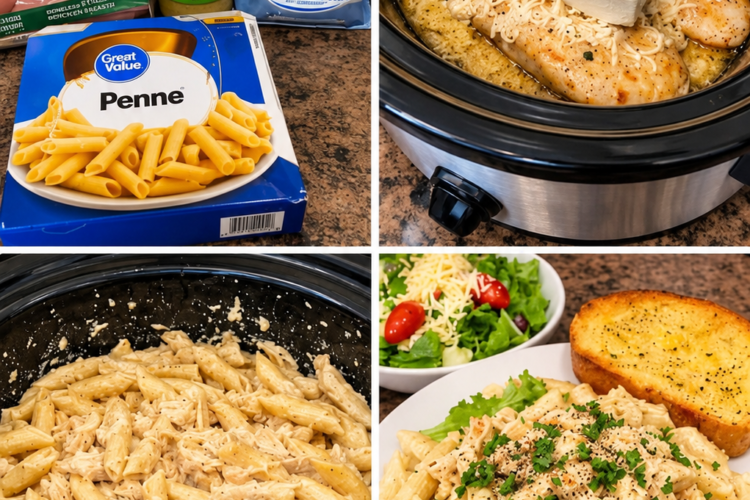
Slow Cooker Chicken Pasta Recipe: Creamy One-Pot Chicken Alfredo-Style Dinner
My husband came home from work last Tuesday and found me dumping chicken breasts and Italian dressing into the slow cooker. He gave me that look, the one that means what exactly are we having tonight, and I just smiled and told him dinner would be ready in four hours. Four hours later he was standing at my counter eating this straight out of the pot with a fork, which is the highest compliment this recipe will ever receive. This slow cooker chicken pasta recipe is one of those meals that sounds almost too simple to be good. Chicken, Italian dressing, cream cheese, Parmesan, pasta. Five things, most of them already in the fridge door. But something happens over four hours in a slow cooker that does not happen on a stove. The chicken goes past tender and shreds with a fork instead of a knife. The cream cheese melts down into a velvety sauce. The Italian dressing seasons everything without you measuring a single thing, which is the entire reason this method works. I served it over penne and the sauce coated every piece the way it is supposed to, clinging rather than pooling at the bottom of the bowl. My daughter, who usually pushes food around the plate and calls it full, had two plates. My son asked if we could have it again this weekend, which is the review I was actually cooking for. And at about forty grams of protein per serving, it is one of those quiet weeknight dinners that happens to be genuinely nutritious, not a compromise dressed up as one. The last instruction, the one that confuses people, is tossing the pasta directly into the slow cooker. Yes, the big stoneware insert. It looks wrong and it is right. The starch in the pasta water loosens the cream cheese sauce and turns it from a thick sauce into something that actually clings, and you get to skip a second pot of butter and cream entirely. Everything ends up in one vessel, which means one thing to wash. Two things to know before you start. Add the cream cheese at the end, not the beginning. Cream cheese is an emulsion, and dairy emulsions break when held at a long, gentle simmer, which is exactly the four-hour condition in a slow cooker. And check the chicken for 165°F before you shred it. Slow cookers vary wildly in how hot they actually get, and the clock is not a temperature reading.Why You Will Love This Slow Cooker Chicken Pasta Recipe
- Five ingredients and one pot: chicken, Italian dressing, cream cheese, Parmesan, pasta. A very short list of things you already own.
- Completely hands-off for four hours: you put it on before dinner and the slow cooker does everything else.
- Genuinely high protein: about 40 g per serving from 1.5 pounds of chicken plus Parmesan and pasta, which makes it a real protein-forward dinner rather than a carb bowl with a token of chicken.
- The chicken shreds with a fork: no cutting, no slicing, no knife skills required, and no tough pieces left behind.
- No second sauce to make: the pasta goes into the pot and the starch does the work. Skip a whole pot of butter, flour, and cream.
- Family-proof and scalable: doubles easily for a crowd, and everyone can top their own bowl.
- Restaurant-style result at a home price: roughly $2.20 to $3.50 a serving, against $18 to $24 for the same dish at a restaurant.
- Easy gluten-free: use a certified gluten-free penne and a dressing without wheat-derived thickeners, and the dish is already dairy-forward and simple enough to convert.
- A real low-carb option exists: swap the pasta for a chickpea or cauliflower-penne blend and you cut the carbohydrates roughly in half while adding protein.
- Better the next day: the sauce settles into the shredded chicken overnight and reheats to something closer to the restaurant version than the fresh one.
Why This Slow Cooker Chicken Pasta Recipe Works
The four-hour cook is doing something specific to the chicken. Poultry breast is a lean, tightly packed muscle that turns dry and stringy under almost any dry heat. In a slow cooker, the chicken sits in liquid at a steady, forgiving temperature for a long time, and collagen and water slowly give way, so the meat ends up tender enough to pull apart with a fork. That is not cooking harder. It is cooking long enough that the muscle structure gives up. The Italian dressing is the seasoning engine, and the reason this recipe needs no salt, no pepper, no garlic powder, and no herbs is that the dressing already contains all of it. The acid from the vinegar softens the chicken, the oil carries flavor into the meat rather than sitting on it, and the sugar in the dressing caramelizes slightly over four hours and gives the finished sauce a mild sweetness that reads as homemade. This is also why the recipe works with any decent bottle you have, and why an expensive bottle tastes better but is not required. The technique that makes this worth learning is the order of operations with the cream cheese. Add it at the start and you have a problem. Cream cheese is a stabilized dairy emulsion, and the combination of fat, protein, and a long gentle simmer will eventually split it, leaving you with a watery, grainy, slightly curdled sauce in the bottom of your pot. The recipe avoids this by shredding the chicken, removing it, melting the cream cheese and Parmesan into the hot liquid in about a minute, and then putting the chicken back. The sauce goes from hot to finished in under two minutes, which is far too fast to break. The final move, tossing the pasta in the pot, is what separates a good version from a disappointing one. Fresh pasta releases starch into its cooking water, and that starch has two jobs here. It loosens the sauce from the thickness of frosting to the consistency of a proper cream sauce, and it makes the sauce cling to the ridges of the penne instead of sliding off and settling in the bottom of the bowl. Do not skip draining the pasta well but do not rinse it either, because the rinsed starch on the surface is the exact thing you want. Everything is building toward a protein-forward bowl. Thirty-odd grams of protein per serving comes from the chicken alone, the Parmesan adds more, and standard wheat pasta contributes a surprising amount on top of that. Replace the pasta with a legume-based penne and the number goes up while the carbohydrates go down. That is why this lands as a genuinely nutritious weeknight dinner and not just a creamy one.Ingredient Breakdown
2 to 3 Boneless, Skinless Chicken Breasts, About 1 1/2 Pounds
Use 1 1/2 pounds of chicken. That is two large breasts or three small ones, and it feeds six people properly. Buy the value pack and freeze the extra, because the sauce converts leftover chicken beautifully and this is a good place to spend up on quality. Fully thaw the chicken before it goes in the cooker, either in the fridge overnight or in cold water, because chicken cooked from frozen cooks unevenly and the outside gets overcooked before the center is safe.1 Bottle (16 Oz) Italian Dressing
This is the seasoning, the cooking liquid, and the source of the sauce's flavor base, all in one. Any decent Italian-style vinaigrette works, and store brand is perfectly good here. What you are looking for is one with real herbs listed, and you are avoiding anything thickened with flour or starch if you are cooking for gluten-free guests. Shake the bottle well before you pour, because the oil and vinegar separate as they sit, and the first half of the bottle carries more vinegar while the second half carries more oil.1 Block (8 Oz) Cream Cheese, Cubed
Cut into cubes so it melts fast in the final two minutes rather than sitting in lumps on top of the sauce. Full-fat is what gives you the richness and the body, and the sauce will not be as silky with the reduced-fat version. Neufchâtel, which is about a third less fat, works if you want a lighter dish and you accept a slightly thinner sauce, and it is a legitimate swap rather than a compromise. Soften the block at room temperature for fifteen minutes so it stirs in without any lumps.1 Cup Shredded Parmesan, Plus More for the Top
Grated Parmesan is what makes this taste like a restaurant version rather than a homemade one, because it adds a salty, nutty depth that cream alone cannot. Finely grated melts in completely, and pre-shredded bagged cheese is coated in an anti-caking powder that keeps it from melting smoothly. A 4-ounce block grated by hand costs less, melts better, and gives you more control over how fine it is. Reserve a quarter cup for the top of each bowl, added off the heat, because Parmesan added at the very end stays visibly grated and tastes brighter.1 Pound Penne Pasta
One pound makes enough for six generous servings. Penne specifically, because the sauce needs something to grip, and the ridges and the hollow core are what hold the creamy coating. Cook it one minute less than the package says, since it finishes cooking in the sauce. For a gluten-free version, use a certified gluten-free penne. For a lower-carbohydrate version, use a chickpea or cauliflower-penne blend, which cuts the carbohydrate roughly in half and adds several grams of protein. Both are sold in the pasta aisle next to the regular boxes.Fresh Parsley and Salt and Pepper
Parsley is optional but it does three things: it adds a fresh, green note against all that cream, it makes the dish look like it was plated with intent, and it is a signal to the person eating that this is a dinner you made rather than a dinner you assembled. On salt, be careful. A full bottle of Italian dressing carries a great deal of sodium already, so taste the sauce before you add any. Black pepper, generously, is always welcome. A store-brand basket of these ingredients runs about $13 to $15 for the whole pot. Using a branded dressing and a whole block of Parmesan to grate yourself pushes it closer to $20 to $21. Per serving across six servings that is roughly $2.20 to $3.50, which is a genuinely good price for a dinner this good, though it is honestly not one of the cheapest recipes here. The single biggest cost lever is the Parmesan, and the second is buying chicken on sale in a value pack and freezing the difference.Kitchen Equipment You Will Need
You need a slow cooker and a pot of water. That is the short list.- A 5- to 6-quart slow cooker. An 8-quart works but takes longer to reach temperature, and an oversized pot means the sauce reduces down too far.
- A large pot for the pasta, plus a colander
- Two forks for shredding the chicken. This is the only tool the recipe really asks for.
- A small cutting board and a knife for cubing the cream cheese
- An instant-read thermometer. Not optional for the chicken.
- A Dutch oven or heavy saucepan for reheating leftovers, since the slow cooker is likely still on the counter
How to Make This Slow Cooker Chicken Pasta Recipe
Step 1: Prep the Night Before or While You Are at Work
Thaw the chicken fully. Cut the cream cheese into cubes and set it in the fridge so it is cold and ready for the end. Grate the Parmesan if you are working from a block. Pull the parsley and chop it, or leave the whole bunch on a sprig and strip the leaves later. Everything in this recipe is either prep-able or cookable for four hours, and none of it is urgent.Step 2: Load the Slow Cooker
Put the chicken breasts in the bottom of the slow cooker in a single layer. Shake the bottle of Italian dressing and pour the entire bottle over the chicken, which is what makes this a no-measuring recipe. Press the chicken down gently so it sits submerged. Do not add the cream cheese or the Parmesan yet, and do not add the pasta. This is a four-hour step and nothing else belongs in the pot right now.Step 3: Cook Low for 3 to 4 Hours Until It Reaches 165°F
Cover and cook on low until the chicken is tender and fully cooked, about 3 to 4 hours for 1 1/2 pounds. Take the internal temperature in the thickest part of the breast with an instant-read thermometer and confirm it has reached 165°F. Slow cookers vary enormously in actual output, from a barely warm 150°F in a cheap unit to a genuine simmer in an expensive one, so the clock is a loose estimate and the thermometer is the answer. If you need it faster, cook on high for 2 to 3 hours instead, and check the temperature at the two-hour mark. The chicken is done when it shreds easily, but never before the thermometer says so.Step 4: Start the Pasta and Shred the Chicken
About 20 minutes before you plan to serve, bring a large pot of salted water to a boil and cook the penne one minute short of the package directions. While the pasta cooks, remove the chicken from the slow cooker and set it on a cutting board. Shred it with two forks, pulling in the direction of the grain, until you have loose shreds with no big chunks left. Shredding it in the pot is faster but the fibers drag the sauce out of the crock and you lose some of it.Step 5: Melt the Cream Cheese Into the Sauce
Drain the pasta well and set it aside, and do not rinse it. Add the cubed cream cheese and 3/4 cup of the shredded Parmesan to the liquid in the slow cooker and stir over medium or high heat until the cheese melts completely and the sauce looks smooth and glossy, about one to two minutes. This is the only step in the recipe that uses heat aggressively, and it is deliberately fast, because the reason the cream cheese does not break is that it never spends four hours at a gentle simmer. If it looks grainy at this point, take it off the heat and stir for another minute off the heat, and it will usually come back together.Step 6: Put Everything Together
Return the shredded chicken to the pot and stir until every shred is coated in the sauce. Then add the drained penne directly to the slow cooker and toss thoroughly, working from the bottom up, until every piece is covered. The starch on the surface of the pasta loosens the sauce as you go, and the mixture will go from thick to creamy within about a minute of mixing. Taste it now, before you add anything else, and season with black pepper and a very small amount of salt if it needs it.Step 7: Serve With Parmesan and Parsley Off the Heat
Turn the slow cooker off, and top each bowl with the remaining quarter cup of Parmesan and a good handful of chopped parsley. Adding them now rather than before baking keeps the Parmesan visibly grated and tasting grassy rather than waxy. This is also where the dish is at its best, and where it is at its worst, because the sauce thickens as it sits. Serve it within about half an hour of finishing if you can.Expert Tips
- Add the cream cheese at the end, every time. Four hours of gentle heat will split it, and no amount of stirring afterward brings a broken emulsion back.
- Confirm 165°F with a thermometer. Slow cookers are wildly inconsistent and chicken is not something to eyeball.
- Cook the pasta one minute under the package time. It finishes in the sauce, and overcooked pasta turns mushy in a hot creamy bowl.
- Do not rinse the pasta. The surface starch is what turns the sauce from thick to clingy.
- Shred the chicken on a cutting board, not in the crock. You lose less liquid and you keep the shreds from dragging sauce out of the pot.
- Shake the dressing bottle. Vinegar and oil separate, and the first pour out of a sitting bottle is more acidic than the last.
- Grate your own Parmesan if you can. It costs less, it melts better, and bagged shredded cheese has an anti-caking coating that makes the sauce slightly grainy.
- Taste before you salt. A full bottle of dressing carries a lot of sodium already, and it is the easiest way to make an otherwise balanced dish heavy-handed.
- Keep the heat on high for the final melt. The sauce needs heat to bring the cream cheese together, just not four hours of it.
- Double it without doubling the pot. Two batches is better than one crowded pot, because an overstuffed slow cooker steams instead of reducing and you lose the sauce texture.
Common Mistakes to Avoid
- Cream cheese added at the beginning. The single most common version of this recipe online, and the reason so many slow cooker chicken pasta results are watery and grainy. Add it in the last two minutes.
- Skipping the temperature check. Four hours on low is an estimate, not a guarantee. Undercooked chicken is a safety issue, not a texture preference.
- Cooking the chicken from frozen. The outside overcooks long before the center is safe, and the texture suffers even when it does reach temperature.
- Rinsing the pasta. You wash off exactly the starch the sauce needs in order to coat instead of pool.
- Using pre-shredded bagged Parmesan. The anti-caking powder keeps it from melting smoothly and can leave the sauce slightly grainy.
- Adding all the Parmesan early. It melts in and disappears. Reserve a quarter cup for the top so the bowls look and taste finished.
- Rinsing the shredded chicken. You will wash the flavor and much of the sauce down the drain.
- Overfilling the slow cooker. A crammed pot steams, and you end up with thin sauce and chicken that never quite shreds.
- Letting it sit for an hour before serving. The sauce thickens considerably as it cools. Serve it while it is moving.
Ingredient Substitutions
- Cream cheese: Neufchâtel is about a third lower in fat and works well, with a slightly thinner sauce. Full-fat is what gives you the restaurant texture. Avoid fat-free, which will not emulsify properly and produces a thin, watery result.
- Pasta: for fewer carbohydrates and more protein, a chickpea or cauliflower-penne blend cuts the carbohydrate roughly in half and adds several grams of protein per serving. Spiral-cut zucchini or squash noodles work too, though you will need to salt them first and they release water, so add them only in the last minute. Any short pasta shape works; just avoid angel hair, which disappears into the sauce.
- Chicken: thighs work and are arguably better, because they stay tender and forgiving on a long cook. Thighs are also higher in fat, so expect a slightly richer sauce. Pork tenderloin is an excellent substitute with the same long-cook logic.
- Dressing: a light Italian, a balsamic vinaigrette, or even a bottle of ranch all work, and they move the recipe somewhere different but still good. Italian is the one that reads as chicken Alfredo.
- Parmesan: Asiago or Pecorino Romano are both sharper and saltier, so use about three-quarters as much. A hard aged cheddar melts well and is the move if you want a bolder, cheesier bowl.
- Dairy-free: a plain unsweetened plant-based cream cheese plus nutritional yeast and a little lemon juice approximates the sauce. It will not be identical and it will not be as rich, but it is a real option and this recipe is otherwise dairy-forward for a reason.
Recipe Variations
- Chicken Alfredo version: swap half the Italian dressing for heavy cream so the sauce goes richer and more traditional, and finish with a heavy hand of Parmesan. This is the closest thing to a restaurant copycat on the list.
- Spinach and sun-dried tomato: wilt a couple of handfuls of baby spinach into the sauce in the final minute and add a third of a cup of chopped, drained, oil-packed sun-dried tomatoes. This is the best leftover of the week.
- Creamy Tuscan chicken: add sun-dried tomatoes, spinach, and a handful of garlic, and it becomes a different restaurant order entirely. Excellent with a crusty salad.
- Mushroom and garlic: sauté 8 ounces of sliced cremini in a tablespoon of butter and fold them in with the sauce. Mushrooms add an earthy depth that the original does not have.
- One-pot pizza pasta: add 1 cup of pepperoni to the pot during the last 10 minutes and toss in 1/2 cup of mozzarella during the final 2 minutes. The mozzarella makes it genuinely pizza-flavored.
- Buffalo chicken pasta: replace 1/2 cup of the dressing with buffalo wing sauce and add 1/4 cup of ranch at the end, then top with blue cheese crumbles and scallions. This is extremely popular with kids.
- Broccoli or roasted vegetable version: roast a head of broccoli at 425°F while the chicken cooks and fold it in at the end. It is the easiest way to get a vegetable into the bowl without adding a second pot.
- Sausage and pepper variation: brown 1 pound of Italian sausage in a skillet first, drain the fat, and add it to the pot with the chicken. A small amount of rendered sausage fat in the sauce is a genuine upgrade.
- Slow cooker lasagna bowl: skip the pasta entirely and layer cooked lasagna sheets with the sauce, then top with mozzarella and Parmesan and bake 20 minutes. Completely different dish, same base.
How to Make It Healthier (Honestly)
Let us start with the actual numbers, because the honest version of this recipe is more favorable than you would expect. Across six servings this dish runs roughly 740 calories with about 40 grams of protein, 59 grams of carbohydrate, 38 grams of fat, and 12 grams of saturated fat. The protein number is the headline, and it is real. More than thirty grams of it comes from the 1 1/2 pounds of chicken, which is why this reads as a protein-forward dinner and not as pasta with a chicken garnish. The real nutritional concern is not the cream cheese or the Parmesan. It is the bottle of Italian dressing. Sixteen ounces of vinaigrette carries roughly 900 to 1,100 calories and around 120 grams of fat, and most of that is olive oil, plus somewhere between 1,800 and 2,400 milligrams of sodium. That single ingredient is the majority of both the calories and the sodium in the whole pot. The dressing is also what makes the recipe work, so the goal is not to remove it. It is to control it. These are the levers that actually move the numbers:- Use 12 ounces of dressing instead of 16 and save 4 ounces. This is the single biggest change available and it costs you very little. The sauce still works, because the cream cheese and Parmesan are doing the thickening, not the dressing. You save roughly 200 calories and 25 grams of fat per batch, which is about 35 calories and 4 grams of fat a serving, and the sodium drops by roughly 400 milligrams a serving.
- Switch to a low-sodium Italian dressing. This alone can take the sodium from around 550 milligrams a serving down toward 300, with no meaningful change in flavor. It is the easiest fix on this list and most people cannot taste the difference once the Parmesan and the slow cooking are involved.
- Upgrade the pasta to a legume-based penne. Chickpea and cauliflower-penne blends cut the carbohydrate from about 59 grams a serving to roughly 30 and add three to four grams of protein. This is the move that turns the dish from a creamy pasta dinner into a genuinely high-protein, lower-carbohydrate dinner, and the texture holds up well in a creamy sauce.
- Use Neufchâtel instead of full-fat cream cheese. A third less fat, and the sauce thins slightly, which is honestly an improvement when the pasta is a legume blend and the sauce is already heavy.
- Grate your own Parmesan and use a strong, aged one. A sharper, older block has more flavor in a smaller amount, so you can use 3/4 cup to the cup and get more punch with less.
- Add a vegetable, which this recipe does not ask for. A head of broccoli roasted alongside the chicken, or a handful of spinach wilted into the sauce in the last minute, adds fiber and volume for close to nothing. Two cups of broccoli in each serving moves the fiber from 2 grams toward 6.
- Portion awareness, since this is a creamy bowl and bowls are deceptive. Serve about 1 1/2 cups per person rather than filling a bowl to the rim. At 740 calories a serving, six servings is the honest number and stretching it to eight makes every serving a lie.
Meal Prep Tips
This is ideal meal prep, and it is genuinely better on day two. Make it a day ahead and the shredded chicken sits in the sauce overnight, so every bite is seasoned all the way through instead of only on the surface. The starch from the pasta also continues to loosen the sauce as it cools, so day-two texture is closer to a restaurant version than the fresh batch is. For a week, cook a double batch of the shredded chicken in the sauce without the pasta. That is about 20 minutes of active work and four hours of hands-off time, and it gives you four or five fast dinners. Portion the sauce and chicken into containers and keep the pasta separate, cooked and just barely al dente, or cook it fresh in eight minutes. Reheat the sauce in a covered saucepan over low heat with a splash of water or a spoonful of the pasta water, and stir the pasta in at the very end so it does not turn to mush.Storage
Refrigerate leftovers within 2 hours of serving and use them within 3 to 4 days. Store the pasta already mixed into the sauce rather than separately, because sauce-coated pasta holds its texture better over the first two days than plain pasta sitting next to sauce. If you are storing it for longer than a day, storing the chicken and sauce without the pasta is better, because pasta absorbs liquid and turns soft. When reheating, add a splash of water or a little extra sauce. Creamy pasta loses moisture on the way into the fridge, and without liquid it comes back thicker and heavier than it should be. Warm it gently in a covered saucepan over low heat, stirring, rather than microwaving it, which heats the sauce unevenly and leaves hot and cold patches.Freezing
Freeze the chicken and sauce without the pasta for up to 2 to 3 months. Cool it completely first, portion into freezer-safe containers or a zip-top bag with a little room for expansion, and label it. Thaw overnight in the refrigerator, never on the counter. Reheat gently in a covered saucepan with a splash of water until it is steaming hot throughout, then add freshly cooked pasta. I would not freeze the pasta in the sauce. Starch and dairy together change texture badly on freezing and thawing, and a creamy penne goes grainy and separates. Freezing the sauce on its own costs you eight minutes of pasta cooking later and saves you from a disappointing bowl. The Parmesan topping goes on after reheating, not before.Reheating
Reheat in a covered saucepan over low heat, stirring every minute or so, until the sauce is steaming hot all the way through, about 8 to 10 minutes for most of a container. Add a splash of water as you go, and only a little, because the sauce should loosen back to a cream consistency rather than become thin. Bring the temperature to 165°F if you are reheating a leftover portion for anyone at higher risk. A microwave works in about four minutes at half power with a stir halfway through, and it is a legitimate option, but watch the edges, because the sauce superheats in the spots touching the container. The stovetop gives you even heat and lets you control the consistency as it thickens, which is the whole reason to prefer it. Add a fresh shower of grated Parmesan and a few parsley leaves after reheating, off the heat, and it will taste freshly made.What to Serve With It
This is a main dish, not a dessert course, and it does not need much company. A simple green salad with a lemon vinaigrette is the right pairing, because the acid cuts the richness and the crunch gives the bowl something to contrast with. Garlic bread is not wrong, but it is a lot of bread next to a bowl of pasta, so I would rather you spend that effort on a salad. Roasted broccoli or a tray of vegetables on the same sheet as the chicken does double duty and costs nothing extra. For a family table, serve the Parmesan and parsley as a topping station rather than doing it for everyone, so people can add what they want. A small bowl of red pepper flakes and one of extra Parmesan at the table turn this into a dinner that feels finished, and both are the kind of cheap detail that makes a weeknight meal look intentional.Beverage Pairings
- Cold lager: the cleanest match. The carbonation cuts through the cream and the malt balances the Parmesan.
- Dry white wine: a Pinot Grigio or a light Sauvignon Blanc, served cold. The acidity is exactly what a creamy pasta wants.
- Sparkling water with lemon: the non-alcoholic answer that genuinely works rather than merely being acceptable. Add a lot of ice.
- Italian soda water: with a splash of orange juice if you have it. This is what people are actually drinking at the table in Italy.
- Sweet tea: for a family dinner where the kids are at the table and you do not want a fight over the wine.
- A small glass of red wine: Chianti or Barbera both work here, and neither is the obvious answer.
Frequently Asked Questions
Can I make this slow cooker chicken pasta recipe ahead of time?
Yes, and it is better on the second day. Make the chicken and sauce a day ahead and refrigerate, then cook fresh pasta at the last minute. The chicken sits in the dressing and cream all night, so the flavor goes all the way through. A useful variation for meal prep is to cook a double batch of the chicken and sauce with no pasta, which gives you four or five fast dinners. Portion it, chill it, and add pasta only when you are ready to eat.Why is my slow cooker chicken pasta watery or grainy?
Almost always the cream cheese. If you added it at the beginning with the chicken, four hours of gentle heat split the emulsion, and you get a thin sauce with small curds in it. Add the cream cheese only in the last two minutes, with the heat turned up, and stir until it disappears. The second cause is not draining the pasta, because the water in the pot thins the sauce. Drain it well, and remember that you are not rinsing it.How long do I cook chicken in a slow cooker?
Three to four hours on low for 1 1/2 pounds of boneless skinless chicken breast, or about 2 to 3 hours on high. Those are estimates, because slow cookers vary enormously in how hot they actually run, some barely reaching 150°F. The reliable test is an internal temperature of 165°F in the thickest part of the breast, checked with an instant-read thermometer. For the texture, the chicken is ready when it shreds easily with two forks. For safety, it is ready at 165°F. Check both.Can I use chicken thighs instead of breasts?
Yes, and many people prefer them. Thighs are more forgiving on a long cook, they will not dry out if you run a little long, and they add some fat to the sauce, which helps it taste richer. Use about the same weight, boneless and skinless. You can also mix, which is what I do: a breast and a thigh gives you the flavor of the thigh with the lower fat of the breast.Is this recipe low-carb or keto?
Not as written, because a pound of standard penne is roughly 320 grams of carbohydrate before you divide it, which works out to about 59 grams a serving. That is not a low-carb dinner. The good news is that the swap is easy and it makes the recipe better for what it already is. A chickpea or cauliflower-penne blend brings that down to roughly 30 grams a serving and adds protein, and the creamy sauce coats it just as well. Spiralized zucchini works, though salt it first and add it in the last minute so it does not release water into the sauce. A genuinely low-carb version would mean leaving the pasta out entirely and serving the chicken and sauce over something else, and at that point you have made a different dish.Can I make it gluten-free?
Yes, and it converts cleanly. Use a certified gluten-free penne, which is widely available and cooks in about the same time. Check the Italian dressing label for wheat-derived thickeners or malt vinegar, and pick a brand that does not carry them. Cream cheese, Parmesan, and parsley are all naturally gluten-free. Be aware that many Italian dressings and shredded cheeses are manufactured in facilities that also handle wheat, which matters for someone with celiac disease rather than for someone who simply wants to eat less gluten.Can I use ranch instead of Italian dressing?
You can, and the result is a different, quite good dish that leans into a herb and buttermilk flavor. The cream cheese and Parmesan still do all the work of building the sauce, so it stays creamy and savory. It reads more like a chicken bake than an Alfredo. The one thing to do differently is salt later and more carefully, because ranch is already quite seasoned and combined with the Parmesan it can get heavy.Why is my sauce too thick or too thin after I add the pasta?
Both are normal and both are fixable, because the pasta water is the control variable. Too thick means there was not enough liquid, so loosen it with a splash of pasta water, a tablespoon at a time, and stir. Too thin means you did not drain the pasta well enough, so either let it sit in the colander for another minute, or add a little more Parmesan and let it melt in over low heat. You want the consistency of thick cream, where a spoon dragged through the sauce leaves a slow-filling channel.How much does this recipe cost?
A store-brand basket runs about $13 to $15 for the whole pot, and using a branded dressing and a whole block of Parmesan to grate yourself pushes it to roughly $20 to $21. Across six servings that is about $2.20 to $3.50 a serving. The same dish at a restaurant runs $18 to $24, so you are saving substantially, though this is honestly not one of the cheapest recipes here. The Parmesan and the chicken are the two lines that matter. Buying chicken on sale in a value pack and freezing the extra, and grating your own block of Parmesan, are the two changes that move the number most.Can I freeze the leftovers?
Freeze the chicken and sauce, not the pasta. Cool it completely, portion into containers or a bag with room to expand, and keep it for up to 2 to 3 months. Thaw overnight in the refrigerator and reheat gently in a covered saucepan with a splash of water until steaming hot throughout, then add freshly cooked pasta. Creamy pasta does not freeze or thaw well, because the starch and dairy separate and the sauce goes grainy. Eight minutes of pasta cooking later is a small price for a bowl that is not disappointing.Nutrition Information
Estimated per serving, 1 of 6, using 16 oz of standard Italian dressing, full-fat cream cheese, whole-wheat-free standard penne, and chicken breast:| Nutrient | Amount |
|---|---|
| Calories | ~740 kcal |
| Protein | ~40 g |
| Total Fat | ~38 g |
| Saturated Fat | ~12 g |
| Carbohydrates | ~59 g |
| Fiber | ~2 g |
| Sugar | ~7 g |
| Sodium | ~550 mg |
Final Thoughts
My grandmother never had a slow cooker. She had a pot on the stove, a wooden spoon, and a habit of standing in the kitchen long after everybody had eaten, eating the last of whatever she made out of a pan she had not properly washed yet. I like to think this recipe is the same idea in a machine that does the waiting for you. You put four things in a pot in the morning, and the kitchen fills with a smell that tells everyone there is dinner, and everybody comes to find out what it is. The technique is worth keeping even when you change everything about it. Brown something first, deglaze with the liquid, add the cream or dairy at the end so it never breaks, save the pasta water, and shred the protein rather than slicing it. Follow that sequence and you can build about forty different dinners out of a slow cooker, most of them with the same five-minute effort. Now, the question I asked on the night I made this, which is who in your house would go back for seconds. In mine, it was the man who walked in that Tuesday with the what-are-we-having look and then stood at the counter eating it with a fork, which is the review I have been cooking for ever since. Make it, and tell me who comes back for seconds. And if you double it, tell me whether you got the same fork-counter crowd I did. From my kitchen to yours, creamy, high-protein, and gone before the dishes hit the sink. Because there is exactly one pot, and I do not mean to wash it tonight.Slow Cooker Chicken Pasta Recipe (Printable Card)
Slow Cooker Chicken Pasta Recipe
Creamy One-Pot • 4 Hands-Off Hours • ~40 g Protein per Serving • 5 Ingredients
Ingredients
Instructions
- Prep first. Fully thaw the chicken. Cube the cream cheese and chill it. Grate the Parmesan. Chop the parsley.
- Put the chicken in the bottom of a 5–6 quart slow cooker in a single layer.
- Shake the dressing bottle and pour the entire bottle over the chicken. Press it down gently to submerge.
- Cover and cook on low for 3–4 hours, until an instant-read thermometer reads 165°F in the thickest part. 2–3 hours on high works too.
- About 20 minutes before serving, bring a large pot of salted water to a boil and cook the penne 1 minute under package directions.
- Remove the chicken and shred it on a cutting board with two forks.
- Drain the pasta well. Do not rinse.
- Turn the slow cooker up. Add the cubed cream cheese and 3/4 cup Parmesan to the liquid. Stir over medium-high until completely melted and glossy, 1–2 minutes. Do not add the cream cheese before this step.
- Return the shredded chicken and stir to coat.
- Add the drained penne directly to the pot and toss from the bottom until every piece is coated. Taste, then season with black pepper and a small amount of salt if needed.
- Turn off the heat. Top each bowl with the remaining Parmesan and chopped parsley.
Estimated Nutrition (per serving, 1 of 6)
~740Calories
~40 gProtein
~38 gTotal Fat
~12 gSaturated Fat
~59 gCarbs
~2 gFiber
~7 gSugar
~550 mgSodium
~$2.85Cost / serving
Cost notes: store-brand basket $13–$15 for the whole pot; branded dressing plus a whole block of Parmesan grated by hand pushes it to $20–$21. Across 6 servings that is roughly $2.20–$3.50 a serving. The same dish at a restaurant runs $18–$24. The chicken and the Parmesan are the two lines that matter — buy chicken on sale in a value pack and freeze the extra, and grate your own block.
The three rules that matter: add the cream cheese in the last two minutes with the heat up, because four hours of gentle heat splits it. Confirm the chicken has reached 165°F with a thermometer, because slow cookers vary enormously. Do not rinse the pasta, because the surface starch is what makes the sauce cling instead of pool.
Gluten-free: use a certified gluten-free penne and a dressing with no wheat-derived thickeners. Cream cheese, Parmesan, and parsley are naturally gluten-free. Many dressings and shredded cheeses are made in facilities that also handle wheat, which matters for celiac disease.
Lower carbohydrate: a chickpea or cauliflower-penne blend brings this to roughly 30 g carbs per serving and adds protein. Not low-carb or keto as written — 1 lb of standard penne is about 59 g carbs a serving.
Storage and reheating: refrigerate within 2 hours, use within 3–4 days, and reheat covered over low heat with a splash of water. Freeze the chicken and sauce without the pasta for up to 2–3 months; creamy pasta does not freeze or thaw well. Reheat to steaming hot throughout, 165°F for anyone at higher risk.
Honest disclosure: the main nutritional lever in this recipe is the Italian dressing, not the cream cheese. A full 16 oz bottle of vinaigrette carries roughly 900–1,100 calories, ~120 g fat, and up to 2,400 mg sodium on its own. Using 12 oz instead, or a low-sodium dressing, moves calories, fat, and sodium substantially with no detectable flavor change. Bottled Italian dressing varies more than any other ingredient here, so read your own label.
Independent recipe: this is an original, unaffiliated recipe. It is not prepared for, sponsored by, or endorsed by Olive Garden or any other restaurant, and any restaurant references are descriptive only.
Printing just this recipe card. If the button does not respond, use your browser’s own print command and select the card only.