
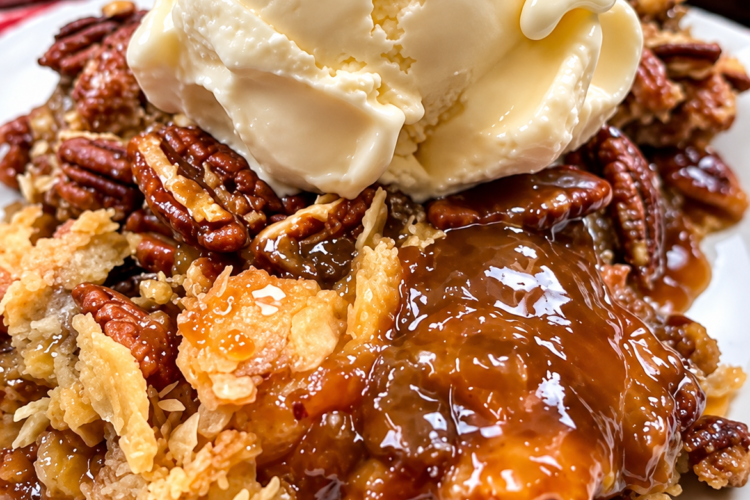
Pecan Cobbler Recipe: A Southern Church Cookbook Classic That Silences the Room
My mother-in-law brought this to Sunday dinner last month and I watched three grown men go completely silent while they ate. No phones. No conversation. Just forks scraping plates and someone asking if there was more before the pan was even empty. I have never been more impressed by a dessert in my life, and I have eaten a lot of desserts. I'm not even a huge pecan person, but this thing is dangerous. The top bakes up into a buttery, golden crust with toasted pecans scattered across it, and underneath there's a glossy, almost caramel-like sauce that soaks into the cake as it bakes. You scoop into it and it's part cobbler, part molten pecan pie, and part something I don't have a name for. It's the kind of dessert that makes people lean back in their chairs and close their eyes for a second, which is a thing I've never said about a cake before this one. She told me the recipe came from her grandmother's church cookbook from the '70s, and honestly, it tastes like it. That old-school, no-fuss Southern comfort that just works, with no frosting, no crust, no decoration, and a list of ingredients you could recite from memory. There's something I trust about a recipe that survived four decades of handwriting and butter smudges on a page. I've made it twice since then. Once for a potluck where it disappeared so fast I didn't get a second piece, and once on a random Wednesday because I had pecans to use up. Same reaction both times. This is one of those Southern pecan cobbler recipes you save for when you need to feed a crowd something that feels like a hug, and it also happens to be about fifty-four cents a slice, which I did not expect.Why You'll Love This Pecan Cobbler
I've made this four times now, and the reason it keeps happening is that it has almost no failure modes and an enormous reach. That combination is rare.- About 54 cents a serving, 12 servings. Roughly $6.50 for the whole thing, and the single most cost-effective crowd dessert I make. Skip the pecans and it drops to about $3.75.
- One dish, two bowls, no frosting. There is nothing to frost, nothing to layer, and nothing to buy. You make a batter, you pour it over melted butter, and the oven builds the rest.
- It feeds a dozen from one pan. A 9x13 cut into twelve generous scoops. For a holiday table, this is the dessert that covers everybody without a second batch.
- The bottom layer is a pecan caramel sauce. This is the entire point of the recipe, and it's why people scrape the dish for the last scoop.
- It is genuinely make-ahead. Bake it up to two days early, cool, cover, and warm before dinner. The flavor improves on day two.
- It freezes in either state. Baked or unbaked, up to three months, and a thawed cobbler rewarms into something close to fresh.
- Eight ingredients, most of which you already have. Flour, sugar, milk, vanilla, butter, pecans. There is no specialty item and no expensive spice.
- It's a heritage recipe, not a novelty. Four decades of church cookbook and family hands, and it still works, which is the highest compliment a recipe can get.
Why This Pecan Cobbler Recipe Works
A cobbler is not a cake and it is not a cobbler in the British sense. It's a specifically American construction, and every part of it is load-bearing. Here's what's actually happening in that 9x13.The melted butter in the pan is the "crust"
There is no pastry, no crust, and nothing you knead. The layer of butter melted in the bottom of the dish is the crust, and it works because you pour batter directly on top of it. The batter cooks from the heat of the oven and the butter cooks from below, so the underside of the cake layer browns, sets, and comes out as that buttery golden base. This is why the dish goes into the oven while it's preheating. If a puddle of butter is still solid when the batter lands, you get a raw butter puddle in the middle of the cobbler instead of a layer.The brown sugar and hot water is the sauce, and the order matters
Dissolving the brown sugar in hot water first and then pouring it over the top is what creates the glossy caramel layer in the bottom of the dish. The dissolved sugar runs down through the batter, pools in the melted butter, and caramelizes against the hot pan over the course of the bake. Hot water is the requirement, not warm, not room temperature. Cold water dissolves the sugar slowly and unevenly, so you get a thin watery layer at the end of forty minutes instead of a glossy sauce. And dissolve it in a separate bowl before pouring, because brown sugar dumped on top and drizzled leaves gritty pockets that never fully dissolve.You must not stir, at any point
Every layer stays distinct because you never disturb them. Batter over butter, then pecans, then the sugar water. The moment you stir, you homogenize the whole thing into a single sweet cake batter with nuts suspended in it, the caramel layer never forms, and you lose the entire texture that people are reacting to at the table. This recipe looks like it's going wrong and it is going exactly right. The mess is the method.The pecans split between the top and the sauce
Sprinkling the pecans over the batter rather than folding them in means roughly half stay on the surface, where the dry heat of the oven toasts them until they smell like the whole kitchen, and the rest sink through the batter and into the sauce below. Fold them in and they all go to the bottom, you lose the golden nut crust that gives this dessert its look, and the top comes out comparatively bare. Watch for the point halfway through the bake when the top nuts turn from pale tan to dark brown, because that's the moment you know the layer is going to be right.350°F protects the caramel
This recipe has more sugar in it than almost any other thing I write, and more of it is sitting where it can burn. At 400°F the sauce at the edges caramelizes past caramel into something bitter, the top browns long before the center sets, and the bottom of a metal pan can scorch. At 350°F the whole 40 minutes is spent building the sauce gradually, which is why this is the temperature in the original and why I wouldn't change it. The color you want is a deep amber, not mahogany.The ten-minute cool is structural
Right out of the oven the sauce is thin and mobile and the cake layer is still setting. Scoop it and the first serving is soup with a crust. Ten minutes lets the sauce thicken and the cake firm enough to hold a clean scoop on a plate for a few minutes before it relaxes, which is a real difference when you're serving twelve people from one pan.Ingredient Breakdown: What Each Thing Is Doing
The cake layer
1 1/2 cups self-rising flour. The lift comes from the baking powder already in the self-rising blend, which means there's nothing to add and nothing to measure separately. If you use all-purpose flour instead, see the substitutions, because getting the leavening wrong gives you a dense pancake. 1 1/2 cups white sugar. This is a sweet cake and a lot of that sweetness is structural, wetting the flour proteins and tenderizing the crumb. 2/3 cup milk and 1 teaspoon vanilla. Together they make the batter a thick, pourable cake batter rather than a dough. It should look like the box mix you're used to pouring, and if it's too thick to spread, loosen it with a tablespoon of milk.The butter layer
6 tablespoons of real butter. Six tablespoons, not a third of a cup, and this is the one measurement in the recipe I'd ask you not to fudge. It melts into the bottom of the dish, browns with the sugar, and becomes both the crust and the source of the sauce's richness. She was right about this and I want to be right about it too. The dish goes into the oven during preheating so the butter melts completely and evenly by the time you're ready to pour.The nut layer
1 cup of pecans, chopped. Roughly four ounces, and the single most expensive line item at about $3.75. Chop them rather than leaving them whole, because chopped nuts have more surface area, toast more evenly, and stay in place instead of floating. Toast them dry in a skillet for three minutes first if you want the deepest flavor, and it's a two-minute upgrade that changes the finished cobbler more than anything else on this list. Black walnuts are the traditional choice and they're cheaper, if you can find them.The sauce
1 1/2 cups packed brown sugar plus 1 1/2 cups hot water. Dissolved together until smooth, then poured over everything. This is the caramel layer, and it's worth understanding that the brown sugar here is not primarily a sweetener, it's the sauce. That's also why it's a poor candidate for a sugar reduction, which I'll get into honestly further down. No salt appears anywhere in this recipe, which is authentic to old cookbooks and worth knowing about. A tiny pinch in the batter and a sprinkle of flaky salt on top are genuine improvements, not corrections.Honest cost per serving
Pecans about $3.75, butter about $0.50, self-rising flour about $0.40, white sugar about $0.45, brown sugar about $1.00, milk about $0.20, and vanilla about $0.15. That comes to roughly $6.50 total, or about 54 cents a serving cut into twelve. The pecans are 58 percent of the total, which is the one thing to know if you're pricing a holiday dessert out. Walnuts drop the cost to about $4, and skipping the nuts entirely brings it to about $3.75, at the cost of the toasted top that half the reason people fight over the last scoop.The Kitchen Equipment You Actually Need
- 9x13-inch baking dish, glass preferred. Glass gives you two things: even heat and the ability to see the caramel forming at the edges through the side of the dish, which is your best doneness signal. Metal works and runs hotter, so if you use it, check the bottom color early.
- Heavy whisk for the batter. A fork works, but the batter needs to be lump-free and a fork leaves small pockets.
- Two mixing bowls. One for the batter, one for the brown sugar and water. You need them separate, because the order of pouring is the technique.
- Measuring cups and spoons, plus a kitchen scale if you have one. Packed brown sugar is the measurement people get wrong most often.
- Large spoon or rubber spatula for stirring the sugar into the hot water until it's fully dissolved.
- Ice cream scoop or a large serving spoon for portioning. This is served in scoops, not slices, and a spring-loaded scoop makes twelve of them look deliberate and take about forty seconds.
- Small saucepan or a kettle for heating the water, which needs to be genuinely hot rather than warm.
- Foil or a cake dome, if you're making it ahead, and a trivet, because the dish comes out of the oven with a molten layer in it.
Step-by-Step: How to Make This Southern Pecan Cobbler
- Start the butter melting with the oven. Preheat the oven to 350°F. Put 6 tablespoons of butter in a 9x13-inch baking dish and set the dish inside the oven while it preheats. Leave it there until the butter is completely melted and the foam has subsided, which is usually right as the oven reaches temperature. This is the step people skip and it's why they get raw butter pockets.
- Make the batter. In a bowl, whisk 1 1/2 cups of self-rising flour and 1 1/2 cups of white sugar together, then stir in 2/3 cup of milk and 1 teaspoon of vanilla. Mix until smooth, with no dry streaks in the bottom of the bowl. The batter should be thick and pourable, roughly the consistency of a boxed cake mix. If it's too stiff to spread, beat in a tablespoon of milk.
- Dissolve the sugar sauce. In a second bowl, combine 1 1/2 cups of packed brown sugar with 1 1/2 cups of hot water. Stir until the sugar is completely dissolved and the mixture is smooth and pourable, with no gritty sugar at the bottom. If it doesn't dissolve, the water wasn't hot enough, so heat it another minute and stir again. This step is the sauce and it's not optional.
- Pull the dish and pour the batter. Remove the dish from the oven. The butter should be fully melted and pooled across the bottom. Pour the batter directly over the melted butter and do not stir it. Spread it gently to the edges with the back of a spoon if it doesn't reach the corners, and let it sit for a minute. It will look alarming and separate, and that is exactly correct.
- Scatter the pecans. Sprinkle 1 cup of chopped pecans evenly over the whole surface, right out to the edges. Don't stir them in. Half of them will stay on top and toast, and half will sink into the batter and into the sauce.
- Pour the sugar water over everything. Slowly pour the brown sugar and hot water mixture over the top, distributing it across the whole dish rather than dumping it in one spot. Again, do not stir. It will look completely chaotic. That chaos is the recipe, and it becomes a glossy caramel sauce in the bottom half.
- Bake 35 to 40 minutes. Bake until the top is golden, the edges are bubbling with dark caramel sauce, and a toothpick inserted into the center comes out clean or with a few moist crumbs. The sauce at the edges should be a deep amber, not dark brown. If the top is browning before the center sets, tent loosely with foil for the last 8 minutes.
- Cool 10 minutes, then scoop. Let the dish rest about 10 minutes so the sauce thickens enough to scoop cleanly. Then serve it in scoops rather than slices, with vanilla ice cream or whipped cream. Scrape the last of the caramel from the bottom of the dish and treat that as a portion.
Expert Tips for the Best Pecan Cobbler
- Toast the pecans dry first. Three minutes in a dry skillet until fragrant, then cool them before they go in. This is the single biggest flavor upgrade available to this recipe and it takes almost no time.
- Chop the nuts, don't leave them whole. Chopped nuts toast more evenly, stay put in the dish, and give the top a finer, more even crust.
- Use hot water, properly hot. If your sugar doesn't dissolve in the bowl, the water wasn't hot enough. Heat it another minute. This is the difference between a caramel layer and a watery one.
- Dissolve the brown sugar completely. Any sugar left sitting on top stays granular and the sauce turns grainy in the dish.
- Pour the sugar water in thin streams. Even distribution gives you a consistent layer. Dumping it in one corner gives you one great puddle and a dry spot.
- Watch the nut color, not just the crust. The nuts should turn from pale to medium brown at around the 25-minute mark. Pale nuts mean a pale, underdeveloped top.
- A pinch of salt in the batter genuinely makes this better, and a sprinkle of flaky salt on top after baking is the single easiest upgrade in this article. The original has no salt, which is authentic, not a flaw.
- Bourbon is the right addition. Two tablespoons stirred into the batter or drizzled over after baking. It makes the caramel read as deeper and it's the traditional move in the cookbook this came from.
- Use glass if you have it. You can see the sauce forming through the side of the dish, which is a better doneness signal than any timer.
- Serve it in scoops, not slices. It's a cobbler, and scooping gets you the sauce-to-cake ratio that's actually good. A flat serving of just the top is the most common serving mistake.
- Scrape the dish. The last of the caramel at the bottom and the buttery edges stuck to the corners are the best part of the whole thing, and leaving them is a waste.
Common Pecan Cobbler Mistakes to Avoid
- Stirring the layers. Destroys the sauce entirely. Batter over butter, pecans over batter, sugar water over everything, and no stirring at any point.
- Pouring the batter onto butter that hasn't fully melted. You'll get solid butter streaks baked into the middle of the cobbler. Wait for the foam to subside.
- Using warm instead of hot water. The sugar won't dissolve, the sauce won't caramelize properly, and you'll get a thin layer at the bottom instead of a glossy one.
- Baking hotter than 350°F. This recipe is mostly sugar sitting near heat. Above 350 the sauce goes bitter and the edges scorch before the center sets.
- Cutting into it straight from the oven. The first scoop will be liquid. Give it the full ten minutes.
- Scooping from the top only. The caramel layer is the whole point. Get down into the bottom of each serving.
- Unpacked brown sugar. Loosely filled measuring cups put roughly a quarter cup less sugar in the dish, which weakens the sauce noticeably. Pack it.
- Overcrowding with too many pecans. A heavy layer of nuts on top insulates the batter and keeps the center from setting through. An even single layer is right.
- Skipping the nut layer entirely and calling it a cobbler. It'll taste good, but you'll miss the toasted top that half the reason people ask for a second scoop.
Ingredient Substitutions That Still Work
Straight up, because it's important here: this recipe as written is not gluten-free, not keto, and it is very high in sugar. Standard self-rising flour is wheat, and this cobbler contains three cups of sugar between the white and the brown, so roughly fifty grams of added sugar per serving. I won't describe it as a healthy dessert in a title or a Meta description, because that's exactly the kind of claim that gets food posts flagged. Here's what genuinely swaps in.- All-purpose flour for self-rising. 1 1/2 cups all-purpose flour plus 2 1/4 teaspoons baking powder and 3/8 teaspoon salt. Whisk those three together before adding the sugar, and you'll get the same lift.
- Gluten-free: This is one of the cleaner conversions in any cobbler. Use a 1:1 gluten-free baking cup blend in place of the self-rising flour. A 1:1 blend already includes baking powder and salt, so don't add more, but check the back of the bag because some brands recommend a little extra leavening. Verify the blend is certified GF and check your milk and vanilla too. If all four components check out, that's an honest claim; if you can't verify all of it, don't label it.
- No pecans, or fewer: Walnuts work and are traditional in the South, black walnuts are the most authentic and considerably cheaper, and almonds are a decent substitute. A fruit version with blueberries or peaches and no nuts is a completely different dessert that still works. Cutting the pecans in half is the single best budget move in this recipe and costs you very little.
- No brown sugar: White sugar plus 1 tablespoon of molasses in place of each cup of brown sugar gives a comparable depth. Dark brown sugar in place of light is a genuine upgrade for the flavor of the sauce, and it's usually on the same shelf.
- Richer batter: Half-and-half or heavy cream instead of milk makes a more tender, fudgier cake layer. The original is milk and that's what the cookbook had, but this is a real improvement.
- Add something: Diced apples with the pecans reduced, a can of drained peaches, fresh blueberries, sweet potato, pumpkin, a teaspoon of cinnamon or nutmeg, orange zest, or two tablespoons of bourbon. All of these go in with the batter and all of them work.
- Smaller dishes: Two 8x8-inch squares bake in 25 to 30 minutes and give you six to eight servings, which is easier to transport and easier to eat. A single 8x8 is a perfectly good four-serving cobbler.
- Lower sugar: You can cut the white sugar in the batter by a quarter to a half cup and add a teaspoon of extra vanilla, with little effect on the finished dish. Do not reduce the brown sugar layer, because that liquid is the sauce and thinning it turns the bottom of the cobbler watery. I'll be honest with you rather than telling you this one converts well, because it doesn't.
Pecan Cobbler Variations to Try
- Bourbon pecan cobbler. Two tablespoons of bourbon stirred into the batter, and two more drizzled over the top about five minutes before it comes out so the alcohol cooks off and the caramel deepens. This is the version the original cookbook family probably made, and it's the one I'd bake first.
- Apple pecan cobbler. Two cups of diced Granny Smith apples folded into the batter, with the pecans reduced to 3/4 cup. The apples release juice and make the cake layer more tender and less sweet, which is a genuinely good balance for a dessert this rich.
- Chocolate pecan cobbler. Two tablespoons of cocoa in the batter, 3/4 cup chocolate chips in the middle, and a drizzle of melted chocolate over the top after baking. This is the one my kids ask for by name, and the cocoa does not make the sauce bitter because the sauce is underneath.
- Sweet potato pecan cobbler. One cup of mashed sweet potato in the batter. This is a genuinely traditional Thanksgiving version, and it makes the cake layer taste like the holiday even when the date doesn't.
- Pumpkin pecan cobbler. One cup of pumpkin puree in place of 1/3 cup of the milk. Add a teaspoon of pumpkin pie spice and reduce the sugar by a quarter cup. Genuinely good, and it is not a health claim.
- Blueberry or peach cobbler. A cup of fresh blueberries or two sliced peaches on top with no pecans at all. Add a tablespoon of cornstarch to absorb the juice, and bake 5 minutes less.
- Salted caramel pecan cobbler. Reduce the brown sugar in the water to 1 cup, and drizzle 3/4 cup of salted caramel sauce over the top about 5 minutes before the end of the bake so it melts into the crust. A very good idea with a tablespoon less effort than it sounds.
- Cinnamon pecan cobbler. Two teaspoons of cinnamon and a quarter teaspoon of nutmeg added to the batter, and a heavy sprinkle of cinnamon sugar over the top before baking. This one smells like a bakery when it comes out of the oven.
- White chocolate pecan. Swap half the brown sugar layer for white chocolate chips stirred into the hot water, which will not dissolve, so make it a deliberate pour of white chocolate instead. Bake 3 minutes less.
- Mini cobblers. Same recipe, poured into four or six 6-ounce ramekins and baked 22 to 25 minutes. Perfect for a dinner party because each one is an individual portion and nobody has to scoop from the pan.
Make It Healthier (Small Tweaks, Honest Limits)
Let me be direct about this one, because it's the dessert where I have the least room to be clever. This cobbler contains three cups of sugar and about fifty grams of added sugar per serving. That is a lot, and I will not pretend the pecans offset it. What I can tell you is what's factual, and then the changes that actually matter.- Cut the portion, and it's the real fix. This is written to yield twelve generous servings. Cut it into fifteen or eighteen smaller ones instead and the per-serving numbers drop by a third to a half without changing a thing about the recipe. Nobody misses a smaller scoop of a dessert this rich.
- Top with Greek yogurt instead of ice cream. Plain Greek yogurt whipped with a spoon of honey and a little vanilla brings the same creamy contrast for a fraction of the added sugar, and it's the highest-impact swap available.
- Use a small scoop of ice cream, or none. A generous scoop of vanilla ice cream adds 200 calories and another 20 grams of sugar to a dessert that already has fifty. This is where most of the sugar people eat at this meal actually comes from.
- Reduce the white sugar in the batter. Cut a quarter to a half cup and add a teaspoon of extra vanilla. The cake layer barely notices. Don't touch the brown sugar layer, because that's the sauce.
- Keep the pecans, honestly. This is the one place I'll say a component is worth keeping rather than swapping. A cup of pecans brings real fat and a few grams of protein, and they toast into genuine flavor. A pecan version and a nutless version are not equally good desserts, and pretending otherwise would be dishonest.
- Add fruit. Diced apples, peaches, or blueberries stretch the cobbler out, add fiber, and dilute the sweetness per serving. The apple version is the best of the bunch for this.
- Make less of it. Use an 8x8 pan for a family of four instead of a 9x13 for twelve. The sugar per serving is the same, but you're not making dessert nobody eats, which is the actual waste.
- Pair it with coffee and stop there. No second dessert, no pie. Coffee's bitterness is the right counterweight and it costs thirty seconds.
Meal Prep and Make-Ahead Tips
- Bake it up to two days early. Cool completely, cover loosely with foil, and refrigerate. Warm at 350°F for 20 minutes before serving. The flavor is better on day two, which is unusual and true.
- Assemble it ahead with one extra step. You can build the cobbler fully, unbaked, up to 24 hours ahead. The butter will have solidified in the dish, so before baking, put the whole dish back in a 350°F oven for 5 minutes to re-melt the butter, pull it out, let it sit five minutes, and then bake as directed. Do not skip the re-melt or you'll get a solid butter layer.
- Freeze it baked, up to three months. Cool completely, cover the dish in plastic and a layer of foil, and freeze flat. Thaw in the refrigerator overnight and rewarm at 350°F for 20 to 25 minutes until the sauce is bubbling again.
- Freeze it unbaked, and this is the better version. Cover the assembled dish tightly and freeze for up to 3 months. Thaw in the refrigerator overnight, then put it in the oven with the butter layer for 5 minutes to re-melt before the full bake. You get a cobbler that tastes like you made it that afternoon.
- Scoop it the day before. Twelve scoops arranged in a single layer in a covered container, refrigerated. Rewarm the whole container at 350°F for 20 minutes and you're serving in thirty seconds with no pan to carry.
- Make two 8x8 pans for a party. Twenty-five to thirty minutes each, they travel in a bag, and twelve people can each take one to their seat without a serving spoon being passed around a table.
- Toast the pecans and cook nothing else in advance. The only real prep is chopping and toasting the nuts, and doing that the night before is the whole time investment.
- Warm the serving scoops. A metal ice cream scoop dipped in hot water leaves clean scoops instead of sticky ones with a layer of cobbler glued to them. Do it before you serve.
Storage: How Long Does Pecan Cobbler Last?
Covered and refrigerated, pecan cobbler keeps for 4 days, and it holds its texture well because the caramel sauce and the nut topping are both stable. The cake layer actually firms up as it sits, which means day two gives you a slightly denser, more cohesive scoop than day one, and most people prefer it. Cool it completely before covering, because a lid on a warm cobbler traps condensation and makes the nut topping soft and sticky rather than crisp. Store it in the dish if you have room, because transferring a gooey cobbler to another container means scraping out most of the caramel and leaving it behind. If you must move it, oil the container first. The sauce will firm up considerably in the refrigerator, which is normal and is exactly why it needs twenty minutes back in the oven rather than a microwave. For food safety, no more than two hours at room temperature, and one hour in hot weather or outdoors at a party. If you're serving it at a holiday dinner where it sits out through cleanup, plan to put the leftovers away before everyone sits down.Can You Freeze a Pecan Cobbler?
Yes, and this is one of the most freezer-friendly baked desserts there is, because there's no egg, no yeast, and no rising. Nothing about the structure breaks in the freezer. Freezing baked is the easy route. Cool it completely, wrap the dish tightly in plastic and a layer of foil, and freeze flat for up to 3 months. Thaw in the refrigerator overnight, never on the counter, then rewarm at 350°F for 20 to 25 minutes until the sauce is bubbling again. Thaw time depends on how full your refrigerator is; a full 9x13 can take most of a night, so plan on baking it a day before you need it or moving it to the fridge early in the morning. Freezing unbaked gives a fresher cobbler and takes slightly more planning. Assemble everything, cover the dish tightly with plastic and foil, and freeze for up to 3 months. Thaw completely in the refrigerator, then put the dish in a 350°F oven for 5 minutes to re-melt the butter layer before baking as directed, about 40 minutes. If you skip the re-melt step you'll have a solid butter layer in the middle, and it's the one thing that can't be fixed after. Individual portions also freeze well. Scoop twelve portions while cool, wrap each one individually, and freeze flat. They reheat from frozen in 25 to 30 minutes at 350°F, which makes them a genuinely useful thing to have on hand. Don't refreeze anything you've thawed.Reheating Pecan Cobbler
Unlike a lot of baked goods, this one is built to be reheated, because the caramel layer is meant to be liquid. The only real rule is that the oven is better than the microwave, and the reason is the nut topping, which goes from crisp to soft in about forty seconds of microwave heat. Put the whole dish, or as many scoops as you need in a single layer, in a 350°F oven for 20 to 25 minutes until the sauce is visibly bubbling again and the top is hot all the way through. A cold cobbler from the refrigerator needs the full time; a room-temperature one needs closer to 15. Warming it uncovered is what re-crisps the pecans, and the caramel will look loose coming out of the fridge and thickened again by the time it hits the bowl, which is correct and not a sign you overcooked it. The microwave works, and I'll be honest about the tradeoff. Forty-five to sixty seconds at 70% power gets a serving hot quickly, and this is the one dessert where the microwave is not an insult, because a slightly soft nut topping over a molten caramel sauce is a perfectly good result. Cover loosely with a paper towel to keep the top from going rubbery. The sauce in the bottom of the container will still be cold, so stir it before you eat, and heat in 30-second bursts rather than one long blast. Add the ice cream or whipped cream after reheating, never before. Vanilla ice cream melted into a hot cobbler turns the sauce thinner and the surface greasy, and you lose the temperature contrast that makes this dessert worth serving.What to Serve With This Pecan Cobbler
This is a rich, sweet, buttery dessert with a caramel layer, so almost everything you put next to it should be hot, cold, bitter, or tart. It does not need much, and the temptation to add a scoop of ice cream, a drizzle of caramel, and some whipped cream all at once is the mistake most people make.- A scoop of vanilla ice cream. The classic pairing, and the only one I'd consider mandatory. Vanilla bean is better and worth the price on a dessert like this.
- Whipped cream, for anyone who wants the cold contrast without the extra sugar. Heavy cream whipped with a spoon of powdered sugar and a little vanilla is the right level of sweet.
- Hot coffee, which is the most important pairing on this list and the one people forget. The bitterness is exactly what this much sugar needs, and it costs a dollar and thirty seconds.
- Cold brew or an iced Americano if it's still warm enough outside for a dessert like this.
- A drizzle of bourbon after baking, or a bourbon sauce poured over each scoop. The right amount is about two tablespoons, and it makes the caramel read as much deeper.
- Caramel or salted caramel sauce drizzled at the table. Use salted, because a dessert with three cups of sugar in it needs the counterweight and people rarely think of it.
- A pinch of flaky salt, right before serving, for the same reason. Thirty seconds of work, and it's the single most surprising improvement in this article.
- Fresh berries alongside, which add acid and cut the sweetness. This isn't traditional, and it's still correct.
- Chai or spiced tea, which brings warmth and spice that sit well next to the nuts.
- For a holiday table: serve small scoops, with coffee and ice cream set out for people to add themselves. A 9x13 of this on a Thanksgiving table should be a generous, unhurried thing at the end, not the main event.
Beverage Pairings for Pecan Cobbler
- Hot black coffee, brewed fresh. The best pairing you can make for this dessert, and the reason this is a good Sunday dinner rather than a heavy finish.
- Bourbon, on the rocks or as a coffee. The caramel, vanilla, and nut notes in the cobbler are all things bourbon tastes like, which is why the bourbon variation exists in the first place.
- Irish coffee, for a holiday table. Coffee, cream, whiskey, and sugar against a caramel dessert is a combination that requires no explanation.
- Tawny port or a late-harvest wine, in small pours. Very sweet, but it matches, and it's the traditional pairing in the cookbook tradition this recipe comes from.
- Cold brew or iced coffee, for a September cobbler in a warm room.
- Chai latte or spiced tea, with cinnamon. Warm, sweet, and it harmonizes with the nuts rather than competing with them.
- Sweet tea or iced tea, which is the correct drink for a Southern dessert and needs no justification from me.
- Cold milk, for children and for anyone who wants the temperature contrast. Not a joke.
- Sparkling water with lemon, for a non-coffee option that doesn't add more sugar to the evening.
FAQ: Pecan Cobbler Questions, Answered
Do I have to stir the layers together?
No, and this is the one instruction in the recipe you must not break. The batter goes over melted butter, the pecans go over the batter, and the brown sugar and hot water go over everything, and nothing gets stirred at any point. The layers work because the dissolved sugar runs down through the batter, pools in the butter, and caramelizes against the hot pan to create the glossy sauce in the bottom. Stir it and the layers homogenize, the caramel never forms, and you get a sweet cake with nuts in it, which is a different dessert from the one this is.Why didn't my pecan cobbler make a sauce at the bottom?
Four causes, in order of likelihood. You used warm water instead of hot, so the brown sugar never dissolved and never reached the pan in liquid form. You poured the sugar on top and drizzled the water over it instead of dissolving it first in a bowl. Your butter wasn't fully melted, so the sugar had cold butter to sit in rather than a hot pool. Or you stirred. Check the butter was melted before pouring, dissolve the sugar completely in hot water first, pour it on in thin streams across the whole dish, and give it the full 35 to 40 minutes. A thin watery layer is almost always a water temperature problem.Can I make pecan cobbler ahead of time?
Yes, and it's genuinely better on the second day. Bake it up to two days early, cool it completely, cover loosely, and refrigerate, then rewarm at 350°F for 20 minutes before serving. You can also assemble it fully unbaked up to 24 hours ahead, with one extra step: put the assembled dish back in a 350°F oven for 5 minutes before baking to re-melt the butter, pull it out, let it sit five minutes, then bake as directed. For serving, scooping it the day before into a single covered container and warming the whole thing takes about twenty minutes and gets you out of the kitchen on the day.Can I freeze pecan cobbler, and how long does it last?
It freezes well for up to 3 months, baked or unbaked. Baked is easier: cool it completely, wrap the dish in plastic and foil, freeze flat, thaw in the refrigerator overnight, and rewarm at 350°F for 20 to 25 minutes. Unbaked gives a fresher result but needs a re-melt step, because the butter solidifies in the fridge: put the dish in the oven for 5 minutes before the full bake. Refrigerated and covered, it keeps 4 days, and it holds its texture because both the caramel and the nut topping are stable.How do I know when a pecan cobbler is done?
Three signals together. The top is golden, the edges are bubbling with dark amber caramel sauce, and a toothpick inserted in the center comes out clean or with a few moist crumbs. The color of the sauce at the edges matters more than the color of the top, because that sauce is the part that can go from caramel to bitter quickly. Deep amber, not dark brown. If the top is browning faster than the center sets, tent loosely with foil for the last eight minutes. Do not bake it past done, because the extra sugar in the sauce keeps caramelizing and you can push it into bitter territory.Can I make pecan cobbler gluten-free?
Not as written, since standard self-rising flour is wheat. This is one of the cleaner conversions of any cobbler, though, because there's no gluten structure doing the work and the crumb comes entirely from the sugar, milk, and butter. Use a 1:1 gluten-free baking cup blend in place of the self-rising flour. A 1:1 blend already has baking powder and salt in it, so don't add more, but check the bag because some brands recommend a small extra amount. Verify the blend, the milk, and the vanilla are all certified gluten-free, and only describe it as gluten-free if every component checks out.Can I reduce the sugar in a pecan cobbler?
Partly, and I'd rather be straight about which part. You can cut the white sugar in the batter by a quarter to a half cup and add a teaspoon of extra vanilla, with almost no effect on the finished cobbler. You should not meaningfully cut the brown sugar layer, because that liquid brown sugar and water is the caramel sauce, and thinning it turns the bottom of the cobbler watery rather than making it healthier. This is one of the desserts where the sugar genuinely is the recipe. The real lever is portion size, and cutting this into fifteen or eighteen servings instead of twelve drops the per-serving sugar by a third without changing anything you do.How many people does a 9x13 pecan cobbler serve?
Twelve generous scoops, or eighteen if you cut it smaller, which I'd recommend. It is a rich dessert with three cups of sugar in it, and smaller scoops with a little ice cream satisfy more people from the same pan. For a dinner party, plan on two per person from a 9x13, which is six people comfortably. For a holiday table where it's one of several dishes, one scoop each is plenty. For a potluck, make two 8x8 pans rather than one 9x13, because they bake faster, they're easier to carry, and twelve people can each take one to their seat.Nutrition Information
These are labeled estimates for one of twelve servings of a 9x13-inch cobbler, with no ice cream or whipped cream included. Actual values will vary with brand, particularly the pecans and the brown sugar, and with scoop size. Because this is a layered cobbler, the ratio of cake to caramel sauce varies quite a bit from one scoop to the next, so a serving taken from the top of the dish will be significantly higher in sugar than one that includes sauce from the bottom. Treat this as a guide, not a measurement.| Nutrient | Approx. per serving | Approx. per serving | Approx. per serving |
|---|---|---|---|
| Calories | Fat | Carbohydrates | |
| ~390 kcal | ~12 g | ~67 g | |
| Protein | Saturated Fat | Sodium | |
| ~3 g | ~4 g | ~110 mg |
Final Thoughts
What I like most about this one is that it isn't clever. There's no technique to master, no ingredient that's hard to find, and no step where you can really go wrong if you pay attention to the order. Butter, batter, nuts, sugar water, oven. It's the most forgiving recipe I write, and it produced the most consistently stunned reaction at any table I've served it at. It also came to me the way the best recipes do, which is by being handed over rather than looked up. Somebody's grandmother wrote it down in a church cookbook in the '70s, somebody's mother made it on Sundays, and then it was carried through four decades of handwriting and butter smudges until it showed up at a table in my life with no attribution attached. That's a real thing and it's rare. I think about the women who made this on a Tuesday with the same jar and the same can, and I've started to think the reason it never needed improving is that nobody who made it was looking for something to improve. It's about fifty-four cents a slice, it feeds twelve, it makes two desserts out of one pan if you bake it in two smaller dishes, and it freezes either way. So the only real decision left is whether you're the person who eats it standing at the counter scraping the last of the caramel out of the dish, or whether you actually plate it, scoop it properly, and put a bowl of ice cream in the middle of the table like a host. I'll be honest: I've done both, and the counter version is better. But I'm not going to be the one to say that out loud at dinner.Southern Church Cookbook Classic
Southern Pecan Cobbler Recipe
A buttery golden cake layer over melted butter and pecans, with a glossy brown sugar caramel sauce in the bottom of the dish. Eight ingredients, one pan, no frosting, and it feeds twelve for about 54 cents a scoop.
Ingredients
Cake Layer
Butter Layer
Nut Layer
Caramel Sauce Layer
For Serving
Do not stir anything. Batter over butter, pecans over batter, sugar water over everything. The layers are the technique.
Instructions
- Melt the butter in the oven. Preheat to 350°F. Put 6 tablespoons of butter in a 9x13-inch baking dish and set the dish inside the oven to melt completely while it preheats. This is the "crust," so it has to be fully melted before you pour.
- Mix the batter. Whisk 1 1/2 cups self-rising flour with 1 1/2 cups white sugar, then stir in 2/3 cup milk and 1 teaspoon vanilla until smooth with no dry streaks. Thin with a tablespoon of milk if too stiff.
- Dissolve the sauce. In a second bowl, stir 1 1/2 cups packed brown sugar into 1 1/2 cups hot water until completely dissolved with no gritty sugar left. If it will not dissolve, the water is not hot enough.
- Pour the batter over the butter. Pull the dish out and pour the batter straight over the melted butter. Do not stir. Spread gently to the edges with the back of a spoon and let it sit a minute.
- Scatter the pecans. Sprinkle 1 cup chopped pecans evenly over the top, out to the edges. Do not stir them in; half stay on top and toast.
- Pour the sugar water over everything. Slowly pour the brown sugar and hot water over the whole dish in thin streams. Do not stir. It will look like a mess, and that is correct.
- Bake 35 to 40 minutes. Bake until the top is golden, the edges bubble with dark amber caramel, and a toothpick in the center comes out clean or with moist crumbs. The sauce should be deep amber, not dark brown.
- Cool 10 minutes, then scoop. Rest so the sauce thickens enough to scoop cleanly. Serve in scoops with vanilla ice cream, get down into the caramel at the bottom, and scrape the last of the dish for whoever wants it.
Cook's Notes
Costs are estimates based on pecans at roughly $3.75, plus butter, self-rising flour, white and brown sugar, milk, and vanilla. The pecans are 58 percent of the total, so swapping in walnuts drops the whole pan to about $4, and skipping them brings it to about $3.75.
- Never stir this recipe. The whole dessert is four separate layers, and the glossy caramel sauce in the bottom forms because the dissolved brown sugar runs down through the batter into the melted butter. Stir it and the layers homogenize, the sauce never forms, and you get a sweet cake instead of a cobbler.
- Hot water is the requirement, and it must dissolve completely. Combine 1 1/2 cups packed brown sugar with 1 1/2 cups of genuinely hot water and stir until smooth before you pour. Cold or merely warm water dissolves slowly, leaves gritty sugar, and gives you a watery layer instead of a caramel one.
- Make it ahead and freeze it either way. Baked, it keeps 4 days refrigerated and 3 months frozen, and it rewarms into something close to fresh. Unbaked, it freezes 3 months and needs one extra step: 5 minutes in the oven before baking to re-melt the butter. The only non-negotiable rule in the whole recipe is that the butter has to be liquid before the batter lands.
Nutrition (Labeled Estimates)
Approximate values for 1 of 12 servings of a 9x13-inch cobbler, with no ice cream or whipped cream included. Estimates only; actual values vary by brand, particularly the pecans and brown sugar, and by scoop size. Because this is a layered cobbler, a scoop from the top of the dish will be significantly higher in sugar than one that includes sauce from the bottom.
Sugar: approximately 50 g per serving, essentially all added. This cobbler contains 3 cups of sugar, and a scoop of vanilla ice cream adds roughly 20 g more. We are flagging it on purpose, which is why the article focuses on portion size and on the Greek yogurt swap rather than on a reduced-sugar version that doesn't exist. Contains milk, wheat, and egg. Not gluten-free, not keto, not low-carb, and not a low-sugar dessert.