
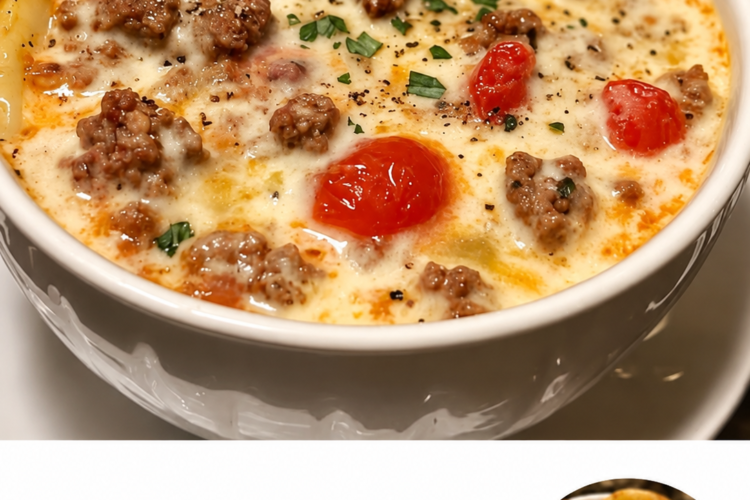
Alfredo Lasagna Soup: One-Pot Comfort With Broken Noodles and Real Sausage
My husband walked in from work on a Thursday, dropped his bag in the hallway, came into the kitchen, looked at the pot bubbling on the stove, and said, "Whatever that is, I'm having three bowls." He was not exaggerating, and he went back for the third one about forty minutes later, standing at the counter, with the lid off, at nine o'clock at night.
I threw it together the first time because I had half a pound of Italian sausage in the freezer and about eight lasagna noodles that had snapped in the box. Not the good kind of snapped. The kind where you drop the box and the whole thing looks like a crime scene on the counter and you think, well, I am not throwing these away, I am going to make soup out of them. That was the entire plan. I did not expect it to work and it worked completely.
I have made this maybe fifteen times since then, which is a lot for a recipe that came from leftovers and a broken box. The creamy base is essentially a very short Alfredo sauce made with chicken broth instead of all that milk and butter, and the noodles cook right in it, so everything thickens and coats itself in one pot with nothing to drain and nothing to assemble.
It is what I make when I want lasagna without the four hours and the nine pans. It is what I make when the week has been too long and I want somebody in my house to say something approving about dinner. And it is, quietly, one of the better things I have ever accidentally invented, which is a strange sentence to write about something that took twenty minutes and a box of noodles.
Why You'll Love This Alfredo Lasagna Soup
One pot, start to finish, about forty minutes. There is no baking, no assembling, no second dish to wash at the end, and the thing you stir is the thing you eat. For a weeknight when the last thing you want is a sink full of pans, that is not a minor convenience, it is the entire reason this recipe exists.
The sausage is doing the job people expect beef to do in a soup. It renders fat, it browns, and it builds a savory base that the cream and broth sit on top of. It also breaks into crumbles, which means every spoonful has some in it. If you use plain ground beef this becomes a different and blander soup, not a bad one, just a different one.
The tomatoes are the part people leave out and the part I think about most. Cherry tomatoes stirred in at the end, so they warm and burst but do not turn to mush, give you bright little pockets of acid against all that cream. Without them the whole thing is rich and heavy and a bit flat, and with them it tastes like it had thought about itself.
It reheats better than almost any pasta dish I make. Cream and broth loosen when they sit, and the noodles absorb liquid overnight, so a bowl that was perfect at the stove is actually better on day two. Most pasta dishes need a splash of liquid when you reheat them. This one just needs heat.
And nineteen grams of protein a bowl, at roughly two dollars sixty a serving. That is a genuinely filling dinner for six people out of one pot, which matters in a season where my grocery bill has opinions about how many separate meals a week can afford to be.
Why This Alfredo Lasagna Soup Works (And What It Honestly Is Not)
The reason it tastes like Alfredo rather than like cream soup is that there are three things in it that are not water. Broth, cream, and the starch that comes off the noodles as they cook. That last one is the one people do not think about and it is doing real work. As the broken noodles soften, they release enough starch to thicken the broth on its own, which means the soup gets a body that cream alone would not give you.
Which is also why breaking the noodles into pieces is not a compromise. Long noodles in a pot of liquid are a timing problem and a stirring problem and a frustration problem. Broken pieces cook faster, they do not need stirring to keep them from tangling into a brick, and they give you a spoonful that contains a piece of noodle rather than a coil of it. If you are using a box that is already broken, you have accidentally made this recipe better.
Broth instead of milk is the other decision. Traditional Alfredo is milk, butter, and parmesan, which thickens fast and tastes rich and also costs more and takes longer because you have to reduce it. Broth gets you to a place in forty minutes with one pot. The heavy cream brings the richness back at the end, and the Parmesan is what makes it taste like the Alfredo sauce you remember rather than like a cheesy soup.
Add the cheese off the heat, or nearly so. Mozzarella and Parmesan stirred into a boiling pot will clump and go stringy and seize into little rubbery bits. Lower the heat, add them, and stir gently until they melt into the liquid. It takes an extra minute and it is the difference between a velvety soup and a soup with cheese chunks in it.
And the greens go in last, in two stages. Spinach stirred into soup at a rolling boil cooks down to nothing and turns the whole pot murky green. Added at the end over lower heat, it wilts into ribbons and keeps its color and its shape.
Now the honest part. This is not a keto recipe. It is not low-carb, not close, with about 36 grams of carbohydrate per bowl and almost all of it coming from the noodles. It is not gluten-free either, since the noodles are wheat, and it is not light, at roughly 30 grams of fat a bowl, most of it from the cream. I am telling you the numbers because this is exactly the kind of recipe people ask about for low-carb and I would rather you had the figure before you made six servings of it.
What it honestly is: a forty-minute one-pot dinner that feeds six for about two dollars sixty a head and makes your husband say something out loud.
Ingredient Breakdown: What Each Thing Is Doing
Half a pound of ground Italian sausage. The savory foundation and the fat that makes the whole thing taste like food rather than like cheese. Fennel seed is in most varieties, and that is a deliberate flavor, not an accident, and it reads clearly in the finished soup. Use a mild variety if you are feeding kids, hot if you are not. Sweet Italian sausage works too and gives you a slightly different, more pepperoni-adjacent result that I like very much.
One small onion, chopped. The base note. Cooked until softened and translucent, not browned, because browned onion pushes the soup toward a meatier, heavier place that competes with the pasta. Five minutes is enough.
Eight ounces of mushrooms, sliced. Umami and bulk, and they absorb broth as they cook, which means they season themselves. Cremini are the right choice here. Shiitake are good but pricier, button mushrooms are fine, and I would avoid fresh portobellos because they release a lot of water and can make the broth thin.
Two cloves of garlic, minced. Stirred in after the vegetables soften and cooked about a minute, no more. Garlic burns fast at this point and burned garlic in a pot of cream is a flavor you cannot take back.
Five cups low-sodium chicken broth. The liquid, and low-sodium is specified for a reason. You are also adding sausage, cheese, and heavy cream, all of which bring serious sodium, so starting with the lower-sodium can is what keeps the pot from becoming a salt delivery system. Five cups is deliberate and it produces a soup that still reads as soup rather than as a very thick cheese sauce.
One cup of heavy cream. The richness. This is the single most expensive ingredient in the pot at about a dollar thirty, and it is the one worth spending on. Half-and-half works and I use it when I need to, but you lose a layer of mouthfeel and it will not coat the noodles the same way. Do not substitute plain milk. It will not thicken properly and it will separate when the cheese goes in.
Eight to ten lasagna noodles, broken into pieces. The starch source and the entire point of the recipe. Broken into rough two-to-three-inch pieces, they cook faster, they do not tangle, and every spoonful gets a piece. Cook them in the broth rather than in water first, because that starch is what thickens the soup.
Four cups of baby spinach. Stirred in at the very end. It wilts into the soup in about a minute and gives you greens in a bowl that otherwise has almost none, without changing the character of it. Do not add it with the broth, where it cooks down to grey nothing and turns the pot murky.
One cup shredded mozzarella and half a cup grated Parmesan. Two cheeses doing two jobs. Mozzarella is the body and the stretch and what makes people think of lasagna. Parmesan is the flavor and it is what pulls the whole pot toward actual Alfredo sauce. Shred both yourself if you care; pre-shredded has anti-caking powder on it that makes the melted texture slightly grainy.
A cup of halved cherry tomatoes. Added with the spinach, off the heat, so they warm and burst without collapsing into mush. These are the brightness in the bowl and the reason a heavy cream soup does not put you to sleep. Grape tomatoes work equally well, and drained canned diced tomatoes work acceptably if you drain them properly.
Fresh basil or parsley, plus salt, pepper, and Italian seasoning. A finishing handful of basil, torn rather than chopped, added off the heat. Season more lightly than you think, because the broth was salted, the sausage is salted, and the cheese is salted.
Kitchen Equipment You Need
A large pot with a lid. A Dutch oven, a stockpot, or a five-quart saucepan with a lid is the right size. This makes about eight cups and it needs room to simmer without the cream scorching the bottom, so do not use a small saucepan. A lid matters more than you would think, because the noodles need to cook in liquid and if you lose evaporation to an uncovered pot you end up with a dense, over-reduced soup at the end.
A wooden spoon or a sturdy silicone spatula. The noodles need stirring every few minutes and so do the vegetables at the start.
A colander or sieve, for the spinach. About four cups of raw spinach wilts down to nothing, and pulling it straight out of the pot is awkward and dangerous.
A box grater, if you are shredding your own cheese. A large spoon or ladle for serving, and wide shallow bowls, because this is a substantial soup and a narrow bowl makes it look like less than it is.
A separate pot or a microwave-safe bowl, for reheating leftovers. This one reheats better than it sounds and you want to be able to warm single portions without touching the whole pot.
Step-by-Step Instructions
Start by browning the sausage. Set a large pot over medium heat, add the half pound of ground Italian sausage, and let it sit undisturbed for a few minutes before you touch it so it actually browns. Then break it up with a spoon, cook until crumbly and fully cooked, and drain off the excess fat, leaving maybe a tablespoon in the pot. That tablespoon is what you are going to cook the onion in.
Add the onion and mushrooms. Cook for about five minutes, until the onion is soft and translucent and the mushrooms have lost their raw look and started to brown at the edges. Do not rush this and do not push it to deep brown.
Add the garlic. Stir in the minced garlic and cook about one minute, just until you can smell it. If it starts to color, pull the pot off the heat.
Pour in the broth and bring it up. Add the five cups of low-sodium chicken broth, stir to scrape the browned bits off the bottom of the pot, which is where all the flavor is sitting, and bring it to a gentle boil.
Add the broken noodles. Break the lasagna noodles into rough two-to-three-inch pieces and add them to the pot. Cook according to the package time, usually 7 to 9 minutes for broken pieces, stirring every two or three minutes so nothing sticks to the bottom. You want the noodles fully tender, not just starting to soften, because they will keep cooking in the hot broth.
Lower the heat, then add the cream. Turn the heat down to low and stir in the cup of heavy cream. It will thicken noticeably and go from thin broth to something that coats a spoon.
Add the cheese. Off the heat or over the lowest heat, stir in the shredded mozzarella and the grated Parmesan and keep stirring gently until everything has melted and the soup looks glossy and velvety. This takes a minute and it is the step that goes wrong most often, because a boiling pot plus cheese equals clumps.
Add the greens and tomatoes. Stir in the spinach and the halved cherry tomatoes over low heat, just until the spinach wilts and the tomatoes start to soften. Thirty to sixty seconds. The spinach should stay visibly green.
Season and finish. Taste it. Add salt and pepper and a pinch of Italian seasoning, adjusting more gently than you think you need to. Ladle into wide bowls and finish with torn basil or chopped parsley.
Expert Tips From a Pot of Clumpy Soup
Break the noodles and cook them in the broth. Both parts matter. Broken pieces cook faster, stir less, and put a piece in every spoonful. Cooking them in the broth rather than boiling them separately means all that starch dissolves into the liquid and thickens the soup for free. If you pre-boil them and drain them, you are back to making pasta and then soup.
Add the cheese with the heat off or on the lowest setting. Melted cheese off heat mixes smoothly into the fat and liquid already in the soup. Cheese added to a boil seizes into rubbery strings and you cannot stir them back out.
Stir the spinach in at the end. Boiled spinach turns the whole pot grey-green and muddy, and you lose the color and most of the texture. Low heat, thirty seconds, and it stays bright.
Drain the sausage fat. All but about a tablespoon. Half a pound of Italian sausage renders a serious amount of fat and if you leave it, the soup has a greasy film on the surface and the cream and cheese never taste like they are doing anything.
Shred your own cheese when you have five minutes. Pre-shredded cheese carries anti-caking powder, and when it melts into liquid that powder becomes a fine graininess you can taste in a dish this smooth.
Do not let it boil once the cream goes in. Gentle simmer only. Cream at a rolling boil will eventually break, especially with the cheese in it, and a broken cream soup cannot be rescued by stirring.
Taste before you season and then again after. Broth, sausage, and cheese each bring salt, so the pot usually needs a fraction of what you would add to a plain soup. Over-salted Alfredo soup is a real and common outcome.
Use low-sodium broth and do not skip it. With sausage, heavy cream, and two cheeses already in the pot, regular broth pushes this well past 800 milligrams a bowl without you noticing.
Common Mistakes to Avoid
Whole unbroken noodles. They tangle, they cook unevenly, and they turn into a solid brick if you stir too late. Break them. This is the single thing that separates a good version from a frustrating one.
Cheese added to a boiling pot. It clumps, seizes into rubbery bits, and no amount of stirring fixes it. Heat off or lowest setting.
Spinach added with the broth. It cooks down to nothing, turns the soup murky, and you have wasted four cups of greens. Add it at the very end.
Overcooking the noodles. They keep cooking in the hot broth after you turn the heat down, so pull them at the low end of the package time. Noodles cooked to mush make the soup cloudy and starchy in a bad way rather than a nice way.
Not draining the sausage fat. A greasy film on top of the bowl and a cream sauce that tastes like nothing underneath it. Leave a tablespoon, drain the rest.
Regular broth instead of low-sodium. The pot already has sausage, cream, mozzarella, and Parmesan in it. Regular broth plus all of that lands somewhere unpleasant and you will not be able to fix it by adding more anything.
Fresh mushrooms unwashed and untrimmed. Not dangerous, but the grit ends up in the bottom of the bowl. Wipe or rinse them and trim the stems before they go in.
Blending it. Tempting and wrong. A blended version loses the noodle texture that makes this dish feel like lasagna soup instead of cheesy potato soup.
Adding tomatoes early with the broth. They cook to nothing and release water that thins the pot. Add them with the spinach.
Ingredient Substitutions
Half-and-half for the heavy cream. The substitution your source noted, and it is a fair one. It saves about sixty cents and roughly6 grams of fat a serving, and it stays creamy. Expect a slightly thinner soup and a less velvety coating on the noodles. Plain milk will not work; it will not thicken and it will separate when the cheese goes in.
Ground beef or turkey for the sausage. Plain ground beef works and the soup is still good, just less flavorful. Ground turkey needs more seasoning, since you are losing the fennel and the fat. Chorizo is genuinely excellent and this is one of the few recipes where I would encourage you to make it spicier than you think you should.
Any sturdy pasta. Penne, rigatoni, or ziti all work broken into pieces. Shells are actually ideal because they hold the soup. Avoid thin spaghetti, which goes to mush quickly, and avoid fresh pasta, which does not need this much cooking and turns to porridge.
Zucchini or cauliflower in place of noodles. Both work and both reduce the carbohydrate meaningfully, though this changes the dish. Zucchini needs to be cut into half-moons and salted for ten minutes first to draw out water, or the soup thins. Cauliflower florets soften in about the same time as the noodles and absorb broth well. Neither version is lasagna soup anymore, and I would not describe it as such.
Spinach out, kale or Swiss chard in. Kale goes in with the broth because it needs the time and it holds its shape. Swiss chard is excellent and goes in at the end with the stems removed. Frozen spinach works fine here and is cheaper, since it wilts straight into the pot.
Cream cheese for half the cream. Soften two ounces and stir it in with the Parmesan, using half a cup of heavy cream instead of a full one. It adds body and tang and it is a genuine saving. Do not add it cold or with the heat on, or it will seize into lumps.
Fresh grated Parmesan only, skip the mozzarella. You lose the stretch and the visual lasagna cue, and the soup tastes more like a sauce than a bowl. Use this if you are avoiding it for a reason, not as a preference.
Variations Worth Making
Spinach and sausage lasagna soup, which is the one I make most. Double the spinach to six or eight cups and add a large handful of fresh basil with it. It looks like a healthier soup and it is genuinely a different bowl, greener and fresher, and it disappears faster.
Chicken alfredo lasagna soup. Swap the sausage for shredded rotisserie chicken and add a cup of cooked broccoli. This is genuinely good and it is the version I make for people who do not eat pork. It also reheats better than the sausage version.
Red pepper lasagna soup. Two roasted red peppers, blended with a half cup of the broth, stirred in with the cream. Sweet, smoky, and it keeps the same creamy base. This one is a real improvement rather than a variation for variation's sake.
Taco lasagna soup. Ground beef, one and a half cups of tomato sauce instead of a cup of broth, a packet of taco seasoning, and tortilla chips standing in for the noodles. Cheddar instead of Parmesan, and sour cream dolloped on top. This is a different recipe that happens to use the same pot, and my family asks for it by name.
Cacio e pepe lasagna soup. Skip the sausage and the tomatoes entirely. Broth, noodles, heavy cream, a lot of Parmesan, and cracked black pepper. This is the adult version and it is remarkably good with nothing in it but four ingredients.
Meatball lasagna soup. Add a package of frozen Italian meatballs, cut in half, with the broth. Do not brown them. They go in frozen, they cook in the soup, and they flavor it properly, which takes about twenty minutes and one less pan.
Make It Healthier, Honestly
This is a heavy cream soup with sausage and two cheeses in it. It is not a light dinner and there is no version of this recipe that is going to pretend otherwise. About540 calories and 30 grams of fat per bowl is what this is.
That said, it is a bowl of food, not a bowl of butter, and nineteen grams of protein for two dollars sixty is a legitimately efficient dinner. Soup keeps you full for longer than a plate of pasta, which is a real effect and not a sales pitch, and this one has greens and mushrooms and tomatoes in it, which most cream soups do not.
The levers. Half-and-half instead of heavy cream saves roughly 6 grams of fat and sixty cents a serving, and it is the swap I make when I want the lighter version without it tasting like a compromise. Reduced-fat mozzarella saves about 3 grams. Skipping the Parmesan entirely saves about 5 and you lose the Alfredo character, so I would not, but it is available to you.
The two swaps that actually move the carbohydrate are the only ones that do. Zucchini or cauliflower for the noodles takes a bowl from 36 grams of carbs down to about 9, and it is a real change in the dish, so treat it as a different soup rather than a lighter version of this one. Cutting the noodles to six instead of nine gets you about 24 grams and keeps everything else intact.
On the sodium, low-sodium broth is doing real work here and it is not a small thing. Regular broth plus sausage plus two cheeses will land this bowl somewhere I would not put in a post, so if you are using regular broth, use half of it and half low-sodium and do not add salt at the end until you taste.
Meal Prep Tips
This is a good make-ahead soup and better than most, because it genuinely improves overnight rather than just surviving.
Make it the night before, cool it, refrigerate, and reheat. The noodles absorb broth as they sit, which means the soup thickens and the flavors settle into one thing instead of tasting like a pot of separate components added at different times. Day two is genuinely better.
Leave the noodles slightly underdone if you are making it ahead. They will finish cooking in the reheating, and pasta that was cooked to exactly tender and then cooked again in a hot oven is where soup turns to glue.
Add the spinach, tomatoes, and garnish fresh. If you wilt the greens into the whole pot and refrigerate, the spinach goes dull and the tomatoes collapse and you have saved eleven minutes to make a slightly worse bowl. Portion the base without them and add a handful of fresh spinach to each serving as you reheat.
This freezes, unusually for a cream soup, and I will cover how below. But the better use of this recipe is as a fridge meal prep item. Make the full pot, let it cool, and portion it into four or six containers. That is four or six lunches or quick dinners that take five minutes to reheat.
It also thickens as it sits, so portion with that in mind and keep a carton of broth on hand. A bowl that needed a splash on day one often needs none on day three.
Storage: How Long It Lasts in the Fridge
Four days refrigerated, and I would use it inside that window. This has dairy and meat in it and I am not going to be the person who says day five is fine.
Cool it before you cover it. Put the pot on a trivet or a folded towel and let it stop steaming, because a lid on a hot pot creates condensation that drips straight back into the soup and thins it.
Portion into containers rather than leaving it in the pot, mostly so you do not reheat the whole thing every time you take a bowl. A shallow container reheats faster and more evenly than a deep pot, which matters with noodles in it, because you want the center hot without overcooking the noodles on top.
Expect it to be thicker the next day. That is correct behavior, not a problem, and it is the starch. Loosen with a splash of broth when you reheat, a quarter cup at a time.
Do not leave it on the counter. This has cream, sausage, and dairy noodles in it, and a pot of it sitting out at a party is exactly the thing that gives somebody food poisoning.
Freezing
Yes, and this is one of the few cream soups where it genuinely works, with two adjustments.
Freeze the noodles separately, or slightly undercook them. Cream soup thickens as it cools, and pasta continues to absorb liquid as it cools, so a fully cooked pot of this will set into something close to a solid block. Take the noodles out two minutes early and freeze them in a separate bag, then drop them into the soup as it reheats.
Slightly undercook the pasta and cool the whole thing quickly. Spread it into a shallow container rather than leaving it in the hot pot, so it chills fast. Then cover and freeze.
Up to three months frozen. The cream and cream cheese can thicken and grain slightly on thawing and no amount of stirring completely fixes it, so plan on whisking hard at the end and adding a splash of broth. It will not be quite as good, and I would rather say that than pretend freezing is free.
Thaw in the refrigerator overnight. Never on the counter, never in a microwave, because a pot of dairy soup brought to room temperature from frozen is a food safety question rather than a texture one.
Reheat from thawed over medium-low heat, stirring often, and add the broth gradually as it thickens. Do not let it boil. Add fresh spinach and any fresh tomato at the end rather than freezing them into the soup, where they go to mush and grey.
Honestly, the refrigerator version is better and this is a three-day soup by design. Freezing is for the case where you made two pots and one of them is going to sit untouched for two months. Freeze it, yes. Prefer it refrigerated.
Reheating
This reheats better than almost any pasta dish, but it does need liquid and it does need low heat.
Stovetop, best option. Medium-low heat, stirring every two or three minutes, and a splash of broth as it thickens. Ten minutes for a bowl, fifteen for a couple of servings. Do not let it boil, because the noodles will go soft and the cream can break.
Microwave, for one portion. Two-minute bursts, stirring between each one, and never a single four-minute cycle. N reheats unevenly in a microwave and the noodles will be hot while the broth is still cold. Two minutes at a time is the difference between reheated soup and a bowl with hot pasta floating in cold broth.
With the spinach held back. This is the one thing I would do differently each time. Add fresh spinach when you reheat rather than having it in the soup already. It wilts in the last thirty seconds and stays bright green, and it is the single easiest quality upgrade on this list.
The broth adjustment. Because the noodles drank the broth overnight, day-two soup needs more liquid than the recipe says. Start with a quarter cup per serving and add more if it still looks thick. Getting this wrong in either direction is the whole difficulty of reheating this dish.
Do not reheat more than once. Every trip dries the noodles further and pushes it closer to glue. Reheat only the portion you are about to eat and keep the rest cold.
What to Serve With This Alfredo Lasagna Soup
Crusty garlic bread, and this is the answer your own recipe reached for and it is correct. The soup is creamy and soft, the bread is crunchy and garlicky, and the two are a meal with no other components. Buy a good dense loaf rather than a soft one, because soft bread goes to mush in the bowl.
A plain green salad. Again the acid argument, and it matters more here than with most soups because this is a heavy one. Something sharp and cold cuts the cream better than anything you would put in the bowl itself.
Pepperoni pizza sticks or a small side salad alongside the bread if you are feeding people who want more. Bread plus soup is already a complete dinner, and this is the addition that makes it feel like one for children.
Crackers, specifically something sturdy like Triscuits or a rosemary cracker. Thinner crackers break when you try to dip them and you end up fishing pieces out of the bowl.
A simple green salad with lemon and olive oil, and nothing more complicated. If you are serving this as a meal rather than as a starter, add the salad and you have a plate that looks considered.
For the meal context, this works as a main with bread, or as a first course before a roast or a baked chicken, because it is rich enough to be interesting on its own and substantial enough not to be a gimmick.
Beverage Pairings
A dry white wine, and this is one where the pairing is worth the money. A crisp Pinot Grigio or a Sauvignon Blanc handles cream and broth and sausage far better than most people expect, because the acidity and the cold cut straight through the fat. Avoid any oaked or buttery white, which reads as more richness on top of richness.
A light lager. The most popular pairing and it works, because cold and bubbly is exactly what a bowl of cream soup wants.
Sparkling water with lemon. Not the most interesting answer on this list but the most correct one for a weeknight, because it is cold, it is acidic, and it does not add a fourth flavor to a bowl that already has a lot going on.
Cold-brew coffee, and I am going to keep saying this. This is genuinely a nice pairing for a bowl of this on a warm evening, because the bitterness and the cold handle the cream and the sausage without competing. Nobody has ever told me I was wrong about this.
A dry sparkling rosé, which is the same argument as the dry white and is better if you have both kinds of people at the table.
One to avoid: red wine, and any heavy or oaked white. Tannic red with cream and sausage makes both taste worse, and an oaked chardonnay goes creamy on a dish that is already creamy and you lose all sense of what you are eating.
Frequently Asked Questions
How long do you cook Alfredo lasagna soup? About forty minutes total, with roughly thirty-five of that on the stove. Browning the sausage takes ten, the onion and mushrooms five, the broth and noodles another twelve, and then the cream, cheese, and greens go in at the end over low heat. It is a forty-minute meal, not a thirty-minute one.
Do I have to break the lasagna noodles? Yes, and this is the step that makes the difference. Broken pieces cook faster, need stirring every two or three minutes instead of constantly, and put an actual piece of noodle in every spoonful instead of a coil. If the box is already broken, you have accidentally improved the recipe.
Why is my lasagna soup clumpy? Almost always the cheese. It went in at too high a heat. Take the pot off the burner, add the mozzarella and Parmesan, and stir gently until they melt into the liquid. Cheese added to a boiling pot seizes into rubbery bits and stirring will not bring them back.
Can I make Alfredo lasagna soup ahead of time? Yes, and it is better the next day. Cool it before covering, refrigerate, and reheat over medium-low with a splash of broth, since the noodles will have absorbed liquid. Hold the spinach and any fresh tomato out and add them fresh when you reheat, because they go dull and grey otherwise.
Is Alfredo lasagna soup keto or low-carb? No. About 36 grams of carbohydrate per bowl, and essentially all of it comes from the noodles, so roughly 35 grams of net carbs. If you want to move that number meaningfully, cut the noodles to six pieces, which gets you to about 24 grams, or substitute zucchini or cauliflower, which takes it to about 9 and changes the dish into something I would not call lasagna soup.
Can I make this with ground turkey instead of sausage? Yes. Use ninety-three percent turkey and season it more aggressively than you would the sausage, since you are losing both the fat and the fennel seed. Add a teaspoon of fennel or Italian seasoning with it and it lands in the same neighborhood. It is a leaner bowl, not a better one.
Why does my soup thicken so much overnight? That is the noodles, not the cream. Pasta continues absorbing liquid as it cools and releases starch, so the soup sets thicker in the fridge. This is normal and it is why reheating needs a splash of broth. Loosen it a quarter cup at a time until it looks right and do not add more than that at once.
Can I freeze Alfredo lasagna soup? Yes, with two adjustments. Cook the noodles two minutes short and cool the whole thing quickly in a shallow container, because pasta that is fully cooked and then frozen and reheated will set into a solid block. Freeze for up to three months and thaw overnight in the fridge. Expect the cream to thicken slightly and whisk it hard while adding broth over low heat.
Nutrition Information
These are estimates, calculated from ingredient weights for the full pot and reported per serving. The yield assumption is six generous bowls from about eight cups of finished soup, which is what you get from five cups of broth plus a cup of cream plus the solids, and every figure below is derived from that number.
Per serving: approximately 540 calories, 19 grams of protein, 30 grams of total fat, 36 grams of carbohydrate, 35 grams of net carbs, about 3 grams of fiber, roughly 6 grams of sugar, and around 580 milligrams of sodium.
Where the protein comes from: about 8 grams from the sausage, 8 from the noodles, 4 from the mozzarella, and 4 from the Parmesan, with the rest spread through the vegetables. Nineteen grams a bowl for a soup is genuinely high, and it is the number that keeps this in my rotation instead of being something I make twice a year.
Where the fat comes from: roughly 17 grams from the heavy cream, 8 from the sausage, 4 from the mozzarella, and 4 from the Parmesan. The cream is by far the largest contributor, which is why the half-and-half substitution is the only swap that meaningfully changes this number.
Where the carbohydrate comes from: about 30 of the 36 grams from the dried noodles, with the rest from the onion, broth, and tomatoes. Nothing is hiding it. This is not a low-carbohydrate soup and I would rather give you the figure than let you guess.
Where the sodium comes from: the sausage and the cheese, with the low-sodium broth keeping it in check. Using regular broth instead would push this bowl several hundred milligrams higher, which is the single easiest way to make this recipe worse for you.
Allergens in the base recipe: milk and dairy, from the cream, mozzarella, and Parmesan. Wheat and gluten, from the lasagna noodles. Most brands of lasagna noodles also contain egg, so read the box if that matters in your household.
Food safety: brown the sausage fully and drain the fat. When reheating leftovers, heat the center to 165°F rather than just until the bowl is warm, because cream and dairy cool unevenly in a microwave. Cool any leftovers within two hours, refrigerate promptly, and use inside four days. This is a dish I would not leave sitting out at a party past a couple of hours.
Final Thoughts
I did not invent this recipe. I want to be clear about that, because the internet will tell you somebody did and they are not necessarily right. A box of lasagna noodles fell on the floor, I had sausage in the freezer, and I made soup. That is the entire origin story and I find it more satisfying than most of the ones I read.
What is interesting is how many versions of it now exist. Somebody in Ohio makes it with pepperoni. Somebody in Texas uses a can of diced tomatoes instead of half the broth. My husband's cousin adds a whole package of ranch seasoning and calls it something else. None of these are wrong, and all of them came from the same place, which is a person standing in a kitchen with half an hour of energy and a box of noodles.
It is also the best argument I know for cooking from what you have rather than from a list. I have bought ingredients for a lasagna soup three times in this house and I have made this one zero times, because every time I actually wanted it there were broken noodles in the cupboard and sausage in the freezer and I did not want to go to the store. The version I make most is the one that costs the least.
So here is my question, and it is the one my husband asks me when I make it. Do you eat it with a spoon like soup, or do you eat it with a fork, off the plate, because it is thick enough to stand up to it? He says fork. I say spoon. We have been having this argument for about fifteen times now and I have learned that the only outcome is I make it more often, so I am not actually opposed.
Spoon or fork, at your house?
One Pot, Six Bowls
Alfredo Lasagna Soup
Italian sausage, broken lasagna noodles, cream, and two cheeses in one pot
Ingredients
- 1/2 pound ground Italian sausage
- 1 small onion, chopped
- 8 ounces mushrooms, sliced cremini preferred
- 2 cloves garlic, minced
- 5 cups low-sodium chicken broth
- 1 cup heavy cream
- 8 to 10 lasagna noodles, broken into 2 to 3 inch pieces
- 4 cups baby spinach
- 1 cup shredded mozzarella cheese
- 1/2 cup grated Parmesan cheese
- 1 cup cherry tomatoes, halved
- Fresh basil or parsley, salt, pepper, and Italian seasoning, to taste
Step-by-Step Instructions
- Brown the ground sausage in a large pot over medium heat. Let it sit undisturbed before breaking it up, then cook until crumbly and fully cooked. Drain the excess fat, leaving about a tablespoon in the pot.
- Add the chopped onion and sliced mushrooms. Cook 5 minutes, until the onion is soft and translucent and the mushrooms have browned at the edges. Do not let them go deep brown.
- Stir in the minced garlic and cook 1 minute, just until fragrant. If it starts to color, pull the pot off the heat.
- Pour in the 5 cups of low-sodium chicken broth, scrape the browned bits off the bottom of the pot, and bring it to a gentle boil.
- Add the broken lasagna noodle pieces. Cook 7 to 9 minutes per the package time, stirring every 2 to 3 minutes so nothing sticks. The noodles should be just tender, since they keep cooking in the hot broth.
- Lower the heat to low and stir in the cup of heavy cream. The soup will thicken noticeably and begin to coat a spoon.
- Take the pot off the heat or to the lowest setting. Stir in the mozzarella and Parmesan gently until fully melted and the soup looks glossy and velvety. This takes about a minute.
- Over low heat, stir in the baby spinach and halved cherry tomatoes just until the spinach wilts and the tomatoes soften, 30 to 60 seconds. Keep the spinach visibly green.
- Season with salt, pepper, and a pinch of Italian seasoning, adjusting more gently than you think. Ladle into wide bowls and finish with torn basil or chopped parsley.
Cook's Notes
Cost is about 2.63 a serving, roughly 15.75 for the whole pot feeding six. Nineteen grams of protein a bowl, and it makes one pot with no baking and only one thing to wash.
Break the noodles and cook them in the broth. Both parts matter. Broken pieces cook faster and stir less, and cooking them in the broth rather than boiling them separately is what thickens the soup through starch. Pre-boiling and draining them puts you back to making pasta and then soup.
Add the cheese with the heat off or on the lowest setting. Melted cheese off heat mixes smoothly into the fat and liquid. Cheese added to a rolling boil seizes into rubbery strings and stirring will not bring them back.
Stir the spinach in at the very end and hold it back when reheating leftovers. Added with the broth it cooks down to nothing and turns the pot murky grey-green. Add fresh greens as you reheat each portion and it stays bright.
Not keto and not low-carb, at about 35 grams of net carbs per bowl, almost all from the noodles. Not gluten-free, since the noodles are wheat. About 580 milligrams of sodium, which low-sodium broth keeps in check. Contains milk, dairy, wheat, gluten, and usually egg. Brown the sausage fully and reheat leftovers to 165 degrees F in the center.
Nutrition Per Serving
Estimates, 6 generous bowls from one pot.
Alfredo lasagna soup, serves 6, about 2.63 per serving. Total 40 minutes, one pot. Better on day two.