
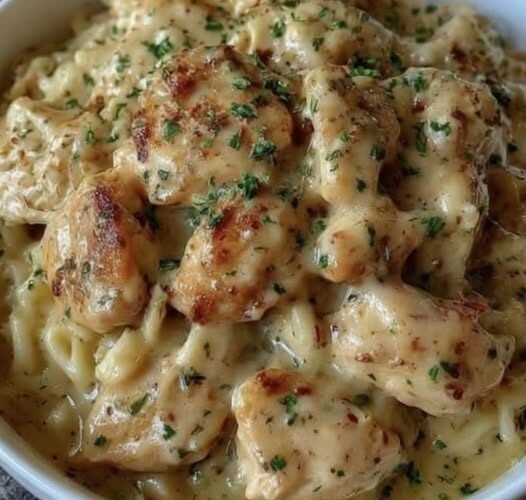
Angel Chicken: Creamy Garlic Sauce, One Skillet, Thirty Minutes to the Table
Some nights you want a project. This is not that night. Angel chicken is the meal I make when I want something that tastes like somebody took care of me, and I want it in under half an hour, with one pan to wash and nobody hovering over my shoulder asking how long. My mother made a version of this on Sundays, and it was never angel chicken exactly — she used whatever chicken was in the freezer and she made the sauce with a can of soup rather than cream, which I do not recommend. What she got right was the method: brown the chicken, make a sauce in the same pan, and then let the chicken poach in that sauce until it went completely tender. Everything good about this dish comes from that last step, and everybody skips it. The reason this works is that a cream sauce at a bare simmer is a poaching liquid. It sits at around 185 degrees, which is hot enough to cook chicken gently and move the fat into the sauce without ever getting hot enough to make it tighten and break. You sear for color and flavor, then you cook for texture, and those are two different jobs. The recipe I started from did the first one well and then held the chicken in the sauce for twenty-five minutes, which turns a boneless breast into something you could use as rope. Pull it at 165 degrees and walk away from the clock. I also want to be straight about the sauce, because it is the best part and it is not a light sauce. A cup of heavy cream, four tablespoons of butter, and a packet of Italian dressing mix makes a rich, garlic-forward, faintly herby cream that is closer to a pasta sauce than to a chicken sauce. It is excellent. It is also about 900 calories a serving with pasta, and I would rather tell you that than have you find out at the bottom of a bowl.Why You’ll Love This Angel Chicken
One skillet, start to finish. Sear, sauce, simmer, serve. There is no second pan, no colander full of dishes, and nothing transfers except the pasta. If you boil the pasta in a separate pot while the chicken simmers, everything is ready in about thirty minutes. The sauce is made in the pan. Those browned bits on the bottom of the skillet after you sear the chicken are the entire flavor foundation. You degligate them with the broth and they become the sauce. This is a free upgrade that most versions skip by pouring sauce in from a can. It uses the whole breast without drying it out. Because the cook happens in liquid at a low temperature rather than in a hot dry pan, the breast stays juicy. This is the single best argument for cooking breasts in sauce instead of pan-searing them and calling it done. It is a weeknight recipe that looks like a Sunday one. The sauce is glossy, the chicken is coated, and the parsley goes on at the end. Nobody looks at it and thinks you did anything difficult, and that is the goal. The sauce carries onto leftovers. Day-two angel chicken over fresh pasta is genuinely better than the first night, because the sauce has had time to thicken and the flavors have settled. It is cheap for something this rich. About ten dollars for four servings, and the expensive part is the chicken. Use thighs and it drops to about eight and the result is more forgiving, which I get into below.Why This Creamy Chicken Sauce Works
Four things, and once you understand them you will never again overcook chicken in a cream sauce. First, the sauce temperature is a gentle simmer, roughly 180 to 190 degrees, and that is a specific target. Not a boil, not a rapid bubble. Heavy cream is a fat-in-water emulsion, and it holds together somewhere around 165 to 180. Above that, or if it reduces too far, the fat separates from the water and you get a grainy, oily sauce that tastes curdled and cannot be fixed by stirring. If you see steady bubbles across the surface, turn the heat down. If you see only one bubble every second or two, you are right. Second, the chicken is done long before the timer says so. A chicken breast in185-degree liquid passes through the165-degree window in about four to six minutes. The recipe says simmer for twenty to twenty-five, which assumes you are cooking it from raw with no sear, and even then that is generous. My skillet version sears first, so the breast enters the sauce already partway cooked. Start checking at eight minutes into the simmer and pull it the moment the thickest part reads 165. Third, the butter is browned and that step is not optional. Four tablespoons of butter melted over medium heat until it smells nutty is a browned butter, and it is the reason the sauce tastes like something rather than like dairy. The garlic goes in after and gets about a minute, no longer, because garlic goes from golden to burnt in about fifteen seconds at that heat. Burnt garlic will follow you through the whole dish. Fourth, the dressing mix is a salt-and-acid component, and it is doing the job you would otherwise do with cream of chicken soup. Traditional angel chicken uses a can of condensed soup for body. This version replaces that with cream for body and the Italian mix for the salty, herby, slightly vinegary punch that keeps a cream sauce from tasting flat. That is a genuinely better swap than the original and it is why I use it. And the thing the original recipe leaves out entirely: pasta water is the loosening tool. Before you drain the pasta, scoop out a cup of that cloudy water. Cream sauce thickens as it sits and as it hits hot pasta, and a splash of starchy water loosens it back to the consistency that clings instead of pools at the bottom of the bowl. This is what separates restaurant pasta from homemade pasta and it takes ten seconds.Ingredient Breakdown: What Each One Is Actually Doing
Boneless skinless chicken breasts, 4. About 1.5 pounds raw, which serves 4. Butterflied or cut into two thick cutlets each, they cook faster and more evenly and give you more surface for the sauce. That is my single strongest recommendation in this recipe. Thighs work and are better on a busy night: harder to overcook, more forgiving, and usually cheaper. If you use thighs, cut them into bite-size pieces because a whole thigh takes considerably longer to reach temperature. Heavy cream, 1 cup. The body, the richness, and the entire mouthfeel. Half-and-half works and gives you a lighter, thinner sauce that you will need to reduce longer to get anywhere near the same consistency, so give it five extra minutes and watch it more closely. Do not use milk. Milk will break the moment it hits the browned butter and the pasta water, and there is no rescue. Chicken broth, 1 cup. De-glazes the browned bits and thins the cream to something the pasta can absorb. This is not optional. All-butter is also fine. If you have the pan juices from a roasted chicken in the fridge, that is better than either. Italian dressing mix, 1 packet. Salt, vinegar, garlic powder, oregano, and a little sugar. This is the component that keeps a cream sauce from being boring, and a packet costs about 75 cents. Deconstructed, it is about 40 cents and tastes better: 1/4 cup olive oil, 2 tablespoons red wine vinegar, 1 teaspoon dried oregano, 1 teaspoon garlic powder, 1/2 teaspoon salt, and a pinch of sugar. Whisk it into the broth and cream with everything else. Butter, 4 tablespoons. You sear in it and it goes into the sauce, so you need a full stick’s worth. Brown it, do not just melt it. If you are using it only for searing and then wiping the pan, you lose most of the benefit. Garlic, 4 cloves, minced. Fresh, because this is a stovetop dish that finishes fast and fresh garlic does not have time to burn the way it would in an hour-long bake. Four cloves for four servings is right. Five is better. Ten is a mistake. Dried parsley, 1 teaspoon, plus fresh for garnish. Dried goes into the sauce during the last few minutes of cooking. Fresh goes on at the very end, off the heat, because it turns black and bitter if it cooks. If you have only one or the other, use fresh and add it off the heat. Pasta, 8 ounces cooked. Read this part carefully, because the original recipe says to serve it over a big pile of pasta and that is wrong. This sauce quantity coats about 8 ounces. A big pile is 12 ounces and you will end up with dry pasta under a puddle of sauce. Cook 8 ounces, or double the sauce if you want a bigger pile.
Read this first. Chicken must reach 165°F in the thickest part. The original timing for this recipe — 3 to 4 minutes per side, then 20 to 25 minutes of simmering — will overcook boneless breast badly. Start checking at 8 minutes into the simmer and pull on temperature, not on the clock. A meat thermometer is not optional in this recipe.
Angel Chicken
Skillet Chicken · Creamy Garlic Sauce · No Oven
Ingredients
Instructions
- 1Season the chicken breasts with salt and pepper on both sides.
- 2Melt 4 tablespoons of butter in a large skillet over medium heat, undisturbed, until it foams and smells nutty and brown. About 3 minutes.
- 3Add the minced garlic and cook about 45 seconds, just until fragrant. Pull it off the heat the second it starts to turn gold.
- 4Lay in the chicken. Sear 3 to 4 minutes per side until light golden. They will not be cooked through and that is expected.
- 5Whisk 1 cup chicken broth, 1 cup heavy cream, and the Italian dressing mix together in a bowl until smooth.
- 6Pour the sauce over the chicken. Turn to coat, then bring it to a bare simmer — one or two bubbles per second, not a rolling boil.
- 7Cover and simmer gently, checking the temperature after 8 minutes. Pull the chicken the moment the thickest part reads 165°F. It will usually be ready well before 20 minutes.
- 8Move the chicken to a plate. Stir the dried parsley into the sauce and taste it. If it is too tight, loosen with a splash of broth or pasta water; if too loose, simmer it2 more minutes off the heat.
- 9Cook8 oz pasta. Scoop out 1 cup of the pasta water before draining.
- 10Toss the pasta into the skillet with the sauce and a splash of pasta water, slice the chicken over the top, and finish with fresh parsley.
Kitchen Notes & Cost Breakdown
- Estimated cost: about $10.00 total, or $2.50 per serving across 4 servings. Chicken about $5.50, cream $1.60, dressing mix $0.75, butter $0.65, pasta $1.20, garlic and parsley $0.30. Using thighs instead of breasts drops it to about $8.00 total.
- Pull the chicken at 165°F, not at20 minutes. Start checking at 8 minutes of simmering. Breast in a cream sauce goes dry fast and the difference between pulled at 165 and pulled at 200 is the whole quality of the dish.
- Keep the sauce at a bare simmer. Heavy cream breaks above roughly 180°F and also breaks if it reduces too far. One or two bubbles per second. If you see steady bubbling, drop the heat.
- Save the pasta water. A cup scooped before draining loosens the sauce to cling rather than pool. This is the single most common gap between homemade and restaurant pasta.
- There is enough sauce for 8 oz of pasta, not a big pile. The original says to serve it over a big pile, which will leave you with dry pasta under a puddle. Double the sauce if you want more pasta.
- Butterflied or cut into cutlets. Thinner chicken cooks faster, more evenly, and gives the sauce more surface. This is the best improvement to this recipe.
- Make your own dressing mix: 1/4 cup olive oil, 2 tbsp red wine vinegar, 1 tsp dried oregano, 1 tsp garlic powder, 1/2 tsp salt, and a pinch of sugar. Cheaper and better.
- Keyword tip: “How long do I cook chicken in cream sauce” is the highest-traffic question here and the answer is always temperature-based, never time-based. Say that in the image caption.
- Keyword tip: A shot of the sauce clinging to the pasta as it is tossed in the pan beats a plated bowl. Shoot the skillet, not the plate.
Nutrition Facts (estimated, per serving)
690Calories
40 gProtein
48 gCarbs
37 gTotal Fat
4 gFiber
900 mgSodium
Estimate for 1 of 4 servings, based on 4 oz chicken breast, 1 cup cooked pasta, and roughly1/2 cup of cream sauce. Half-and-half instead of heavy cream saves about 200 calories and 22 g of fat. Skipping the butter and searing in olive oil saves about 100 calories. Values vary by brand.
Food Safety
- Chicken must reach 165°F in the thickest part of the breast. Check it, do not guess.
- Do not rinse raw chicken. Wash hands, boards, and utensils with hot soapy water after handling it.
- Refrigerate leftovers within 2 hours, use within 3 to 4 days, and reheat until steaming hot. Cream sauces spoil faster than a tomato sauce.
- If the sauce breaks, it is not a safety problem. Remove it from the heat and whisk in a tablespoon of cold heavy cream off the heat, which will often bring it back together.
This recipe contains dairy and is not keto, gluten-free, low-carb, or low-fat. It is solidly protein-forward at approximately 40 g per serving, and all nutrition figures are estimates. Nothing on this page is medical advice or a weight-loss claim — if you have specific dietary guidance from a clinician, follow that instead of a website.