
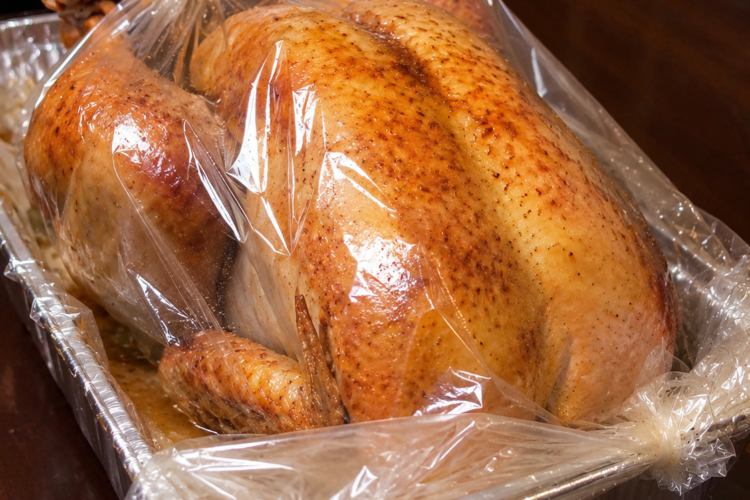
How to Roast Turkey in an Oven Bag: Juicier Meat, Less Cleanup, One Thing to Read First
I started roasting turkey in an oven bag around the third Thanksgiving of cooking for other people, and I have not gone back. My reason is not that the meat is magically better. It is that it is reliably better, and with a dinner this size, reliable is the thing you actually need. A turkey is four hours of oven time and thirty people, and I would rather spend that time doing something else. What the bag does is create a closed, humid environment around the bird. Steam circulates, the juices cannot escape, and you are essentially braising and roasting at the same time. The result is a bird that is still juicy when you carve it, which is the one thing a plain roasted turkey is never reliably. It also means your roasting pan stays almost clean, because the drippings and the rendered fat are sealed inside the bag with the vegetables, and the bag goes in the trash when dinner is over. Before we go any further, there is one safety instruction that most versions of this recipe skip and I am not going to.You must use an oven bag with the manufacturer’s label that says it is oven-safe. Do not use a grocery store produce bag, a Ziploc, or a bag off a roll. Those melt, they can transfer chemicals into the food, and they can flare up at the burner. A box of branded oven bags costs about four dollars at any grocery store and it is the only version of this method I will stand behind. I also want to correct something I see repeated constantly, which is a roast time that will leave you serving raw turkey. A 15-pound unstuffed bird does not take two and a half hours. It takes three and a half to four. I have included the full chart below, and more importantly, I want you to stop cooking by the clock entirely and cook by temperature. That is the whole ballgame on Thanksgiving.Why You’ll Love Roasting Turkey in an Oven Bag
The meat stays juicy. This is the actual reason. In a covered, humid environment the bird cannot lose moisture to dry oven air, which is the single cause of disappointing turkey. People argue endlessly about brines and butter and basting, and none of them matter as much as keeping moisture in. One dish, one bag, almost no cleanup. Everything goes in the bag. The roasting pan comes out nearly clean. There is no separate roasting rack to scrub, no stuck-on drippings burned onto metal, and no pan soaking in the sink. On a day when you are making six other things, this is worth as much as the flavor. The vegetables cook in the drippings. The onion, carrots, and celery go in the bottom of the bag and roast in turkey fat and juice for four hours. They come out caramelized and deeply seasoned, and they are a genuine side dish rather than an afterthought. This is the part of the method that quietly wins you the compliment. Fewer basting interruptions. You open the oven once, maybe twice, to check temperature. You are not basting every30 minutes with a leaky foil tent while trying not to drip on the burner. No spinning the bird, no flipping. The bird roasts on one side. People who have brined a turkey spend half an hour flipping it around, breaking skin and cooling the oven. In a bag you leave it alone for hours. It scales and it is forgiving. Everything works from 12 pounds to 24 pounds with the same method. And because the environment is moist, the difference between pulling at the right moment and pulling15 minutes late is a smaller window of failure than it is with an open-roasted bird.Why the Oven Bag Method Works
Four things are happening in there at once, and knowing them is what lets you troubleshoot when something goes wrong. First, the bag traps steam and the steam is the cooking medium. A conventional roast has dry hot air hitting the surface, and moisture boils off that surface continuously over four hours. Inside the bag, water vapor instead fills the space, so the bird is essentially sitting in a very hot humid oven. Water cannot evaporate efficiently into already-saturated air, which means the surface stays wet and the inside does too. Second, the flour on the inside of the bag is a release agent, not seasoning. This is the step everybody thinks is optional and it is not. An ungreased oven bag will weld itself to the turkey skin and to the pan. One tablespoon of flour shaken around the inside of an empty bag creates a barrier that keeps the plastic from bonding. Do not skip it and do not use more, because loose flour in a hot bag is a grease-fire risk and it will smoke your kitchen. One tablespoon, shaken, is the whole job. Third, the vegetables act as a heat-transfer base and a drippings reservoir. They sit in the rendered fat at the bottom, they shield the pan surface, and they steam as they cook. But note the tradeoff honestly: vegetables sitting in the drippings get flavorful, the drippings get more vegetal, and if you want a clean classic gravy you may want to pull the bag contents early and strain. Nobody tells you that. Fourth, the small slits are mandatory and they are not optional. If you seal a bag with no vent, the steam expands and the bag inflates like a balloon until it pops, dumps raw turkey onto your oven floor, and takes the top of the turkey with it. Four or five slits, a quarter inch long, in the upper flat panel. This is the single most common catastrophic failure in the whole method. And what the bag does not do is crisp the skin. In fact it works slightly against crisp skin, because trapped steam softens the surface. If crisp skin matters to you, I have a fix in the variations below and it costs you fifteen minutes and a single uncovered step. Do not be disappointed by this expectation going in, because it is the one honest downside of the method.Ingredient Breakdown: What Each One Is Actually Doing
Whole turkey, 12 to 24 pounds, fully thawed. Two pounds per person is generous, one and a half is standard, one is plenty. Buy frozen rather than fresh, because a frozen turkey is almost always thawed to the same quality and costs substantially less in November. Never cook a partly frozen bird: the frozen center will not cook through and you cannot tell by looking. One large oven-safe bag, manufacturer-labeled. Buy the ones that come in a box. Large birds need two bags, or one bag in a second bag for extra insurance, because bag failure on a 24 pounder is a disaster you cannot clean up. Butter, two-thirds cup, softened. The rub. Softened is not a detail, room temperature butter spreads and adheres; melted butter runs off the bird into the bag and does nothing. Mix in the garlic and salt, and it becomes a proper herbed butter under the skin or all over it. Salt and pepper. Season the bird inside and out. The bag traps moisture, which means seasoning penetrates better, but it also means you should be a little restrained because the pan juices concentrate. Season the cavity generously and the surface lightly. Dried herbs, 2 tablespoons. Thyme, rosemary, and sage, which is the correct trio and the reason this reads as a holiday rather than a Tuesday. Use dried, not fresh, because four hours at 350 will turn fresh herbs black and bitter. Garlic, 4 cloves, minced. Four hours is enough for garlic to go from pleasant to acrid, so do not increase it. One whole head of roasted garlic alongside the bird is the safe version if you want more. White onion, 3 celery stalks, 2 carrots, roughly chopped. The aromatics under the bird. Roughly chopped, not diced, because diced vegetables disintegrate over four hours and you want pieces that hold their shape and can still be identified on the plate. Two carrots and three stalks for a 16-pound bird is right; scale up for larger. Flour, 1 tablespoon. Only for the inside of the bag. This is the anti-stick step. Do not put flour in with the food.
Read this before anything else. Use only an oven bag with the manufacturer’s label stating it is oven-safe, the kind sold in a box at the grocery store. Never use a produce bag, a Ziploc, or a bag off a roll. Those can melt, release chemicals into the food, and flare at the oven burner. If your bag is unbranded, buy a box. They are about four dollars.
Turkey in an Oven Bag
Roast Turkey in an Oven Bag · One Dish · Unstuffed
Ingredients
Instructions
- 1Preheat the oven to 350°F and position the rack one level below center.
- 2Take the turkey out of the packaging, remove the neck and giblets from the cavity, and set them aside for gravy. Pat the bird dry. Do not rinse it.
- 3Mix 2/3 cup softened butter with the minced garlic, dried herbs, and a generous pinch of salt and pepper.
- 4Tuck the wing tips back under the bird or tie them with kitchen twine. Season the cavity with salt, then rub the butter mixture all over the outside of the bird.
- 5Put 1 tablespoon of flour in an empty oven bag and shake it around to coat the interior. Put the onion, carrots, and celery in the bottom of the bag, then set the turkey on top.
- 6Seal the bag at the top. Cut 4 or 5 slits, about 1/4 inch long, in the upper flat panel. This is required — an unvented bag bursts. Set the bag in your roasting pan.
- 7Roast according to the chart below, but check the temperature every 20 minutes after the halfway mark. Stop cooking when the thickest part of the thigh reads 165°F.
- 8Pull the turkey out at 160-162°F in the breast if you want the best texture — the carryover cooking will bring it up to safe temperature while it rests.
- 9Carefully cut the bag open away from your face, lift the turkey onto a platter, and discard the bag.
- 10Rest 20 to 30 minutes before carving. Do not skip this. Resting is what redistributes the juice.
Roasting Chart (unstuffed,350°F)
| Turkey weight | Approximate roast time |
|---|---|
| 8-12 lb | 2-1/2 to 3 hours |
| 12-14 lb | 3 to 3-1/2 hours |
| 14-16 lb | 3-1/2 to 4 hours |
| 16-18 lb | 4 to 4-1/2 hours |
| 18-20 lb | 4-1/2 to 5 hours |
| 20-24 lb | 5 to 5-1/2 hours |
These times are a guide for an unstuffed bird only. Cooking by temperature is the only method that works. Check the thigh at 2 hours regardless of the chart and stop when the thermometer says so.
Kitchen Notes & Cost Breakdown
- Estimated cost: about $53 total for a 16 lb frozen turkey, or $4.40 per serving across 12 servings. Turkey about $42 in November, butter and aromatics about $8. Buy frozen — a frozen turkey thawed at home costs about half of a fresh one at holiday prices.
- The bag must be labeled oven-safe. Never a produce bag, a Ziploc, or a bag off a roll. Non-oven-safe plastic can melt, leach chemicals, and flare at the burner.
- Cut the slits. Always. Four or five quarter-inch slits in the upper flat panel. A sealed bag inflates and bursts, which dumps raw turkey and liquid across your oven floor.
- One tablespoon of flour in the bag, and only in the bag. It is a release agent so the plastic does not bond to the skin. More than a tablespoon is a smoke and grease-fire risk.
- Flour the bag while it is empty and dry, before the vegetables go in. Once there is moisture in there the flour will clump and stop working.
- Temperature, not time, decides doneness. 165°F in the thickest thigh and innermost thigh and wing, per USDA. Pull the breast at 160-162°F and let carryover finish it.
- Use two bags for anything over 18 lb. Bag failure on a large bird is not cleanable.
- The bag softens skin. If crisp skin matters, roast in the bag for the first 3 hours, then open the bag and finish uncovered at 425°F for 15-20 minutes.
Food Safety — Do Not Skip Any Of This
- Oven bags: manufacturer-labeled, oven-safe only. Never substitute unbranded plastic.
- Fully thaw the turkey. In the fridge, allow 1 day per 5 lb. In cold water, 30 minutes per lb, changed every 30 minutes. Never thaw on the counter and never cook from frozen.
- Do not rinse the bird. You will spread bacteria across the skin and the cavity rather than removing it.
- Cook to 165°F minimum in the thickest part of the breast, the innermost part of the thigh, and the innermost part of the wing. Check all three. The thigh and the wing are last.
- Carryover cooking is real. Pulling the breast at 160-162°F is standard professional practice; the residual heat finishes the cook during the rest. Verify with a thermometer before carving.
- Check the bag mid-roast. If you see the plastic stuck to the skin or the bag has leaked, open it carefully and finish the bird uncovered.
- Leftovers: refrigerate within 2 hours, use within 3 to 4 days, and reheat to 165°F. Refrigerate the pan juices separately and use them within 3 days.
Nutrition Facts (estimated, per serving)
400Calories
35 gProtein
12 gTotal Fat
20 gCarbs
900 mgSodium
4 gFiber
Estimate for a serving of roughly 4 oz turkey meat with a small portion of pan gravy and vegetables. Stuffing, mashed potatoes, pie, and drinks are counted separately. Turkey skin is the single largest fat contributor, so removing it drops a serving by about 8 g of fat. Values vary by bird and by how you season it.
Contains turkey (poultry). All nutrition figures are estimates. Nothing on this page is medical or food-safety advice from a qualified professional — for the official USDA guidance on cooking and handling poultry, go to fsis.usda.gov and follow it exactly. This recipe is not low-sodium; do not use it if you have been given specific dietary guidance by a clinician.