
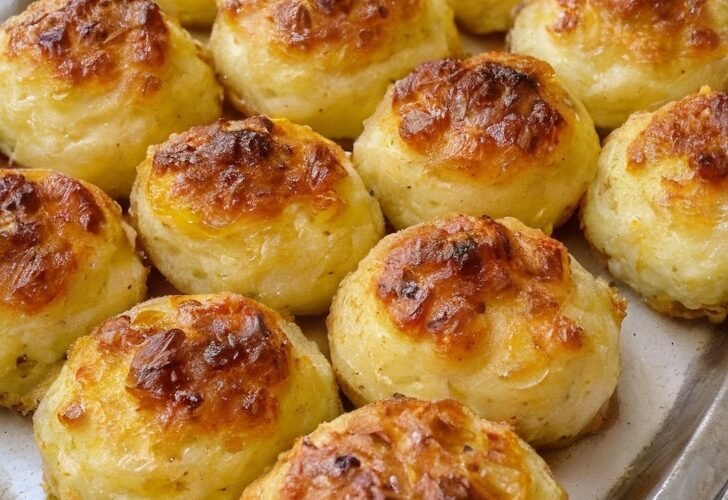
Party Potato Puffs: 4 Ingredients, 10 Cents Each, and the Best Thing to Do With Leftover Mashed Potatoes
Every Thanksgiving I end up with a bowl of mashed potatoes nobody finished, and for years I would put it in the fridge and then throw it away three days later. That was about a dollar and a half of potatoes and a full container of landfill, and I felt faintly guilty about it every single time. Party potato puffs are what I do instead now, and they have completely solved my leftover problem. They are also, and I cannot stress this enough, the cheapest thing on this entire website. About ten cents a puff. I made a batch for a party last month and I laid the tray out on a platter and the plate was empty in eleven minutes, and my friend asked me where I bought them. She did not believe ten cents when I told her. It is two eggs, a cup of grated cheese, some potatoes I already had, and a green onion. That is the recipe. The reason they work when most leftover-potato recipes do not is a piece of food science I did not appreciate until it explained a lot of failures for me. Potato starch, once you cook it and then cool it, partially recrystallizes into a form that is stiffer and more resistant. That is why cold mashed potatoes will hold a shape on a spoon and warm ones will not, and it is the single reason this recipe insists on cold, firm, day-old mash rather than whatever is still warm in the pot. What you end up with is a bite-size thing with a browned, slightly crisp shell and a soft, almost custardy center, which is a texture you cannot get any other way and which costs nothing. My aunt had a version of this on an index card from the 1960s that went to every potluck in the church basement, and the card had a grease stain in the corner, and the whole thing still works exactly as written. I have only added salt and a specific way to check the potatoes, which is the only step that can actually go wrong.Why You’ll Love These Party Potato Puffs
Ten cents a puff. Twenty-four to thirty of them for under three dollars. There is nothing else on this site at that price and I doubt there is much of anything anywhere at that price. It uses up leftovers instead of creating them. This is a recipe whose primary ingredient you probably threw away last week. That is the whole appeal and it is a real one, not a throwaway line. They are the correct party food. Miniature, handheld, no utensils, no plate, no sitting down. They go on a platter, people pick them up with toothpicks, and they are gone in ten minutes without anybody noticing they left. They are genuinely gluten-free. Potatoes, eggs, cheese, and green onion. Nothing needs substituting and nothing needs omitting. This is a real claim and I checked it rather than hedging it, which is not something I can say for a lot of the recipes on here. Four ingredients and one bowl. Mix, scoop, bake. There is no sauce to make and nothing to prepare in advance. They make a real breakfast. Two puffs with scrambled eggs is a legitimate weekday breakfast. I have done this more than once on purpose. They freeze before baking. Scoop them, freeze them on a sheet pan, bag them, and bake from frozen. This is a genuine make-ahead dish, not a theoretical one.Why This Potato Puff Recipe Works
Four things, and if you get these right nothing else can go wrong. First, the eggs are the binder and the structure. Two eggs per two cups of potato, and that ratio is doing real work. Egg proteins coagulate around 160 degrees and set the whole mixture into something that holds its shape. Too few eggs and the puffs slump and collapse in the pan; too many and you get an eggy, rubbery, bouncy bite with a distinctly frittata character. Two eggs per two cups of potatoes is the ratio, and it is not adjustable in either direction without knowing what you are doing. Second, cold starch is the second half of the structure. This is the part nobody explains. When you cook a potato, its granules absorb water and swell, and if you let the cooked potato cool, a portion of that starch retrogrades into a more crystalline, more rigid structure. It does not go back to being a raw potato, but it does get noticeably firmer and it resists slumping. This is why refrigerated mashed potatoes hold and warm ones drip, and it is why a bowl of mash you made this morning will not work as well as a bowl from three days ago. Third, the cheese does three jobs at once. It adds salt, it adds fat, and it browns. That last one is why the top of these puffs is crisp and the bottom is soft. A cup of shredded cheddar in a400-degree oven produces genuine browning through the Maillard reaction, and that is what turns a pale potato cake into something you want to eat standing up. If you swap in a mild processed cheese you get melt and no browning, which is why the Colby and American suggestion in the original works for flavor but not for texture. Fourth, a mini muffin pan is the format, and it is not cosmetic. A shallow cup means a high surface-to-volume ratio, which means the exterior browns and dries out while the interior is still just setting. On a regular muffin pan, the same mixture produces a taller, more breaded, paler object that needs 5 to 7 extra minutes and comes out more like a muffin than a party bite. The size of the pan is the difference between a snack and a pastry. And the one that is not obvious: salt is not optional. Two cups of mashed potatoes made with unsalted water plus one cup of cheddar is under-seasoned on its own, because cheese carries salt but not enough of it to season a full dish. Half a teaspoon of salt, and taste it before it goes in the pan.Ingredient Breakdown: What Each One Is Doing
Cold leftover mashed potatoes, 2 cups, firm. About three days old is the sweet spot. This is the only ingredient that can ruin the recipe and it is the one nobody manages correctly, so here is the actual test: drop a spoonful onto a plate and leave it for30 seconds. If it holds a mound and barely slumps, you are fine. If it spreads into a puddle or you can pour it, you have too much liquid in there and you need to fix it before you start. See the Substitutions section for how, but the short version is add a third egg and 2 tablespoons of the cheese, and if it is still loose, 2 tablespoons of dry breadcrumbs. Do not add more milk. That is how you got here. Eggs, 2 large. The binder and the set. Room temperature is easier but not important in a baked application. Do not use extra-large, which adds liquid and leans the mixture toward custardy. Shredded cheddar, 1 cup. Medium or sharp. Sharp is better because this is a bland potato base and it needs the flavor. Grate it yourself from a block: pre-shredded contains anti-caking powder and it will not brown properly, which is the single thing you want from this recipe. Colby or American works if you want a milder, more 1960s result, but expect less browning. Green onion, 1/4 cup, finely chopped. The whites go in for flavor; the green tops go on after baking for color, because 20 minutes in a 400-degree oven turns raw green dull and olive. This is a small improvement that makes them look photographed rather than assembled. Salt, 1/2 teaspoon. Not in the original recipe, and it should be. If your mashed potatoes were already salted, use 1/4 teaspoon and taste. Black pepper. A few grinds, optional but good. Paprika on top after baking is a free visual upgrade.
Check your mashed potatoes first. Drop a spoonful on a plate and wait 30 seconds. If it holds a mound with barely any slumping, bake. If it spreads or you can pour it, add a third egg and 2 tablespoons more cheese before mixing the rest, and add 2 tablespoons dry breadcrumbs if it still will not hold. Too-wet potatoes will not save themselves in the oven.
Party Potato Puffs
4 Ingredients · Mini Muffin Pan · Gluten Free
Ingredients
Instructions
- 1Test the mashed potatoes: drop a spoonful on a plate, wait 30 seconds, and confirm it holds a mound. If it spreads, add a third egg and 2 tablespoons of cheese now, and 2 tablespoons dry breadcrumbs if still loose.
- 2Preheat the oven to 400°F and grease a 24-count mini muffin pan thoroughly.
- 3Break up the cold potatoes in a bowl with a fork so there are no large lumps. Do not mash them further or puree them.
- 4Stir in the beaten eggs until fully incorporated and the mixture looks smooth and thick.
- 5Fold in the shredded cheddar, the white parts of the green onion, the salt, and the pepper until evenly distributed.
- 6Scoop into the prepared cups, filling each almost to the top. Smooth the top and mound the very center slightly so they puff up properly.
- 7Bake on the middle rack 18-22 minutes, until set, golden at the edges, and lightly crisp on top. A regular muffin pan needs 5-7 extra minutes.
- 8Cool in the pan 5 minutes, then run a butter knife around the edges and lift them out to a platter.
- 9Scatter the reserved green tops and a little paprika over the top right before serving.
Kitchen Notes & Cost Breakdown
- Estimated cost: about $2.80 total, or $0.10 per puff across 24 puffs. Cheddar $2.00, eggs $0.50, green onion $0.30. The potatoes are free if you had leftovers.
- Test the potatoes before you commit. Mashed potato moisture ranges from 55% to 75% water depending on how much milk and butter went in. This is the only step that can fail.
- Cold and firm, ideally 3 days old. Potato starch retrogrades as it cools, which is what gives these structure. Mash made this morning is noticeably less cooperative.
- Grate your own cheese. Pre-shredded has anti-caking powder and will not brown. Browning on top is the whole texture of this food.
- Green tops go on after baking. Twenty minutes at 400°F turns raw green dull and olive. Add them in the last thirty seconds.
- Mini muffin pan, not regular. Shallow cups give you a browned shell around a soft center. A regular pan makes taller, paler, breadier puffs that need 5-7 extra minutes.
- Fill almost to the top and mound the center. Underfilling gives you a flat, sad little disc. The mound is what becomes the domed top.
- Make ahead: mix, cover, refrigerate up to 24 hours, then scoop and bake. Let it sit out 15 minutes first if it refrigerated overnight, because it stiffens.
- Freeze unbaked: scoop onto a lined sheet pan, freeze until solid, then transfer to a bag. Bake from frozen at 400°F with 5-8 extra minutes.
- Keyword tip: A straight-down shot of the full mini muffin pan right out of the oven is the thumbnail. These are visually repetitive on purpose and that repetition is what makes a platter look abundant.
Nutrition Facts (estimated)
44Cal / Puff
4.2 gCarbs
1.9 gFat
2 gProtein
75 mgSodium
135Cal / 3 Puffs
Estimates based on 24 puffs, assuming about 3 tablespoons of milk and butter per 2 cups of mashed potatoes. Fiber is approximately 0.4 g per puff. Sodium is mostly from the cheddar and varies a lot by brand; reduced-fat cheese lowers it meaningfully. Serving size is realistically 2 to 3 puffs, since nobody eats one.
Food Safety
- Use fully cooked, refrigerated mashed potatoes that are 3 to 4 days old or less.
- These contain raw egg. Keep the mixture chilled until you bake, and wash hands and utensils after handling eggs.
- Bake until fully set in the center. Because the puffs are small, check one: the center should reach 160°F on an instant-read thermometer. A pale, wet middle means more time.
- Do not leave finished puffs at room temperature for more than 2 hours, or 1 hour if the room is above 90°F.
- Refrigerate leftovers covered and use within 3 to 4 days. Reheat at 350°F until hot all the way through.
This recipe contains dairy and egg and is gluten-free as written, using only potatoes, eggs, cheese, and green onion. It is not keto, low-carb, low-sugar, or high-protein. All nutrition figures are estimates. Nothing on this page is medical advice or a weight-loss claim — if you have specific dietary guidance from a clinician, follow that instead of a website.