
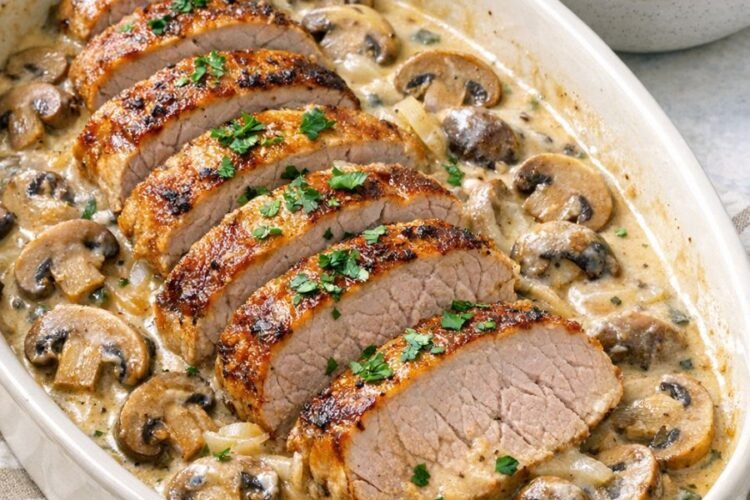
Oven Pork Tenderloin: 4 Ingredients, One Dish, and 43 Grams of Protein Per Serving
There is exactly one thing to watch in this recipe and it is not the sauce, it is not the oven, and it is not the four ingredients. It is the thermometer, in the fifteen minutes after you pull the foil off. Get that wrong and you will serve a technically safe, entirely dry tenderloin, and you will never understand why the version you remember was so good. Here is the whole method. You put a raw pork tenderloin in a glass dish. You whisk together a can of cream of mushroom soup, half a cup of sour cream, and a packet of dry onion soup mix. You pour it over the meat, cover it with foil, and bake it for half an hour. Then you pull the foil, baste it, and bake it again until it hits 145 degrees. Then you let it sit in the sauce and slice it thick. There is nowhere to hide and nowhere to mess up, which is why I have made it about fifteen times and it has worked every single time. The 145-degree figure in most versions of this recipe is correct, and it is also the floor and not the target. Pork tenderloin is the leanest cut of pork you can buy in a supermarket, running about three percent fat, and fat is the entire reason meat stays juicy while it cooks. Take the fat away and juiciness has to come from somewhere else, which means the meat has to be cooked gently and it cannot be cooked far past done. USDA says 145 with a three-minute rest. I pull it at 148 to 150. **Past 155 the muscle proteins contract hard, squeeze out what water is left in there, and you have something that is safe and dry at the same time.** That is the entire lesson. Which is why the thing I changed from the version you sent me is a check-in at the thirty-minute mark, before the uncovered phase even starts, and then every five minutes during it. That source gives you a window of fifteen to twenty-five minutes with no thermometer mention in between, and on a two-pound tenderloin you can go from ideal to overdone inside that window without noticing until you slice it. I also added salt, pepper, and garlic powder to the meat itself. The original has none, and it is not a flaw in the sauce's seasoning, it is a flaw in the architecture: a lean cut sitting under a sauce is still under-seasoned where it counts, because the sauce only touches the outside. Rub it. Thirty seconds. It is the difference between gravy-flavored pork and seasoned pork.Why You’ll Love This Oven Pork Tenderloin
Forty-three grams of protein a serving. That is the number I am proudest of on this page, and it came from weighing it out rather than assuming. Tenderloin is one of the best protein-per-calorie cuts in most American supermarkets, and here it comes with only about 12 grams of fat. Four ingredients and one dish. No searing, no marinade, no browning step, no second pan. Nothing to wash except the bowl and the whisk. Ten minutes of actual work. The other forty-five is oven time, and you can leave the house if you want to, which is not true of most weeknight dinners. About two dollars sixty a serving. For a 43-gram-protein dinner that is the best value on your site, and the reason is that the two expensive-flavor components are shelf-stable concentrates doing the work of an afternoon. It re-heats better than almost anything I have posted. Slice it, put it back in the sauce, add a splash of milk, and it is nearly as good on day three. It feeds four for one dinner, or two for two nights. The leftovers are genuinely a second meal, not an obligation. Nobody needs a fancy weeknight. This is the dinner for the Tuesday when everybody is tired and you would still rather cook than order.
Check the temperature before the uncovered phase starts, and every 5 minutes during it. The covered30 minutes will usually leave the tenderloin somewhere around 135 to 140°F. The uncovered phase needs to finish the job, and that can take 8 minutes or 20 minutes depending on how big your tenderloins are and how much sauce you poured over. Pull the foil off, baste, then check at 5 minutes, 10 minutes, and then every 5 until you hit 148 to 150°F. Do not go past 155°F. 145°F is the safe floor, not the target.
Also: glass dish safety. Use an oven-rated glass dish, never put a cold dish into a preheated oven, and when it comes out set it on a dry towel or a wooden board — not on a cold, wet countertop. A hot glass dish meeting a wet surface can shatter. Wear dry oven mitts and expect the foil to be extremely hot, because trapped steam is doing the cooking.
Oven Pork Tenderloin
4 Ingredients · One Dish · 43 g Protein
Ingredients
Instructions
- 1Take the pork out of the fridge and let it sit at room temperature for 20 minutes. Cold meat goes into a hot oven unevenly, and you lose the outer few minutes to the preheat.
- 2Preheat the oven to 375°F. If the glass dish is straight from the fridge, let it come to room temperature first. Do not put cold glass into a hot oven.
- 3Rub the tenderloin all over with 1/2 teaspoon salt, 1/2 teaspoon pepper, and the garlic powder. If the onion mix packet is salty, season lightly — you can always add salt to the finished sauce, but you cannot take it off the meat.
- 4Place the pork in the center of the dish. If you have two tenderloins, lay them side by side but not touching, and keep them clear of the sides so the sauce can circulate. Crowding is the reason some of these bake unevenly.
- 5In a separate bowl, whisk the condensed soup, the sour cream, and the onion soup mix until completely smooth and thick. Use a separate bowl and clean utensils, because this way you never touch the raw pork and then the sauce.
- 6Scatter the mushrooms around the pork if you are using them, then pour the sauce evenly over everything. Use a spatula to coat the top and sides of the meat and make sure the sauce reaches the corners of the dish.
- 7Cover tightly with foil, crimping it well around the rim. Put it on the middle rack and bake 30 minutes. The foil is not optional; it traps steam so the meat cooks in a saturated environment instead of dry oven air, which is why this phase is 30 minutes and the next one is only ten.
- 8Put on dry oven mitts. Lift the foil carefully, away from your face, because the escaping steam will scald. Spoon some of the hot sauce over the top of the pork.
- 9Check the temperature now, before you commit to any more time. It will usually be around 135 to 140°F. This is the check-in the original recipe skips and it is the whole point.
- 10Return the dish uncovered and check every 5 minutes until a thermometer in the thickest part reads 148 to 150°F. For a small tenderloin this may be 8 more minutes. For a large one it can be 20. It is done at 145°F if you prefer to eat early, but do not go past 155°F.
- 11Take the dish out and let it sit5 to 10 minutes. Rest it in the sauce, not on a board — the juice that runs out goes back into the gravy instead of onto your cutting board.
- 12Slice into thick medallions, about 3/4 inch, and spoon plenty of the creamy sauce over each serving.
The Only Temperature Guide That Matters
| Internal Temp | What Is Happening | Verdict |
|---|---|---|
| Under 135°F | Still cooking through. Carryover heat will not finish it. | Keep going. |
| 138°F | Rare and still firm in the middle. | Too tight. Tenderloin is too lean to be tender at this point. |
| 145°F | The USDA safe minimum, plus a 3-minute rest. | Acceptable and safe. Slightly firmer than it needs to be. |
| 148–150°F | Carryover finishes the cooking on the way to the table. | This is the target. Juiciest and most tender. |
| 155°F | Muscle proteins have contracted and squeezed out the water. | The ceiling. Safe but dry. |
| 160°F and up | Shrinking noticeably, sauce thickening around it. | You went too far. It is still safe, just not tender. |
Kitchen Notes & Cost Breakdown
- Estimated cost: about $10.45 for 4 servings, or $2.60 a person. Pork tenderloin $7.00, cream of mushroom soup $1.50, sour cream $0.75, onion soup mix $1.00, salt and pepper $0.20. Forty-three grams of protein for two dollars sixty is the best dollar-per-gram-of-protein on this entire site.
- Salt the meat. The sauce goes on top and cannot season the inside of anything. A lean cut under a sauce needs seasoning on the meat, full stop.
- Check at the 30-minute mark. This is the fix. It takes five seconds and it is the difference between a tenderloin and a loaf.
- 148 to 150, not 145. Tenderloin has almost no fat and no second chance. See the table above.
- Full-fat sour cream only. Light and fat-free versions contain added starches that behave badly at oven temperatures, and the sauce will break into grainy bits and thin out. The original recipe's suggestion to use light sour cream to lighten the dish makes it worse, not lighter.
- Sodium is the real issue here, not calories or fat. As written this lands around 600 mg a serving, because condensed soup and onion soup mix are both salt concentrates. See Make It Healthier for the two changes that fix most of it.
- Add the mushrooms. The sauce is called cream of mushroom and contains no mushrooms. Eight ounces of sliced mushrooms, tucked in around the pork, costs about a dollar and makes it taste like its own name.
- Glass dish care. Oven-rated glass only, never cold glass into a hot oven, and set the hot dish on a dry towel or wooden board when it comes out. Thermal shock cracks dishes and it is preventable.
- Not overcrowded. The tenderloins should not touch each other or the sides. Crowding means uneven cooking and sauce that never gets to circulate.
- Rest it in the sauce. Ten minutes. The cutting board version wastes your best juice.
- Keyword tip: the thumbnail is the dish straight out of the oven with the foil peeled back, sauce bubbling, and the sliced medallions fanned over the top with gravy spooned over. Shoot it slightly above and slightly behind so you see both the bubbling sauce and the cut faces of the meat. The cut face is what proves it is not dry, and that is what the person clicking is worried about.
Nutrition Facts (estimated)
425Cal / Serving
43 gProtein
12 gFat
6 gCarbs
~600 mgSodium
8Servings in Dish
Estimates based on 1.75 lb of raw pork tenderloin divided into 4 servings, with full-fat sour cream and a1.5 oz packet of onion soup mix. Two things worth knowing: this is genuinely high protein and genuinely low fat for a pork dinner, at about 12 g of fat per serving. And the sodium is high, around 600 mg, which comes almost entirely from the two shelf-stable concentrates. Using reduced-sodium soup and half the onion mix gets you to roughly 340 mg. Sodium content varies a lot by brand. All figures are estimates, not a lab analysis.
Food Safety
- Pork tenderloin must reach 145°F with a 3-minute rest. This recipe goes past that to 148–150°F for texture, which is safe.
- Put the raw pork in the dish first, then mix the sauce in a separate clean bowl with clean utensils and pour it in. Never touch the raw pork and then go back to the bowl.
- Always use dry oven mitts. The foil-covered dish and the escaping steam at the end of the covered phase are both genuinely hot.
- Cool leftovers within 2 hours, refrigerate covered, and use within 4 days.
- Reheat until steaming hot all the way through, gently. See the reheating section — this dish does not like high heat.
- Do not leave cooked pork at room temperature for more than 2 hours, or 1 hour above 90°F.
Contains dairy and wheat. This recipe is not gluten-free as written, because nearly all dry onion soup mixes contain wheat flour; a gluten-free mix or the homemade version above makes it gluten-free. It is not keto, low-carb, low-sugar, or low-sodium. Itis high in protein by verified measurement. All nutrition figures are estimates. Nothing on this page is medical advice or a weight-loss claim. If you have specific dietary guidance from a clinician, follow that instead of a website.