
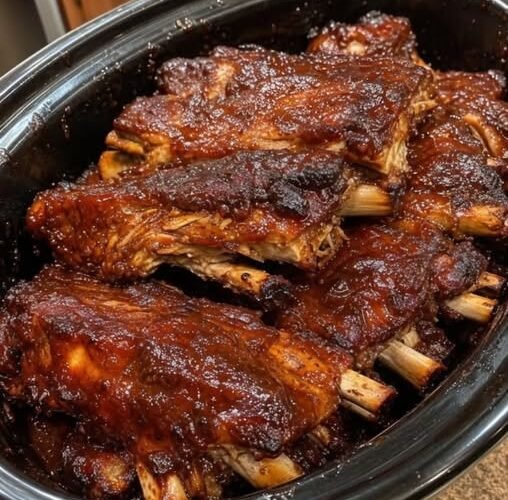
Crockpot Baby Back Ribs: Fall-Off-the-Bone BBQ Without the Grill
These crockpot baby back ribs exist because my dad used to say ribs were "too much work for a weeknight." Then I made them in the slow cooker one random Tuesday, and he called me three days later asking if I still had the recipe written down somewhere. That's the whole story of this dish: it takes the one thing that makes ribs intimidating — babysitting a grill for hours — and throws it out the window. You put them in, you go about your day, and you come home to meat that falls off the bone so easily you barely need a fork and a sauce that's gone thick, glossy, and almost candied where it caramelizes against the side of the pot. What makes me laugh is how special it feels for how little it asks of you. The meat cooks low and slow until the collagen melts and the ribs turn unbelievably tender without a single moment of fussing. The vinegar in the sauce cuts through the richness just enough to keep you going back for more, the brown sugar rounds it into something sticky and deep, and the smoked paprika gives it that faint campfire note so nobody guesses it never touched a grill. It tastes like you spent all afternoon tending a smoker. You spent the afternoon doing literally anything else. I've been making these on repeat since last month, and they've become the meal that makes everyone suddenly appear in the kitchen twenty minutes early, hovering near the crockpot and asking if it's "done yet." My brother-in-law, who usually just eats and leaves, stuck around to scrape the sauce off the bottom of the pot with a piece of bread. And the smell that fills your kitchen after about four hours is absolutely dangerous if you're trying to wait until dinner. That's the whole pitch: it's the kind of meal you make when you want to impress someone without actually trying that hard. The honest notes are simple. As written they aren't low-carb or keto — barbecue sauce and brown sugar see to that — but a sugar-free sauce with the brown sugar dialed back makes a much lower-carb version, so say the word and I'll point you there. They're naturally gluten-free if your barbecue sauce is, so check the label on that one bottle. They're genuinely high in protein at about 30 grams a serving, and pork ribs are a fatty cut by nature, so that richness is part of the deal rather than a flaw. Sodium runs around 900 milligrams a serving, almost all of it from the sauce, so a reduced-sodium bottle drops that a lot. And at about three dollars ninety a serving, it's a splurge next to my ground-beef dinners, but still a fraction of what ribs cost at a restaurant. Pork needs to hit a safe 145°F, with ribs happiest up around 195°F to 203°F for that fall-off-the-bone pull. Let's make them.Why You'll Love These Crockpot Baby Back Ribs
- Fall-off-the-bone tender with almost no effort — the slow cooker does the work.
- Throw everything in before work and come home to dinner that smells incredible.
- A thick, glossy, slightly sweet sauce with a vinegar edge that keeps you reaching back.
- No grill, no smoker, no temperature-watching, no skill required.
- Optional broil gives you sticky, caramelized, bubbling edges in four minutes.
- Genuinely high in protein at about 30 grams a serving.
- Feeds a hungry family or a game-day crowd and makes great leftovers.
- Naturally gluten-free with a gluten-free barbecue sauce — one label check.
Why This Crockpot Baby Back Ribs Recipe Works
Ribs are tough and wonderful in exactly the same way: they're full of connective tissue that's miserable when cooked fast and transcendent when cooked slow. Baby back ribs come from right along the spine and they're meaty, relatively lean for ribs, and loaded with collagen. Over seven or eight hours in a moist, sealed environment, that collagen slowly melts into gelatin, which is precisely what makes the meat slide off the bone. A grill can do this, but it demands attention; a slow cooker does it while you're at work, and the trapped steam keeps everything moist in a way a dry oven won't. The sauce is doing real work too, and it's more than just "barbecue sauce poured on ribs." Bottled barbecue sauce is thick and sweet, and on its own it can taste flat and cloying over a long cook. The apple cider vinegar is the fix — it cuts the sugar, brightens the whole pot, and keeps you wanting another bite instead of feeling overwhelmed. The brown sugar deepens the sauce as it cooks and helps it cling, the garlic powder seasons the meat from both sides, and the smoked paprika does a clever thing: it sneaks in a woodsmoke flavor so the finished ribs taste grilled even though they've never seen a flame. That little pinch is the single most effective trick in the whole recipe. The method is deliberately hands-off, but there's one step that separates tender ribs from tough ones, and it happens before they ever go in the pot. That thin membrane on the back of the rack — the silver skin — doesn't break down the way the meat does. Leave it on and it turns into a rubbery sheet that steams the flavor out and keeps everything tight; pull it off and the seasonings absorb, the meat loosens, and the ribs actually fall apart the way you want. It's a thirty-second job and it's the difference between ribs people rave about and ribs people politely finish. After that, it's pour, cover, and walk away.Ingredient Breakdown
| Ingredient | What it does | Notes |
|---|---|---|
| 3 lb pork baby back ribs | The star — meaty, tender, quick-cooking ribs | Ask for a rack or two. Remove the membrane before cooking. Safe minimum 145°F; aim for 195–203°F for fall-off-the-bone. |
| 1 1/2 cups barbecue sauce | Flavor, sweetness, and that sticky glaze | Use a brand you actually like, since it defines the dish. This is the sodium and sugar driver — reduced-sodium or sugar-free works. |
| 1/4 cup brown sugar | Deepens the sauce and helps it caramelize and cling | Light or dark both work; dark has a touch more molasses depth. Cut it back or skip it for a lower-sugar version. |
| 2 tbsp apple cider vinegar | Balances the sweet sauce and keeps it from tasting cloying | Don't skip it — it's the secret to ribs that don't overwhelm after a few bites. |
| 1 tsp garlic powder | Seasoning for both the rub and the sauce | Also used in the dry rub on the ribs. |
| 1/2 tsp smoked paprika | Fakes a woodsmoke flavor so the ribs taste grilled | Optional in name only — it's the highest-impact half-teaspoon in the recipe. |
| Salt and black pepper | Seasoning the meat | Go moderate; the sauce brings plenty of salt. Season the ribs, not the sauce. |
The one thing to get right: pull the membrane off the back of the rack. It doesn't soften with cooking, and leaving it on is the number one reason slow-cooker ribs come out tough instead of fall-off-the-bone.
Kitchen Equipment You Actually Need
- Slow cooker (crockpot) — a 6-quart is ideal for a 3-pound rack. A smaller one works if you cut the ribs into more sections.
- Paper towel — to grip and peel off the membrane.
- Small bowl and whisk — for mixing the sauce.
- Sharp knife — to cut the rack into sections that fit the pot.
- Rimmed baking sheet — only if you plan to broil the ribs at the end; line it with foil.
- Tongs — for moving hot ribs and turning them on the sheet.
- Basting brush (optional) — for brushing on extra sauce before broiling.
- Instant-read thermometer (optional) — the surest way to check doneness.
Step-by-Step Instructions
- Remove the membrane. Turn the rack meat-side down and peel off the thin membrane from the back if it's still attached. A paper towel helps you grip it.
- Season the ribs. Season both sides generously with salt, pepper, and garlic powder.
- Cut to fit. Cut the ribs into sections that fit comfortably in your crockpot.
- Mix the sauce. In a bowl, whisk together the barbecue sauce, brown sugar, apple cider vinegar, and smoked paprika until smooth.
- Load the pot. Place the rib sections in the crockpot, standing them up along the edges if possible, or layering them flat.
- Pour and coat. Pour the sauce mixture over the ribs, making sure every piece gets coated.
- Cook low and slow. Cover and cook on low 7–8 hours, or on high 4–5 hours, until the meat is fork-tender and pulling away from the bone.
- Optional broil. For a stickier, caramelized finish, transfer the ribs to a foil-lined baking sheet, brush with extra sauce, and broil 3–4 minutes until the edges bubble and darken slightly.
- Rest and serve. Let them rest a few minutes so the sauce thickens up just a bit more, then serve.
Pork doneness and leftovers, stated plainly. Pork must reach a safe minimum internal temperature of 145°F, though ribs only turn truly tender up around 195°F to 203°F as the collagen melts — that's a texture target, not a safety one. Cook only on low or high as directed, never on "warm." Cool leftovers within two hours and refrigerate promptly; eat them within 3 to 4 days, and reheat until steaming hot.
Expert Tips
Remove the membrane — every time. If you skip it, the ribs stay tough and the flavor can't get in. Grip it with a paper towel and peel it in one slow pull.
Season the ribs, not the sauce. The dry rub of salt, pepper, and garlic powder goes on the meat before it ever hits the sauce. Adding more salt to the sauce just makes it salty.
Stand the ribs up when you can. Propping the sections along the edges of the pot lets them cook more evenly and keeps the lower pieces from stewing in the sauce.
Don't add water. The slow cooker traps everything the ribs and sauce release. Extra liquid just dilutes that thick, glossy sauce you're after.
Give it the full time on low. Low and slow is what melts the collagen. The high setting works when you're short on time, but low is what gives you the fall-off-the-bone texture.
Skim or thicken the sauce if you like. If the sauce is thinner than you want, spoon some into a small pan and simmer it down, or stir in a little cornstarch slurry.
Broil for restaurant edges. That quick pass under the broiler with a brush of extra sauce is what gives you the sticky, caramelized, bubbly edges that make people think you grilled.
Don't overcook into mush. Beyond about 9 hours on low, tender tips toward falling completely apart. Check around 7 hours and pull when it's pull-apart tender but still holding shape.
Rest before serving. A few minutes off the heat lets the juices redistribute and the sauce tighten up on the meat instead of running off.
Common Mistakes
Leaving the membrane on. The most common reason ribs turn out chewy. That silver skin never softens — peel it off before seasoning.
Adding water or broth. It's tempting, but the pot already has all the moisture it needs. Extra liquid turns a thick, sticky sauce into a watery one.
Cooking on "warm" or undercooking. "Warm" is a holding setting, not a cooking one. Use low or high as directed and cook long enough that the meat pulls from the bone.
Overcooking. At the other extreme, leaving them in too long makes the meat fall to shreds with no bite. Check at 7 hours on low.
Using a bland or overly sweet sauce. The sauce is the whole flavor of the dish. Pick one you'd happily eat off a spoon, and let the vinegar balance it.
Forgetting the vinegar. Without that acid, sweet barbecue sauce gets cloying fast over a long cook. That two tablespoons is not optional.
Skimping on the smoked paprika. It's labeled optional, but it's what makes crockpot ribs taste grilled. Leave it in.
Not broiling when you have the option. Straight from the pot they're tender and good; a four-minute broil makes them glossy, caramelized, and genuinely impressive.
Not resting. Cutting in immediately means sauce sliding off the meat and juice on the plate instead of in the bite.
Ingredient Substitutions
| If you don't have… | Use… | Watch out for… |
|---|---|---|
| Baby back ribs | Spare ribs, country-style pork ribs, or beef back ribs | Spare ribs are fattier and meatier — add 1–2 hours. Country-style ribs are boneless-ish and cook faster. Beef ribs need more time. |
| Barbecue sauce | Any favorite bottled sauce, or homemade | Flavor, sugar, and sodium vary widely. A GF sauce makes the dish gluten-free; a reduced-sodium one cuts salt a lot; a sugar-free one cuts carbs. |
| Brown sugar | Honey, maple syrup, or coconut sugar | All sweeten and help caramelize. Honey is sweeter, so use a little less. Skip it entirely for a lower-sugar version. |
| Apple cider vinegar | White vinegar, rice vinegar, or a splash of apple juice | White vinegar is sharper, so use slightly less. Apple juice adds sweetness instead of tang. |
| Smoked paprika | Sweet paprika plus a drop of liquid smoke | A few drops of liquid smoke go a long way — measure carefully. Regular paprika alone won't add smokiness. |
| Garlic powder | Granulated garlic or fresh minced garlic in the sauce | Fresh garlic is brighter but can burn in a dry rub; keep it in the sauce. |
| Salt and pepper rub | A prepared BBQ dry rub | Dry rubs are salty, so skip or reduce added salt. Check the blend for gluten if you're going GF. |
Variations
- Spicy ribs. Add a chopped chipotle in adobo, a spoonful of hot sauce, or a pinch of cayenne to the sauce for a sweet-heat kick.
- Honey garlic. Swap the brown sugar for honey and bump the garlic for a sticky, mellow, finger-licking version.
- Korean-style. Use gochujang, soy sauce, honey, ginger, and a little sesame oil instead of BBQ sauce (use tamari for GF).
- Cola or root beer ribs. Pour in a splash of cola or root beer with less brown sugar — the soda reduces into a dark, glossy glaze.
- Dry-rub only. Skip the sauce entirely, cook with just the rub, and finish under the broiler for a drier, bark-forward style.
- Slow-cooker pulled pork. Same sauce, but use a pork shoulder and shred it for sandwiches after 8–10 hours.
- Rib tips or country ribs. Cheaper cuts that love this method; adjust time based on the cut and check for tenderness.
- Lower-sugar. Use a sugar-free barbecue sauce and cut or omit the brown sugar for a version with far fewer carbs.
Make It Healthier
Let me be honest with you first: pork ribs are a fatty cut, and this recipe's sauce is sweet. If you're looking for a lean weeknight dish, this isn't it, and I won't pretend otherwise. That said, there's plenty of room to lighten the parts that matter most. The single biggest lever is the sauce, which drives almost all the sugar and sodium here — using a reduced-sodium or sugar-free barbecue sauce and cutting the brown sugar to a tablespoon (or leaving it out) slashes both dramatically with barely a dent in flavor, especially since the vinegar and smoked paprika are carrying a lot of the taste. Beyond the sauce, trim large pockets of visible fat from the rack before cooking (some fat is what keeps ribs juicy, so don't strip it bare), and watch your portion — this is rich food, so about three or four rib bones with a big pile of vegetables is a satisfying plate. Skip brushing extra sauce on before broiling if you're cutting sugar, and serve the ribs alongside lighter sides like a vinegar-based slaw, steamed green beans, or a crunchy cucumber salad instead of heavier comfort sides. Pork itself is a good source of protein, so a modest portion of ribs with lots of vegetables on the plate is a perfectly reasonable dinner in a balanced week.Meal Prep
Because the slow cooker does the work unattended, these ribs are almost custom-made for meal prep — you can start them in the morning and have dinner and tomorrow's lunch both handled by the time you're home. Portion the ribs with some of the pan sauce into containers, refrigerate, and you've got an excellent lunch that reheats beautifully; the sauce thickens further overnight and the flavor deepens. If you're feeding a crowd, a 6-quart slow cooker holds about 3 pounds comfortably, so for more than four people, cook two batches back to back or use a second pot rather than crowding one. You can also prep the components ahead so mornings are effortless: mix the sauce the night before and refrigerate it, season the ribs and store them covered, or even cut the rack into sections and have everything ready in the crockpot insert (refrigerated) so the next morning you just drop it in and turn it on. If you're planning to broil for the caramelized finish, do it the night you serve rather than ahead, since that sticky glaze is best fresh. Leftovers shred beautifully into sandwiches, tacos, or a loaded baked potato, so nothing goes to waste.Storage
Store leftover ribs in an airtight container in the refrigerator for 3 to 4 days. Keep some of the sauce with them — it thickens as it chills and reheats into a lovely glaze rather than drying the meat out. Cool them within two hours of cooking and refrigerate promptly, since this is cooked pork and it's perishable. If you made a large batch, portion into a couple of smaller containers so they cool fast and reheat evenly. The meat is even more tender the next day, and the flavor deepens overnight, so leftovers are genuinely a treat rather than an afterthought. You can eat them cold right out of the fridge if you're the type (I am), or reheat gently. Discard anything that's been refrigerated longer than four days or that smells or looks off — the sauce hides a lot, so trust your nose and your calendar here.Freezing
These ribs freeze beautifully and keep for up to 3 months, which makes them a fantastic cook-ahead option for game days, holidays, and busy seasons. Freeze the ribs with a good spoonful of the sauce in each portion so they don't dry out — individually portioned bags or containers mean you can thaw just what you need. Squeeze the air out, label with the date, and freeze flat for quick stacking and faster thawing. To use, thaw overnight in the refrigerator, then reheat gently in a covered skillet or a low oven (about 300°F) until heated through, adding a splash of water if the sauce tightens too much. For the best texture, finish thawed ribs under the broiler for a couple of minutes to re-crisp the edges and re-glaze the sauce. The meat stays remarkably tender after freezing; the only real change is that the sauce loosens a bit on thawing, which a quick broil or a brief simmer on the stovetop fixes completely.Reheating and Serving Leftover Ribs
The gentlest way to reheat ribs is in a covered skillet over medium-low heat with a spoonful of water or a little extra sauce to keep them moist, turning once, for about 8 to 10 minutes until steaming hot. A 300°F oven, covered, works the same way for a larger batch. The microwave is fast and fine for a single portion — cover it and heat in short bursts so the meat doesn't toughen — but if you want that fresh-from-the-crockpot feel, a couple of minutes under the broiler after warming brings the sauce back to a sticky, bubbling glaze. Leftover ribs are also a springboard rather than just a reheat. Shred or chop the meat and pile it into sliders or tacos, scatter it over nachos or a baked potato, fold it into a grilled cheese, or stir it into baked beans. The sauce that's left in the container is liquid gold — spoon it over the meat, use it as a dipping sauce, or thin it with a splash of vinegar and toss it with greens. However you serve them, they're the rare dish that's just as good on day three as it was on night one.What to Serve With It
Ribs cry out for classic barbecue sides. Creamy coleslaw is the essential pairing — that cool, tangy crunch is the perfect counterpoint to rich, sweet, sticky pork. Cornbread or a pan of buttermilk biscuits soaks up the sauce beautifully, baked beans add sweetness and bulk, and macaroni and cheese rounds things into full-on comfort-food territory. On the lighter side, corn on the cob, grilled or roasted vegetables, a vinegary cucumber-and-onion salad, or a big pile of steamed green beans keep the plate from tipping too heavy. For a game-day spread, set the ribs out on a platter with pickles, sliced raw onion, extra barbecue sauce, and a stack of soft rolls or slider buns so people can build their own. Potato salad, deviled eggs, and a bowl of watermelon are all welcome company in summer. And if you're eating these on a random Tuesday like I did, don't overthink the sides — a bag of slaw from the store and some cornbread from a mix is a perfectly respectable way to make a weeknight feel like a cookout.Beverage Pairings
Sweet tea is the classic Southern answer and it's hard to beat — the sugar plays off the sauce and the caffeine keeps you going through a second helping. Homemade lemonade is a bright, refreshing match for sticky ribs, and a cold root beer or cola is the nostalgic soda choice that feels like a backyard cookout. For beer, the sweetness and smoke here beg for something with a little bitterness and carbonation to cut through: a crisp lager, a pale ale, an amber ale, or a smoky porter all work well, and a Mexican-style lager with a squeeze of lime is about as easy-drinking as it gets. If you'd rather have wine, keep it fruity and low-tannin — a Zinfandel, a Syrah, or a jammy red blend stands up to barbecue sauce beautifully, and a slightly off-dry rosé or a hard cider is a stellar, often-overlooked match for sweet-and-smoky pork. What to avoid: delicate, oaky whites and big, tannic Cabernet, both of which the sweet sauce flattens and makes taste bitter. On the nonalcoholic side, sweet tea, lemonade, ginger ale, or sparkling water with lime all keep the cookout mood going without any fuss.Frequently Asked Questions
How do I remove the membrane from baby back ribs?
Flip the rack meat-side down. The membrane is the thin, shiny, slightly translucent sheet covering the bones. Work a knife or your fingers under one edge to lift it, grab it with a paper towel for grip, and pull it off in one slow, steady motion. If it tears, just get under it again and keep going. It's a thirty-second job and it makes a real difference in tenderness.Can I put frozen ribs in the crockpot?
It's safest to thaw them first. Frozen ribs cook unevenly in a slow cooker, can spend too long in the temperature danger zone, and throw off the timing since the frozen meat has to come up to temperature before it starts cooking. Thaw overnight in the refrigerator, then season and cook as written. If you're truly in a pinch, thaw under cold running water first — but don't start from frozen.Should I cook the ribs on low or high, and for how long?
Either works, but low and slow gives the best texture. Cook on low for 7–8 hours, or on high for 4–5 hours, until the meat is fork-tender and pulling away from the bone. Low is the better choice if you're at work all day, since it's far more forgiving and renders the collagen most gently. Never use the "warm" setting to cook — that's for holding food after it's cooked.Why are my slow-cooker ribs tough?
The usual culprits are leaving the membrane on, not cooking them long enough, or cooking on too low a setting for too short a time. Ribs need time for the collagen to break down — if they're chewy, they almost always need more time, not more heat. Give them another hour on low and check for that fork-tender, pulling-away-from-the-bone feel. Also make sure you actually peeled off the membrane before cooking.Are crockpot baby back ribs gluten-free?
The ribs, brown sugar, apple cider vinegar, garlic powder, smoked paprika, salt, and pepper are all naturally gluten-free, so the dish is gluten-free if your barbecue sauce is. Barbecue sauces sometimes contain soy sauce, wheat-based thickeners, or barley malt, so read the label — many major brands are GF, but it varies by flavor. Use a certified gluten-free sauce and you're good to go.Do I have to broil the ribs at the end?
No — straight from the crockpot, they're tender, saucy, and delicious, and that's how I make them on a regular weeknight. Broiling for 3–4 minutes on a foil-lined sheet with a brush of extra sauce is purely for the sticky, caramelized, bubbly edges, and it's worth it when you're feeding a crowd or want them to look like they came off a grill. The meat is already cooked, so you're just finishing the surface.Can I use spare ribs or country-style ribs instead?
Yes, with adjustjustments [should read: adjustments] to time. Spare ribs are fattier and meatier, so plan for an extra 1–2 hours on low. Country-style pork ribs are partly boneless and cook faster, so start checking around 5–6 hours on low. Beef back ribs need considerably longer. Always go by tenderness rather than the clock — the meat should pull away from the bone and be fork-tender.Can I make these ahead or freeze them?
Absolutely on both. They store in the fridge for 3–4 days and reheat beautifully, and they freeze for up to 3 months if you include some sauce in each portion. Thaw overnight in the fridge, then reheat covered on the stovetop or in a low oven, and finish under the broiler for the best texture. You can also mix the sauce and season the ribs the night before so the morning is as simple as loading the pot and walking away.Nutrition Facts (Estimated)
| Per serving (1/4 of recipe) | Amount |
|---|---|
| Calories | ~600 |
| Total Fat | ~30 g |
| Saturated Fat | ~10 g |
| Carbohydrates | ~38 g |
| Fiber | ~1 g |
| Sugars | ~33 g |
| Protein | ~30 g |
| Sodium | ~900 mg |
Final Thoughts
Crockpot baby back ribs are the recipe that finally made my dad admit ribs can belong on a weeknight. You peel the membrane, season the meat, pour over a sweet-savory sauce with just enough vinegar to keep it interesting, and then you walk away for seven hours and let the slow cooker turn a tough, bony rack into something impossibly tender and glossy. No grill, no smoker, no babysitting, no skill — just a little patience and a kitchen that smells like a cookout by mid-afternoon. To answer the question I always get: I'm broiling them. There's nothing wrong with eating them straight out of the pot, and on a busy Tuesday that's exactly what happens, but four minutes under the broiler with a brush of extra sauce transforms the edges into that sticky, caramelized, faintly charred glaze that makes everyone think you did more than dump and go. So the honest answer is do both — eat a couple out of the pot while you're standing at the counter, then broil the rest and take the credit. Make them once as written, then make them yours: spicy, honey garlic, or lower-sugar. Save this one for the next time you need to impress someone without actually trying that hard, and don't be surprised when a brother-in-law you've never seen linger starts scraping the pot with a piece of bread.Crockpot Baby Back Ribs
Fall-off-the-bone BBQ pork ribs made low and slow in the slow cooker — no grill, no fussIngredients
Directions
- Remove the thin membrane from the back of the ribs if it's still attached.
- Season both sides of the ribs generously with salt, pepper, and garlic powder.
- Cut the ribs into sections that fit comfortably in your crockpot.
- In a bowl, whisk together the barbecue sauce, brown sugar, apple cider vinegar, and smoked paprika until smooth.
- Place the rib sections in the crockpot, standing them up along the edges if possible, or layering them flat.
- Pour the sauce mixture over the ribs, making sure every piece gets coated.
- Cover and cook on low 7–8 hours, or on high 4–5 hours, until the meat is fork-tender and pulling away from the bone.
- For a stickier, caramelized finish, transfer the ribs to a foil-lined baking sheet, brush with extra sauce, and broil 3–4 minutes until the edges bubble and darken slightly.
- Let them rest a few minutes before serving so the sauce thickens up a bit more.
Cost: about $15.50 per batch — roughly $3.90 per serving (4 servings).
Keyword tips: targets "crockpot baby back ribs," "slow cooker baby back ribs," and "fall off the bone crockpot ribs." Emphasize no-grill, set-and-forget, and game-day in the intro.
Don't skip the membrane: peeling the silver skin off the back is the single biggest factor in fall-off-the-bone tenderness.
Safety: pork's safe minimum is 145°F; ribs are most tender at 195–203°F. Cook only on low or high, never "warm." Refrigerate leftovers within 2 hours; use in 3–4 days.
Gluten-free: naturally GF only with a gluten-free barbecue sauce — check the bottle. Use a reduced-sodium or sugar-free sauce to cut salt or carbs.
Nutrition (estimated per serving)
600Calories
30 gProtein
30 gFat
38 gCarbs
33 gSugar
900 mgSodium
Estimates only — not medical or dietary advice. Based on 4 servings; sodium and sugar come mostly from the barbecue sauce (much of it stays in the pot). Reduced-sodium or sugar-free sauce lowers both. GF only with a GF barbecue sauce.