
5-Ingredient Chicken Casserole: Creamy, Cheap, and Done in One Dish
I made this 5-ingredient chicken casserole on a Wednesday in the middle of a week that had already taken more out of me than it gave back. It was roughly quarter past five, the good light was already gone, and I had exactly one functioning brain cell left to spend. So I diced two pounds of chicken breast, dumped it in the glass dish, and combined three things from the pantry. It went in the oven at 375 and my youngest came to the table about forty minutes later asking if there was more, which is the only review I have ever trusted.
I want to be honest about why this one works, because it is not clever. There is no searing, no brining, no technique that would show up on a cooking show. Raw diced chicken goes into the dish, a wet sauce goes over the top, cheese goes on that, and the oven does the work. The whole reason it turns out tender is that the chicken is cut small and it spends forty minutes sitting in liquid rather than being seared first and then left to finish dry in the oven like so many chicken bakes.
That is also why it is the dish I make when I have nothing left. Five ingredients, one pan, and roughly seven dollars and change of groceries feeding six people. My mother made a version of this with cream of mushroom soup and called it nothing special, and she was right, and it was the best thing at the table every single time it came out of her oven in that dish with the little blue flower on it.
I have made it four times in the last month. Twice I added vegetables so it was a whole meal, twice I did not, and both times it disappeared. My husband eats it cold the next day over rice, which I do not recommend but will not stop mentioning, because watching a man eat leftover casserole standing at the counter is one of the great unsung pleasures of being married.
Why You'll Love This 5-Ingredient Chicken Casserole
Five ingredients is not a marketing trick here, it is the actual shopping list. Two pounds of chicken breast, a can of cream of chicken soup, a cup of sour cream, a packet of dry onion soup mix, and a cup of cheddar. Three of those live in the same aisle of the same store, and the whole thing costs about seven dollars and forty-four cents for six servings.
One dish. That matters more than the ingredient count. There is a glass casserole dish, a bowl you stir in, and a spoon you wipe. No saute pan to wash while the chicken cooks, no colander, no second baking sheet. I am not a tidiest cook in the world but I am a cook who will abandon a recipe that creates more than three things to clean, and this one does not.
Forty grams of protein per serving. That is the number I care about, and it is not a small one. Two pounds of chicken breast in a single dish divided six ways does the work, and it means this is legitimately a protein-forward dinner rather than a side dish pretending to be a meal. It is also the reason this is the casserole I make most often when I am trying to eat well without it feeling like a project.
It feeds six for about a dollar forty-one a head, and it reheats without turning into anything unpleasant. Those two facts together are why this is in my rotation as a standing weekly dinner rather than a thing I make when I am trying to impress somebody.
Why This Recipe Works (And What It Honestly Is Not)
Start with the dicing, because that is doing more work than anything else in the recipe. Chicken breast cut into bite-size pieces cooks faster and more evenly than a whole breast, and in a dish like this where the chicken is essentially poached in a hot, fatty, cheesy liquid, smaller pieces mean the center catches up to the edges. A two-inch cube takes about forty minutes. A whole breast in the same dish will be overcooked at the outside and raw at the center in that same window. Dice it and this problem disappears.
Then there is the sauce. Cream of chicken soup, sour cream, and the dry onion soup mix combine into something that is genuinely more than three pantry items. The soup supplies body and salt and a little chicken flavor. The sour cream supplies fat and acidity that keeps it from tasting flat. The onion soup mix supplies a concentration of onion and beef and salt that would take an hour to build from scratch, and it does it in thirty seconds. That combination is what makes this taste like more than five things went into it.
Layered on top, the cheese does a specific job: it forms a lid. It traps steam, browns at the edges, and keeps the top of the dish from drying out under long baking. It also gives you the visual cue that tells you when it is done, which matters more than you would think.
The 165°F internal temperature is the real test, and I mean the center of the largest piece, not the sauce. The sauce will be bubbling and hot long before the chicken is done, which is exactly how people undercook this. If you own a thermometer, use it. If you do not, cut into the biggest piece near the center of the dish and look at it, and do not eat a piece that is still pink.
Now the honest part. This is not a gluten-free recipe, and I cannot make it one. Cream of chicken soup and dry onion soup mix both almost always contain wheat thickeners or flour, and you cannot verify that by reading the front of a can, so a gluten-free claim here would be a guess. It is also not keto. Per serving it lands at roughly 11 grams of carbohydrate, which is low, but the soup and the onion mix contain cornstarch and dextrose in amounts that vary by brand, and 11 grams is not the same thing as being keto. I would rather give you the number and let you decide than put a label on it I cannot stand behind.
What it is honestly: a cheap, high-protein, one-pan weeknight dinner that costs under a dollar fifty a serving and reheats well. That is a good enough thing to be.
Ingredient Breakdown: What Each One Is Doing
Two pounds raw chicken breast, diced. The whole meal and the entire protein budget. Buy it boneless skinless, which is what the recipe assumes in the cost, and trim it if the package looks heavy with loose pieces. Dice it into roughly one-inch chunks, and be honest with yourself about size. Smaller than a golf ball cooks evenly and needs less time; larger than that and you are back to the same dry-edge problem you were trying to avoid.
Cooked, two pounds yields about one and a half pounds of chicken, so six generous servings is right, not stretching it. This is a dish where the sauce and the cheese stretch it, so you will get six full plates rather than six plates with a token piece of chicken.
One 10.5-ounce can of cream of chicken soup. The body of the sauce. It is a thick, salty, slightly grainy emulsion, and it is what makes this work without any real cooking technique. Cost me about a dollar twenty-nine. This is one of those pantry items where the store brand is genuinely indistinguishable in a dish this busy, so buy whichever one is on sale.
One cup sour cream. The richness and the acid. This is the ingredient people leave out when they make it and then wonder why theirs tastes flat. It also stops the cream of chicken soup from tasting like a can, which is the whole problem with a lot of quick chicken bakes. Use full-fat, and do not substitute plain yogurt if you are sensitive to dairy, because it will split in a dish this hot.
One packet dry onion soup mix. The best thing in the dish for the money. It is roughly sixty cents and it contributes a concentrated onion and roasted beef note that makes the whole casserole taste like it simmered. Use less than the full packet if you are feeding people who are sensitive to salt, which is a real consideration in a dish that already has canned soup in it.
One cup shredded cheddar cheese. The lid and the browning. Shred it yourself if you care, but a bag is fine and about a dollar fifteen. Cheddar is the right choice because the flavor holds up against the onion mix. Mozzarella would be milder and sweeter and would need salt you would have to add yourself.
Kitchen Equipment You Need
A 9x13 inch glass casserole dish. Glass rather than metal, because you want to see the sauce bubbling at the edges through the whole forty minutes instead of guessing, and because glass gives you a non-stick surface for a dish with this much butter and cheese in it. Lightly grease it anyway. A metal pan works, but you will need to check the doneness more often because it heats differently.
A medium mixing bowl and a wooden spoon or rubber spatula for combining the sauce.
A large cutting board and a sharp knife for dicing two pounds of chicken. This is the only real prep work and it is what takes the ten minutes.
A spatula for spreading, and a large spoon for serving.
An instant-read thermometer is genuinely worth having for this one, because the sauce looks done long before the chicken is. It is the difference between serving dinner and serving a chicken safety incident.
Step-by-Step Instructions
First, the oven and the dish. Preheat to 375°F and lightly grease a 9x13 inch glass casserole dish with butter or cooking spray.
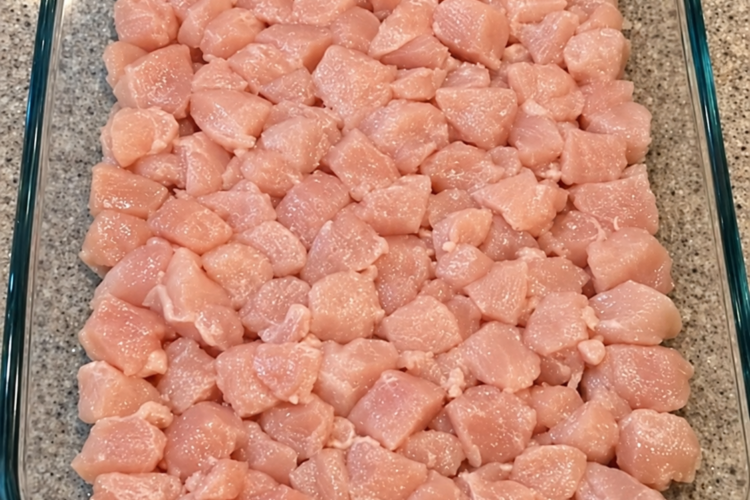
Next, dice the chicken. Trim two pounds of boneless skinless chicken breast, cut it into roughly one-inch bite-size pieces, and add it to the dish. Spread it into an even layer that covers most of the bottom. A thick mound in the center steams and an empty edge burns, so spread it out. It will look like far too much chicken for the dish. It is not.
Now mix the sauce. In a medium bowl, stir together the can of cream of chicken soup, the cup of sour cream, and the packet of dry onion soup mix. Stir for a full minute, scraping the bottom, until there are no dry pockets of powder left and the color is completely even. A dry pocket of mix that did not dissolve will taste salty and bitter in one spot and nowhere else, which is the most common flavor complaint on this recipe.
Pour it over the chicken. Spoon the mixture over the diced chicken and spread it gently with the back of your spoon so every piece is coated and the sauce reaches the corners. Do not stir it in. Layering is the point, because the cheese goes on top and needs a wet surface to sit on.
Add the cheese. Sprinkle the cup of shredded cheddar evenly over the whole surface, right to the edges.
Bake it uncovered at 375°F for 35 to 45 minutes. Start checking at 30, because the difference between tender and dry in this dish is about eight minutes. It is done when the cheese is melted with light golden spots, the sauce is bubbling around the edges, and the thickest pieces of chicken read 165°F in the center. Pull it the second it passes, not after.
Rest and serve. Let it sit five minutes before you touch it. The sauce is very hot and the dish is glass, and the rest also lets the sauce thicken just enough to sit on the rice instead of running off it.
Expert Tips From a Bunch of Overbaked Pans
Dice smaller than feels right. One inch is the ceiling, not the target. Pieces closer to three-quarter inch cook evenly through the sauce without drying, and they give you a much better ratio of chicken to sauce in every bite.
Stir the sauce until it is completely smooth. Ninety seconds with a wooden spoon, scraping the bottom, is not excessive. The dry spots of onion mix powder are the single most common reason this tastes oddly salty in one bite and fine in the next.
Start checking at thirty minutes, not forty. Every oven runs differently and every chicken is a slightly different size. If you bake the full forty-five minutes on autopilot, you will dry it out. This is the mistake I made most often before I started using a thermometer.
Trim the chicken properly. Two pounds of raw chicken breast from the package is not two pounds of meat. Loose bits and fat go in the bin. Trimming properly gets you closer to the six full servings the recipe claims instead of five generous ones and a layer of rendered fat in the dish.
Do not stir the chicken into the sauce. It feels like it should be mixed, and it makes a mess. Layer, and let the oven do it.
Grease the dish even though glass is non-stick. Cheese and butter will find any bare patch and stick to it, and the one thing that ruins this dish is trying to serve a casserole out of a dish where the top layer welded itself in.
Rest it five minutes. Not for flavor. Because the sauce is molten and the dish is hot glass, and because a five-minute rest is the difference between a sauce that sits on your rice and one that runs off it.
Common Mistakes to Avoid
Chunks of chicken too big. This is the number one problem and the reason so many versions of this come out with dry edges. Thirty-five to forty-five minutes is enough for one-inch pieces. Anything larger will still be pink in the middle when the outside is overcooked.
Baking the full forty-five minutes every time. The recipe gives a range, not a target. Start checking at thirty and pull the moment the chicken hits 165°F in the thickest piece. Chicken breast has a very narrow window between perfect and dry, and it is narrower than most casseroles.
Judging doneness by the sauce. The sauce bubbles and looks done while the chicken is still undercooked. Cut into the largest piece near the center of the dish. If it is pink, give it five more minutes. This is the raw chicken safety point and it is the one thing on this page I would not skip.
Undissolved dry onion mix. You get one intensely salty bitter bite and the rest of the dish is fine, which is maddening. Stir the sauce until every trace of powder is gone before it goes over the chicken.
Stirring the chicken into the sauce. It makes the dish harder to assemble and harder to serve, and it does nothing for the cooking. Layer the chicken, pour the sauce, sprinkle the cheese.
Not letting it rest. Cutting into it straight out of the oven means the sauce runs everywhere and the serving spoon breaks the cheese layer. Five minutes.
Skipping the grease on the glass dish. The cheese crust at the edges will stick, and you will end up loosening the whole top layer with a knife and tearing it.
Overcrowding the dish. If your chicken mounds above the sauce level, those pieces are essentially roasting instead of baking and they will dry out. Spread it into one even layer even if that seems like a lot of chicken for the pan.
Ingredient Substitutions
Chicken thighs for breast. Boneless skinless thighs work and they are more forgiving, because the higher fat content means a longer window before they turn dry. Reduce the bake by about five minutes and check early. Thighs will not shred the way breast does, so this is closer to a diced chicken bake than a pulled one.
Cream of mushroom soup. The most common swap and it is a good one, just as creamy and slightly earthier. It is also the version my mother made. Use the same amount, and consider a half teaspoon of dried thyme if you want to lean into it.
Plain Greek yogurt for sour cream. It works and it adds a bit more tang. Use full-fat and add it off the heat if your stove-baked version runs hot, because yogurt can curdle. Do not use it if you are avoiding dairy, and do not use nonfat, which will split.
Less onion soup mix. This is the adjustment I would make for younger kids or anyone watching sodium. Half a packet still gives you the onion flavor. A quarter packet gives you a hint of it. I would also add a quarter teaspoon of garlic powder to replace some of what you lose.
Mexican cheese, Monterey Jack, or a blend. Any melting cheese works. A Mexican four-cheese blend is excellent if you want to lean into the onion soup mix, which has a mild southwestern warmth to it. Smoked gouda is a genuinely good option and nobody expects it.
Fresh onion and beef bouillon. If you want to skip the packet, use one diced small onion plus two cubes of beef bouillon dissolved in the soup. It is more work and it is not a five-ingredient recipe anymore, but it is closer to the from-scratch version of this flavor.
Variations Worth Making
Add vegetables to make it a full meal. Stir in a cup of frozen peas, a cup of chopped broccoli florets, or a cup of sliced mushrooms before the sauce goes on, and add ten minutes to the bake time. Frozen is better than fresh here because it does not release as much water. This is what I do on weeknights when I want one dish instead of two.
Ranch chicken casserole. One packet of ranch seasoning, half a cup of ranch dressing, and shredded cheddar. Skip the onion soup mix. This is a different casserole entirely and I make it roughly as often as this one, which tells you something about my kitchen.
Creamy chicken and rice. Two cups of cooked white rice folded in with the sauce before baking, and add half a cup of chicken broth to keep it from getting too thick. The rice absorbs the sauce and you end up with something closer to a chicken casserole with a built-in starch, which is a real weeknight win.
Buffalo chicken casserole. Swap the onion soup mix for a third of a cup of buffalo sauce and a quarter cup of blue cheese dressing, and use pepper jack. Serve with celery sticks. This one gets made in my house during football season and it disappears faster than the original.
Casserole for two. This is the version I make when it is just me. Use three-quarters of a pound of chicken, a quarter cup of sour cream, half a can of soup, and about a third of the cheese, in a small square dish. Bake 25 to 30 minutes and do not try to halve the time, because the dish depth changes the cooking.
Leftover chicken and vegetable casserole. Cooked rotisserie or leftover roast chicken works, and this is a genuinely good way to use a half bird. Add the vegetables, drop the bake to 25 minutes, and season more aggressively since cooked chicken has less to give.
Make It Healthier, Honestly
There is not much to say here that would be honest, so I will keep it short. This is not a diet recipe and it is not trying to be one.
What is actually true: it is forty grams of protein per serving in a dish that costs about a dollar forty-one, and that combination is hard to argue with. A lot of "healthy" weeknight dinners cost three times as much and deliver half the protein.
The levers, if you want them. Use low-fat cream of chicken soup, which loses maybe 60 calories a serving and changes the richness noticeably. Use reduced-fat cheddar, which saves about 40. Skip the sour cream entirely and replace it with plain Greek yogurt, which is the single biggest fat reduction available. Use a reduced-sodium soup, which matters here more than in most dishes because you have a can of soup and a packet of soup mix both contributing.
On the onion soup mix, this is the one I would genuinely think about. A full packet plus a can of soup is a lot of sodium in one pan, and using half a packet makes a dish that still tastes seasoned. That is the real adjustment, not the cheese.
Add the vegetables. A cup of broccoli or peas adds volume and fiber and makes it a complete plate without changing the method. That is the move that improves this dish on every level at once.
Pair it with something other than a starch if you want to lighten the plate. It is already substantial on its own over rice with a green salad alongside.
Meal Prep Tips
This is a good make-ahead dinner for a different reason than most casseroles, and it is worth knowing before you plan your week.
You can do all the prep a day ahead and keep it raw. Dice the chicken and keep it refrigerated. Combine the sauce in a covered container. When you are ready to cook, pour the sauce over the chicken, add the cheese, and bake. Total active time that night is about four minutes, which is about as close to nothing as a from-scratch dinner gets.
Do not combine the raw chicken and the sauce a full day ahead in the dish, uncovered or covered, in the fridge. It works but it sits in a lot of liquid for a long time, and you are losing some of the flavor you baked in. Keep them separate until you are actually cooking.
The leftovers are the real meal-prep win. This makes six servings, and one serving on Monday is a lunch that needs nothing added to it. Portion into containers, keep them in the back of the fridge, and eat within four days.
One note on reheating, because it is the part people get wrong. See below, but the short version is that the microwave makes this dish worse than almost nothing else will. A hot oven or a skillet gives you a much better second meal.
Storage: How Long It Lasts in the Fridge
Four days refrigerated, covered tightly, and that is a real limit rather than a rounded-up one. It is a dish built on dairy and canned soup, so I do not push past four days.
Store it in the same dish if you have room and the size works, because moving a casserole into smaller containers and back is how you end up with a broken cheese crust. Otherwise use one or two lidded containers and do not stack them, since the cheese layer will stick to whatever is on top of it.
Cover it properly. This dish has enough butter and cheese on top that it will form a skin in the refrigerator within a few hours, and that skin is unpleasant both to look at and to eat.
Take it out of the fridge about twenty minutes before you heat it. A casserole that goes from refrigerator to hot oven takes longer to heat through than you think, and the middle stays lukewarm longer than is comfortable.
Freezing
Yes, and it freezes well for up to three months. This is a useful thing to know in November.
Freeze it after baking, not before. The texture is meaningfully better baked first, because the cheese sets, the sauce thickens around the chicken, and you are freezing a finished dish rather than a raw one that will release water on thaw. It also means you can cool one pan and get two dinners instead of committing a whole pan to the freezer raw.
Cool it completely on a rack first. Then portion into individual servings, because a frozen casserole you have to thaw a whole pan to eat is a casserole that goes in the back of the freezer and stays there.
Wrap each portion in plastic wrap and then foil, or put the wrapped portions in a freezer bag laid flat. Thaw overnight in the refrigerator, never on the counter. A full oven or a hot pan will thaw the outside long before the middle, and this dish goes through a stage where the middle is cool and the edges are boiling.
Reheat from thawed at 350°F until the center is piping hot throughout, which for a refrigerated portion is usually 25 to 30 minutes. Bumping it to 375 for the last five minutes brings the cheese back to life.
Reheating
This is the part of the recipe that needs the most care, because a reheated casserole can go from fine to genuinely bad very quickly.
The oven, and the best option. 350°F, covered with foil, for 25 to 30 minutes, until the center is hot all the way through. Take the foil off for the last five minutes so the cheese re-bloats and browns slightly. It comes back tasting remarkably like the day you made it.
The skillet, for a single portion. A quarter cup of sauce in a skillet over medium heat, then the serving spooned in, and let it heat through, about 6 to 8 minutes. This is the fastest way to get a genuinely good second meal out of it, and it is what I do on the nights I am eating leftovers alone.
The microwave, with a caveat. It works and it is fast, but the cheese goes rubbery and the sauce gets a skin on it. Cover the container loosely with a damp paper towel, heat in two-minute bursts rather than one long one, stir in between, and give it a full minute to sit before you eat. Two minutes at a time, not four, is the difference.
Do not reheat it more than once. Each trip through the microwave dries the chicken further and makes the sauce thinner. If you are reheating leftovers, reheat only what you are about to eat and leave the rest cold in the fridge.
One serving also reheats straight from frozen in a microwave, in about five minutes, if you portioned it that way. Do not try to reheat a whole frozen pan in a microwave. Nobody has ever succeeded at that.
What to Serve With This Chicken Casserole
Rice, and it is the first thing to put down because it is what the sauce is for. White rice, brown rice, whatever you have. Spoon the casserole over it and let the sauce run into the grains, which is the entire point of serving this dish over a starch rather than beside one.
Egg noodles, and this is my husband's preference. Wide egg noodles hold a creamy sauce better than rice does. Boil them a minute less than the box says and let them finish in the dish.
Mashed potatoes, made with butter and milk and nothing clever. Same reasoning, same result. If you want to use instant potatoes, use the good kind, because this sauce will cover a cheap one and you will taste the difference.
A green salad, and the acid in it is genuinely necessary rather than decorative. Plain lettuce with a squeeze of lemon and olive oil is enough. The dish is rich and heavy and a sharp, cold salad is what makes it feel like a meal instead of a problem.
Steamed green beans or roasted broccoli. Straight from a bag with butter and salt is fine and takes four minutes. This is the fastest way to turn a casserole into a plate with two sides.
For bread, a warm dinner roll or a slice of garlic bread. Not both. The dish already has a lot going on and one starch in the sauce and one on the side is plenty.
Beverage Pairings
Cold water with lemon, and I am leading with the obvious because it is genuinely the right answer for a dish this rich.
Cold milk. This is a creamy, cheesy, salty casserole and cold milk is the most natural drink on the table. My kids drink it with this every time, and I have stopped pretending that is a problem.
Sweet tea, and this one is regionally correct. A iced sweet tea or an Arnold Palmer cuts the richness better than almost anything else I have tried, and if you are anywhere in the South this is not a strange suggestion.
A light lager or a pale ale. The carbonation and light body handle a rich baked dish well. Nothing heavy or hoppy, and I would not pour anything red.
Hot coffee is not a dinner drink, but if this is a Sunday and you are having a slice at four in the afternoon, this is a dessert casserole and it takes coffee very well.
One to avoid: a sweet red wine or any dessert wine. The dish already has caramel-level sweetness from the onion soup mix and the cheddar, and a dessert wine on top of that is cloying in a way that is hard to fix.
Frequently Asked Questions
How do I know when 5-ingredient chicken casserole is done? Three signals together, not one. The cheese is melted with light golden spots, the sauce is bubbling around the edges of the dish, and the thickest piece of chicken reads 165°F in the center. Check with a thermometer in the middle of the largest piece, never in the sauce, because the sauce gets hot long before the chicken does.
Why is my chicken casserole dry? Almost always bake time or piece size. Two pounds of chicken breast cut larger than an inch needs more than 45 minutes at 375, and by the time the center is safe the outside is dry. Dice smaller, trim the chicken properly, and start checking at 30 minutes instead of baking the full range on autopilot.
Can I make this with cooked chicken or rotisserie leftovers? Yes, and it is a good way to use a half bird. Reduce the bake to about 25 minutes since there is no raw chicken to cook through, and season more aggressively, because cooked chicken has much less to give. This is also the fastest version if you already have leftover roast chicken sitting in the fridge.
How long should I bake a 5-ingredient chicken casserole? Thirty-five to forty-five minutes at 375°F uncovered, in a 9x13 dish with two pounds of one-inch chicken. The variance is why you check early. With thighs rather than breast, or with added vegetables, add five minutes.
Is this chicken casserole gluten-free? No, and you cannot easily make it so. Cream of chicken soup and dry onion soup mix both commonly contain wheat or flour thickeners, and you generally cannot verify that from the front label. If you need it gluten-free, use a certified gluten-free cream of mushroom soup, omit the onion mix, and add garlic powder and beef bouillon instead.
Can I make it ahead of time? Yes, and this is one of its better features. Dice the chicken and mix the sauce the day before, keep them separate in the refrigerator, then combine and bake when you are ready. Four minutes of work that night. Keep them separate rather than layering them raw a full day ahead.
How many servings does this make? Six. Two pounds of raw chicken breast trims down to roughly a pound and a half cooked, and the sauce and cheese fill out the rest of the dish. If your chicken was not trimmed, expect closer to five full servings, which is worth checking on the package before you start.
How do I reheat this casserole so the chicken does not get rubbery? Use a 350°F oven covered in foil for 25 to 30 minutes, uncovering for the last five so the cheese comes back. The microwave works but makes the cheese rubbery, so heat it in two-minute bursts with a stir in between, not one long cycle.
Nutrition Information
These are estimates, calculated from ingredient weights for the full batch and reported per serving of one-sixth of the dish. I assumed about 907 grams of trimmed raw chicken breast, a full 297-gram can of cream of chicken soup, 227 grams of sour cream, one standard 43-gram packet of dry onion soup mix, and 113 grams of shredded cheddar. Your brands will move these numbers, and the sodium especially depends on which soup and which onion mix you buy.
Per serving: approximately 390 calories, 40 grams of protein, 20 grams of total fat, 11 grams of carbohydrate, about 1 gram of fiber, and approximately 800 milligrams of sodium.
Where the protein comes from: about 34 grams from the chicken and 6 grams from the cheese, soup, and sour cream combined. That is the strongest number in this recipe and the reason I make it as often as I do.
Where the sodium comes from: mostly the cream of chicken soup and the dry onion soup mix, and they are stacking. A can of cream of chicken soup carries roughly 700 milligrams and a packet of onion mix can carry 2,000 or more, though a portion of that stays behind with the dry powder rather than dissolving. If you are trying to bring the number down, halving the onion soup mix is the single move that does the most.
On carbohydrates, per serving is about 11 grams, and I want to be clear that this is not the same as a keto recipe. The cream of chicken soup and the onion soup mix contain cornstarch and dextrose in brand-dependent amounts, and I cannot verify those from a label. It is a low-carbohydrate dinner, not a ketogenic one, and the difference matters if you are counting for a medical reason.
Allergens in the base recipe: milk and dairy, from the sour cream, cheddar, and the canned soup. Wheat and gluten, from the soup thickeners and almost certainly the onion soup mix. Check both labels, because recipes using this pantry combination are rarely labeled for either.
Food safety: this recipe relies on chicken reaching 165°F internally. That is not a suggestion and it is the one step in this post I would not skip, particularly if you are serving anyone pregnant, elderly, very young, or immunocompromised. Let the dish rest five minutes before serving, both for the texture and because molten sauce in hot glass is a real burn risk.
Final Thoughts
The thing I like most about this recipe is that it asks nothing of me. No brining, no searing, no timing that I have to watch. I dice something, I pour something over it, I put cheese on top, and I walk away for forty minutes. On a bad week that is not a compromise. That is the entire point.
It is also forty grams of protein for about a dollar forty-one a person, and I have never figured out how to make that sound less impressive than it is. My mother called this nothing special and fed six people with it on a regular Tuesday. She was right on both counts.
It freezes, it travels, it reheats into a genuinely good second dinner, and it works whether you add vegetables or not. In a world of recipes that ask for a trip to a specialty store and an afternoon of mise en place, five ingredients and one dish is a kind of relief.
So here is the only question I have: do you serve it over rice, or over egg noodles? My husband says noodles, I say rice, and we have been having this argument for long enough that the kids now ask for whichever one they think is going to win. I would genuinely like to know how you do it, because I have apparently been arguing about this at my own table for longer than I realized.
Rice or noodles, in your house?
High Protein, One Dish
5-Ingredient Chicken Casserole
Diced chicken breast baked in cream of chicken soup, sour cream, onion mix, and cheddar
Ingredients
- 2 pounds raw chicken breast, boneless skinless, trimmed and diced
- 1 can cream of chicken soup, 10.5 ounces
- 1 cup sour cream, full fat
- 1 packet dry onion soup mix
- 1 cup shredded cheddar cheese
Step-by-Step Instructions
- Preheat the oven to 375 degrees F and lightly grease a 9x13 inch glass casserole dish.
- Trim and dice the chicken into about one-inch bite-size pieces. Add to the dish and spread into one even layer covering most of the bottom.
- In a medium bowl, stir together the cream of chicken soup, sour cream, and onion soup mix for a full minute, scraping the bottom, until completely smooth with no dry powder left.
- Spoon the sauce over the chicken and spread gently so every piece is coated and it reaches the corners. Do not stir it in.
- Sprinkle the shredded cheddar evenly over the entire surface, right to the edges.
- Bake uncovered for 35 to 45 minutes, starting to check at 30. Done when the cheese is melted with light golden spots, the sauce bubbles at the edges, and the thickest pieces reach 165 degrees F in the center.
- Rest 5 minutes before serving, then spoon over rice, egg noodles, or mashed potatoes.
Cook's Notes
Cost is about 1.41 a serving, roughly 7.44 for the whole dish feeding six. Five pantry ingredients and about forty grams of protein per plate.
Dice the chicken smaller than feels right, closer to three-quarter inch. Piece size and bake time are the only two things standing between this and a dry casserole. Start checking at thirty minutes, not forty.
Judge doneness by the chicken, never the sauce. The sauce bubbles and looks finished while the center of the largest piece is still pink. Use a thermometer in the biggest piece and confirm 165 degrees F.
Not gluten-free and not keto. Cream of chicken soup and dry onion mix contain wheat thickeners and brand-dependent cornstarch, so neither claim can be verified. Per serving this lands at about 11 grams of carbs and 40 grams of protein.
Contains milk, dairy, and wheat. Reheat at 350 degrees F covered in foil for 25 to 30 minutes rather than microwaving, so the cheese and chicken both survive.
Nutrition Per Serving
Estimates, 6 servings per 9x13 dish.
5-ingredient chicken casserole, serves 6, about 1.41 per serving. Total time 50 minutes.