
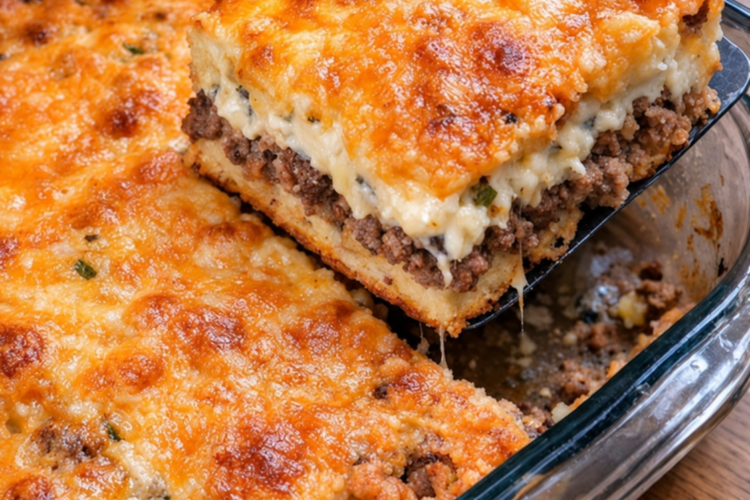
John Wayne Casserole: The 5-Ingredient Ground Beef Bake That Feeds Eight
My uncle clipped the recipe out of a magazine in 1979 and taped it inside the cupboard door above the stove, where it lived for about as long as that kitchen existed. He made it every time the whole family came in from somewhere, which meant for most of my childhood it was the thing everybody was quietly waiting for. Not the turkey, not the ham. The casserole. It went into the oven in the dish with the blue flowers on it, and about forty minutes later a square would come out with a crust you could hear from the other room.
He died in 2016 and my cousin found that cupboard door in a box. The tape had gone yellow and the print had faded to the point where you had to hold it at an angle to read the taco seasoning step, and I stood in his kitchen holding a piece of paper and crying in a way I was not prepared for. So I made it that weekend. Six people, a 9x13 dish, and the same recipe, and it came out right.
This is the version I have made every since. It is a John Wayne casserole, which is either a funny name or the most accurate name a recipe has ever had, depending on whether you grew up in the same house. Canned biscuits pressed into a crust, a pound and a half of browned ground beef seasoned with taco spice, sour cream, and a lot of cheddar. Five ingredients, one dish, and it feeds eight for about a dollar thirty-five a head.
The thing people never believe until they make it is how fast it comes together, because there are three separate cooking stages and none of them take long. Ten minutes to set the biscuit crust. Fifteen minutes to brown the beef while that happens. Half an hour to finish it. That is the whole evening, and most of it happens without you standing there.
Why You'll Love This John Wayne Casserole
Five ingredients, and they are all things you can buy in one trip without reading a list twice. A can of biscuits, a pound and a half of ground beef, a packet of taco seasoning, a cup of sour cream, and two cups of cheddar. That is the entire shopping list. There is no fresh produce to waste, no cream to soften, nothing that will turn into something in the back of the fridge while you ignore it.
The biscuit crust is the part that makes me call this a casserole and not just a tray bake. Par-baking it first turns raw dough into something that holds itself together, so when you layer the beef and the sour cream and the cheese on top, you get a real bottom. Cut a square and you get crust, then beef, then sour cream, then cheese. Four layers, in the right order, holding together on a fork.
It feeds eight. That is a genuine accomplishment for a dish with this much dairy and ground beef in it, because the sour cream layer is what makes a slice satisfying on its own. A casserole that runs out to eight servings is the difference between feeding your family and feeding your family twice.
It is also cheap, which is not a small consideration when you are cooking for a reunion. The whole thing is about ten dollars and eighty cents. That is the number I grew up with, when nobody was tracking a grocery budget and the calculation was just whether there was enough for seconds, and it still holds up.
And it freezes. This matters more than it sounds. A John Wayne casserole that can be made two days ahead and frozen in portions is one of the most useful things you can have in your back pocket for a week when the calendar is full.
Why This Recipe Works (And What It Honestly Is Not)
The par-bake is the step that makes the whole thing work, and it is the step everyone thinks they can skip. Ten minutes in the oven with the raw biscuit dough pressed into the dish does two things. It sets the dough so it holds a shape instead of slumping, and it dries the surface enough that the fat and moisture from the beef and sour cream do not turn it to paste.
You are not trying to cook the biscuits to a golden biscuit. You are trying to make a pastry shell. Which golden spots in spots, it is done. And you press the dough together firmly with your fingers first, because gaps in the crust become channels where the filling seeps under and the bottom goes soggy in exactly those places.
Then there is the order of the layers, which is not negotiable. Beef first, because it is the structural layer and it needs to sit on something solid. Sour cream on top of the hot beef, which is why it melts into a layer rather than staying in dollops. Cheese last, because cheese on top is what creates the browned, bubbling lid that tells you the whole thing is hot through.
The sour cream is the ingredient people leave out and then cannot explain why theirs was flat. Between the beef and the cheese, it adds fat, tang, and moisture, and it is what makes this taste like a recipe instead of like ground beef with cheese on it. Skip it and you have something edible but dull.
Ten minutes of resting is not optional. This is a very hot, very loose casserole and the cheese layer is still setting when it comes out. Cut it early and the square slumps and the sour cream runs into the gap. Give it ten minutes and the layers firm up enough to lift out clean on a spatula, which is why mine always look better in the pan than yours are going to right now.
Now the honest part. This is not a keto recipe and it is not low-carb. Those ten refrigerated biscuits are about 21 grams of carbohydrate each, which puts a serving at roughly 29 grams of carbs and 27 grams of net carbs. It is not gluten-free either, since the biscuits are wheat. It is also high in sodium, near a gram per serving, and that comes from three places at once: the biscuits, the taco seasoning, and the cheddar. I would rather you have those numbers in front of you than find out after you made a pan for eight.
What it honestly is: a cheap, crowd-feeding, nostalgic ground beef bake with a real crust. That is a fine thing to be, and I do not need a health claim to like it.
Ingredient Breakdown: What Each Piece Is Doing
One 16-ounce can of refrigerated biscuits. The crust, and the only structurally interesting part of the recipe. A 16-ounce can gives you roughly ten large biscuits, which is exactly enough to line the bottom of a 9x13 and come a short way up the sides. Press them together with your fingertips until there are no visible seams, then up the walls. Small biscuits will not reach; large ones are what you want here, and the leftover dough on the extra biscuit can go in the beef.
A pound and a half of ground beef. The filling and the bulk of the protein. Eighty-twenty is the standard and it is what I buy, because the fat gives the sour cream and cheese something to marry with. Ninety-ten works if you want it leaner, and you will want a little more cheese to compensate for the missing richness. Brown it properly. Grey beef in a skillet, with all the water still in it, is the single most common way this recipe goes wrong.
One packet of taco seasoning. This is the entire flavor profile, and the reason a dish with five ingredients tastes seasoned rather than plain. Stir it into the beef while the beef is still hot and still has some fat in the pan, so it dissolves instead of sitting on the meat as powder. Half a packet if you are feeding anyone sensitive to salt, which is worth considering in a dish that also has biscuits and cheddar in it.
One cup of sour cream. The layer that makes a slice a meal instead of a snack. Full-fat, no substitutions. It softens the taco seasoning, keeps the beef from drying out under the cheese, and gives you a cool tang against the hot cheese on top. Do not drain it and do not add it after baking, because it needs to melt into the hot beef to do its job.
Two cups of shredded cheddar. The lid. Sharp cheddar is the right call and it is the flavor that carries this dish, but a Colby-Jack blend gives a softer melt and a milder finish if you are cooking for people who do not like sharp cheese. Shred it yourself if you care about the cost or the melt; a bag is fine and about two dollars thirty. Do not use a cheese labeled as non-melting, because the whole structure depends on this layer setting into a solid sheet.
Kitchen Equipment You Need
A 9x13 inch glass baking dish. Glass rather than metal, and this one is not fussy about it. You can see the biscuit crust browning along the edges and the bottom through the whole ten-minute par-bake, and you can see the cheese bubbling at the corners to know when the last twenty-five minutes are up. Glass also releases a buttery biscuit crust better than a dark metal pan, which matters because the crust is the point.
A large skillet for browning the beef. Any skillet that holds a pound and a half comfortably, so a 12-inch or a Dutch oven. A Dutch oven does it faster because it holds more heat, and it does it while you are in there watching the biscuit crust.
A wooden spoon or slotted spatula for breaking up and draining the beef.
A large spoon or rubber spatula for dolloping the sour cream, and something flat for spreading it. A butter knife is fine.
A sharp knife or a pizza cutter for cutting squares, and a spatula wide enough to lift a serving out without it breaking apart. That second one matters more than it sounds, because the layers are soft and a thin spatula will fold a square in half.
Step-by-Step Instructions
Start with the oven and the crust. Preheat to 350°F and lightly grease a 9x13 inch glass baking dish with butter or cooking spray.
Separate the biscuits and press them into the bottom of the dish. Use your fingertips to push the dough together into one continuous layer with no gaps, then press it up the sides to about an inch. It will look messy and lumpy and that is fine. The dough overlaps and seams are acceptable, holes are not.
Par-bake the crust for about 10 minutes, until just set and lightly golden in spots. Set a timer, because this goes from set to dark in about two minutes and the difference is real. You are not baking biscuits, you are making a shell. Pull it out of the oven and leave it in the dish while you cook the beef.
Brown the beef while the crust bakes, or right after. Heat a large skillet over medium-high, add the ground beef, and break it up with a spoon. Let it sit undisturbed for a minute at a time so it actually browns, then stir and repeat until the color is even and there is no pink left and no grey liquid pooling in the bottom. Drain off the excess fat. Stir in the taco seasoning and let it coat the meat evenly, about thirty seconds, before you turn off the heat.
Layer it. Spread the seasoned beef evenly over the par-baked crust, right to the corners. Then drop the sour cream over the top in rough dollops and spread it into one even layer with the back of your spoon, so you can see beef through it in a few spots but not many. Do not leave thick unbroken pools of it.
Add the cheese. Sprinkle the two cups of shredded cheddar evenly over the whole surface, edge to edge.
Bake uncovered at 350°F for 25 to 30 minutes, until the cheese is browned and bubbling and the edges of the dish are hot all the way around. The bubbling at the corners is your cue, and it shows up in the last five minutes.
Rest ten minutes before cutting. This is the step that makes the squares come out clean. Lift a corner with a spatula, let the layers hold, and cut with a sharp knife dipped in warm water and wiped between strokes.
Expert Tips From a Bunch of Soggy Bottoms
Do not skip the par-bake and do not shorten it. Ten minutes is the minimum that sets the dough and dries the surface. An under-set crust absorbs the fat from the beef and the moisture from the sour cream and turns into a soft, dense layer that nobody wants.
Press the seams together hard. Biscuit dough does not bond to itself neatly, so you have to close the gaps mechanically with your fingertips. Where you cannot close a gap, put a second biscuit on top of it. Soups of beef with no crust underneath them just taste like casseroles with no crust underneath them.
Brown the beef in two stages. Break it up, let it sit, stir, let it sit again. If you stir constantly you boil the meat in its own liquid and it goes grey and grey beef makes a grey casserole. A little patience here is the whole difference between a good filling and a bad one.
Drain the fat. Yes, even the 80/20, and yes, even though the recipe calls for sour cream on top. Fat left in the skillet goes onto the beef, under the sour cream, and you get a greasy layer between two good ones.
Spread the sour cream thin and even. Thick pools stay cool and wet in the center of a square while everything around them is molten.
Use a wet knife. Dip it in warm water and wipe it between every cut, and the squares come out with clean edges instead of strings of melted cheese dragging behind them. This is the same trick you use on a lasagna and it works identically here.
Cut a small test square before you cut eight. If it holds together on the spatula, you are good. If it folds, give it another five minutes.
Common Mistakes to Avoid
A soggy bottom crust. Almost always the par-bake being skipped or cut short. Ten minutes, and press the dough together with no gaps first. There is no other fix for this, and it is the reason the recipe has two cooking stages instead of one.
Grey, watery beef. You stirred it too constantly or the heat was too low. Let it sit in undisturbed intervals so it can brown, and drain what comes out. Ground beef that has boiled will not brown no matter how long you leave it.
Undissolved taco seasoning. Powder sitting on the meat in patches, which gives you one very salty bite and then a fine one. Stir it into the beef while the pan is still hot and still has fat in it. Thirty seconds does it.
Cutting too early. The cheese layer has not set and the sour cream has not firmed, so the squares slump and slide and you end up serving it with a spoon off a tray. The full ten minutes is what lets the layers hold together on a spatula.
Biscuit dough with holes in it. You will see raw dough showing through in the finished bottom, and the filling will leak through onto the sheet. Overlap the biscuits rather than fitting them edge to edge, and cover any remaining bare spot with a piece of another biscuit.
Biscuit dough above an inch up the sides. It overcooks, goes hard and dark, and pulls away from the dish. An inch is plenty and it also lets you lift a square out without the sides breaking apart.
Cheese that is not evenly distributed. You get bare beef patches and then a bald spot where the sour cream shows. Spread it to the corners. Cheesy in the middle and bare at the edges is the most common plating mistake.
Baking it covered. A foil cover traps steam and softens the crust and the cheese top. Leave it uncovered so the top can brown.
Ingredient Substitutions
Ground turkey for ground beef. Ninety-three percent turkey works, and so does regular ground turkey. It is leaner, so it has less to give the sour cream layer, and the fix is more cheese or a tablespoon of olive oil in the pan. Season it more than you think, because there is less fat to carry flavor. It is a genuinely good lighter version and nobody at my table has ever asked which meat was in it.
Colby-Jack or Mexican cheese. A Colby-Jack blend gives a softer melt and a milder flavor, which is better for kids. A Mexican four-cheese blend is very good with the taco seasoning, since it leans into the same profile. Pepper jack adds a mild heat that suits the whole dish. Avoid anything labeled as a non-melting cheese, because the top layer has to set into a sheet for the squares to hold.
Less taco seasoning. Half a packet gives you seasoning without the sodium load, and it is the adjustment I would make for children or anyone watching salt. Add a teaspoon of chili powder, a half teaspoon of cumin, and a half teaspoon of smoked paprika to get the flavor back without the salt. Do not simply leave it out; the dish needs it.
Greek yogurt for sour cream. Full-fat plain Greek yogurt works and adds more tang. Add it after the beef comes off the heat so it does not split, and expect a slightly firmer layer. Do not use nonfat, which will curdle under the cheese, and do not use a sweetened variety.
Crescent roll dough. The sheet-not-tub kind, unrolled into a rectangle in the dish, par-baked the same way. It is sweeter and flakier, so add a tablespoon of melted butter to the beef to balance it. This is a genuinely good shortcut and it works better than biscuits in some ways, because it is one piece instead of ten and the seams are gone.
Pizza dough. Thawed store-bought pizza dough pressed into the dish, par-baked the same way, is the best "almost from scratch" version and it gives you the most crust. Add a tablespoon of olive oil to the beef.
Variations Worth Making
Taco casserole with a cornbread base. A box of cornbread mix, or a pan of cornbread, in place of the biscuits. This is not a John Wayne casserole anymore, so I am not calling it one, but it is the same filling doing the same job and it is excellent. Cut a square and it holds up better than the biscuit version.
Cheeseburger casserole. Skip the taco seasoning entirely and use two tablespoons of Worcestershire, a half teaspoon of garlic powder, and a teaspoon of Italian seasoning. Add a handful of diced pickles with the beef if you want the real thing. Serve it with ketchup and people will be genuinely confused about what it is, in a good way.
Crispy taco bake. The same dish, but skip the par-bake and go straight to topping with crushed tortilla chips. Drop the biscuit layer, layer the beef and sour cream in the dish, and add crushed chips and cheese on top. That is a different recipe and it is a good one.
Loaded nacho casserole. Add a can of drained black beans and a chopped jalapeño with the beef, and finish with sour cream and a few crushed chips after baking. Feed eight as a main dish.
BBQ beef casserole. Half a cup of barbecue sauce with the taco seasoning, and shredded cheddar or a smoked gouda and cheddar blend. This is the version my husband asks for and it is very good, though it is not a taco flavor profile at all.
Buffalo chicken casserole. Frank's RedHot instead of the taco seasoning, a quarter cup of ranch stirred into the sour cream, and blue cheese or cheddar on top. Serve with celery. This is a Super Bowl dish and it has been made at my house roughly four times since I started writing this down.
Make It Healthier, Honestly
There is not a version of this that becomes a health food, and I am not going to pretend otherwise. A can of biscuits, a pound and a half of ground beef, and two cups of cheese is what it is.
What is actually true: this feeds eight for about a dollar thirty-five a serving with 27 grams of protein each. Compared with a lot of what fills eight people, that is a genuinely efficient dinner, and I would rather have this than eight servings of something lighter that costs twice as much and leaves people hungry an hour later.
The levers, if you want them. Ninety-three percent ground turkey instead of eighty-twenty is the biggest one, and it costs you maybe five grams of fat per serving. Reduced-fat cheddar saves about four grams of fat and you will genuinely miss it less than you expect. Low-sodium cream cheese does not apply here, but a reduced-sodium soup does, and half a taco seasoning packet instead of a full one is the single biggest sodium reduction available, worth roughly 600 milligrams a serving.
Add vegetables to the beef. A cup of frozen corn, a can of drained black beans, or a cup of chopped bell pepper stirred in with the taco seasoning adds volume and fiber and stretches the meat. It is the move that improves this dish at every level at once.
Serve it with salad instead of nothing. This is rich enough that a plain green salad with a squeeze of lime genuinely balances the plate, and the acid is doing more work than the calories are. That is a serving suggestion, not a claim that the casserole is good for you.
Meal Prep Tips
This is a good make-ahead dish, and the best version of that is to do the one step that takes the longest well in advance.
Brown and season the beef a day ahead. Cool it, refrigerate it in a sealed container, and use it within three days. This removes fifteen minutes from the evening and it is the step I do most often, because browning a pound and a half of beef is the part that makes a mess and I would rather make that mess on a Sunday.
You can par-bake the biscuit crust up to a day ahead as well. Press it, bake it ten minutes, cover it loosely, and refrigerate. Assemble and finish the next day, adding five minutes to the final bake because the crust is cold.
Keep the components separate until you are baking. Biscuit crust, cooked beef, sour cream, cheese, four containers in the refrigerator, and about five minutes of assembly the night you want it. That is the whole make-ahead strategy and it works completely.
The leftovers are the real prize. This makes eight servings, and one serving on Tuesday is a lunch that needs nothing added to it. Portion into containers and keep them at the back of the fridge where you will see them.
Storage: How Long It Lasts in the Fridge
Four days refrigerated, covered, and I mean four rather than five. Ground beef and dairy are both in this and I do not want to be the person who says day five is fine.
Keep it in the same dish if you can, and cover it properly. A John Wayne casserole left uncovered will form a skin on the sour cream and dry out around the edges overnight, and reheating it will not bring that back.
Do not stack servings on top of each other in the same container. The cheese layer sticks to whatever is above it, and you will lose the top of one serving to the bottom of another. Parchment or wax paper between layers fixes it completely.
Take it out of the refrigerator twenty minutes before reheating. Going straight from fridge to hot oven means the middle spends an uncomfortable amount of time lukewarm while the edges boil.
Freezing
Yes, up to three months, and this is one of the recipes where freezing genuinely works well.
Freeze it after baking. The texture is meaningfully better baked first, because the cheese has set and the beef has firmed, so you are freezing a finished casserole rather than a raw assembly that will release water as it thaws. Cool it completely on a rack first, which takes longer than you would guess.
Portion it. Do not freeze the whole pan unless you are feeding eight at once three months from now. Individual servings freeze better, thaw faster, and get eaten instead of being forgotten in the back of the freezer.
Wrap each serving in plastic wrap, then foil, or put the wrapped servings in a freezer bag laid flat. Parchment between layers if you are stacking them in a shallow container.
Thaw in the refrigerator overnight. Never on the counter. A pan that goes from freezer to hot oven thaws the outside long before the middle, and this dish spends an awkward stage where the center is cool and the cheese is bubbling.
Reheat from thawed at 350°F, uncovered, for 20 to 25 minutes until the center is hot all the way through. Bump to 375 for the last five minutes to bring the cheese back.
Reheating
This dish needs the oven. The microwave is genuinely bad for it, and it is the one thing in this post I would push back on if you were planning to just nuke a square.
The oven, best option. 350°F, uncovered, for 20 to 25 minutes, until the center is hot through. Covering it with foil for the first 15 and then uncovering for the last 10 is the best version, because the foil brings the center up to temperature and the uncovered time brings the cheese back to bubbling.
The skillet, for one portion. A cut square in a lightly buttered skillet over medium heat, 6 to 8 minutes a side, until the bottom is crisp and the center is hot. This is better than the original, and I do not say that about a lot of leftovers.
The microwave, with a real caveat. It works, it is fast, and the cheese goes rubbery and the sour cream splits into a grainy layer. Cover with a damp paper towel, heat in two-minute bursts with a stir between, do not do one long cycle, and let it sit a full minute before you eat it.
Reheat once only. Every additional trip dries the beef and thickens the sauce. If you have leftovers, reheat only what you are about to eat and keep the rest cold.
What to Serve With This John Wayne Casserole
A plain green salad, and this is not an afterthought. The dish is heavy, warm, and salty, and a cold sharp salad is the thing that makes it a dinner instead of an event. Lettuce, cucumber, a squeeze of lime, olive oil. Nothing elaborate, and the lime specifically, because the acid echoes the taco seasoning.
Salsa, on the side, not on top. A spoonful of salsa on a hot square turns the crust soft underneath it. Passing it separately means each person decides how much, and you keep the layers intact.
Pickled jalapeños, which is the obvious Tex-Mex move and the right one. The acid and the heat cut straight through eight hundred milligrams of sodium.
A can of black beans, warmed through, as a side. It costs about a dollar, it adds protein and fiber, and it makes the plate feel complete for very little money.
Sliced tomatoes with just a pinch of salt, and that is the whole preparation.
Steamed green beans, straight from the bag with butter and salt. Four minutes, and the only vegetable most people actually want next to this.
For fruit, a bowl of cut melon or pineapple. This is a strange-sounding pairing and it works, because cold sweet fruit next to a hot savory square is a genuine contrast, and it gives people an out if they are not in the mood for anything else on the table.
Beverage Pairings
A cold lager or a light Mexican-style lager. This is a Tex-Mex-adjacent casserole and a Modelo, a Dos Equis, or a plain lager is what most people will actually reach for. The carbonation and the cold cut the richness better than anything else on this list.
Cold water with a wedge of lime. Boring and correct, and I am leading with it because this dish is salty.
Iced tea with a squeeze of lemon, over ice, lemon wedges still in the glass so people can add more. It does not get cloying the way sweet tea does with a dish this rich.
A Paloma, if you are doing something festive. Grapefruit soda with a salt rim and a splash of tequila. The salt rim against a savory casserole is a better idea than it sounds.
Watermelon agua fresca with lime and a pinch of salt, for the kids and for anyone not drinking. Cold, hydrating, and it does the same counterweight that the salad does.
One to avoid: a heavy red wine. Nothing tannic against ground beef and melted cheese. If you are pouring red, keep it light and keep it cold, and give the beer option instead.
Frequently Asked Questions
What is a John Wayne casserole? A five-ingredient ground beef bake made with refrigerated biscuits, browned seasoned beef, sour cream, and cheddar. The biscuits are pressed into a 9x13 dish and par-baked for ten minutes to form a crust, the beef goes on top, then sour cream, then cheese, and it bakes another 25 to 30 minutes. It feeds six to eight and it is one of the cheapest crowd-pleasing dinners you can make.
Why do you have to par-bake the biscuit crust? Because raw biscuit dough under a layer of beef and sour cream will absorb the fat and steam and turn into a dense, soggy bottom. Ten minutes sets the dough and dries the surface so it holds a shape and stays crisp under the filling. If you skip it you will get a casserole without a crust, and no amount of resting will bring it back.
How long do you bake a John Wayne casserole? Ten minutes for the biscuit crust at 350°F, then 25 to 30 minutes for the assembled dish, plus a ten-minute rest before cutting. That is 45 to 50 minutes total, most of which happens without you standing in front of the oven. Start watching the corners in the last five minutes, where the cheese bubbles first.
Can I make a John Wayne casserole ahead of time? Yes, and this is one of its best features. Brown and season the beef up to three days ahead and refrigerate it, and par-bake the biscuit crust up to a day ahead and cover it loosely. Keep the components separate, then assemble and bake the day you want it, adding five minutes if the crust was refrigerated.
How many servings does a John Wayne casserole make? Six to eight, and the number depends almost entirely on how much you eat and whether you are serving it with sides. The nutrition figures on this page are calculated for eight servings, which is the realistic yield for a 9x13 dish with a pound and a half of beef. If you are serving eight people with salad and bread, six is the honest number.
Can I use crescent roll dough or pizza dough instead of biscuits? Yes, and both work well. Crescent sheet dough unrolled into the dish is one piece instead of ten, so the seams are gone, and you get a flakier, slightly sweeter crust. Thawed pizza dough gives you the most crust of any option. With either one, add a tablespoon of butter or olive oil to the beef to balance the added sweetness.
Is a John Wayne casserole keto or low-carb? No, and the honest number is about 29 grams of carbs and 27 grams of net carbs per serving. The ten refrigerated biscuits supply nearly all of it. It is also not gluten-free, since the biscuits are wheat. It is a cheap, high-protein comfort casserole, and I would rather give you the number than sell you a claim.
Why does my casserole have a soggy bottom? One of two things. Either you skipped or shortened the ten-minute par-bake, which is the most common cause, or you had gaps in the biscuit dough that the filling seeped into. Press the dough together firmly with your fingers, overlap the biscuits instead of fitting them edge to edge, and give the crust the full ten minutes.
Can I make it with ground turkey? Yes. Ninety-three percent ground turkey works well and the dish is genuinely lighter. Season it more than you would the beef, since there is less fat carrying the flavor, and add a tablespoon of olive oil to the pan. Regular ground turkey works too, just expect a leaner, slightly firmer filling.
Nutrition Information
These are estimates, calculated from ingredient weights for the full batch and reported per serving of one-eighth of the dish. I assumed about ten refrigerated biscuits from a 16-ounce can, 680 grams of 80/20 ground beef on a raw weight basis, one 43-gram packet of taco seasoning, 227 grams of full-fat sour cream, and 226 grams of shredded sharp cheddar. Your brands will move these numbers, and sodium more than any other value here.
Per serving: approximately 600 calories, 27 grams of protein, 38 grams of total fat, 29 grams of carbohydrate, 2 grams of fiber, about 1,000 milligrams of sodium, and 105 milligrams of cholesterol.
Where the protein comes from: roughly 14 grams from the ground beef and 6 to 7 grams from the cheddar, with the biscuits and sour cream making up the rest. That 27 grams is the number that keeps this in my rotation for a family dinner.
Where the sodium comes from: three sources stacking on top of each other. The biscuits carry roughly 500 milligrams each, which is about 5,000 milligrams across the can. The taco seasoning packet carries 1,000 or more. The cheddar carries another 1,400 across the batch. Halving the taco seasoning packet is the single biggest reduction available to you.
Where the fat comes from: the ground beef is the largest contributor at about 17 grams, the cheddar about 9 grams, and the sour cream about 5 grams per serving. This is why ninety-three percent turkey is the meaningful swap rather than a token one.
Allergens in the base recipe: milk and dairy, from the sour cream and the cheddar. Wheat and gluten, from the refrigerated biscuits. Check the biscuit can, because many brands also contain soybean oil, which means a soy allergen as well.
Food safety: this is a ground beef dish, so it needs to reach 160°F in the center for the beef itself. Given the volume and the 25 to 30 minute bake at 350°F, that is comfortably achieved, but if you use pre-cooked or leftover beef, bring it to 165°F instead. Cool leftovers within two hours, and do not leave this sitting out on the counter at a party, because dairy and ground beef are the two things on this table that will not forgive it.
Final Thoughts
I do not think this is a good recipe. I think it is a faithful recipe, which is a different and better thing. Somebody clipped it out of a magazine in 1979 and taped it to a cupboard door, and it got made maybe a hundred times over four decades, and it never once needed to change. That is a kind of quality that has nothing to do with technique and everything to do with a recipe doing exactly one thing well.
It is also the most useful dinner I own for the exact weeks when the calendar is full and I am running on nothing. Five ingredients, one dish, feeds eight, and about half the work can happen the day before. I have brought it to three weddings and a funeral and it has never once let me down, and I have never once had to stand there explaining what it is.
My cousin now has that piece of paper. It is in a plastic sleeve, and the fold is soft from being opened and closed a hundred times, and I told her to tape it up somewhere she would see it every day. That is the whole legacy, really. Not the recipe, which is written down anywhere. The habit of keeping it.
So here is my question, and it is the one my whole family argues about. Do you cut it in big squares, four pieces to a pan, or do you cut it small, eight pieces, so everybody gets a proper portion and can go back for a second? My uncle cut it big and took the first square out of the pan himself, which I have always thought was the correct move. I have been doing it his way for years. I would like to know what you do.
Big squares or small ones in your house?
Five Ingredients, One Dish, Feeds Eight
John Wayne Casserole
Biscuit crust, seasoned ground beef, sour cream, and cheddar since 1979
Ingredients
- 1 can refrigerated biscuits, 16 ounces about 10 large biscuits
- 1 1/2 pounds ground beef, 80/20
- 1 packet dry taco seasoning
- 1 cup sour cream, full fat
- 2 cups shredded sharp cheddar cheese
Step-by-Step Instructions
- Preheat the oven to 350 degrees F and lightly grease a 9x13 inch glass baking dish.
- Separate the biscuits and press them into the bottom of the dish and up the sides about an inch. Push the dough together with your fingertips so there are no gaps, overlapping where you need to. Do not leave holes.
- Par-bake the crust for about 10 minutes, until just set and lightly golden in spots. Leave it in the dish while you cook the beef.
- Brown the ground beef in a large skillet over medium-high heat, breaking it up and letting it sit in intervals so it browns rather than steams. Drain the excess fat, then stir in the taco seasoning until every piece is evenly coated.
- Spread the seasoned beef evenly over the par-baked crust, right to the corners. Dollop the sour cream across the top and spread it into an even layer. Sprinkle the cheddar evenly over everything.
- Bake uncovered for 25 to 30 minutes, until the cheese is browned and bubbling and the edges of the dish are hot throughout. Watch the corners, where the bubbling starts.
- Rest 10 minutes before cutting. Use a sharp knife dipped in warm water and wiped between strokes so the squares come out clean.
Cook's Notes
Cost is about 1.35 a serving, roughly 10.80 for the whole dish feeding eight. Twenty-seven grams of protein per square, and it costs less than most dinner ideas I could put in front of you.
Do not skip the 10-minute par-bake on the biscuit crust. That step is what keeps the bottom crisp instead of soggy, and there is no way to fix it afterward. Press the dough together firmly with your fingers, because gaps become channels where the filling seeps through.
Brown the beef in intervals rather than stirring constantly. Grey beef that boiled in its own liquid makes a grey casserole. Drain the fat, stir the taco seasoning in while the pan is still hot, and spread the sour cream thin and even.
Not keto and not low-carb, at about 29 grams of carbs and 27 grams of net carbs per serving, and not gluten-free since the biscuits are wheat. Contains milk, dairy, wheat, gluten, and soy. Ground beef needs 160 degrees F in the center; use 165 if reheating cooked or leftover beef.
Nutrition Per Serving
Estimates, 8 servings per 9x13 dish.
John Wayne casserole, serves 8, about 1.35 per serving. Total time 55 minutes including the rest.