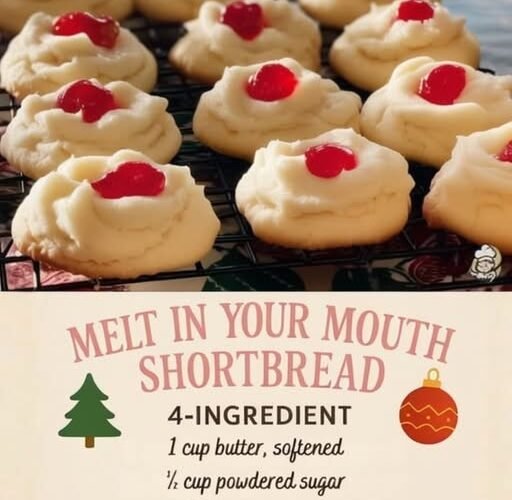
Christmas Shortbread Cookies: 4 Ingredients, No Mixer, No Chilling
Every December, my grandmother made the same thing. She started before anyone else in that house was awake, and by the time the rest of us dragged ourselves downstairs there would already be a tin sitting out on the counter, and that smell would be in the kitchen like a person. Butter and sugar and something faintly sweet that I could never quite name as a child. These are the christmas shortbread cookies from that house, the exact four-ingredient version she made for as long as I can remember, and I had not baked them in years until my daughter asked me one afternoon if we could make "those cookies Grandma used to make." I almost lost it standing right there in front of the flour.
Here is the thing about this recipe that I wish somebody had told me sooner. It is not complicated. It is not fussy. There is no mixer required, no rolling pin, no cookie scoop you need to special-order, and no overnight chill sitting in your fridge with your name on it. It is four ingredients and about twenty minutes, and if you keep the oven at 300 degrees the way my grandmother did, you get cookies that genuinely do seem to dissolve on the way down.
The first batch disappeared before they had even finished cooling. My husband ate three standing at the counter in a way he will deny to this day, and my daughter, who is ten and has strong opinions, announced that they were better than store-bought. Coming from that child, that is basically a Michelin star, and I have decided to take it as one.
I frosted mine with a plain buttercream swirl and topped each one with a maraschino cherry, because that is what my grandmother did and I am not above copying her. But plain shortbread is the more classic call, and if you want to change the shape of the cookie rather than the topping, there are a dozen good ways to do that further down. Either way, these are the kind that make somebody ask for the recipe before they finish chewing.
Why You'll Love These Christmas Shortbread Cookies
Four ingredients. That is the whole list. Butter, powdered sugar, cornstarch, flour. Nothing in a jar with a picture of a cartoon animal on it.
Twenty minutes start to finish. This is a genuinely quick bake, which means you can make them the afternoon before a holiday gathering instead of the day of, when everybody is in your kitchen anyway.
No mixer, no chilling, no technique. A wooden spoon and a little arm work. The dough does not need to rest because there is barely any gluten in it to relax, which I explain properly further down.
They keep for a full week. Shortbread is one of the best-keeping cookies you can bake, which makes it the right thing to make ahead for a cookie tray.
They freeze like a dream. The dough freezes for months and the baked cookies freeze for months, so you can make one batch and cover two holidays.
About 23 cents a cookie. Four ingredients and no filling means this is one of the cheapest things you can put on a holiday tray, and it tastes like you spent an afternoon on it.
Why These Christmas Shortbread Cookies Are the Only Ones I Make
Four ingredients is a gimmick until you understand what each one is actually doing, and once you see it you will never make shortbread any other way.
Butter is the entire structure. There is no flour-built scaffolding in shortbread and no leavening, so these cookies are held together entirely by the fat in the butter. That is why creaming matters, why the dough is soft and crumbly, and why the cookies do not get tough in the way ordinary cookies do. It also means the butter has to be genuinely softened, not melted. Melted butter makes cookies that spread into thin, greasy wafers. Cold butter makes dough that will not cream and cookies that come out tough. Room temperature is the whole ball game.
Cornstarch is the ingredient everybody skips and everybody should not. It has no gluten at all, so it actively works against gluten development. That is the entire secret to the texture. A cookie with flour alone builds a gluten network as you mix, and that network is what makes cookies chewy and sliceable. Block that network with cornstarch and there is nothing holding a structure together except butter, which is precisely why shortbread crumbles instead of snapping, and why it seems to melt rather than break apart. The cornstarch also drinks up moisture, which keeps the cookies tender and stops them from getting tough in the oven. There is no substitute for it. If you leave it out you are not making shortbread, you are making a sad, flat, butter cookie, and people will absolutely notice.
Powdered sugar is not just for looks, even though it is also for looks. Fine, dissolving sugar is what softens the texture, and the small amount of extra starch in powdered sugar works with the cornstarch to keep things tender. It is also why these are one of the lowest-sugar cookies you can bake. With half a cup spread across two dozen cookies, you are looking at roughly two grams of sugar in each one. A frosted sugar cookie routinely carries three times that. Do not skip it and do not swap it for granulated without a plan.
And flour, finally, which is the odd one out. One and a half cups sounds like a lot, but there is no baking powder, no soda, and no eggs, so nothing is being leavened or bound. The flour mostly provides weight and a little chew to keep the butter from tasting like a pat of butter. That is also why the cornstarch matters so much, because the flour needs help being kept tender.
One last piece of the puzzle is the oven temperature, and this is where most people lose the plot. Thirty degrees is not an accident and it is not a typo. A low, slow oven melts the butter fat gently, bakes the cookies all the way through before the surface sets, and lets them stay pale. Push it to 350 or 375 and the milk proteins in the butter set into the outside of the cookie first, which is exactly what makes it hard. The pale top and barely-golden edges in this recipe are the target, not a sign that you were a minute short.
Ingredient Breakdown
Four ingredients, and then the cost of what they add up to. Prices are typical US grocery range prices for a budget shop in 2026 and will vary, but this is a genuinely inexpensive recipe, and the reason matters: most of the cost is butter, and butter is the one thing you should not cheap out on.
1 cup butter, softened (two sticks) — about $4.29. This is two thirds of the entire cost of the recipe and it is where the flavor lives. Use real butter, not the tub spread, because margarine has less fat and more water and you will lose the crumbly texture. If the sticks are on sale, this is the recipe to buy four sticks for.
1/2 cup powdered sugar (about 2 ounces) — about $0.45. Out of a bugler or a bag you already have. If you are out, blend granulated sugar with a spoonful of cornstarch in a food processor for about fifteen seconds and you have the real thing.
1/4 cup cornstarch (about 1 ounce) — about $0.10. A tin you will use again for thickening something else, so this is a one-time purchase in reality.
1-1/2 cups all-purpose flour (about 1-1/4 cups spooned and leveled) — about $0.40 by the cup out of a five pound bag. Spoon and level it. Scooping straight from the bag is the single most common reason a batch of cookies comes out cakey instead of crumbly.
Parchment paper — about $0.30 for a half sheet, and it is worth using because shortbread sticks to bare pans more than almost anything else.
That is about $5.50 all in, which across roughly two dozen cookies is about $0.23 a cookie. Add buttercream and a jar of cherries and you are closer to $7.50, or about $0.31 a frosted cookie. For comparison, most bakery cookie trays in a grocery store run somewhere in the neighborhood of a dollar apiece, so this is the clear winner for a holiday table you are trying to fill without thinking about it.
Kitchen Equipment
If you have these five things, you can make these cookies tonight.
A large mixing bowl, the kind you mix salad in.
A wooden spoon or rubber spatula. A spoon does the job perfectly. This is the whole "no fancy technique" promise.
A baking sheet. One is enough, you just do two batches. Two trays if you want to do it in one go.
Parchment paper, cut to fit, or a silicone baking mat if that is what you own.
A wire cooling rack. Important, and I explain why in a minute. A flat towel on the counter will steam the bottoms of your cookies soft.
What you do not need: a stand mixer, a rolling pin, a cookie press, a piping bag, or a thermometer. The optional extras are a small ice cream scoop for consistent portions and a jar of maraschino cherries if you are frosting.
Step-by-Step Instructions
Step 1: Soften the butter properly, ahead of time. Cut two sticks into cubes and leave them out at room temperature for about thirty minutes, which gives you small pieces that cream faster. They should dent easily when you press a finger into one and still hold their shape. If they are shiny and soft, they are too warm. If they are hard as rocks, give them ten more minutes. There is no microwave shortcut worth taking here, because unevenly melted butter is how you get greasy, flat cookies.
Step 2: Heat the oven to 300°F and line a baking sheet. Set it now so it is fully preheated by the time your dough is ready. Put the parchment on the sheet while it is cool, because it lays flatter that way and does not shrink in the oven.
Step 3: Cream the butter and powdered sugar. Put the softened butter in the bowl and beat it with the spoon until it is pale, soft, and light, about two minutes of real arm work. Let me be straight with you: by hand is more work than the phrase "no mixer needed" usually implies, because you are working air into a full cup of butter. If you own a stand mixer, use it, nobody will judge you. What you are aiming for is a mixture that looks a shade lighter and fluffier, not whipped like frosting. Over-beating here is a real mistake, because all that extra air makes the cookies spread more and turns them slightly cakey. Two minutes, then stop.
Step 4: Add the cornstarch and flour and mix with a light hand. Stir in the cornstarch first and let it absorb, then add the flour a little at a time. Mix just until you no longer see dry streaks. Do not knead it, do not beat it, and stop the moment it comes together. You should have a soft, slightly crumbly dough that holds together when you press a spoonful between your fingers but crumbles apart if you pinch it. A few faint floury streaks in the bowl are completely fine.
Step 5: Scoop and space. Drop tablespoon-sized portions onto the lined sheet, about two inches apart, and leave them as rustic little mounds or gently press them into rounds. The easiest way to get consistent portions is to use a one-tablespoon measuring spoon and scrape it level against the rim of the bowl for every single cookie. This matters more than it sounds: cookies that are different sizes finish at different times, and the small ones over-bake while the large ones are still pale.
Step 6: Bake at 300°F for 18 to 22 minutes. They are done when the very edges are just barely golden and the tops still look distinctly pale. Do not wait for them to brown. They should feel firm at the edge and give slightly in the center, and they will finish setting as they cool. If you bake them past golden, they will be good cookies, but they will not be shortbread, they will be hard little discs, and that is the whole failure point in this recipe.
Step 7: Cool on the sheet for five minutes, then move them. This rest is not optional. The cookies are still fragile and hot, and moving them too early is how you end up with broken half-cookies. After five minutes they have set enough to lift, and a thin spatula or a fish slice works well. Transfer to a wire rack and let them cool completely before frosting or stacking.
Step 8: Frost, if you are frosting. Pipe a small buttercream swirl on each cookie once they are completely cool, and finish with a maraschino cherry. Warm cookies will melt the frosting and slide it off. If you are leaving them plain, dust them with a little extra powdered sugar just before serving and call it done.
Expert Tips
Use salted butter. It is the single best upgrade available and it costs nothing extra. The salt plays against the sweetness in a way that makes people think you did something clever.
Do not skip the cornstarch. Do not halve it. Cornstarch is not a thickener in this recipe, it is the texture. Without it, or with half of it, you get cookies that spread, crisp at the edges, and turn chewy in the middle.
Keep the oven at 300°F. If your oven runs hot, set it a notch lower. The pale top is the target, and heat is what turns shortbread hard.
Spoon and level the flour. Dipping a measuring cup into the bag adds up to a quarter cup of extra flour across a batch, and extra flour is exactly what makes crumbly cookies cakey.
Freeze half the dough. Roll the unused dough into a log, wrap it tightly, and freeze it for up to three months. Thaw it in the fridge overnight, slice it one-quarter inch thick with a sharp knife, and bake. This is how you make these on your terms instead of on the calendar's terms.
Make your own powdered sugar. Blitz granulated sugar with a teaspoon of cornstarch for about fifteen seconds until fine. It costs pennies and it works identically.
A 20-minute chill gives cleaner edges. You do not have to chill this dough and the recipe works beautifully without it. But if you want tidier rounds that hold their shape and spread less, a short rest in the fridge is worth it.
Add vanilla, but only as a fifth ingredient. Two teaspoons of vanilla bean paste makes these taste like a different, slightly more grown-up cookie. I keep the four-ingredient version pure because that is the version my grandmother made, but vanilla is the one addition I would make every time.
Common Mistakes to Avoid
Melted butter. The number one cause of flat, greasy, spread-out cookies. Soften it; never microwave it.
Baking too hot. Anything at 350°F or above sets the outside of the cookie before the inside bakes, which is how you get a hard shell. Stay at 300°F.
Waiting for golden tops. The tops should stay pale. If you are waiting for them to brown, you have already gone too far.
Over-beating the butter and sugar. Two minutes, until light. Beating it into fluffy takes in more air than the dough wants and pushes the cookies to spread and turn cakey.
Scooping the flour instead of spooning it. This is the quiet cause of half the disappointing shortbread I have been handed.
Mixed sizes on the tray. Use a level tablespoon for every one so they all finish together.
Moving them off the pan too soon. Five full minutes. They are structurally still soft and will snap if you rush.
Frosting warm cookies. They need to be completely cool, not just close to it, or the buttercream melts and slides.
Making a double batch in one pan. If you double the recipe, use two pans. Crowding drops the oven temperature and you get merged, pale, underbaked blobs.
Ingredient Substitutions
Gluten-free: A one-for-one gluten-free baking blend works reasonably well here, and shortbread is one of the easier cookies to make gluten-free because the structure comes from butter rather than from gluten. Expect a slightly grittier texture, and let the dough rest five minutes longer because gluten-free flours need more time to hydrate. Do not use almond flour in place of the wheat in this recipe; that is a different cookie entirely, and a delicious one, but it will not be your grandmother's.
Butter: Half butter and half shortening works, and it is the more tender option, but you lose a lot of flavor. Ghee is the one swap I like, and you reduce the sugar slightly because ghee does not carry as much water as butter. Do not use olive oil; this is not that cookie.
Powdered sugar: Make it from granulated. You can also use a mix of powdered and a small amount of honey for a slightly deeper flavor, but then it is no longer four ingredients and the texture shifts a little.
Cornstarch: There is no substitute. If you are out, the closest thing is more flour plus a tablespoon of tapioca or arrowroot, which gets you partway there, but you are going to notice the difference and so will everyone else.
Flour: Whole wheat pastry flour is the one swap I would actually make. Same weight, more nutty flavor, slightly more crumb, and it still tastes like a holiday cookie. All-purpose folded with a quarter cup of almond flour is also excellent and leans nutty rather than wheaty.
Sweetener: Monk fruit and allulose both work one for one by volume here and the cookies stay tender because the cornstarch is doing the structural work, not the sugar. Reduce allulose by about a quarter, because it bakes a little sweeter than sugar. Erythritol works, but it cools and it can recrystallize, so it is the least good option for this recipe.
Variations
Classic plain. The four-ingredient version, dusted with powdered sugar. This is what my grandmother made and it is the correct answer.
Buttercream and cherry. The version I do now. Plain vanilla buttercream, a small swirl, one cherry. It looks festive and tastes like a holiday and takes five extra minutes.
Chocolate-dipped. Melt 4 ounces of chocolate or semisweet chocolate and dunk the cooled cookies halfway. Add a little sea salt to the chocolate. This is the most popular version with adults and the least popular with children, which is a useful thing to know before you make it.
Lemon shortbread. Add the zest of one lemon and a tablespoon of fresh juice to the dough. It tastes like a spring cookie and is unreal with a thin lemon glaze on top.
Chocolate chip. Half a cup of mini chocolate chips folded in at the end. This is a real departure from tradition and children will act like you have won the year.
Cinnamon and sugar. Roll the formed balls in a small bowl of cinnamon mixed with two tablespoons of granulated sugar before baking. Smells like a bakery when they come out.
Cranberry orange. Fold in a third of a cup of dried cranberries and the zest of half an orange. This is a grown-up holiday cookie and it disappears fastest of any version.
Pressed fancy. Instead of mounds, press each one flat with a glass bottom and bake five minutes less. You get a traditional round shortbread that stacks beautifully on a tray.
Pecan sandies. Add a half cup of toasted chopped pecans. My grandmother's neighbor did this and it was always the first thing to go.
Make It Healthier
I am going to be straight about this in a way I wish more recipe blogs would be. This is a butter cookie. It is not a health food, it is not low calorie, and nothing here is going to do anything for you medically. What I can do is point out the genuine positives and then give you the adjustments that are worth making.
The sugar is already low. Half a cup of powdered sugar across roughly two dozen cookies works out to about two grams per cookie. That is genuinely one of the lowest-sugar cookies you can bake, and most of what people perceive as sweetness in a butter cookie comes from the butter itself, not the sugar. If you want to go further, swap in monk fruit or allulose one for one and nothing else in the recipe needs to change.
There is nothing artificial in it. Four ingredients, no shortening, no preservatives, no high-fructose anything. That is a real advantage over a packaged cookie, and it is an honest one rather than a health claim.
Whole wheat pastry flour adds a meaningful amount of fiber and gives a nuttier, more adult cookie without making it taste healthy. This is the swap I make most often.
Use half the butter and all olive oil? No. Do not. That is a different recipe and it will not be shortbread, and I would rather you enjoy this one than eat something you resent.
Watch the portion, honestly. One of these is about 110 calories. Two is a small, deliberate snack. A whole cookie eaten standing at the counter, which I have personally done, is a decision rather than an accident. Both are fine, and the second one is exactly the kind of thing I write this blog about rather than pretend does not happen.
Meal Prep Tips
Holiday baking is the best meal prep there is, and this recipe in particular is built for it.
Freeze the dough in a log for up to three months. This is the single most useful thing I can tell you about shortbread. Roll the unused dough into a one-and-a-half inch log, wrap it tightly in plastic and then foil, and freeze. Thaw it in the fridge overnight, slice it a quarter inch thick with a sharp knife, and bake straight from cold, adding a minute or two. You can put cookies in the oven in December without thinking about it in advance.
Bake once, freeze half. Cool the cookies completely, layer them in a freezer-safe container with parchment between the layers, and freeze for up to three months. Thaw at room temperature in the container for about two hours and they are indistinguishable from fresh.
Make the dough the night before. You do not have to chill it, but a covered bowl in the fridge overnight works and makes the morning calmer. Press the portions before it goes in, because the dough is firmer cold and holds its shape better.
Freeze the buttercream, not just the cookies. Buttercream freezes well in an airtight container for a month. Bring it to room temperature and beat it again for fifteen seconds before piping. This is how you frost holiday cookies the night before without touching a mixer at seven in the morning.
Label and date everything. Freezer-baked cookies need a date on the bag, because a labeled container makes its way to the front of the freezer and an unlabeled one becomes archaeological evidence.
Storage
Unfrosted shortbread keeps at room temperature in an airtight container for about five to seven days, and in my experience it rarely gets close to the end of that. Layer the cookies with parchment or wax paper so they do not stick to each other, and store them in a single layer if you can. If the weather is very hot or humid, shortbread softens faster, so move it to the fridge in a sealed container for a few days rather than leaving it on the counter. That is a quality issue, not a safety one, because there is no egg and no custard in this dough.
Frosted cookies are a different case. Buttercream is perishable, so refrigerate frosted cookies and let them come back to room temperature for about twenty minutes before serving, or the frosting will be hard and the cookie will be cold. Because of the cherry on top, frosted shortbread really should stay in the fridge, and I would not leave it out on a counter overnight.
Shortbread also travels extremely well, which is why it is the best cookie to mail. Packed tightly in a tin, it holds its texture where other cookies go stale and soft.
Freezing
This is the best freezing recipe in my rotation and there are two separate ways to do it, depending on how much warning you have.
To freeze the dough, roll it into a log about one and a half inches thick, wrap it tightly in plastic wrap, then in a layer of foil, and freeze for up to three months. To bake from frozen, thaw the log in the refrigerator overnight, slice it with a sharp knife a quarter inch thick, and place the slices straight on the lined pan. They may need a minute or two of extra time and they will spread a little more, so give them a bit more room. This is the method I use when I want shortbread cookies in February and did not plan for it in December.
To freeze baked cookies, let them cool completely, then layer them in an airtight freezer container with parchment or wax paper between the layers so they do not bond to each other. They keep well for up to three months. Thaw them in the closed container at room temperature for about two hours rather than opening it early, because the trapped air is what keeps them from getting condensation-damp. Never thaw shortbread in the microwave or on a wire rack in the open air, because either way you will get moisture on the surface and a soft cookie.
Do not freeze the frosted ones if you can avoid it. The frosting texture suffers more than the cookie does, and it is not worth it when the dough option exists.
Reheating
Shortbread is at its best at room temperature, and honestly that is the only way most people will ever eat it. That said, if you are serving a batch that has been in the freezer, or you just want a warm cookie with coffee on a cold afternoon, here is how to do it without wrecking the texture.
For a frozen cookie, put it straight from the freezer into a 300°F oven and bake for five to seven minutes until it is warm all the way through. It comes out tasting like it came out of the oven, which is a real improvement on a thawed room-temperature cookie. Do not let it get past warm, because that is the same mistake as over-baking and it hardens the cookie.
For a room-temperature cookie you want warmed through, five minutes at 300°F does the same job. Ten seconds in the microwave works, and it softens the texture nicely, but it also makes a warm cookie go slightly chewy and dries the next day, so it is a now-and-thing rather than a batch strategy. A shortbread cookie warmed in the microwave and served with a mug of coffee on a Saturday morning is one of the genuinely good pleasures of this recipe, and I am not going to pretend otherwise even though the un-warmed version is better.
What to Serve With It
Shortbread is a cookie, not a course, but it does more than survive a holiday tray. Here is how to build around it.
A cheese board. Sharp cheddar, aged gouda, some walnuts, a few jars of preserves, and a stack of these. The crumbly texture is genuinely ideal next to a soft cheese.
Espresso or a good cup of black coffee. The single most important pairing, and the reason these are on my grandmother's counter at seven in the morning. The bitterness cuts the butter.
A cheeseburger. This sounds ridiculous and I will not apologize for it. A shortbread cookie alongside a burger is a genuinely great combination of salt and sweet, and it is a real thing people do.
Over vanilla ice cream. Let a still-warm cookie sit on a scoop for about a minute so it softens just slightly, then eat it with a spoon. This is the best thing I have ever done with a shortbread cookie.
With fresh berries and whipped cream. A plate of these, a handful of raspberries, and barely sweetened cream turns a plate of cookies into something that reads as a dessert course.
Tucked into a hot toddy or cider. A buttery cookie floating on top of a warm spiced drink is a real holiday custom in some parts of the country and it is worth doing once.
On a cookie tray for a swap. A dozen plain ones and a dozen frosted ones covers every preference in the room and still costs you about five dollars.
Beverage Pairings
These cookies are sweet and rich, so what you drink with them should cut, not add. Coffee is the default and it is correct.
Black coffee or espresso. The only pairing I would call essential. The roast bitterness against the butter is the whole reason my grandmother had a pot going before the rest of us woke up.
Strong black tea, English breakfast or an Earl Grey. The bergamot in Earl Grey is a lovely unexpected match to the plain version.
Milk, if you are going the way my family actually eats them, which is a cookie and a glass of cold milk and no pretension whatsoever.
Dry champagne or brut sparkling wine, for the adults at a holiday gathering. The bubbles scrub the butter off your palate and the acidity keeps you reaching for another.
Hot cider with cinnamon and orange, if you are making a whole holiday spread rather than just dessert. The spice echoes the cinnamon variations.
Irish coffee or coffee with cream. On a cold evening this is the correct adult version of coffee and a cookie.
Skip anything sweet. Sweet cider, soda, sweet wine, and flavored creamers all make a butter cookie taste cloying rather than rich.
FAQ
Why Are My Shortbread Cookies Hard?
Almost always the oven, and this is the single most common shortbread problem. If they are hard, your oven was too hot or you left them in too long. Anything at 350°F or above sets the outside of the cookie before the inside finishes baking, and that shell is exactly what makes it hard. Shortbread needs a low and slow 300°F bake, and the tops should still look distinctly pale when they come out. The second most common cause is leaving out the cornstarch, because without it the flour builds a gluten network and the cookie gets firm and cracker-like instead of crumbly. The third is over-beating the butter and sugar, which packs in too much air and makes a denser, cakier cookie. Fix the temperature first, because it accounts for most of the hard cookies I get asked about.
Do I Have to Chill Shortbread Dough?
No, and this is genuinely unusual for a cookie dough. Most cookie recipes want an hour in the fridge because the gluten needs time to relax and the butter needs to firm up. Shortbread has almost no gluten in it to relax, and the fat is already soft, so the dough behaves exactly as you want it to the moment you finish mixing. You can scoop and bake immediately. A twenty-minute chill is worth it if you want tidy rounds that spread less and hold their shape, but it is a nicety rather than a requirement, and this is the recipe I make when I have no patience left in me at all.
Why Is Cornstarch in Shortbread, and Can I Leave It Out?
Cornstarch is the reason shortbread is shortbread, and you should not leave it out. It contains no gluten, so it blocks gluten development in the flour, and that is precisely what produces the crumbly, sandy, seemingly melt-away texture instead of a chewy cookie. It also absorbs moisture, which keeps the cookies tender through the bake rather than letting them dry out and harden. If you halve it, you will get cookies that spread, crisp at the edges, and turn chewy in the middle. If you omit it entirely, you have a plain butter cookie that spreads into a thin disc, and people will absolutely notice. There is no substitute. If you are out, the closest available option is replacing some of the flour with tapioca or arrowroot starch, which gets you part of the way there, not all of it.
Can I Make Shortbread Cookies Without a Mixer?
Yes, and it is a four-ingredient recipe that genuinely was made before hand mixers were common. A wooden spoon and about two minutes of arm work will cream a cup of softened butter with powdered sugar properly. I will be honest that "no mixer needed" undersells the effort involved, because you are working air into a full cup of butter, and if you own a stand mixer then a mixer is the easier choice and nobody is going to award you extra points for suffering. What matters is the endpoint, not the tool: you want the mixture pale, soft, and slightly lighter, not whipped into frosting. Stop at two minutes. The part that is genuinely tool-free is everything after this, since no rolling, no chilling, and no piping is required to get cookies on a tray.
How Do I Know When Shortbread Is Done?
Judge by the edges, not the tops. The cookies are done when the very outer edges are just barely golden and the tops still look pale, which feels wrong and is correct. They should feel firm at the edge and give slightly if you press the center. They will finish setting as they cool on the pan, so a cookie that looks slightly underdone in the oven is usually right when it comes out. If you are waiting for golden tops, you have gone too far and the cookies will be hard. A useful second signal is the smell: when the kitchen smells like baked butter rather than like toasting, pull the pan.
Can I Freeze Shortbread Cookies or the Dough?
Both, and this is the best thing about the recipe for anybody who bakes on a schedule rather than on inspiration. Frozen dough keeps for up to three months as a tightly wrapped log; thaw it in the fridge overnight, slice it a quarter inch thick, and bake straight from cold with a minute or two of extra time. Baked cookies also freeze for three months, layered in an airtight container with parchment between the layers. Thaw them in the closed container at room temperature, which takes about two hours, and do not open it early, because the trapped air is what keeps condensation off the surface. I do not recommend freezing frosted cookies, because the frosting takes more damage than the cookie does.
Are These Shortbread Cookies Gluten-Free or Keto?
As written, no to both, and I would rather tell you that than let you assume otherwise. The one and a half cups of all-purpose flour is the structure of the cookie, so this is not a gluten-free or keto recipe. That said, shortbread is one of the easier cookies to make gluten-free, because the structure comes from the butter rather than from a gluten network, so a one-for-one gluten-free baking blend works reasonably well with only a slightly grittier texture. For a keto version you would need to replace all of the flour with almond and coconut flour, reduce the sweetener accordingly, and expect a completely different cookie, more shortbread-cookie-adjacent than shortbread cookie. That is a fine recipe to have, and it is not this one, so I am not going to pretend the substitution is one to one.
What Is the Best Frosting for Shortbread Cookies?
Plain vanilla buttercream for a classic holiday look, which is what I do, and it is what my grandmother did. A thin pourable glaze is easier and looks more polished, and it lets the crumbly texture show through better than a thick swirl does. Melted chocolate dunked halfway is the most popular with adults and the least popular with children, which is worth knowing before a holiday gathering. A simple powdered sugar and milk glaze with a little lemon is my pick if you are making these for people who do not like buttercream, and it takes about ninety seconds to drizzle. Whatever you choose, the cookies have to be completely cool first, because warm cookies will melt the frosting and slide it right off.
How Many Cookies Does This Make, and Can I Double It?
About two dozen at tablespoon size, and you can reasonably stretch that to twenty-eight if you make them small. Double the recipe with no adjustment at all, but use two baking sheets rather than crowding one pan. Crowding drops the oven temperature and gives you merged, pale, underbaked blobs, which is the one way a double batch goes wrong. Halving it works fine too and is the better option if you are using a small pan. If you want a head start, the dough freezes for three months as a log, which I consider a better use of a double batch than making two trays of cookies you will regret.
Nutrition Information
These figures are estimates for one plain shortbread cookie at tablespoon size, calculated as roughly one twenty-fourth of the finished batch using standard values for butter, powdered sugar, cornstarch, and all-purpose flour. They are not laboratory-tested, and they will vary with the brands and the exact size of your scoops, so treat them as a guide rather than a precise record.
Per cookie, approximately 110 calories, 9.5 g carbohydrate, 7.5 g fat, 4.5 g saturated fat, less than 1 g protein, and roughly 75 mg sodium. A batch makes about 24 cookies. A frosted cookie with buttercream and a cherry adds approximately 100 to 130 calories depending on how much you pipe on.
I want to be straightforward about what this is. It is a butter cookie, it is not a health food, and it makes no medical, weight-loss, or dietary claims beyond the low sugar load I noted earlier, which is accurate and is about two grams per cookie. The honest positives are that there are four ingredients in it, nothing artificial, and about a quarter of the cost of a bakery cookie. The honest negatives are that one is 110 calories of butter, and if you eat four in a sitting standing up, that is a different story than serving them at a holiday table. Both are allowed. I simply would rather say the number than hide it.
Final Thoughts
I think about this recipe more than is probably reasonable. Four ingredients is a small list, and there is no technique in it worth bragging about, and yet it is the thing my daughter asked for by name when she wanted something that felt like belonging to us. That is a strange amount of weight for a cookie to carry. My grandmother did not write any of this down, and I am fairly sure she would have found the whole conversation a bit silly, because to her it was not a recipe so much as a December. It was something you did because the calendar said so, and the tin came out at the same time every year whether or not anybody had earned it.
So here is my question, and it is really yours. Do you keep yours strictly classic, four ingredients, a cherry on top, exactly the way it has always been made? Or do you change something every year, a new flavor, a new shape, whatever you are in the mood for that December? I am genuinely torn, and I would love to know what the tradition looks like in your kitchen, and what your version of these has become.
Holiday Baking · 4 Ingredients · No Mixer or Chilling
Christmas Shortbread Cookies
Four ingredients and about twenty minutes, baked low and slow at 300°F for a crumbly, melt-away texture. The cornstarch is the whole secret.
Active: 10 min
Bake: 18 to 22 min
Total: about 25 min
Yield: about 24 cookies
About $0.23 a cookie
Ingredients
Method
Soften the butter ahead of time. Cut two sticks into cubes and leave them out about 30 minutes. They should dent under a finger and still hold their shape.
Heat the oven to 300°F and line a baking sheet. Set it now so it is fully preheated. Fit the parchment while the sheet is cool so it lays flat.
Cream the butter and powdered sugar, about 2 minutes. Beat until pale and soft, not whipped. Over-beating packs in air and the cookies spread and turn cakey.
Add the cornstarch, then the flour. Mix with a light hand just until no dry streaks remain. The dough should hold when pressed and crumble when pinched. A few floury streaks are fine.
Scoop level tablespoon portions, 2 inches apart. Scrape the spoon level against the bowl every time. Even sizes mean everything finishes together.
Bake at 300°F for 18 to 22 minutes. Done when the very edges are just barely golden and the tops still look pale. Firm at the edge, slight give in the center.
Rest 5 minutes on the sheet, then move to a wire rack. They are still fragile and hot. Moving them early is how cookies break.
Frost when completely cool, or leave plain. Pipe a small buttercream swirl and top with a cherry, or dust with powdered sugar and serve.
Notes, Cost & Tips
$5.50Estimated total
$0.23Cost per cookie
4Ingredients
300°FOven temp, do not raise
The cornstarch tip that makes or breaks this recipe. It has no gluten, so it blocks gluten development in the flour, and that is exactly what produces a crumbly, melt-away cookie instead of a chewy one. Leave it out or halve it and you get cookies that spread, crisp at the edges, and turn chewy in the middle. There is no substitute.
Freeze the dough, skip the calendar. Roll the extra dough into a 1-1/2 inch log, wrap tight in plastic and foil, and freeze for up to three months. Thaw in the fridge overnight, slice 1/4 inch thick, and bake from cold with a minute or two extra. This is how you get cookies on a table in February without planning in December.
Keep the oven at 300°F. The pale top is the target, not a sign you were short. Anything at 350°F or above sets the outside of the cookie before the inside bakes, and that shell is why shortbread comes out hard.
Estimated Nutrition (per cookie)
110Calories
9.5 gCarbohydrate
7.5 gFat
4.5 gSaturated fat
<1 gProtein
75 mgSodium
Nutrition values are estimates for one plain cookie at tablespoon size, calculated as roughly one twenty-fourth of the finished batch using standard values for butter, powdered sugar, cornstarch, and all-purpose flour. They are not laboratory-tested and will vary with brands and scoop size. A frosted cookie with buttercream and a cherry adds roughly 100 to 130 calories. Sugar is about 2 grams per cookie, which is genuinely low for a butter cookie, but this is a butter cookie and no health, medical, or weight-loss claims are made for it.