
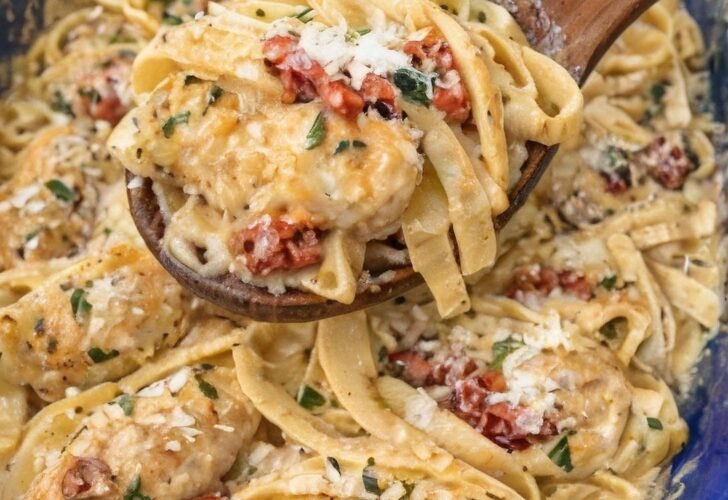
Marry Me Chicken Pasta: The One-Pan Dinner That Makes Everybody Ask for the Recipe
There is a reason this dish has the name it has. You make it once, you set it on the table bubbling and golden at the edges, and within about four minutes somebody across the room says something to the effect of you should marry whoever cooked that. I have served it at a friend’s dinner party, at a Sunday dinner where my mother-in-law asked twice, and once at a holiday gathering where the dish was gone before I made it to the kitchen with the leftovers container. I have never fully recovered from that last one. What makes it work is that it looks like you made an enormous effort and it took about ten minutes of your attention. There is one dish. There is no colander, no pot of boiling water, no draining, no sauce on the side. Dry pasta goes straight into the baking dish, chicken goes on top, and a sauce goes over everything, and then time and a hot oven do the rest. The oven does the stirring. Time is the only real ingredient. The creamy sauce comes out tasting like it simmered all afternoon, which it did not. It tastes like sun-dried tomatoes and a lot of Parmesan and a shortcut you are not supposed to advertise. This version is built on jarred Alfredo, which brings the cost per serving down to about three dollars and thirty cents and makes it genuinely a Tuesday-night dinner rather than a Saturday project. I make it with the jar on purpose and I would make it that way again. One honesty note before we start, because the name of this recipe online misleads people constantly. The viral version is called a five-ingredient recipe. This one is not five ingredients. It is closer to eight, and I will walk you through exactly which ones you could drop to get there, and which one you absolutely should not drop. More on that below.Why You’ll Love This Marry Me Chicken Pasta
It is genuinely one pan. One baking dish, one bowl, one wooden spoon. You never boil anything, you never drain anything, and you are not standing over a sink watching starch go down the drain while sauce boils over on the burner. This is the single biggest reason the recipe went viral and it is the reason I still make it. It is high protein without anybody having to try. Roughly 54 grams of protein per serving, most of it from1.5 pounds of chicken. That is a number most protein-focused recipes have to work very hard to hit with meat substitutes and protein powder. You get it here by using an actual pound and a half of chicken. It feeds six people for about twenty dollars. This is the recipe I make when the grocery budget is already spoken for and the table still needs feeding. Twenty dollars total, and the leftovers are genuinely worth eating the next day, which is not true of a lot of cheap dinners. The flavor is disproportionate to the effort. Sun-dried tomatoes and Parmesan and slow baking do something to a jarred sauce that you would not believe until you taste it. Nobody has ever told me this tastes like a shortcut, and several people have told me it tastes like my grandmother’s cooking, which I am choosing to take as a compliment. It scales and it freezes. Doubling it for a crowd works with no changes. Freezing the unbaked assembled dish and baking it the next day works, which is a genuinely useful thing to know in December. It photographs beautifully. Golden Parmesan crust, bubbling edges, sun-dried tomatoes flecked through cream. I am not above telling you that this is partly why I make it.Why This One-Pan Chicken Pasta Recipe Actually Works
Every clever thing about this method has a reason, and three of them matter most. First, dry pasta in the dish absorbs sauce it never would have absorbed in a pot. When you cook pasta in water, the water is doing the hydrating and the pasta drinks it up, which is why starchy pasta water is good for loosening a sauce. Here there is no water to drink. The pasta has to hydrate from the sauce itself, and it can only do that because you added 1.5 cups of water to the Alfredo. That water thins the jarred sauce to roughly the consistency of a thin cream sauce, which is thin enough for the pasta to drink and thick enough that it turns creamy when it finishes cooking. If you leave the water out, you get a congealed, pasty, clumped mess. This is the single most important detail in the recipe and it is the one everybody skips. Second, the foil-covered first stage is a steam chamber. Pasta needs three things to cook: heat, moisture, and time. Water gives you moisture and a pot gives you drainage. The foil gives you all three without giving up the one-pan format. Thirty-five minutes covered at 375 degrees is long enough for a short pasta shape to go from dry and brittle to tender, and it is long enough to bring the chicken to 165 degrees without drying it out, because the steam keeps the protein from losing moisture to a dry oven. Third, the uncovered stage is a browning stage, not a cooking stage. Once you pull the foil, the top1/2 cup of Parmesan dries, browns, and forms a skin. That skin is the entire visual appeal of the dish and it is also a textural contrast, because everything underneath it is still molten. Most people would leave the foil on because they are afraid of drying it out. That is backwards. Dry pasta pasta does not need protecting at this stage, it needs a blast of heat. Fourth, the chicken sits on top of the pasta, not buried in it. Heat from a hot oven passes down through the top layer, so pieces sitting on the surface cook faster and more evenly than pieces buried under noodles. That is why the cut size matters more than it would in a stovetop dish. If your chicken is uneven, you get raw centers, and there is no amount of extra time that fixes the pieces that are already dry.Ingredient Breakdown: What Each One Is Actually Doing
Short pasta, 12 ounces (penne, rotini, rigatoni, cavatappi). The base and the main source of carbohydrate, about 84 grams per serving. Shape matters more than people think. Medium shapes with ridges and hollows catch the sauce and drink it in; large flat shapes like fettuccine or bucatini sit on the bottom of the dish and stay chewy in the center because the water cannot reach their middle. Avoid anything jumbo. Cavatappi and shells are the best performers and I would buy those over penne if you have the choice. Boneless skinless chicken breasts, 1.5 pounds, cut into bite-size pieces. About 35 grams of protein per serving, which is the entire point. Cut them into pieces roughly the same size, about the size of a quarter, and cut them smaller than feels natural. If you have thighs, they work better than breasts and they are usually cheaper. Trim visible fat off or the dish gets greasy on top. Jarred Alfredo sauce, one 16-ounce jar. The base. I have tested the shelf-stable jars, the refrigerated jars, and homemade heavy cream with melted Parmesan, and the jar wins for a Tuesday. The homemade version is better by a margin. It is also forty-five minutes and five more ingredients, and I am not always going to do that. If you use refrigerated Alfredo rather than shelf-stable, add 1/2 cup less water because it is already thinner. Oil-packed sun-dried tomatoes, 1/2 cup, drained and chopped. This is the ingredient that separates this from generic chicken alfredo bake. Drain them well and pat them dry, because the oil they come in carries a lot of salt and if you skip that you will salt the whole dish twice before the pasta is even in it. Chopping them small spreads their flavor instead of hiding it in one tangy lump. Grated Parmesan, 1.5 cups, divided. About 4.5 ounces, which is a lot, and it is correct. One cup goes into the sauce where it melts and makes the sauce genuinely creamy rather than just thick. The remaining 1/2 cup goes on top in the final stage and browns. Do not skip the top layer; it is not decoration. Grate it yourself if you can. Pre-shredded Parmesan has anti-caking powder in it and it will not melt properly, it will just sit there looking like it melted. Water, 1.5 cups. Do not skip this and do not substitute it away. See the reasoning above. This is the ingredient that makes dry pasta work without a pot. Kosher salt and black pepper, to taste, and only after you taste. Jarred Alfredo plus 4.5 ounces of Parmesan is already a salty dish. You will very likely need none of either. Taste the sauce mixture before it goes in the dish, because there is no fixing a salt error after 35 minutes of baking.Marry Me Chicken Pasta
One Pan · Oven Baked · High Protein
Ingredients
Instructions
- 1Preheat the oven to 375°F. Lightly grease a deep 3-quart oval or 9x13-inch baking dish with nonstick spray or a thin film of olive oil.
- 2Add the dry pasta to the dish and spread it into an even layer. Using dry pasta here is what makes this one pan — there is no pot of water.
- 3Scatter the bite-size chicken over the pasta in a mostly single layer so the pieces cook evenly.
- 4Whisk together the Alfredo sauce, chopped sun-dried tomatoes, 1 cup of the Parmesan, and the water until smooth. The water is not optional — it is what lets the dry pasta hydrate.
- 5Taste the sauce and season with salt and pepper only if it needs it. Whisk again.
- 6Pour the sauce over the pasta and chicken. Gently nudge the pasta with a wooden spoon so there are no dry pockets, and smooth the top.
- 7Cover the dish tightly with foil, sealed well around all four edges to trap steam. Bake 35 minutes on the middle rack.
- 8Carefully remove the foil (steam will escape hard). Stir well, scraping up sauce from the corners and redistributing the chicken.
- 9Sprinkle the remaining 1/2 cup Parmesan over the top. Bake uncovered 10-15 minutes, until lightly golden in spots, bubbling at the edges, and the thickest chicken pieces read 165°F.
- 10For a deeper golden top, broil on high 1-2 minutes, watching constantly.
- 11Rest 5-10 minutes. The sauce thickens as it sits, which is what makes it cling. Stir from the bottom before serving.
Kitchen Notes & Cost Breakdown
- Estimated cost: about $19.70 total, or $3.30 per serving across 6 servings. Using store-brand Alfredo and chicken thighs brings it to roughly $15.50, or $2.60 per serving.
- Chicken is the main cost at about $8.50, pasta about $1.20, Alfredo about $3.50, Parmesan about $4.00, sun-dried tomatoes about $2.50.
- Keyword tip: The viral name saysfive ingredient but this recipe needs8. Publish a separate short post answering “how do I make marry me chicken pasta with5 ingredients” and link it up. That is a low-competition query with an obvious answer.
- Keyword tip: People search this at dinner time, not in the morning. Schedule the post for3 to 5pm.
- 165°F is not optional. The chicken is baked under pasta for part of the time and sits on top for the rest, so pieces vary. Check the thickest one with an instant-read thermometer.
- Grate your own Parmesan. Pre-shredded will not brown or melt properly.
- Do not add the water. A subtitle: “can I make this without water?” No. Without it the pasta never hydrates and the sauce congeals.
- Foil on tight, foil off for the last 10 minutes. The uncovered stage is where the golden top happens.
Nutrition Facts (estimated, per serving)
780Calories
54 gProtein
92 gCarbs
30 gTotal Fat
6 gFiber
1150 mgSodium
Nutrition is an estimate calculated from the ingredients as written and rounded. Sodium is high because of the jarred Alfredo, the Parmesan, and the salt-packed sun-dried tomatoes. Values vary by brand.
Food Safety
- Use a separate cutting board and knife for raw chicken, and wash hands, board, and knife with hot soapy water after handling raw poultry.
- Do not rinse raw chicken. You will spread the bacteria, not remove it.
- Chicken must reach 165°F in the thickest pieces. If it is not there after 50 to 55 minutes total, cover loosely with foil and bake a few minutes more.
- Refrigerate leftovers within 2 hours and reheat until steaming hot throughout.
This recipe isnot keto, low-carb, gluten-free, or low-sodium. It is a high-protein (~54 g/serving) creamy pasta bake and all nutrition figures are estimates. Nothing on this page is medical advice or a weight-loss claim — if you have specific dietary guidance from a clinician, follow that instead of a website.