
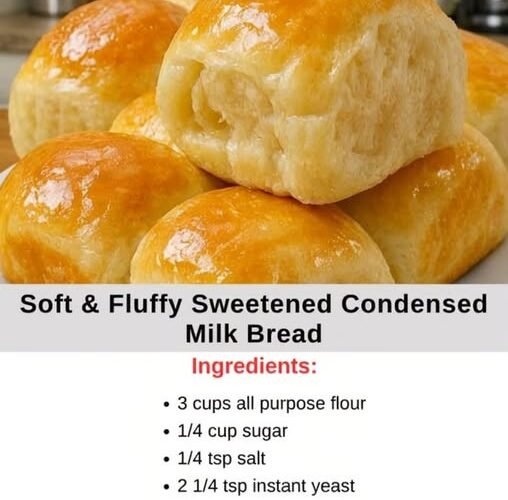
Sweet Condensed Milk Dinner Rolls: No-Knead Rolls That Rise Themselves
I have made a lot of bread in this kitchen, and most of it has asked something of me. You have to feel the dough. You have to time the rise. You have to stand there and knead for ten minutes while somebody in the other room needs you. Condensed milk dinner rolls are the opposite of that, and after the third batch I made on a weeknight when I genuinely did not want to be touched by dough, I stopped making the other kind. This one asks for eight minutes of stirring and then ninety minutes of you doing literally anything else. The whole thing rests on a piece of quiet chemistry. You mix flour, sugar, salt, yeast, warm water, and half a can of sweetened condensed milk into something that looks like a mess. You cover it with a towel. You leave. In an hour it has doubled and it is full of air, because the yeast ate the sugar and drank the water and made carbon dioxide, and the flour walls held it in. That is the kneading. The kneading was optional and nobody told me. What you get is a roll with a soft, almost custardy crumb and a browned, glossy top from an egg wash and a brush of butter while the pan is still screaming hot. It tears apart instead of slicing. It is sweet, but it is sweet the way a good dinner roll is sweet, which is to say it is pleasant with soup and completely fine on its own at8pm with nobody watching. It also happens to cost about twenty-three cents a roll, which I still think about. Nine of them for a bit over two dollars. I keep a can of condensed milk in the pantry now the way I used to keep flour, and when the weather turns and the light goes low at four in the afternoon, that is usually when a bowl comes out.Why You'll Love These Condensed Milk Dinner Rolls
There is no kneading and no mixer. Everything happens in one bowl with a wooden spoon. If you have never made bread before, this is the recipe I would hand you, because the failure modes are forgiving and the result is high enough that you will believe you did it. Almost all of it is waiting. Twenty minutes of work spread across ninety minutes of rise time. You can start it before dinner, go take a bath, read two chapters of something, and come back to finished rolls. They are soft for days. The condensed milk and the fat in the butter hold moisture in the crumb in a way that a leaner bread does not. Day-two rolls are still worth eating, which is rare and which matters enormously if you are baking for people at different times. The sweetness is moderate, not dessert-level. This is not a cinnamon roll situation. There is a quarter cup of sugar plus the condensed milk, and the result sits in that pleasant middle ground where it works with a bowl of soup and also works with butter and jam at breakfast. They freeze beautifully before baking. You can shape them, freeze them unbaked, and bake them fresh whenever you want. That single fact turns this into the best emergency dinner I have ever had in the house, because the rolls are ready and you just turn the oven on. They look like you tried. Golden, glossy, brushed, slightly irregular. Nobody is inspecting them for symmetry.Why This No-Knead Recipe Actually Works
The reason you can skip kneading is that a wet, no-knead dough is not relying on you to organize its gluten. It is relying on time. First, this dough is unusually wet on purpose. Three cups of flour with half a cup of water and half a cup of condensed milk gives you a shaggy, sticky dough that should not look like dough at all. That high hydration is what allows the flour to hydrate fully on its own. Gluten links form during that rest without any mechanical work, which is also why you must not add extra flour when it looks sticky. You are looking at the correct dough. Second, sugar feeds the yeast. Instant yeast is a living organism that needs fuel and moisture. The quarter cup of sugar plus the lactose and sucrose in the condensed milk is plenty, and the small amount of salt keeps the yeast from running wild and over-fermenting. Third, the condensed milk does two jobs at once. It hydrates the flour and it adds fat and protein from the milk solids, which is why the crumb is tender and why the rolls stay soft instead of drying out. Swap it for plain water and you get a decent roll. Swap it for plain milk plus sugar and you get a noticeably tighter, less pillowy crumb, which is exactly what your original swap tip warned about and is true. Fourth, there are two rises, and the second one matters more than the first. Most people underproof the second rise because they are in a hurry. That is the single reason home dinner rolls come out squat and dense. Thirty minutes, covered, and they will puff into glossy pillows right up until they go in the oven. Fifth, the egg wash is for shine and the butter is for flavor. Egg proteins set and brown with the milk fat in them, which is what gives the top its lacquered look. The melted butter goes on after the oven, while the crust is still soft enough to absorb it. Skip the butter and the rolls are still good. Skip the egg wash and they still rise. Skip either and you will notice. Sixth, and this one catches people: you need instant yeast, not active dry yeast. Instant yeast does not need its own proofing step and can be mixed straight into the flour. Active dry yeast in a cold dough like this will sit there not doing anything and then underperform. If that is all you own, dissolve it in the warm water first and add15 minutes to the first rise.Ingredient Breakdown: What Each One Is Doing
All-purpose flour (3 cups). The structure. Bread flour works too and gives a chewier roll, which I do not love here because the point is pillowy. Do not use whole wheat for more than a third of the total, and never all of it; this no-knead method depends on hydrated gluten and whole wheat stays coarse and dry. Sugar (1/4 cup). Yeast food, and just enough sweetness to keep the rolls from tasting like a bread roll. This is not a place to cut by more than a couple of tablespoons. Salt (1/4 teaspoon). Flavor first, yeast regulation second. If you want to reduce sodium, you can go down to 1/8 teaspoon, but do not go to zero. Undersalted bread tastes flat and rises inconsistently. Instant yeast (2 and 1/4 teaspoons). About 3/4 of a standard packet. It lives on the surface of the flour, so no proofing needed. If your kitchen is cold, 3 teaspoons is safer than 2, because cold dough rises slowly. Warm water (1/2 cup). This is the one measurement people get wrong, and getting it wrong is why dough does not rise. Aim for 110 to 115 degrees Fahrenheit. Use a thermometer. Above about 130 degrees you kill the yeast outright, and below 100 it will take forever in a cool kitchen. Sweetened condensed milk (1/2 cup). The reason this recipe is different from every other no-knead roll on the internet. Roughly 10.5 ounces, about a third of a 14-ounce can. Milk solids plus fat plus sugar. Egg (1, for the wash). Beaten with a teaspoon of milk or water so it is not too slippery to spread. It gives the glossy, deeply browned top. Butter (2 tablespoons, melted, for brushing). Pure flavor, applied while the rolls are hot. It is also the reason the top is soft and slightly sweet for a day or two.The Kitchen Equipment You Actually Need
One large mixing bowl, a wooden spoon or a sturdy spatula, and a clean kitchen towel with a rubber band around the bowl. That is the entire tool list. No rolling pin, no bench scraper, no dough hook, no stand mixer. You need an instant-read thermometer for the water. This is not fussy equipment; it is the single thing standing between you and dough that either dies or sits there for four hours. Alcohol thermometer or infrared both work. You need a half-sheet baking sheet lined with parchment. Not a greased pan; parchment. Sugar plus butter plus a hot oven will weld any bare metal surface to itself, and I have ruined a pan this way more than once. One thing you do not need is a cooling rack, though it helps. Rolls go on the sheet pan and cool there, and the residual heat finishes them evenly. A pastry brush is nice. A clean silicone basting brush or even a folded paper towel and a little patience will do the same job for the egg wash. For freezing unbaked rolls you will want a second baking sheet and a freezer bag or a roll of plastic wrap. That is the whole infrastructure for the trick that matters most.Step-by-Step: How to Make Condensed Milk Dinner Rolls
Step 1. Heat1/2 cup of water to 110-115 degrees F. Check it. If it is above 130, let it cool; if it is tepid, microwave it another fifteen seconds. Step 2. In a large bowl, whisk together 3 cups flour, 1/4 cup sugar, 1/4 tsp salt, and 2 and 1/4 tsp instant yeast. Step 3. Pour in the warm water and 1/2 cup condensed milk. Stir with a wooden spoon until everything comes together. It will look shaggy and sticky and wrong. That is correct. Do not add flour. Step 4. Cover the bowl with a clean towel, secure it with a rubber band, and set it somewhere warm for about 1 hour, until doubled in size and bubbly. Step 5. Oil your hands, then punch the dough down and turn it out. Divide into 9 equal pieces. Step 6. Shape each piece into a smooth ball by tucking the edges underneath and rolling it gently against the counter. Place them on a parchment-lined sheet pan, 2 to 3 inches apart. Step 7. Cover again and let them rise for another 30 minutes, until visibly puffy. Do not skip or shortcut this. Step 8. Preheat the oven to 350 degrees F during the second rise. Step 9. Beat 1 egg with a teaspoon of milk and brush it gently over the tops. Step 10. Bake 18 to 22 minutes, until the tops are deeply golden and the rolls sound slightly hollow when tapped on the bottom. Step 11. Brush with 2 tablespoons of melted butter immediately, while they are still hot enough to absorb it. Step 12. Cool five minutes if you have the discipline. Then stop being a disciplined person.Expert Tips From the Batches I Ruined
Buy a thermometer for the water. Do not eyeball it. My fastest ruined batch came from water straight out of the kettle at about 150 degrees. The dough sat there for two hours doing nothing and I nearly threw the yeast out. Cheap thermometer, ten dollars, and this problem never happens again. Warm kitchen beats warm water. If your kitchen is 65 degrees, the hour rise becomes two. Put the bowl on top of the oven while it preheats, or in a closed cupboard, or in a bowl of warm water. Do not put it in a hot car, which will over-proof it and give you a flat, sour, dense roll. Oil your hands, not the dough surface. If you are fighting sticky dough and reaching for the flour bag, stop. That is how you get a heavy, tough, no-longer-pillowy roll. A little oil on your palms handles it perfectly. Let the second rise finish properly. The rolls should look puffy and slightly domed, not identical to how they looked going in. If you are unsure, wait another ten minutes. Underproofed rolls are the number one reason people give up on homemade rolls. Tear, do not cut. The crust tears away and you get a ragged edge that soaks up butter. A clean knife cut makes flat faces that do not. I know a knife is faster. I do not care. Brush while hot, not after. Melted butter on a cooled roll just sits there. On a hot one it soaks in and the crust turns slightly sweet and shiny for a day. Use one sheet pan, spaced out. Rolls touching each other will proof into each other and pull apart when baked. You get a soft roll either way, but a spaced one is better and you get nine, not one giant blob. If you bake from frozen, skip the thaw. Frozen unbaked rolls go straight into a 350-degree oven with 5 to 10 extra minutes. Thawing first defeats the entire purpose.Common Mistakes and How to Fix Them
The dough did not rise at all. The water was too hot and you killed the yeast, or the yeast was old, or the bowl was cold and the kitchen was cold. Verify the yeast by mixing a teaspoon into a cup of warm water with a pinch of sugar; it should foam within ten minutes. Buy a fresh packet. Many packets are marked with a best-by date two years out, but bakers who cook in a humid kitchen routinely get dead yeast. The rolls came out dense and hard. Overmixed dough, or the second rise was skipped. Once the dough comes together, stop stirring. Also check your oven with a thermometer, because an underbaked-then-overbaked roll is a common outcome when you trust the clock entirely. The rolls are squat and spread out. The second rise was too short, or the oven was too hot. Look for a domed, puffy roll going into the oven, and pull at the 18-minute mark if your oven runs hot. The bottoms are pale or soggy. Two causes. Underbaking, which is common because people are nervous about dark crusts; or the parchment curled up into a wall that trapped steam. Weigh the parchment corners down with a small pan or a couple of spoons. The egg wash slid off and pooled. Pure beaten egg runs. Beat it with a teaspoon of milk or water first so it is not so liquid, and brush the tops with a light touch from underneath the roll upward rather than across. Everything tasted salty or nothing rose. You dumped the salt directly on top of the yeast and it killed it locally. Whisk the dry ingredients thoroughly first, which this recipe already does, and if you are in a hurry, mix the salt into the flour before the yeast goes in. The dough over-proofed and collapsed. You left it somewhere warm for far too long, or you let the second rise go double. Over-proofed dough tears when you handle it and bakes into a flat, dense, faintly sour roll. If it doubled in the first rise and then doubled again, you have gone too far. The rolls browned on the bottom but stayed pale on top. You used a dark or nonstick sheet pan. Use a light aluminum pan, or set the pan on a lower rack.Ingredient Substitutions That Work, and Ones That Do Not
No condensed milk. Your original tip is correct and worth restating precisely: use 1/2 cup whole milk plus 2 extra tablespoons of sugar. The rolls will still be good. They will be slightly tighter, slightly less rich, and they will not stay quite as soft on day three. If you want to close the gap, reduce your homemade condensed milk to about 1/3 cup: simmer 1 cup whole milk with 2/3 cup white sugar over low heat until it thickens and reduces by about a third, then cool it completely. That is roughly a third of the price of the can. Dairy-free. Use unsweetened plant milk and add the 2 tablespoons of sugar that you lost with the condensed milk. Oat milk is the best texture here because of its fat content. Use vegan butter for the topping. For the wash, use aquafaba, which is the liquid in a can of chickpeas, and add a pinch of sugar for color. Whole wheat. Replace up to 1 cup of the 3 with whole wheat flour. More than that and you get a heavy, dense roll because whole wheat bran absorbs water and cuts gluten development. Use whole wheat for flavor, not for health theater. Gluten-free: I would not. No-knead bread relies entirely on hydrated gluten for its structure, and gluten-free flour will give you a dense, bready puck that no amount of rising time will rescue. If you need gluten-free bread, use a recipe written for it rather than adapting this one, and bake from a yeasted dough mix designed for that purpose. Sugar-free. Not realistic. The sugar feeds the yeast, and the condensed milk is the sweet engine of the recipe. Substituting a granulated no-sugar sweetener here will leave you with a plain dinner roll and a confused yeast. Different fat on top. Olive oil brushed on gives you a crustier, less sweet roll that goes beautifully with soup. Ghee works. Buttered honey powder makes it dessert. Lower sodium. Cut the salt to 1/8 teaspoon. The 1/4 teaspoon works out to roughly 590 milligrams of sodium spread across nine rolls, which is the entire sodium content of these rolls.Variations: Sweet Rolls and the Savory Turn
Cinnamon rolls. Roll the dough into a log, brush with melted butter, sprinkle with1/3 cup brown sugar and 2 teaspoons cinnamon, roll up, cut into 8 or 9 spirals, and proof as directed. Frost with a simple cream cheese glaze while they are still warm. Same dough, entirely different animal. Herb and cheese dinner rolls. Omit the sugar and the condensed milk, replace them with 1/2 cup warm broth and 2 tablespoons olive oil, and fold in 1/2 cup shredded cheddar, 2 tablespoons chopped parsley, and 1 teaspoon garlic powder with the flour. This becomes actual dinner bread rather than a sweet roll, and it is the version I make for Thanksgiving. Apple-cinnamon pecan rolls. Finely dice 1 crisp apple, toss it with cinnamon and a tablespoon of brown sugar, and fold it in with the nuts. Add 1/2 cup chopped pecans for a caramelized bottom. Do not use a soft baking apple; it turns to mush. Chocolate chip dessert rolls. Fold in 3/4 cup chocolate chips after the first rise. Reduce the sugar by a tablespoon so it is not cloying. Pull-apart. Arrange the shaped balls very close together in a round baking dish, almost touching, so they bake as one connected golden mass. Brush the whole surface with butter and put a thin layer of glaze or jam between them. Hamburger buns. Shape into 6 larger balls and bake at 350 degrees for 20 to 24 minutes. Great for sliders. Same dough, same method, just fewer and bigger. Muffin-tin rolls. Fill a 12-count muffin tin halfway with dough, let each one rise into a cup, then bake at 350 for 15 to 18 minutes. Nine to twelve small rolls, which is the version I make for a brunch crowd.How to Make This Bread a Little Healthier
Let us be clear about the starting point. Condensed milk dinner rolls are a sweet bread with about 43 grams of carbohydrate and 34 grams of sugar per roll. There is no version of this that I would call healthy, and I would rather say so than imply otherwise. But you can move things in honest directions. Cut the added sugar to 2 tablespoons. The condensed milk is still doing the sweetening, so the roll stays sweet. You lose very little. Swap 1 cup of the flour for whole wheat. More fiber, a nuttier flavor, and it holds up better on day two. Go no further than that with this method. Use the savory variation. Omit the sugar and condensed milk entirely and use broth and olive oil instead. You have gone from a dessert-adjacent roll to an actual dinner roll, and the calorie and sugar drop is enormous. This is by far the biggest lever available, and it costs you nothing. Brush with olive oil instead of butter. Saves about 7 grams of saturated fat across nine rolls if you eat all nine, which, to be honest, you might. Eaten in context. One of these rolls alongside a bowl of soup with beans and greens is a genuinely balanced meal. The roll is not the problem; the plate it sits on is. What I will not do is tell you these are low-sugar, high-fiber, or keto. They are none of those things, and claiming otherwise is how food blogs get in trouble with readers and with the ad networks.Meal Prep and Make-Ahead Tips
This is one of the few breads I would genuinely call a make-ahead recipe, and the reason is that almost every step pauses. Overnight cold-proof. Do the mix, do the first rise, punch down, shape into balls, place them on a pan, cover, and put the pan in the refrigerator overnight. Take it out at room temperature for 60 to 90 minutes while the oven heats, then brush and bake. The long cold rise develops far more flavor than a two-hour room-temperature rise ever will. This is the single best upgrade to this recipe. Freeze unbaked rolls. Shape after the first rise, arrange on a parchment-lined sheet, freeze until solid, then transfer to a freezer bag with parchment between the layers. They keep for about a month. Bake straight from frozen at 350 degrees with 5 to 10 extra minutes. This is the emergency dinner plan. Freeze the dough as one mass. After the first rise, flatten the dough into a slab in a freezer bag, seal, and refrigerate for up to three days. Thaw overnight in the fridge, punch down, and shape. Double the batch. There is no window where a doubled batch is not useful. Half to eat this week, half to freeze unbaked. The only real cost is that you need two sheet pans and you have to move dough from one to the other, which is annoying. Bake while you clean up. Eighteen to twenty-two minutes is enough time to wash the bowl, the spoon, and the sheet pan. The kitchen is nearly clean when the rolls come out.How to Store Dinner Rolls
Keep them in a plastic bag or an airtight container at room temperature, and eat them within 3 days. A bread bag or a clean pillowcase tied at the end both work; the point is just to keep air off them. Do not refrigerate. Refrigerated air pulls moisture out of the crumb and turns these soft, tender rolls into firm little sponges in about two days. This is the one storage rule people break and then blame the recipe for. If you are storing them cut-side up, cover the exposed face with plastic wrap or a damp towel so the crumb does not dry against the air. For longer than three days, freeze. Either the baked rolls or, preferably, unbaked ones before they ever go in the oven.Can You Freeze Condensed Milk Dinner Rolls?
Yes, and freezing them unbaked is the better version of the answer. Unbaked, shaped. After shaping, lay the rolls on a parchment-lined sheet and freeze them until solid, about an hour. Then move them to a freezer bag with parchment between the layers so they do not bond. They keep for roughly a month and bake directly from frozen at 350 degrees with 5 to 10 extra minutes. Do not thaw them first. Baked. Cool the rolls completely, wrap each one individually in foil or plastic, then bag them. They keep for up to 3 months. Thaw at room temperature for 20 to 30 minutes, or reheat from frozen. For a same-week refresh, bake at 350 for eight minutes, then turn off the heat and leave the rolls in the switched-off oven for ten more minutes. A dry, barely-warm oven does the same job as a proofer.How to Reheat Dinner Rolls
From the oven, best result. 350 degrees for 6 to 8 minutes. Put a teaspoon of water in a small baking dish in the oven with them if you want the crust to stay soft as well as warm. Stovetop skillet. A few tablespoons of butter in a skillet over medium-low heat, 3 to 4 minutes a side. This is the method that makes a day-old roll taste freshly baked, and it is the reason I keep this recipe in the rotation. Toaster oven. Four to six minutes at 350. Best option for one or two rolls without heating the whole kitchen. Microwave, last resort. 15 to 20 seconds per roll. Add a cup of water to the microwave alongside them so the steam keeps the crust from going leathery. Wrap them in a damp paper towel for a softer result. Do not reheat with the egg side facing down. The butter wash reabsorbs into the bottom and you get a soggy, greasy underside. Always cut-side up or top-side up.What to Serve With Condensed Milk Dinner Rolls
The sweetness is mild, which means these work in far more places than a dessert roll would. The rule is to pair them with something salty, savory, or sharp. A bowl of soup is the honest answer and the correct one. Beef stew, chicken and dumpling, minestrone, split pea, or a pot of chili. The rolls are essentially edible spoons for all of it. Red-eye gravy over a split roll is a complete meal in two bites and needs no explanation. Scrambled eggs, or a soft omelet folded into a split roll with a little cheddar. This is breakfast and it is excellent. Slow-roasted pulled pork or a beef pot roast, shredded onto a roll with a drizzle of the pan juices. Moist meat plus moist bread is why this pairing exists. Sharp cheddar or blue cheese melted on top under the broiler, ninety seconds, until it bubbles. Butter and your best jam or preserves. This is the Saturday-morning answer and I do not apologize for it. For the savory version with broth instead of condensed milk, add a bowl of soup and you have a proper dinner with zero sweet in it.Beverage Pairings
Coffee. The default, and correct. Anywhere from black to a latte, and these are sweet enough that even a plain cup works. Chai. The warm spice makes the condensed milk taste intentional rather than sugary. This is my pick for a cold morning. Milk. Cold, straight from the fridge, next to a warm roll. Unfashionable and unbeatable. Sweet tea or iced tea. Slightly sweet, cold, and it cuts the roll without competing with it. Hot cider. Cinnamon and spice against the brown-butter top of the roll. Best in October. Apple cider. The obvious apple pairing, and it works with the butter glaze especially well. A mimosa or a sparkling wine. If you are serving these at a holiday brunch rather than a Tuesday dinner, bubbles and egg wash are a genuinely good combination. Espresso. For the people who will eat three of these and feel fine about it. A double shot cuts straight through.FAQ
Can I really make condensed milk dinner rolls without kneading?
Yes, and the rising time is doing the kneading for you. You mix everything with a spoon until it looks like a shaggy mess, cover it, and leave it for an hour. During that hour the flour hydrates fully and the gluten links form on their own, which is exactly what kneading would have done, only slower and gentler. The dough is intentionally wetter and stickier than a kneaded dough and that is correct. If it does not look messy and sticky, you have added too much flour.Why aren't my dinner rolls fluffy?
Almost always the second rise. People are patient for the first hour and then impatient for the thirty minutes, and the second rise is where the air that makes rolls pillowy actually gets into them. The rolls should look visibly puffy and slightly domed going into the oven, not identical to how they looked shaped. Beyond that, check four things: the water was between 110 and 115 degrees, the yeast was alive, you did not stir once everything came together, and you did not add flour to fix the stickiness.Can I make these dinner rolls ahead of time?
Easily, and this is the best thing about them. For the best flavor, mix the dough, let it rise, punch it down, shape the rolls, cover them, and refrigerate overnight. In the morning take them out while the oven heats, let them come to room temperature for 60 to 90 minutes, brush, and bake. The long slow cold rise is noticeably better than a quick warm one. For even more advance planning, freeze the shaped rolls unbaked on a sheet pan until solid, then bag them and bake straight from frozen whenever you want.Do I have to use condensed milk?
No, but you should know what you lose. Half a cup of whole milk plus 2 extra tablespoons of sugar is a fine substitute and the rolls will still be good. They will just be slightly tighter, slightly less rich, and they will firm up a bit faster on day two because the milk solids are doing less work holding moisture. If you want the original texture for about a third of the price, simmer 1 cup of whole milk with 2/3 cup of sugar until it thickens and drops by a third, then cool it fully before mixing.What temperature should the water be for instant yeast?
Between 110 and 115 degrees Fahrenheit, and you should use a thermometer rather than your wrist. Above roughly 130 degrees you kill the yeast and the dough will sit there for two hours doing nothing. Below 100 degrees it will work but very slowly, and if your kitchen is cool the rise will take closer to ninety minutes than sixty. Warm the water in the microwave in fifteen-second bursts and test it.Are condensed milk dinner rolls gluten-free or keto?
No, on both counts, and I would rather be blunt about it. These are made with 3 cups of all-purpose flour and sweetened condensed milk, so they are not keto, not gluten-free, not low-sugar, and around 255 calories and 34 grams of sugar per roll. I do not offer a gluten-free version of this one on purpose, because no-knead bread depends on hydrated gluten for its structure and a gluten-free swap turns it into a dense puck.How long do homemade dinner rolls stay soft?
About3 days at room temperature in a plastic bag or airtight container, which is longer than most homemade bread. The condensed milk and the butter on top are doing real work holding moisture in the crumb, which is part of why this recipe keeps so well. Do not refrigerate them, because cold air dries bread out fast and you will lose the texture in about two days. For anything beyond three days, freeze them unbaked.Can I turn this dough into hamburger buns?
Yes. Shape it into 6 larger balls instead of 9 and add 3 to 5 minutes to the bake, so roughly 20 to 24 minutes at 350 degrees. The dough is soft enough that it needs no rolling, and the egg wash gives you a bun sturdy enough to hold a patty without falling apart. It is also the base for a cinnamon roll version if you roll the dough into a log, fill it with brown sugar and cinnamon, and cut it into spirals before the second rise.Nutrition Information
These figures are estimates, calculated from the ingredients as written and rounded. Your condensed milk brand and your flour will move the numbers a little. Per roll, based on 9 rolls from one batch:- Calories: approximately 255
- Total fat: approximately 3.5 g
- Carbohydrates: approximately 43 g, of which about 34 g is sugars
- Protein: approximately 4 g
- Fiber: approximately 1 g
- Sodium: approximately 80 mg
Final Thoughts
This is the bread I make when I want the house to smell good and I do not want to be kneading anything. Eight minutes of work, ninety minutes of doing nothing, and a batch of rolls that cost less than the takeout order you would have placed instead. The savory version is the one I have been making more often lately, swapping the condensed milk for broth and olive oil, and it has made me realize how often I reach for sweet when I actually wanted savory. So tell me: are you a sweet-roll person or a garlic-and-herb person? Because the dough is the same either way, and I am curious which half of this table actually eats them.Condensed Milk Dinner Rolls
No-Knead · Sweet Dinner Rolls
Ingredients
Instructions
- 1Heat 1/2 cup of water to 110-115°F. Above 130°F kills the yeast, so check it.
- 2Whisk together 3 cups flour, 1/4 cup sugar, 1/4 tsp salt, and 2-1/4 tsp instant yeast.
- 3Add the warm water and 1/2 cup condensed milk. Stir until it comes together. Shaggy and sticky is correct; do not add flour.
- 4Cover with a clean towel secured with a rubber band. Rise1 hour in a warm spot, until doubled.
- 5Oil your hands, punch down, and divide into 9 equal pieces.
- 6Tuck the edges under and roll each piece into a ball. Place on a parchment-lined sheet pan, 2 to 3 inches apart.
- 7Cover and rise 30 minutes more, until visibly puffy and slightly domed.
- 8Preheat the oven to 350°F during the second rise.
- 9Brush the tops gently with the beaten egg mixture.
- 10Bake 18-22 minutes, until deeply golden and hollow-sounding when tapped on the bottom.
- 11Brush with melted butter immediately, while still hot. Cool 5 minutes if you can wait.
Kitchen Notes & Cost Breakdown
- Estimated cost: about $2.10 for 9 rolls, or $0.23 each. Condensed milk is roughly $0.70 of that; reducing your own on the stove cuts it to about $0.25.
- Keyword tip: Forno-knead dinner rolls, your best asset is the shaggy sticky dough photo, not the finished rolls. That visual is the whole promise of the post.
- Keyword tip: The two questions worth targeting with separate internal links arewhy aren't my dinner rolls fluffy and can I make these ahead of time. Both have real answers further up this page.
- The water temperature is the make-or-break step. Photo of the thermometer reading belongs next to step 1.
- Do not skip the second rise. Underproofing is the number one reason home rolls come out dense.
- Overnight cold-proof in the fridge is the single best upgrade to this recipe. Same method, noticeably better flavor.
- Gluten-free version is not recommended for this dough. No-knead structure depends on hydrated gluten.
Nutrition Facts (estimated, per roll)
255Calories
43 gCarbs
34 gSugars
4 gProtein
3.5 gTotal Fat
80 mgSodium
Nutrition is an estimate calculated from the ingredients as written and rounded, based on 9 rolls. Values vary by brand.
This recipe contains all-purpose flour and sweetened condensed milk and is not keto, gluten-free, low-sugar, or diabetes-friendly. All nutrition figures are estimates. Nothing on this page is medical advice or a weight-loss claim — if you have specific dietary guidance from a clinician, follow that instead of a website.