
Pecan Dump Cake: 8 Ingredients, One Pan, and a Sauce That Sits at the Bottom Like a Trap
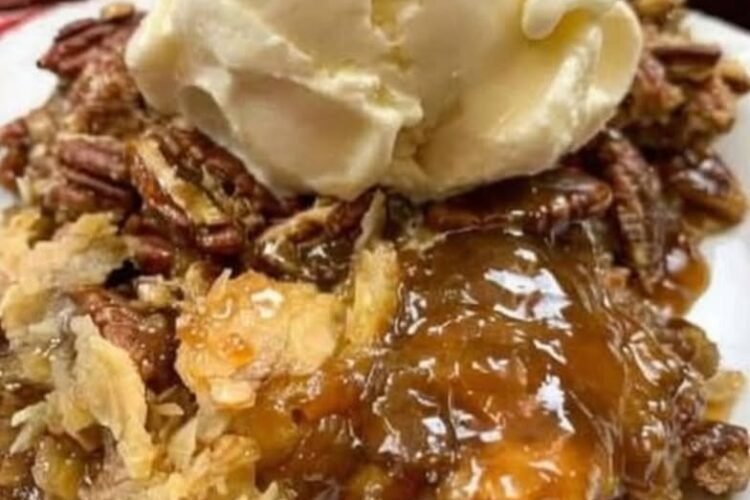
This is the dessert I make when I need to win a room without leaving the house for more than a store run. My mother-in-law brought a pan of it to Sunday dinner a few weeks ago and I watched three grown men stop talking mid-sentence, put their phones face down on the table, and not say another word for about ten minutes. At one point somebody asked if there was more while the pan was still visibly half full. That is how good this thing is. It looks like nothing. Eight ingredients, a 9x13 pan, and about five minutes of work. You put butter in the dish, you pour cake batter over it, you scatter pecans, you pour hot brown sugar water over the top, and then you leave the room for forty minutes. It is called a dump cake because at no point do you do anything more complicated than dump something into a pan, and I want to be clear that the name undersells it badly. What comes out of the oven is two desserts in one dish. The top is a golden, pecan-studded cake that sets up like a coffee cake. The bottom is a glossy, dark, almost caramel sauce that forms underneath the whole thing and then climbs up through the middle as it bakes. You scoop and get both at once, which is why it is part cobbler, part pecan pie, and part something I genuinely do not have a name for. If you want the sauce by itself, dig straight down to the corners with a big spoon like a person with no self-control, which is the only correct way to eat this. It is also the cheapest dessert I make. About five dollars and fifty cents for twelve servings, forty cents a plate, and it fills a table with almost nothing standing at the counter. That is why it has been in Southern church cookbooks and why it will still be in whatever passes for one around here. It has been printed in regional papers for a very long time and the reason is that it never fails, which is more than you can say for most desserts.Why You’ll Love This Pecan Dump Cake
It is eight ingredients and one pan. No mixer, no separate sauce, no draining, no layering. You use one bowl for the batter and one for the sugar and you wash exactly two things. Nearly all of it is oven time. About five minutes of work spread across forty. You can assemble it before dinner, put it in, and come back to it done. It makes its own sauce. This is the part people do not believe until they see it. Butter melts into the bottom of the pan, brown sugar dissolves into hot water, and the two of them caramelize underneath the batter over forty minutes and turn into a real sauce. You are not pouring anything over the top when it is finished. It is even better on day two. The sauce thickens in the fridge overnight into something closer to a pecan caramel, and the cake layer goes from moist to almost fudged. It is a genuinely good make-ahead dish. It scales by two without any math. Double everything, use two dishes, and do not try to make it in one giant pan. Bake time does not double, but it will run a little longer. This is what I make when forty people are coming to Thanksgiving. Feeds a crowd for pocket change. Five dollars and fifty cents for twelve. Nobody has ever complimented the price, and they have all complimented the pan.Why This Dump Cake Recipe Actually Works
The whole thing rests on a piece of deliberate layering, and every step exists to protect the layers. First, the butter goes in the pan cold and the pan goes into the oven. Melting it on the stove and then pouring it in would work, but putting the cold dish in the oven while it preheats means the butter melts slowly from underneath over the course of forty minutes, and the last twenty of those minutes it is browning. That is where the nutty flavor comes from. The butter also prevents the cake from sticking, which means you never grease anything else. Second, the cake batter is very loose, on purpose. One and a half cups of self-rising flour, one and a half cups of sugar, and two-thirds of a cup of milk is a ratio that looks too thin to be cake batter. It is correct. It has to be loose enough to seep down into the butter and the hot sugar water rather than sitting on top of them as a layer. A stiff batter gives you a dry cake on top and a burnt sauce underneath, which is not the dessert anybody wants. Third, the hot water dissolves the sugar and gives the sauce a head start. One and a half cups of packed brown sugar in one and a half cups of hot water will not fully dissolve — you will see some grit at the bottom of the bowl and that is fine, it melts in the pan. But the water has to be genuinely hot. If you dump it cold, you get congealed brown sugar streaks instead of a sauce, and it will not caramelize properly. Boiling is even better. This is one of the few recipes where the instruction “hot” really means hot. Fourth, you never stir, and this is the instruction that sounds wrong every single time. Stirring mixes the batter into the sugar water, and you get a uniform, ordinary, perfectly fine cake. Not stirring keeps them in three distinct layers that transform separately: the batter bakes into a cake on top, the sugar water reduces to caramel underneath, and the butter browns in the middle of both. That is the entire dessert. Every time I have checked, out of curiosity, I have confirmed that I ruined it. Fifth, the pecans go on before the sugar water, not after. They sit in the middle layer, where they get submerged partway and stay on the surface at the edges. That gives you some toasted-on-top nuts and some chewy ones sitting in the sauce, which is better than all one or all the other. Sixth, and this is the practical one: this is not a cobbler in the traditional sense. A cobbler has a fruit filling and a biscuit or crumb topping. What you are making is closer to a cake with caramel poured into the bottom, and calling it a cobbler is how people end up disappointed and questioning their oven.Ingredient Breakdown: What Each One Is Actually Doing
Real butter, 6 tablespoons. The entire dessert, and you were right to write “don’t skip this” next to it. It browns in the pan, it makes the sauce, it prevents sticking, and it is the reason the bottom third of this thing tastes like toffee. Do not substitute oil. Do not use a butter blend or a “baking butter” if you can help it, because the milk solids in those are exactly what stops the flavor from developing. Pecans, 1 cup, chopped. About16 grams of fat and 3 grams of protein per serving, plus the entire flavor identity of the dish. Chop them yourself with the bottom of a heavy pan on a sheet pan, four minutes, rather than using bagged halves, because small pieces distribute better and the halves sit on the surface and scorch. Toast them dry in a skillet first if you want the nuttier version, and cool them completely before they go in or you will melt the butter prematurely. Self-rising flour, 1.5 cups. Structure plus leavening in one, and it is the reason this recipe is genuinely eight ingredients rather than ten. One cup of self-rising flour is roughly one cup of all-purpose plus 1.5 teaspoons of baking powder plus half a teaspoon of salt, so if you use plain flour you will need to add both. I do not recommend it here; the fat content of self-rising flour is marginally higher and the loose batter behaves better. Granulated sugar, 1.5 cups. Sweetness and tenderness in the cake layer, and it also slows the gluten down, which is why the top stays tender rather than turning into a dry crumb cake. Milk, two-thirds cup. The liquid in the batter. Any fat percentage works, and this is the only place a substitution is nearly free. Vanilla extract, 1 teaspoon. Rounds out the brown butter. Use real, not imitation. Packed brown sugar, 1.5 cups. The entire sauce. Melting, molasses, and the color.Pack it. This is the one measurement people get wrong and it matters more than it sounds: a loosely filled cup of brown sugar weighs about 200 grams and a packed cup weighs closer to 220, and the difference shows up as a thinner, weaker sauce. Use dark brown for a deeper molasses flavor and darker color, light for a milder result. Hot water, 1.5 cups. Dissolves the sugar, creates the caramel, and produces the steam that keeps the cake layer moist. Boiling is better than merely hot.Pecan Dump Cake
Southern · One Pan · Brown Sugar Pecan Sauce
Ingredients
Instructions
- 1Preheat the oven to 350°F. Put 6 tablespoons of butter in a 9x13-inch baking dish and set the dish in the oven while it preheats. Let it melt completely, about 10 minutes.
- 2In a bowl, whisk together 1-1/2 cups self-rising flour and 1-1/2 cups granulated sugar.
- 3Stir in 2/3 cup milk and 1 teaspoon vanilla until smooth and thick, like cake batter.
- 4Pour the batter directly over the melted butter. Do not stir. Do not spread. Let it sit.
- 5Scatter the 1 cup of chopped pecans evenly over the top.
- 6In a separate bowl, stir 1-1/2 cups packed brown sugar with 1-1/2 cups hot water until mostly dissolved. A little grit at the bottom is fine.
- 7Pour that mixture slowly and evenly over the whole pan, including the edges. Do not stir. It will look wrong and wrong is correct.
- 8Bake 35-45 minutes at 350°F, until the top is golden and set and the edges are bubbling with dark caramel sauce. If the top darkens before 35 minutes, tent it loosely with foil.
- 9Rest 10 minutes. It firms up as it rests, and slicing too early gives you soup.
- 10Serve warm with vanilla ice cream or whipped cream. Take the sauce from the corners.
Kitchen Notes & Cost Breakdown
- Estimated cost: about $5.50 total, or $0.46 per serving across 12. Pecans are $2.50 of that; every other item is pantry-level.
- Buy brown sugar in-shell if you can. 1.5 cups of chopped pecans is about half a pound in the shell and roughly a third of the price.
- PACK the brown sugar. A loosely filled cup is roughly 20 g lighter than a packed one, and you will get a thinner, weaker sauce. Press it down in the measuring cup with your thumb until it is firm and slightly moist-looking.
- Use boiling water if you have a kettle. The word “hot” in this recipe means hot. Cold water gives you congealed sugar streaks instead of caramel.
- Keyword tip: The wedge of the layered cross-section is the entire content strategy for this post. Photograph the pan immediately after baking, before anyone cuts it. That image answers “what does it look like inside” better than any paragraph can.
- Keyword tip: How do I know when pecan dump cake is done? is the highest-traffic FAQ question in this niche. Put the visual doneness check next to the whipped cream photo, not in text.
- Do not stir at any point after the butter. That is the whole recipe. Everything else is a detail.
- Dark vs light brown sugar: dark gives a deeper molasses flavor and a darker sauce; light gives a milder, more vanilla-forward result. Both work.
Nutrition Facts (estimated, per serving)
400Calories
67 gCarbs
65 gSugars
13 gTotal Fat
3 gProtein
180 mgSodium
Nutrition is an estimate calculated from the ingredients as written and rounded, based on 12 servings. Fiber is approximately 1 g per serving. Values vary by brand.
This recipe contains 3 cups of total sugar and isnot low-sugar, keto, low-carb, gluten-free, or diabetes-friendly. It is a dessert and all nutrition figures are estimates. Nothing on this page is medical advice or a weight-loss claim — if you have specific dietary guidance from a clinician, follow that instead of a website.