
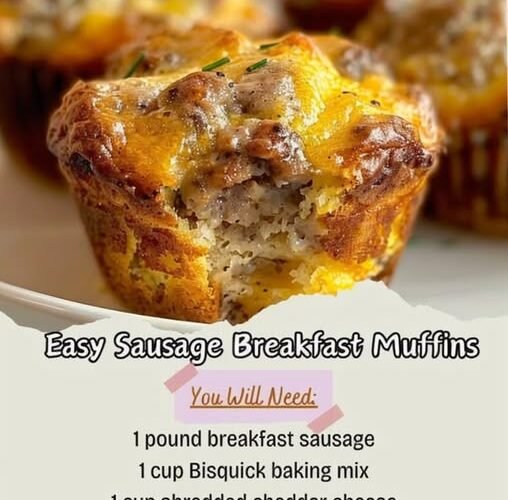
Bisquick Sausage Muffins: The Freezer Breakfast That Gets My Teenager Out of Bed
My son has been sleeping through his alarm for weeks. Every morning has been the same forty minutes of shouting, and I had given up on the idea that a breakfast could fix it. Then I made a batch of these on a Sunday night, and on Monday morning I woke up to the smell coming from the kitchen and he was already down the stairs before I said anything.
That is the whole pitch for these bisquick sausage muffins, and it is a real one. You brown a pound of sausage, whisk four eggs and a little milk, stir in a cup of baking mix, a cup of cheddar, and some pepper, and you get twelve golden savory muffins that hold their shape in one hand and keep somebody full until lunch. Fifty-eight cents each. About forty minutes of work on a Sunday and you have breakfast covered for most of a week
There is a real reason to make these instead of something from a box, and it is not sentiment. The 375-degree oven is what gives you the crispy browned edges, and the quarter cup of milk is what turns what would otherwise be a dense egg puck into an actual soft muffin. Bisquick is flour, double-acting baking powder, and salt — it is a dry ingredient, and with only eggs for liquid the flour never fully hydrates and the baking powder has nothing to expand into. The milk changes the texture completely, and if you have ever made a version of these that came out heavy and tight, that is almost certainly why.
Two things about this recipe you should know before you start, because both matter more than anything else in the instructions. The first is that a toothpick test is the wrong way to tell when they are done. At 375 degrees the outside browns faster than the inside sets, so a muffin can look completely finished on top and still be under-cooked through the middle. Egg-based batter needs to reach 160 degrees. Pull one out, put a thermometer in the center, and check. It takes ten seconds and it is the only test that actually answers the question.
The second is that a batch in the fridge does not last a week. Cooked egg plus cooked pork plus dairy is a four-day refrigerator food, not a seven-day one, and I want to be direct about that because this is exactly the kind of recipe where people keep it longer than they should without thinking about it. Freeze the second half instead. It holds two to three months, it reheats from solid, and it tastes better than it does on day five in the fridge.
Why You’ll Love These Bisquick Sausage Muffins
Fifty-eight cents each and twelve of them. Seven dollars for a week of breakfasts, or a week and a half for one person.
They freeze and come back almost exactly right. Baked fully, cooled completely, wrapped individually. This is the real meal-prep version, not the pretend one.
The milk makes them soft instead of dense. That quarter cup is the difference between a muffin and an egg puck, and it is worth knowing why it is there.
Fifteen and a half grams of protein a muffin. Two of them is thirty-one grams, which is more than most protein bars, and this is a savory thing you actually want to eat.
They travel. One hand, no plate, no utensils, no mess in the car or the backpack. This is the correct shape for a morning.
My teenager eats them. That is the actual review I care about, and it is a harder test than a potluck.
Two swaps make it gluten-free — a gluten-free baking blend and half a teaspoon of xanthan gum per cup of it. Everything else already qualifies.
The batch you assemble on Sunday is one act, not four. Brown, whisk, stir, bake. Twenty-five minutes of oven time you can ignore.
Two things that will ruin this batch. 1. Do not trust a toothpick. At 375°F the tops brown before the centers finish, and egg-based batter has to reach 160°F. Pull one muffin, put a thermometer in the dead center, and check. If you have no thermometer, cut one in half — the center should look set and matte, not wet or glossy.
2. Do not keep these in the fridge for a week. Cooked egg plus cooked pork plus dairy is 4 days maximum. Bake the batch, eat what you will finish in four days, and freeze the rest immediately. Warm muffins go stale in the freezer — cool them completely on a rack first, then wrap, or you will get ice crystals inside the plastic and freezer burn within three weeks.
Bisquick Sausage Muffins
40 Min Work · Freezer Friendly · 12 Muffins
Ingredients
No salt in the ingredient list by default, because sausage and Bisquick both already carry plenty. Add the 1/4 teaspoon only if your sausage is very lean or homemade and unsalted.
Instructions
- 1Preheat the oven to 375°F and grease a 12-cup muffin tin very thoroughly.
- 2Remove the sausage from its casings and brown it in a skillet over medium heat, breaking it into small crumbles. Cook 8 to 10 minutes until it is deeply browned with crispy edges and has reached 160°F. Do not stop at "no pink remains" — pink is a color, not a temperature. Let it cool 5 minutes so it does not scramble the eggs.
- 3Drain off all but about a tablespoon of the grease. Leave a little — that is the flavor and the moisture.
- 4Whisk the eggs and the 1/4 cup milk in a large bowl until completely uniform, with no streaks of white.
- 5Add the Bisquick, three-quarters cup of the cheddar, the pepper, and the garlic powder. Stir with a spoon just until combined, about 15 to 20 strokes. Stop the moment the flour streaks disappear. Overmixing develops gluten and you get dense, tough, bouncy muffins.
- 6Fold in the cooled sausage until evenly distributed.
- 7Divide among the 12 cups. Bisquick uses double-acting baking powder — part of it activates at room temperature when liquid hits it, part in the oven — so they will rise. Fill no more than two-thirds full. Overfilling pushes the top over and you get a mushroom shape that browns before the middle cooks.
- 8Bake 18 to 24 minutes at 375°F. Start checking at 18. They are done when the tops are golden and a thermometer in the center of one reads 160°F. The toothpick test cannot answer this question.
- 9Add the reserved quarter cup of cheddar over the top during the last 3 minutes so it melts into a proper browned cap.
- 10Let them cool in the pan 5 to 10 minutes. Egg muffins stick if you pull them hot. Then run a knife around the edges and turn them out onto a rack.
- 11For freezing: cool completely on the rack, about 30 minutes, before wrapping anything. Warm muffins create condensation inside the plastic and you get freezer burn in three weeks. Wrap each one in plastic, then put them in a freezer bag with the air pressed out, and label it with the date.
Reheating Times — Which One You Want
| Starting State | Best Method | How Long | Result |
|---|---|---|---|
| From the fridge | Microwave on high | 20 to 30 seconds | Good enough for a morning. Soft crust, hot center. |
| From the fridge | 375°F oven or toaster oven | 8 to 12 minutes | Best result. Restores the crust you baked. |
| From frozen | Microwave at 50% power, flip once | 60 to 90 seconds | Thirty seconds is not enough from frozen. That will leave the center cold and the edges hot. |
| From frozen | Air fryer at 375°F | 6 to 8 minutes | Best of both. Crisp outside, hot through, no flip. |
| From frozen | 375°F oven | 12 to 15 minutes | Works fine. Give them 10 minutes from frozen before checking. |
Never microwave a frozen muffin at full power and expect a crisp crust. Microwaving softens by steaming — you will get a hot, wet, slightly doughy exterior every time. If you care about the crust, use the oven or the air fryer.
Kitchen Notes & Cost Breakdown
- Estimated cost: about $7 for 12 muffins, or $0.58 each. Sausage $3.50, cheddar $2.00, eggs $1.00, Bisquick $0.30, milk and spices $0.20. Three of them on a plate with a piece of fruit is under two dollars.
- Brown the sausage to 160°F first. Raw sausage suspended in a partly-set egg matrix is the classic failure. Fully cooking it separately is both the safe version and the one that gives you the crispy edges you described.
- Leave a tablespoon of fat. Drain it all and you drain the flavor. The original instruction says "drain the excess grease," which is right, and "drain all of it," which is wrong.
- Why 375°F and not 350°F. Higher heat sets the outside faster and browns the exposed edges of the cup, which is where the crispness comes from. It also means you must check earlier, because the top will look done before the middle is.
- The milk is not optional. Without it the flour cannot hydrate, the baking powder has nothing to expand into, and you get a dense, scone-like puck. It is also the reason this version yields 12 muffins where a milkless version only yields about 10.
- 160°F, not a toothpick. Egg-based batter. Cut one in half if you have no thermometer — the center should look set and matte, not wet.
- Cool completely before wrapping. Warm muffins in plastic means condensation, which means ice crystals, which means freezer burn. Thirty minutes on a rack.
- Four days in the fridge, two to three months in the freezer. Not a week.
- Grate your own cheddar. Pre-shredded has anti-caking powder and will not melt into that browned cap.
- Keyword tip: the thumbnail is a muffin torn in half on a plate, shot from slightly above, showing the soft interior and the browned sausage crumbles inside. The cross-section is what proves the texture and it is the only thing that separates this photo from a plain muffin photo. Second image: a freezer bag full of wrapped muffins, which sells the meal-prep angle to the exact person searching for this.
Nutrition Facts (estimated)
Estimates based on 12 muffins, standard pork breakfast sausage, and full-fat sharp cheddar. Two muffins is a normal serving and gives you 440 calories with 31 grams of protein. Sodium is the number to know here: roughly 530 mg a muffin, about 1,060 mg for two, coming almost entirely from the sausage, the cheddar, and the baking mix. Turkey sausage and reduced-fat cheddar both cut it substantially. All figures are estimates, not a lab analysis, and sodium varies a lot by brand.
Food Safety
- Cook the raw breakfast sausage to 160°F before it goes anywhere near the eggs. Do not use color as a test.
- The batter contains raw egg. Keep it covered and refrigerated until it goes in the oven, and wash hands and utensils after handling eggs.
- Do not leave the batter out at room temperature more than 2 hours, or 1 hour above 90°F.
- Refrigerate baked muffins covered and use within 4 days. Not a week. Egg, cooked pork, and dairy together do not keep that long.
- Freeze the rest immediately. 2 to 3 months, wrapped individually once fully cool.
- Reheat until steaming hot all the way through. From frozen, that is 60 to 90 seconds at 50% power in the microwave, or 6 to 8 minutes in an air fryer.
- Do not leave a muffin on the counter overnight. It contains cooked egg and cooked pork.
Contains egg, dairy, and pork. It is not gluten-free as written because Bisquick contains wheat; swap to a gluten-free baking blend plus 1/2 teaspoon xanthan gum per cup to make it gluten-free, and verify your sausage and cheese labels. It is not keto, low-carb, low-sugar, low-sodium, or health food — sodium runs about 530 mg a muffin. All nutrition figures are estimates. Nothing on this page is medical advice or a weight-loss claim. If you have specific dietary guidance from a clinician, follow that instead of a website.