
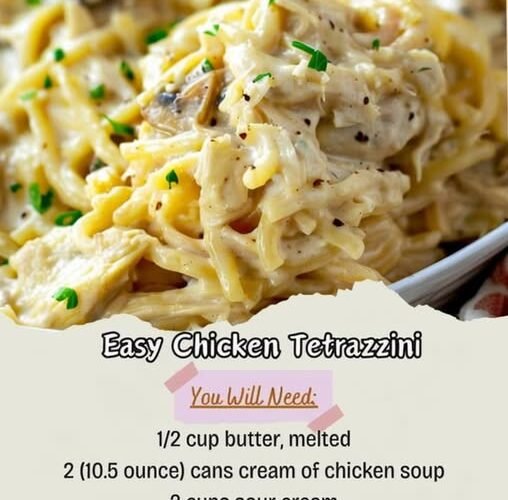
Chicken Tetrazzini: 41 Grams of Protein and the Step Every Recipe Skips
My mother made chicken tetrazzini every single time somebody in the family needed cheering up. Bad day at school, rainy Saturday, a hard week for no particular reason — tetrazzini. And it worked every time, not because it is complicated or fancy, but because it is the kind of meal that makes a room go quiet and everyone just eat. I have been making this version for years now and I am confident about two things. The first is that it has forty-one grams of protein in a generous serving, which is a real number and not a marketing claim — three cups of chicken, half a cup of Parmesan, a cup of mozzarella, and the sauce all add up, and it comes out of a dish that tastes like comfort food rather than a fitness product. The second is that almost every recipe for this dish, including the one I started from, has a step missing, and that missing step is the reason most homemade tetrazzini tastes flat. The missing step is the mushrooms. Every version I have ever read tells you to slice them and stir them straight into the bowl with the sauce and chicken. Raw mushrooms in a casserole are about ninety percent water, and their cell walls are made of chitin, which holds water very tightly and then lets it go all at once when heated. So they steam instead of browning, they dump all of that liquid into your sauce and thin it out, and when the dish comes out of the oven they are pale, spongy, and tasteless. They are decoration rather than an ingredient. Slice them and saut them first. Five to seven minutes in butter over medium heat, until they are deeply browned and the pan is dry again. That single move does two completely different things at once. It drives the water off in the skillet where it evaporates harmlessly instead of going into your sauce, and it gives you Maillard browning, which is a chemical reaction between amino acids and sugars above about 280 degrees that produces hundreds of new flavor compounds that raw mushrooms simply do not have. It is the whole difference between mushrooms that are in the dish and mushrooms that belong in it. The other three things are smaller. Use softened butter, not melted. Melted butter is liquid fat at 140 degrees and cold sour cream is a chilled emulsion at 40, and when the hot fat hits the cold emulsion the butterfat re-solidifies into little beads. You whisk it smooth, you set the bowl down, and the beads come back. Softened butter incorporates without seizing. Do not add the salt until you have tasted it. Two cans of condensed cream of chicken soup carry roughly four thousand four hundred milligrams of sodium by themselves, before the Parmesan, before the mozzarella, before the broth. This is the highest-sodium recipe I have written and I am going to say so in the nutrition panel rather than quietly rounding it down. The ½ teaspoon of salt in the original is on top of that. I cut it to a pinch and told you to taste first. And pull the pasta two minutes before the package says al dente. It spends another thirty-five minutes at 350 degrees absorbing liquid from the sauce. Start at al dente and you end at mush.Why You’ll Love This Chicken Tetrazzini
Forty-one grams of protein a serving. From the chicken, the Parmesan, and the mozzarella, in a dish that does not taste like it is trying to be healthy. That is the number I would put in front of anyone. Six generous servings, or eight modest ones. One 9x13 pan, one bowl, one skillet for the mushrooms. It genuinely feeds a crowd cheaply. A rotisserie chicken gives you three cups of shredded chicken for five dollars, and that is the difference between this being a two-dollar dish and a five-dollar one. It is the comfort food on this site I am most confident about. Creamy pasta, tender chicken, mushrooms, a golden top. It is not a difficult recipe and it does not need to be. You can make it entirely ahead. Assemble it, cover it, refrigerate it overnight, and bake it in the morning. This is a real make-ahead, not a theoretical one. It freezes and reheats well if you do one specific thing, which is in the freezing section. It uses up leftover chicken. A rotisserie chicken, Sunday's roast, or Thanksgiving turkey all work, and the turkey version is genuinely the classic. One substitution and it becomes a completely different dish. Shrimp instead of chicken is the original tetrazzini, named for the opera singer Luisa Tetrazzini. Most people have never heard that and it is true.Chicken Tetrazzini
One Dish · 41 g Protein · Make Ahead
Ingredients
The Greek yogurt swap works, with conditions. Use it at room temperature, fold it gently rather than whisking it, and pull the bake 5 minutes early, at 28 to 30 minutes. Yogurt is cultured and strained so its proteins are already set, and a full 35 minutes at 350°F will tighten them until they squeeze out whey and you get grainy curds.
Instructions
- 1Bring a large pot of generously salted water to a boil. Cook the pasta 2 minutes less than the package directions for al dente, then drain and set aside.
- 2Meanwhile, preheat the oven to 350°F and grease a 9x13 baking dish.
- 3Saut the mushrooms. Melt a tablespoon of butter in a skillet over medium heat, add the sliced mushrooms in a single layer, and leave them alone for 3 to 4 minutes. Stir, then cook another 3 to 4 minutes until they are deeply browned and the pan is dry again. Set them aside.
- 4In a large bowl, whisk together the softened butter, both cans of cream of chicken soup, the room-temperature sour cream, and the cup of broth until completely smooth.
- 5Stir in the cooked chicken, the sauted mushrooms, the Parmesan, the garlic powder, and the pepper. Taste before you add any salt.
- 6Add the drained pasta and fold gently with a spatula until every strand is coated. Fold, do not stir hard — overworking cooked pasta breaks it into short pieces.
- 7Pour into the greased dish and spread it evenly. The mixture should look slightly loose and saucy, not packed. If it looks dry, stir in another 2 tablespoons of broth.
- 8Sprinkle the mozzarella evenly over the top, right to the edges.
- 9Bake 30 to 35 minutes at 350°F, until the edges are actively bubbling and the cheese is melted and lightly golden. Check at 30.
- 10Let it rest 5 full minutes before serving. This is not optional and it is not about the cheese. The sauce is an emulsion held together by the soup's starch and the sour cream's proteins, and it needs those five minutes to set to a consistency that will hold on a spoon. Cut it at zero minutes and you get a puddle.
- 11Garnish with parsley and serve with something to mop up the pan sauce, because that is the part your husband is going to be scraping out.
Sodium: What Is Actually In This
| Source | Approximate Sodium | What To Do |
|---|---|---|
| 2 cans condensed cream of chicken soup | ~4,400 mg | Use the reduced-sodium version. Cuts about 1,200 mg for the whole pan. |
| 1/2 cup Parmesan | ~770 mg | Fine. It is flavor you need. |
| 1 cup mozzarella | ~450 mg | Reduced-sodium mozzarella exists if you need it. |
| 3 cups rotisserie chicken | ~700 mg | Home-cooked or poached chicken drops this to near zero. |
| 1/2 cup broth | ~460 mg | Low-sodium broth is an easy swap. |
| 2 cups sour cream | ~180 mg | Not a factor. |
| The 1/2 tsp added salt | ~1,150 mg | Omit it or cut to a pinch. Taste first. This is the easiest thousand milligrams you will ever remove. |
| Total as written | ~8,100 mg for the pan | About 1,350 mg a serving. Over half the daily recommended limit. |
| Total with the reductions | ~4,300 mg for the pan | About 720 mg a serving. Which is a normal, honest number for a creamy casserole. |
I want to be straightforward about this: the protein in this dish is genuinely excellent and the sodium is genuinely high, and both of those things are true at the same time. Sodium varies a lot by brand, so treat these as directional rather than exact.
Kitchen Notes & Cost Breakdown
- Estimated cost: about $22 for the pan, or $3.70 a generous serving. Rotisserie chicken $5.50, butter $2.50, pasta $1.50, mushrooms $2.50, sour cream $1.50, soup $3.00, mozzarella $3.00, Parmesan $2.25, broth and spices $0.75. A rotisserie chicken is the single best value here and it saves you thirty minutes.
- Saut the mushrooms. This is the fix and I am going to keep saying it. Brown, dry pan, then add them.
- Softened butter, not melted. Cold sour cream seizes melted butter into beads.
- Room-temperature sour cream. Fifteen minutes on the counter while you cook the pasta. It incorporates far better and it will not shock the butter.
- Pull the pasta early. Two minutes before al dente. It cooks for thirty-five more minutes in the oven.
- Broom the broth up to a full cup. Twelve ounces of dry pasta makes about six cups cooked and it will keep drinking while it bakes and while it sits. The original's half cup is the reason this dish goes dry by day two.
- Rest it five minutes. The sauce needs to set before you cut it.
- Taste before salting. See the sodium table above.
- Grate your own cheese. Anti-caking powder in pre-shredded mozzarella keeps it from melting into a proper sheet.
- Keyword tip: the thumbnail is the 9x13 straight from the oven, shot at a slight angle so you see the golden cheese on top and the bubbling sauce at the edge of the dish. One spoon lifting a portion out, with a strand of spaghetti trailing and mushrooms visible, is the shot that proves it is creamy rather than dry. Overhead grids of casseroles do not sell creaminess — the lift does.
Nutrition Facts (estimated)
Estimates based on 6 generous servings from a 9x13. Two things I want to say without dressing them up. The protein is excellent — 41 grams in one serving is a genuinely high-protein dinner and it comes from real chicken rather than a powder. The sodium is high — about 1,350 mg as written, which is over half the daily recommended limit, and almost all of it comes from the condensed soup and the added salt. Using reduced-sodium soup, low-sodium broth, and omitting the added salt brings it to roughly 720 mg, which is a normal figure. Eight modest servings brings the calories down to about 576 with 31 g protein. All figures are estimates, not a lab analysis.
Food Safety
- Use fully cooked chicken. A rotisserie chicken, leftover roast, or poached breast all work. If you want to cook it from raw, cook it to 165°F first — do not put raw chicken in a casserole that bakes for 35 minutes and hope.
- Refrigerate leftovers covered within 2 hours and use within 4 days.
- Reheat until steaming hot all the way through.
- Thaw frozen tetrazzini in the refrigerator overnight, never on the counter.
- Keep it at the lowest possible heat while reheating. Cream sauce and condensed soup break on high heat and go grainy.