
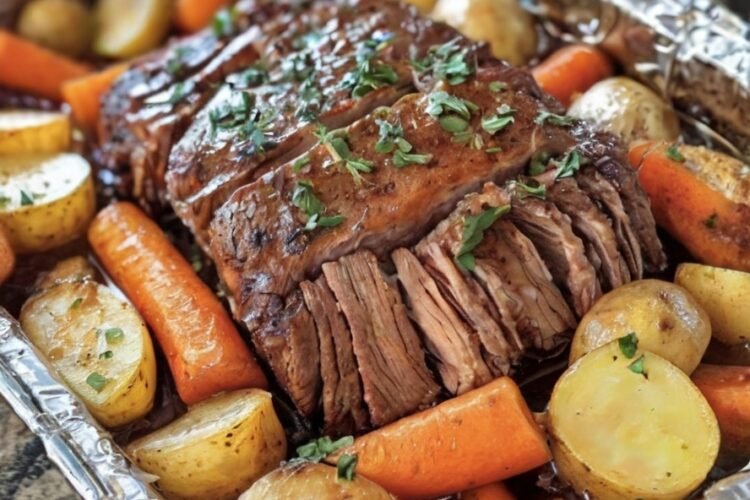
Baked 3 Packet Pot Roast: The Dump-and-Bake Sunday Dinner That Falls Right Apart
This baked 3 packet pot roast is the closest thing to a magic trick my kitchen knows. A chuck roast gets seared, dropped onto a bed of carrots, potatoes, and onion, and then a single bowl of ranch, Italian, and brown gravy mixes whisked with water is poured over the whole thing. Cover it, walk away for three hours, and what comes out is a roast that shreds under a fork, vegetables that soaked up every bit of the gravy, and a dinner that tastes like you spent all day on it when you really spent twenty minutes. The three packets do all the seasoning, thickening, and flavor stacking for you. There's a reason this shortcut became a Midwest potluck staple. Pot roast is one of the oldest comfort foods there is — a cheap cut of beef, slow heat, and patience turning something tough into something melting and rich. The packets are just a modern stand-in for the seasoning shelf: ranch brings herbs and tang, Italian brings oregano and garlic, and brown gravy brings the savory depth and the starch that thickens the pan juices into a real gravy. Together they hit the same notes a long-simmered layered roast would, without the pantry of individual spices. The dish also has a quiet, practical genius to it. Because the vegetables sit underneath the roast, they don't dry out on top of a hot oven — they braise in the fat and juices dripping down through the meat, which is why they come out buttery and deeply savory. And because everything cooks in one oven-safe pot, you're not managing a sauce separately or dirtying a second pan. It's the kind of one-pot dinner that earns a permanent spot in the rotation, and it feeds six with leftovers for lunch. Now the honest part, because I'd rather tell you than let you find out: three seasoning packets plus broth put this around 1,100 milligrams of sodium a serving, and that number is worth respecting. The lower-sodium build below — low-sodium everything — knocks it down a lot while keeping the convenience. This is also not a gluten-free dish as written, since those packets typically contain wheat. But as a hearty, high-protein, comfort-food dinner that basically makes itself, it's hard to beat. Let's make it.Why You'll Love This 3 Packet Pot Roast
- Three seasoning packets do all the work — no spice cabinet required.
- The oven does everything after a 20-minute start. It's genuinely dump-and-bake.
- Chuck roast braises into shreddable, fork-tender meat and rich onion gravy.
- Vegetables cook under the roast and turn buttery, not dry.
- About 35 grams of protein a serving from real whole-muscle beef.
- One pot, minimal cleanup, and it feeds six with leftovers.
- Trivially adaptable to a slow cooker or a lower-sodium build.
Why This Recipe Works
The science here is a braise, and a braise is how you turn a tough cut into a tender one. Chuck roast is full of connective tissue — collagen — that's tough when cooked fast and hot but melts into gelatin when cooked slow and moist. Gelatin is what gives a good pot roast its silky, lip-sticking body, and it only happens in that low, wet, hours-long environment. Baking at 325°F under a tight lid creates exactly that: gentle, humid, even heat that keeps the meat at a simmer without boiling it dry. That's the whole reason the roast can shred with a fork at hour three when it would be shoe leather at hour one on high heat. The packets are doing more than flavoring. The ranch and Italian mixes bring dried herbs, garlic, onion, and tang; the brown gravy mix brings savory depth and, crucially, starch. That starch is what thickens the combination of the roast's rendered fat, its own juices, and the cup of water or broth into a glossy gravy that clings instead of running. Without the gravy packet you'd have delicious meat sitting in watery pan juices. With it, the liquid that collects in the pot becomes a sauce worth spooning over mashed potatoes. That's the shortcut working exactly as advertised. And the layering matters. Searing the roast first builds a browned crust through the Maillard reaction, which is where a lot of the deep, roasted flavor comes from — skip it and the dish tastes flatter. Setting the roast on top of the vegetables rather than mixing them around the meat protects the vegetables from drying out and lets them braise in the drippings that fall through. Everything steams, browns, and mingles in the same sealed pot, and the result is one cohesive dish rather than a roast with a side of vegetables. It's a smart architecture disguised as laziness.Ingredient Breakdown
| Ingredient | What it does | Notes |
|---|---|---|
| 1 (3–4 lb) chuck roast | The star — braises into shreddable, rich beef | Chuck is ideal because of its marbling and collagen. Avoid lean cuts like eye of round; they dry out. |
| 1 packet ranch dressing mix | Herbs, garlic, onion, and tang | The dried dip/dressing mix, not bottled ranch. Same for the others below. |
| 1 packet Italian dressing mix | Oregano, basil, garlic — the Italian herb backbone | Dried dressing/seasoning packet. Adds brightness to the gravy. |
| 1 packet brown gravy mix | Savory depth and the starch that thickens the gravy | This is what turns pan juices into gravy. Don't skip it. |
| 1 cup water or beef broth | The liquid that starts the braise | Broth adds flavor; water is fine. Add only about 1 cup — the covered pot keeps moisture in. |
| 2 tablespoons olive oil | For searing the roast and coating the vegetables | Any high-heat neutral oil works. |
| 4–5 carrots, 5–6 potatoes, 1 onion | The braised vegetable base that soaks up the gravy | Chunky cuts hold up over 3–4 hours. Russets get creamy; Yukon Golds hold shape better. |
| Salt and pepper | For seasoning the roast before searing | Season lightly — the packets bring a lot of salt already. |
The one thing to get right: use only about 1 cup of liquid. The covered pot traps the roast's own juices, and the gravy packet needs a concentrated liquid to turn into gravy. Overfilling makes thin, watery sauce.
Kitchen Equipment You Actually Need
- Dutch oven or large oven-safe pot with a lid — heavy-bottomed is best for searing and even braising. A 5- to 6-quart size fits a 3–4 lb roast plus vegetables.
- Tongs — for turning the roast while searing without piercing it.
- Small bowl and whisk — to combine the three packets with the water or broth until smooth and lump-free.
- Instant-read thermometer — to confirm doneness (145°F food-safety minimum; 200–205°F for shreddable).
- Aluminum foil — a backup if your pot's lid isn't tight.
- Cutting board and knife — for the chunky vegetables and for carving or shredding the roast.
Step-by-Step Instructions
- Preheat and heat the pot. Preheat the oven to 325°F. In a large Dutch oven, heat the olive oil over medium-high heat.
- Sear the roast. Season the chuck roast with salt and pepper and sear it about 3–4 minutes per side until nicely browned all over. Remove it and set it aside.
- Add the vegetables. In the same pot, add the carrots, potatoes, and onion and give them a quick stir to coat in the remaining oil and drippings.
- Return the roast. Set the seared roast back on top of the vegetables.
- Mix the packets. In a small bowl, whisk the ranch, Italian, and brown gravy packets with the water or broth until fully combined and smooth.
- Pour and cover. Pour the mixture evenly over the roast and vegetables, then cover the pot with a lid or foil.
- Bake 3–4 hours. Bake until the meat is fork-tender and falls apart easily, checking at 3 hours.
- Serve. Spoon the gravy over the meat and vegetables and serve hot.
Doneness and leftovers, stated plainly. Beef's food-safety minimum is 145°F with a 3-minute rest, but for a fall-apart pot roast you want to cook to 200–205°F so the collagen melts and the meat shreds. A fork should twist easily and the roast should pull apart with no resistance. Cool leftovers within two hours, refrigerate in an airtight container, and use within 3 to 4 days. Keep the meat stored in the gravy so it stays moist, and reheat covered with a splash of water or broth.
Expert Tips
Don't skip the sear. Those few minutes per side build the browned crust that makes a pot roast taste roasted rather than simply boiled. It's the one step that earns its extra effort.
Season the meat lightly. The three packets carry a lot of salt. Salt the roast sparingly before searing and taste the gravy before adding anything at the table.
Use only about a cup of liquid. A covered braise makes its own juices. More liquid means thin gravy; the packets need a concentrated base to thicken.
Cut the vegetables chunky. They cook for three to four hours. Big, even chunks of carrot, potato, and onion hold their shape and don't dissolve into the gravy.
Choose the right potato. Russets turn creamy and thicken the gravy as they break down; Yukon Golds and red potatoes hold their shape better. Pick based on the texture you want.
Keep the lid tight. A loose lid lets steam escape, \)the braise dry out, and the meat stall. Foil pressed under the lid is a cheap insurance policy.
Check at 3 hours, not 4. Roast sizes and ovens vary. Start checking when the meat is close to fork-tender; a smaller roast may be done early and a larger one may want the full 4 hours.
Let it rest a few minutes. Resting lets the juices redistribute and the gravy settle so the meat stays moist and the sauce stays where you spoon it.
Common Mistakes
Over-salting. The number one trap with packet recipes. Ranch, Italian, and gravy mixes are all salty, and adding extra salt to the meat or the gravy tips the whole dish. Season the roast sparingly and taste before adding more.
Adding too much liquid. A cup is the target. Extra liquid makes the gravy thin and weak, because there's only so much starch in the gravy packet to thicken it.
Skipping the sear. Going straight to baking leaves the roast pale and the flavor flat. The sear is where the deep roasted taste comes from.
Using a lean cut. Eye of round or sirloin will dry out over a long braise. Chuck's fat and connective tissue are exactly why it works here.
Underbaking out of impatience. If the meat is still tough, it isn't done — it needs more time, not less. Toughness at hour two usually means it's just not at the collagen-melting temperature yet.
Cutting the vegetables too small. Small pieces turn to mush over 3–4 hours. Chunk them larger than you think you should.
Using a pan that isn't oven-safe. Handles, coatings, and lids on some pots aren't rated for a 325°F oven for hours. Make sure yours is.
Not keeping the lid on. Every peek lets heat and steam out and stretches the cook time. Cover it and trust the clock.
Ingredient Substitutions
| If you don't have… | Use… | Watch out for… |
|---|---|---|
| Chuck roast | Beef brisket, round roast, or short ribs | Brisket and round are leaner and can need more time and liquid; short ribs are richer and faster. Stick with chuck for the classic result. |
| The three seasoning packets | Low-sodium versions of the same packets | The single easiest sodium fix, and the flavor difference is negligible. Check that the gravy packet is GF if you need GF. |
| Beef broth | Water, or low-sodium beef broth | Water is fine and lowers sodium; broth adds a little depth. Match to your sodium goal. |
| Whole carrots and potatoes | Baby carrots and baby potatoes | Both cook faster and hold shape; baby potatoes don't need peeling. They may soften sooner than large chunks. |
| Russet potatoes | Yukon Gold or red potatoes | Yukon Golds hold shape better; reds are waxy and firm. Russets make a creamier, thicker gravy. |
| Olive oil | Any high-heat neutral oil or bacon fat | Bacon fat adds smoky flavor but more salt and fat — factor it into the sodium. |
| Pot roast (gluten-free) | Certified gluten-free ranch, Italian, and brown gravy packets | Standard packets typically contain wheat and maltodextrin. GF packets exist but must be labeled. That swap is the only GF path. |
| Ranch packet | Homemade ranch seasoning (dried herbs, garlic, onion, dill) | A homemade blend gives you full control over the salt and avoids additives, but it's no longer a 3-packet shortcut. |
Variations
- Slow cooker version. Sear the roast, add everything to the slow cooker, and cook on low 8–10 hours or high 4–5 hours. Same packets, same vegetables, no oven required.
- Mississippi pot roast. Add a stick of butter and a handful of pepperoncini (with a splash of their juice) along with the packets for a tangy, rich, cult-favorite spin.
- Extra root vegetables. Toss in parsnips, turnips, or celery root with the carrots and potatoes for more depth and nutrition.
- Thicker gravy. Whisk a cornstarch slurry (1 tablespoon cornstarch plus water) and stir it in about 30 minutes before the end of cooking.
- Mushroom pot roast. Add 8 ounces of sliced mushrooms in the last hour for an earthy, gravy-friendly addition.
- Low-sodium build. Low-sodium packets, low-sodium broth, and no added salt. It drops the sodium dramatically and still tastes rich.
- Make-your-own seasoning version. Build your own ranch, Italian, and gravy blends from the spice shelf for full control over salt and additives.
Make It Healthier
The honest levers here are sodium, fat, and portion, in that order. Sodium is the big one: switching to low-sodium packets and low-sodium broth and skipping any added salt can cut a large chunk of the 1,100 milligrams a serving without touching the convenience. Since so much of the sodium rides in the gravy, spooning a little less over your plate is another easy reduction. For fat, trim visible fat from the roast before searing and skim some of the pooled fat off the gravy before serving — the braise's flavor comes from the meat and gelatin, not from leaving every bit of fat in the pot. Nutritionally, this dish has a real strength: it's high in protein — about 35 grams a serving from whole-muscle beef — and it includes a full serving of vegetables. To lean into that, add more vegetables (mushrooms, parsnips, extra carrots) and serve it over lightly dressed greens or with a big green salad rather than a mountain of mashed potatoes, so the plate isn't all starch and gravy. What I won't do is pretend three seasoning packets are a health food. They're a convenience, and used thoughtfully with the low-sodium build and a sensible portion, this is a hearty, high-protein, veggie-included dinner that fits a normal week just fine.Meal Prep
This is one of the best meal-prep dinners there is, because pot roast gets better as it sits and the leftovers shred into meal-sized portions with almost no work. After dinner, pull the roast apart with two forks and store the shredded beef in its gravy so it stays moist; portion it with the vegetables into containers and you've got three or four lunches or a couple of dinners handled. The gravy is what keeps it from drying out, so don't drain it off. It's also a natural make-ahead for a busy week: cook it on Sunday and eat it Monday and Tuesday. The flavors deepen overnight, and the meat is even easier to shred the next day. If you want to prep the components, you can chop the vegetables and mix the packets a day ahead and refrigerate them separately, then assemble and bake the next day — the bake time doesn't change, though a cold roast may want a few extra minutes. For a potluck, bake it fully, transport it in the Dutch oven, and reheat it gently; it travels beautifully because it's meant to be served saucy and warm.Storage
Cool leftovers within two hours, then store the beef and vegetables in their gravy in an airtight container in the refrigerator for 3 to 4 days. Keeping everything submerged in the gravy is the whole trick to leftovers that taste as good as the first night — the sauce protects the meat from drying and keeps coaxing flavor into it as it sits. The flavors genuinely meld and improve overnight, which is why pot roast leftovers are often better than day one. The gravy will firm up and may form a layer of fat on top once chilled, which is completely normal. You can lift some of that fat off with a spoon for a leaner reheat, or simply stir it back in for maximum flavor. Store in glass or a non-reactive container; the gravy is mild but glass keeps it clean-tasting. Once reheated a second time, plan to finish it within a day, since repeated reheating softens the vegetables further and dries the meat edges.Freezing
Pot roast freezes beautifully — arguably better than almost any casserole — because it's already a moist, saucy braise. Cool it completely, then freeze the shredded beef and vegetables in the gravy in freezer-safe containers or bags, leaving a little headroom, for up to 3 months. Freezing it in the gravy is what keeps the meat from drying out and turning stringy on thawing. Thaw overnight in the refrigerator, then reheat gently. To reheat from frozen, either thaw first and warm covered in the oven at 325°F for 25–30 minutes, or warm gently on the stovetop in a covered pot with a splash of water or broth, stirring until it's hot through and the gravy is glossy again. Individual portions reheat in the microwave, covered, in about two to three minutes with a splash of liquid. The potatoes will soften a touch on freezing, so if you're freezing on purpose, consider freezing the meat and gravy and adding fresh potatoes when you reheat for the best texture.Reheating
The stovetop is the gentlest way to reheat a full batch: put the roast, vegetables, and gravy in a covered pot over low to medium-low heat with a splash of water or broth, and stir occasionally until everything is hot through. The cover keeps the meat moist and revives the gravy. The oven works equally well — 325°F, covered, 25–30 minutes from the fridge — and is the easiest route if it's already in a Dutch oven. For a single portion, the microwave is fine: put the beef and vegetables in a bowl with a spoonful of gravy and a splash of water, cover, and heat in 60-second bursts, stirring between, until hot. The splash of liquid matters — gravy tightens in the fridge and can scorch or clump if you reheat it dry. What to avoid is reheating uncovered on high heat, which dries the meat, toughens the edges, and reduces the gravy to a salty film. Low, covered, and a little liquid every time.What to Serve With It
Creamy mashed potatoes are the classic and the right call, because pot roast gravy over mashed potatoes is one of the great pairings in American comfort food — the potato soaks up the sauce and the plate becomes a warm, cohesive thing. If you'd rather not add more starch, the roast is a complete meal on its own with the braised carrots and potatoes already in the pot, and you can round it out with steamed or buttered green beans, roasted broccoli, or a mixed greens salad with a light vinaigrette for a fresh, bright contrast. Warm crusty bread is the other essential, not for nutrition but for engineering: it's the tool you use to wipe up the last of the gravy. If you want to stretch the meal for a bigger crowd, serve it over buttered egg noodles, polenta, or rice instead of potatoes, all of which love a savory beef gravy. For a holiday or a cold-weather Sunday, it sits naturally next to a green salad, a dish of pickled or roasted vegetables, and a wedge of cornbread — anything that lets you clean the plate with a little bread and a satisfied sigh.Beverage Pairings
A medium-to-full red is the natural match here. A Cabernet Sauvignon, a Zinfandel, or a Syrah has the body and dark fruit to stand up to rich braised beef and a savory gravy, and the tannin cuts the fat. If you prefer something lighter, a Côtes du Rhône or a Malbec works well. Beer-wise, an amber ale, a brown ale, or a stout pairs beautifully for the same reason — malt and roast notes echo the beef. What to avoid: delicate whites and very light beers, both of which get buried under the gravy. Nonalcoholic options that genuinely work: unsweetened iced tea, sparkling water with a lemon twist, or a tall glass of cold milk, which sounds old-fashioned but is exactly what feels right at a pot-roast dinner. Root beer on ice is another nostalgic pick if kids or non-drinkers are at the table. There's nothing precious happening here — this is Sunday-dinner food, and the right drink is whatever's cold and lets you go back for a second helping of gravy.Frequently Asked Questions
What are the 3 packets in 3 packet pot roast?
One packet of ranch dressing mix, one packet of Italian dressing mix, and one packet of brown gravy mix. Whisked together with about a cup of water or beef broth and poured over a seared chuck roast and vegetables, they season the dish and, thanks to the starch in the gravy mix, thicken the pan juices into gravy. Use the dried dressing/dip and gravy packets from the spice aisle, not bottled dressings.What's the best cut of beef for pot roast?
Chuck roast is the classic and the best choice for this recipe. Its marbling and connective tissue melt into rich, shreddable meat over a long braise. Avoid lean cuts like eye of round or sirloin, which dry out and turn tough when cooked slow and long. Brisket and short ribs also work; brisket is leaner and may need a little more time and liquid, and short ribs are richer and cook a bit faster.Why is my pot roast tough?
Almost always undercooking or the wrong cut. Toughness at hour two usually means the meat hasn't reached the temperature where collagen melts — it needs to get to about 200–205°F, so give it more time, not less. If it's still tough after four hours, your oven may run low or the lid isn't tight and moisture is escaping. Lean cuts like eye of round will be tough no matter what; use chuck. Cook until a fork twists easily and the meat shreds.Can I make this in a slow cooker?
Yes, and it's a great option. Sear the roast in a skillet first for flavor, then add it and the vegetables to the slow cooker with the packet mixture and cook on low 8–10 hours or on high 4–5 hours, until fork-tender. Use the same roughly 1 cup of liquid; the slow cooker traps even more moisture than the oven, so resist adding extra or the gravy turns watery. Thicken with a cornstarch slurry at the end if you like.Why is my gravy watery or too thick?
Watery almost always means too much liquid — more than the gravy packet's starch can thicken. Stick to about 1 cup and no more. Too thick means the liquid cooked down further than expected or the starch is concentrated; just stir in a splash of hot water or broth until it's the consistency you want. For a reliably thicker gravy, whisk in a cornstarch slurry about 30 minutes before the end of cooking.Is 3 packet pot roast gluten-free?
Not as written. Ranch, Italian, and brown gravy packets typically contain wheat and maltodextrin, so the standard version is not gluten-free. To make a gluten-free version, use certified gluten-free packets for all three and a gluten-free beef broth, and check every label. That combination is the only basis for calling it gluten-free — the standard recipe with ordinary packets is not GF.How do I make it lower in sodium?
Use low-sodium ranch, Italian, and brown gravy packets and low-sodium beef broth, skip any added salt on the roast, and use water instead of broth if you want to go further. Since so much of the sodium is in the gravy, spooning a little less over your plate also helps. Those changes cut the per-serving number substantially while keeping the flavor, because the herbs and the beef itself carry a lot of the taste without contributing sodium.How do I know when the pot roast is done?
Use two tests together. The reliable one is a fork: it should twist easily in the meat and the roast should pull apart with little resistance, which usually happens around 200–205°F internally. The food-safety minimum is lower — beef is safe at 145°F with a 3-minute rest — but for a shreddable pot roast you want it well past that, up near 205°F. If it's still firm, cover it back up and keep baking, checking every 20–30 minutes.Nutrition Facts (Estimated)
| Per serving (1/6 of roast with vegetables and gravy) | Amount |
|---|---|
| Calories | ~600 |
| Total Fat | ~30 g |
| Saturated Fat | ~11 g |
| Carbohydrates | ~37 g |
| Fiber | ~5 g |
| Sugars | ~8 g |
| Protein | ~35 g |
| Sodium | ~1,100 mg |
Final Thoughts
Baked 3 packet pot roast is what I make when I want a Sunday-dinner feeling on a Wednesday schedule. Sear a chuck roast, stack the vegetables beneath it, whisk three packets into a cup of liquid, pour it over, and let the oven work for three hours. What comes back is shredded, fork-tender beef, carrots and potatoes swollen with savory gravy, and a pot of sauce that belongs on mashed potatoes. About 35 grams of protein a serving, one pot, and twenty minutes of actually doing something — the rest is patience you can spend elsewhere. Make it in the oven or the slow cooker, add mushroom or root vegetables if you like, and build it low-sodium by using low-sodium packets and broth and holding back on the salt, because the honest truth is that the three packets are where the sodium lives. Serve it with mashed potatoes and green beans for the classic plate, or over noodles and greens for something a little lighter, and put warm bread on the table to clean up the gravy. It's humble, hearty, old-fashioned comfort food that mostly makes itself, and it absolutely belongs in your rotation.Baked 3 Packet Pot Roast
Sear a chuck roast, stack vegetables under it, pour three packets over — the oven does the restIngredients
Directions
- Preheat the oven to 325°F.
- Heat the olive oil in a large oven-safe pot or Dutch oven over medium-high heat.
- Season the roast with salt and pepper and sear 3–4 minutes per side until nicely browned. Remove and set aside.
- Add the carrots, potatoes, and onion to the pot and stir to coat in the remaining oil.
- Place the roast back on top of the vegetables.
- Whisk the ranch, Italian, and brown gravy packets with the water or broth until well combined, then pour over the roast and vegetables.
- Cover with a lid or foil and bake 3–4 hours, until the meat is tender and falls apart easily.
- Serve hot, spooning the gravy over the meat and vegetables.
Cost: about $27.00 per roast — roughly $4.50 per serving.
Liquid: use only about 1 cup. The covered pot traps the roast's own juices, and the gravy packet needs a concentrated liquid to thicken.
Packets: use the dried ranch, Italian, and brown gravy mixes from the spice aisle — not bottled dressings.
Sodium: about 1,100 mg per serving, driven by the three packets and broth. Low-sodium packets plus low-sodium broth cut it a lot.
Gluten-free: not as written. Standard packets contain wheat — use certified GF packets and GF broth for a GF version.
Nutrition (estimated per serving)
600Calories
35 gProtein
30 gFat
37 gCarbs
5 gFiber
1,100 mgSodium
Estimates only — not medical or dietary advice. Values vary by roast leanness, gravy amount, and packet brand. Low-sodium packets and broth reduce sodium substantially.