
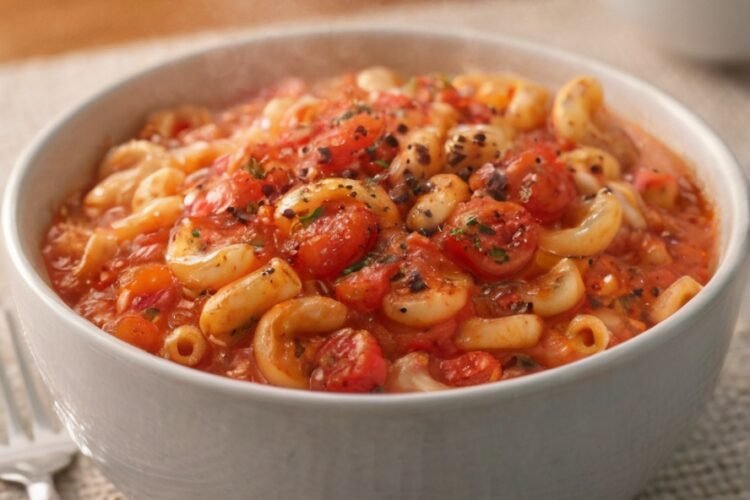
Macaroni and Tomatoes: The 4-Ingredient Oven-Baked Pantry Dinner That Feels Like Home
Macaroni and tomatoes is the meal I make when the pantry is thin and the bank account is thinner. Dry elbow macaroni goes into a glass casserole dish, two cans of diced tomatoes with their juices pour over the top, hot water and a few knobs of butter follow, and the oven does the rest until the pasta is tender and the tomatoes have collapsed into a glossy, savory sauce. There's no boiling the pasta first, no browning meat, no making a sauce — it's the kind of four-ingredient cooking that fed families through hard times and still tastes like the best thing on the table on a cold Tuesday. I know a dish like this looks almost too plain to bother writing down. That's exactly why I'm writing it down. This is Depression-era food in the truest sense: shelf-stable staples turned into a filling, satisfying dinner for about seventy cents a serving, using nothing you can't keep in the cupboard for a year. It is vegetarian, it is affordable past the point of embarrassment, and it tastes like something a grandmother would have made to stretch a can of tomatoes and a box of pasta into a full meal for a family of four. What makes it work is that the pasta cooks directly in the tomato and water — the same idea as cooking pasta in a skillet of sauce instead of a pot of boiling water. The elbows soak up tomato liquid as they soften, the starch they release thickens that liquid into a real sauce, and the butter melts in to round off the acidity. By the time you pull the foil back, you've got tender pasta suspended in a rustic, cozy tomato gravy with almost no effort and exactly one dish to wash. One honest note before we start: this recipe is deliberately bare-bones, and the only real thing to get right is the liquid. Too little and the pasta stays crunchy; too much and it's soupy. I'll give you the exact marks to watch below. And because I'd rather be plain about it, the optional teaspoon of salt is where nearly all the sodium lives, so if you're watching it, hold back and taste at the end. This is humble, cheap, deeply comforting food doing exactly what it's supposed to. Let's make it.Why You'll Love This Macaroni and Tomatoes
- Four ingredients — macaroni, canned tomatoes, water, and butter — plus salt and pepper.
- About seventy cents a serving. This is the cheapest dinner on the entire site.
- No boiling the pasta first. Everything goes into one dish and into the oven.
- It's vegetarian, and it's made almost entirely from things already in your pantry.
- One casserole dish, one baking session, no real skill required.
- Leftovers reheat beautifully for easy make-ahead lunches.
- Endlessly stretchable — add cheese, vegetables, or protein without changing the method.
Why This Recipe Works
The genius of this method is that the pasta hydrates in the dish, not in a separate pot. As the elbows sit in the tomato-and-water mixture, they slowly absorb liquid and soften, and every drop they take in is tomato rather than plain water — so the flavor cooks all the way through the noodle instead of just sitting on the surface. At the same time, the pasta releases starch into the surrounding liquid, and that starch is what thickens everything into a sauce. It's the same principle behind risotto and one-pan pasta, just stripped down to its simplest possible form. The foil is doing real work too. A tightly covered dish traps steam, and steam is what drives even hydration — the pasta doesn't need stirring so much as it needs a moist, hot environment. That's why the recipe tells you not to touch it for the first 35 minutes and then to stir only once. Every time you open the oven, you lose the steam you spent energy building. The covered phase cooks the pasta; the uncovered phase, which the recipe handles by removing the foil near the end, evaporates excess liquid and lets the tomatoes concentrate from watery juice into a thick, saucy glaze. The two ingredients that aren't water or pasta both earn their place. The tomatoes bring acid and sweetness plus just enough body to coat the noodles, and their acidity actually keeps the dish bright instead of heavy. The butter melts in to soften that acidity and add a rich, savory slickness that makes plain pasta and canned tomatoes taste like something you'd order. And that balance — acid, fat, starch, salt — is why four ingredients can taste like so much more than four ingredients. It always comes down to the ratio, and here the ratio is almost foolproof.Ingredient Breakdown
| Ingredient | What it does | Notes |
|---|---|---|
| 2 cups dry elbow macaroni | The body of the dish — it cooks right in the casserole | That's about 8 ounces. Small shapes hydrate fastest; elbows are the classic here. |
| 2 cans (14.5 oz each) diced tomatoes with juices | Acid, sweetness, and the liquid the pasta cooks in | Don't drain them. The juice IS part of the cooking water. Crushed tomatoes make a saucier result. |
| 2 cups hot water | Completes the cooking liquid so the pasta softens evenly | Hot water keeps the bake from starting cold. Tap-hot is fine. |
| 2 tablespoons butter, cut into small pieces | Richness that tames the tomato's acidity | Scatter it so it melts evenly. Olive oil works for a vegan version but changes the flavor. |
| 1 teaspoon salt (optional but recommended) | Seasons the pasta from the inside as it hydrates | Nearly all the sodium in the dish lives here. Halve or skip it and salt at the table instead. |
| Freshly ground black pepper | The finishing note that ties it together | Don't skip it — black pepper and tomatoes are a classic pairing. |
The only number that matters: 2 cups of dry macaroni to 2 cans of tomatoes plus 2 cups of water. Keep that liquid-to-pasta ratio and the dish works every time. Skimp on the water and the pasta stays crunchy; add too much and you get soup.
Kitchen Equipment You Actually Need
- 2-quart glass casserole dish — glass or enameled ceramic, not bare aluminum or cast iron. Tomatoes are acidic and react with reactive metals, which can impart a metallic taste.
- Aluminum foil — the tight cover is what traps the steam that cooks the pasta.
- Measuring cups — one for the dry macaroni, one for the hot water. This recipe runs on ratios.
- Wooden spoon or spatula — for the single stir partway through the bake.
- Teakettle or microwave — to heat the water before it goes in.
- Oven mitts — glass casseroles hold serious heat and the foil lifts off with steam.
Step-by-Step Instructions
- Preheat and prep. Preheat the oven to 375°F and lightly grease a 2-quart glass casserole dish so the pasta doesn't stick.
- Add the dry macaroni. Pour the uncooked elbows evenly into the bottom of the dish and spread them into a single layer with your hand or a spoon.
- Pour over the tomatoes. Add both cans of diced tomatoes with all their juices, spreading them evenly over the dry pasta.
- Add the hot water. Pour the 2 cups of hot water evenly over everything, then gently stir once or twice to make sure the macaroni is mostly submerged.
- Dot with butter and salt. Scatter the butter pieces across the top so they melt and spread during baking, then sprinkle the salt over everything.
- Cover tightly and bake. Seal the dish tightly with foil and bake for 35 minutes.
- Uncover, stir, and check. Remove the foil, give the mixture a good stir, scraping up from the bottom so nothing sticks, and check that most of the liquid has been absorbed.
- Finish baking. If the pasta is still firm, re-cover loosely and bake another 5–10 minutes, checking every few minutes, until the macaroni is tender and the tomatoes are saucy. If it looks dry before the pasta is done, stir in a splash of hot water.
- Rest and serve. Let the dish sit 5–10 minutes so the sauce thickens, taste and adjust salt, and serve with a generous grind of black pepper.
Leftovers and the pan, stated plainly. There's no raw meat or egg here, so the food-safety concern is ordinary: cool leftovers within two hours, refrigerate in an airtight container, and use within 3 to 4 days. Reheat with a splash of water so the pasta loosens back up. And bake this in glass or enameled ceramic, never bare aluminum or unseasoned cast iron — the tomatoes' acid reacts with reactive metals and can leave a metallic taste in the dish.
Expert Tips
Use hot water, not cold. Cold water forces the dish to spend the first minutes of baking just warming up, which throws off your timing and can leave the center unevenly cooked. Hot tap water starts the process immediately.
Stir only once, at the 35-minute mark. The covered phase depends on trapped steam. Opening the oven to stir repeatedly lets that steam escape and slows the pasta down.
Trust the liquid, then adjust. If the pasta is still firm when you uncover it, a splash more hot water plus a few more covered minutes fixes it. If it's already tender but wet, leave the foil off for the last few minutes to evaporate the excess.
Don't drain the tomatoes. The juice is part of the cooking liquid. Drained tomatoes mean undercooked pasta and a dry casserole.
Use a non-reactive dish. Glass and enameled ceramic are ideal. Bare aluminum and cast iron can react with the tomatoes and taste tinny.
Let it rest before serving. Those 5–10 minutes off the heat let the released starch thicken the sauce so it clings to the pasta instead of running.
Salt late if you're watching sodium. The single teaspoon of salt is most of the sodium. Start with half, taste at the end, and finish at the table.
Make it saucy or firm on purpose. Softer and saucier: add a splash more water and bake a touch longer. Firmer and drier: leave it uncovered for the last 10–15 minutes.
Common Mistakes
Not enough liquid. The number-one reason for crunchy macaroni. Two cups of water plus the tomato juice is calibrated to 2 cups of dry pasta — don't cut it back.
Using a dish that's too small. The pasta needs room and the mixture bubbles up. A 2-quart dish is the right size; an overcrowded dish cooks unevenly.
Baking in a reactive pan. Bare aluminum, unlined cast iron, and some cheap metal pans react with the tomatoes and can make the whole dish taste metallic. Stick with glass or enameled ceramic.
Opening the oven repeatedly. Every peek releases steam and stretches the cook time. Cover it, set a timer, and leave it alone.
Forgetting to stir at the 35-minute mark. A single scrape from the bottom keeps the pasta from sticking and redistributes the thickening sauce. Skip it and you risk a stuck, dry bottom layer.
Over-salting early. Canned tomatoes already carry some salt, and the pasta absorbs whatever's in the liquid. Add the teaspoon cautiously and taste before adding more.
Serving immediately. Straight from the oven it's loose and the sauce hasn't set. The short rest is what turns it cohesive.
Judging doneness by the timer alone. Ovens and pasta brands vary. The honest test is a bite: tender through, no chalky center. Adjust with a splash of water and a few minutes if needed.
Ingredient Substitutions
| If you don't have… | Use… | Watch out for… |
|---|---|---|
| Elbow macaroni | Small shells, ditalini, penne, or rotini | Shapes vary in how fast they hydrate. Smaller shapes cook faster; larger ones may need 5–10 extra minutes and a splash more water. |
| Diced tomatoes | Crushed tomatoes (saucier) or whole tomatoes, hand-crushed | Crushed makes a thicker, more sauce-like result. Whole tomatoes need crushing and a few more minutes. |
| Butter | Olive oil for a vegan version | Oil doesn't add the same buttery roundness, but it works and keeps the dish dairy-free. |
| Water | Vegetable broth or a splash of the tomato can rinsed out | Broth adds flavor but also sodium — reduce the added salt accordingly. |
| Salted diced tomatoes | No-salt-added diced tomatoes | Drops the sodium significantly. Add a pinch more salt at the table if needed. |
| Standard elbow macaroni (gluten-free) | Gluten-free elbow pasta (corn, rice, or chickpea based) | GF pasta can absorb liquid differently and turn mushy. Check a few minutes early. This swap is the only basis for a GF version — the dish is not naturally gluten-free. |
| Plain dish | Add dried Italian seasoning, a pinch of red pepper flakes, or minced garlic | All optional flavor without breaking the four-ingredient idea. |
| A side | A simple green salad or steamed frozen vegetables | Keeps the meal balanced without any extra cooking effort. |
Variations
- Cheesy baked version. Stir a handful of shredded mozzarella or cheddar through right after baking, or sprinkle cheese on top and return it uncovered until melted and bubbly.
- Garlic and herb. Use diced tomatoes with basil, garlic, and oregano, or add a small pinch of dried Italian seasoning and a minced clove of garlic before baking.
- Onion and garlic base. Finely chop an onion and a couple of garlic cloves and scatter them over the macaroni before the tomatoes go in. Barely more effort, noticeably more flavor.
- Protein boost. Add a drained can of kidney or cannellini beans, or leftover cooked ground beef or sausage. Add a little extra water if the dish looks dry.
- Spicy Southern-style. Swap in a can of diced tomatoes with green chiles, add a pinch of cumin and chili powder, and top with cheddar.
- Baked-ziti treatment. Layer in ricotta and mozzarella, top with parmesan, and bake uncovered at the end for a golden crust.
- Sunday gravy upgrade. Use crushed tomatoes and a spoonful of tomato paste for a deeper, slower-tasting sauce from the same shortcut method.
Make It Healthier
This is already a meatless, low-fat dish built on pantry vegetables and pasta, so "healthier" here means a few honest, practical levers rather than a rewrite. The easiest is sodium: the single teaspoon of salt is almost the entire sodium load, and no-salt-added canned tomatoes shave more off the top. Start with half the salt, taste at the end, and finish at the table — most people can't tell the difference, and the number drops by hundreds of milligrams a serving. Swapping to a whole-wheat or legume-based pasta raises the fiber and protein and makes the dish more filling for the same calories. The other lever is what you add. A drained can of white beans or a handful of frozen spinach stirred in before baking adds fiber and protein for pennies, and a side of green salad or steamed vegetables turns a starch-forward plate into a balanced meal. Portion is worth mentioning too: at roughly 300 calories a serving this is a light dinner, but it's easy to eat two servings because it goes down so softly — a smaller bowl with a vegetable side is the move if you're watching portions. What I won't do is pretend pasta and canned tomatoes are a "superfood." They're not. They're cheap, real, comforting food that can be made a little better with a couple of small choices, and that's plenty.Meal Prep
This is a genuinely great make-ahead dish because it's just as good on day two as the day it's baked — some would argue better, since the pasta keeps soaking up sauce. Bake it on Sunday and you've got four lunches and a couple of dinners handled for less than three dollars. Portion it into containers while it's still slightly warm, let it cool, and refrigerate; it holds beautifully for 3 to 4 days. The one trick is to underbake it by just a couple of minutes if you're planning to reheat it, so it doesn't go soft by the time you eat the last portion. It's also an easy dish to double when you're feeding a crowd or stocking the freezer. Use two dishes rather than one oversized one so the liquid-to-pasta ratio stays honest, or a large roasting pan with the liquid scaled up proportionally. If you want to assemble ahead and bake later, you can mix everything together and refrigerate it covered for up to 24 hours before it goes in the oven — just know that the pasta will have started absorbing liquid while it sat, so add a splash of hot water right before baking and check it early. It's humble food that plans ahead beautifully.Storage
Cool leftovers within two hours, then store in an airtight container in the refrigerator for 3 to 4 days. Unlike some baked pastas, this one gets better as it sits, because the noodles keep drawing in the tomato sauce and the flavors settle into something rounder. Keep any extra liquid with the portions — a spoonful of the tomato juices reheated with each serving is what brings it back to life. The sauce will tighten and thicken in the fridge, which is completely normal. When you reheat, add a splash of water or a spoonful of the reserved juices and it loosens right back to a saucy texture. Don't store it in a reactive metal container; a glass or plastic container keeps the tomato from picking up any metallic edge. And once it's been reheated, eat it — repeated reheating makes the pasta progressively softer, so plan to finish the dish within a few days for the best texture.Freezing
Macaroni and tomatoes freezes quite well, which makes it a quietly excellent batch-cooking recipe. Cool it completely, portion into freezer-safe containers with a little of the tomato liquid spooned over each, and freeze for up to 3 months. Thaw overnight in the refrigerator, then reheat covered at 350°F for 20–25 minutes or in the microwave with a splash of water, stirring once. The pasta softens a touch in the freezer, so expect a slightly more casserole-like texture on thawing — still delicious, just less firm. Because gluten-free pasta and legume-based pasta tend to soften even more when frozen and reheated, freezing works best with standard wheat elbows. If you do freeze a GF batch, don't overbake it first. And if you'd rather not deal with thawing, you can bake this from frozen in a covered oven-safe dish, adding roughly 20–25 minutes to the covered stage and checking often — but honestly, for a dish this cheap and fast to make fresh, the freezer is more about saving a busy night than saving money.Reheating
The microwave is the fast, easy route the recipe itself suggests: put a portion in a bowl, add a splash of water or a spoonful of the tomato juices, cover loosely, and heat in 60-second bursts, stirring between, until hot. The splash of water is not optional if you want it saucy — without it the pasta dries out and the sauce turns thick and gluey. Ninety seconds to two minutes usually does it for a single serving. For a whole dish, the oven is better: cover with foil and warm at 350°F for 20–25 minutes, adding a splash of water first, then uncover for the last 5 minutes if you want the top a little drier and more concentrated. On the stovetop, a covered skillet over medium-low with a splash of water works for a single portion and lets the bottom get a touch crispy, which is a happy accident. What you don't want is blasting it uncovered on high heat — the pasta toughens and the sauce reduces to a paste. Gentle, covered, and a little water every time.What to Serve With It
This is the kind of dinner that wants something fresh and green next to it, because the plate itself is all starch and tomato. A simple green salad with a sharp vinaigrette is the classic answer and the one I reach for most — the acid and crunch balance the soft, saucy pasta. Steamed or roasted vegetables do the same job with more substance: green beans, broccoli, zucchini, or a bag of frozen mixed vegetables dressed with a little butter and lemon all work. If you want to add protein to the plate, a few meatballs, a sausage, or a piece of baked chicken turns it into a fuller meal. And the dish is a natural base, so the "sides" can also be "toppings." A sprinkle of shredded mozzarella or parmesan makes individual bowls feel more indulgent, and a drizzle of good olive oil or a torn basil leaf lifts the whole thing. Crusty bread is optional but expected at my table — it's a sauce dish, and bread is the sauce sponge. Served straight from the casserole with a generous grind of pepper, it's humble and complete, which is exactly the point of this kind of cooking.Beverage Pairings
Cold drinks win here. Unsweetened iced tea is the honest pairing — the tannin cuts the richness and the acid in the tomatoes. A tall glass of cold milk is the nostalgic answer for a tomato-pasta casserole, and lemonade is a bright, kid-friendly match for the same reason. If you're pouring wine, keep it light and high-acid: a Sangiovese, a young Chianti, or a simple dry red stands up to tomatoes better than a big tannic cabernet, which can taste metallic against them. A dry rosé works too, especially if you've added sausage or spice. What to avoid: heavy oaky reds and anything very sweet, both of which fight the tomato acidity. Nonalcoholic options are easy and good — sparkling water with lime, a salt-and-pepper soda, or a simple tomato-juice-based mocktail if you're feeling thematic. Kids will want milk and should get it. There's nothing sophisticated happening at this dinner, and there isn't supposed to be; the right drink is a cold one and maybe a napkin for the corners of your mouth.Frequently Asked Questions
Can I really bake dry macaroni without boiling it first?
Yes. The macaroni hydrates in the tomato juice and hot water while it bakes under a tight foil cover, so you genuinely skip the pot of boiling water. The only rule is to keep the ratio — 2 cups of dry macaroni to 2 cans of diced tomatoes plus 2 cups of hot water. If you cut the water, the pasta won't soften all the way; if you use a larger pasta shape, add a splash more water and a few more minutes.Why is my macaroni and tomatoes dry or crunchy?
Almost always a liquid problem: not enough water, drained tomatoes, a dish that was too small, or a foil cover that wasn't tight enough to trap steam. The fix during baking is easy — stir in a splash of hot water, re-cover loosely, and give it 5–10 more minutes, checking every few minutes. Choosing a non-reactive 2-quart dish and keeping the liquid measured is the fix next time. If the pasta is tender but the dish looks wet, do the opposite and bake it uncovered for the last few minutes.What can I add to make macaroni and tomatoes more of a meal?
It's built to be stretched. A drained can of white beans or kidney beans, leftover cooked ground beef or sausage, or a handful of frozen spinach all disappear into the dish and add protein or vegetables without changing the method. Top it with shredded cheese for richness, or serve it with a green salad and crusty bread. If you add something dry, add a little extra water so the pasta still has enough liquid to cook in.What kind of dish should I bake it in?
A 2-quart glass or enameled ceramic casserole is ideal, and glass is what the recipe is written around. It's not just about size — tomatoes are acidic and react with bare aluminum and unseasoned cast iron, which can leave a metallic taste. Avoid narrow or overcrowded dishes too; the pasta needs room and the mixture bubbles up as it bakes. A dish that's too small is a common cause of uneven cooking.Is macaroni and tomatoes gluten-free or vegetarian?
Vegetarian, yes — the base is pasta, canned tomatoes, water, and butter, with no meat. Gluten-free, no, not as written: standard elbow macaroni is wheat. To make it gluten-free you'd swap in a gluten-free elbow pasta (corn, rice, or chickpea based) and check it early, because GF pasta absorbs liquid differently and can turn mushy. That swap is the only basis for a gluten-free version; the standard dish is not GF.How do I make it taste less plain or more rich?
Use canned diced tomatoes with basil, garlic, and oregano, or add a pinch of dried Italian seasoning, a minced garlic clove, or a little chopped onion before baking. For richness, stir in a handful of shredded mozzarella or cheddar right after it comes out, or sprinkle cheese on top and return it uncovered until bubbly. A small knob of extra butter or a drizzle of olive oil at the end also rounds the acidity without changing the four-ingredient spirit.What shape of pasta works best?
Elbow macaroni is the classic and what the recipe is timed for, but small shells, ditalini, penne, and rotini all work. The variable is how fast each shape hydrates: smaller shapes cook faster and may be done sooner, while larger shapes like penne often need 5–10 extra minutes and a splash more liquid. Whatever you choose, check it by taste rather than by the clock, since pasta shape and brand both shift the timing.How do I keep the sodium down?
The single teaspoon of salt is most of the sodium, so the simplest move is to start with half or none and finish at the table, where a little goes a lot further. Using no-salt-added canned diced tomatoes trims more, and rinsing is unnecessary because you're using the juice as cooking liquid. If you're adding cheese, beans, or sausage, note their sodium too and season the pasta lightly to compensate. This is a genuinely easy dish to keep low-sodium with small adjustments.Nutrition Facts (Estimated)
| Per serving (1/4 of dish) | Amount |
|---|---|
| Calories | ~300 |
| Total Fat | ~6 g |
| Saturated Fat | ~3 g |
| Carbohydrates | ~54 g |
| Fiber | ~4 g |
| Sugars | ~7 g |
| Protein | ~7 g |
| Sodium | ~700 mg |
Final Thoughts
Macaroni and tomatoes is what I make when I want dinner handled for about seventy cents a plate with almost nothing from the store. Dry elbows go into a glass dish, two cans of diced tomatoes and two cups of hot water go over them, a few pieces of butter and a little salt go on top, and the oven turns those four things into tender pasta in a glossy, sweet-tart tomato sauce. No boiling, no meat, no fuss, and one dish to wash. It is Depression-era food in the best sense — humble, filling, and genuinely good. The only thing to nail is the liquid: two cups of dry macaroni, two cans of tomatoes with their juices, two cups of hot water, kept honest. Get that right and the dish is nearly foolproof, and if you want to dress it up, a handful of cheese, some garlic, or a can of beans or leftover meat turns it into something a little more filling without changing the shortcut that makes it special. Serve it straight from the casserole with a heavy grind of black pepper, a green salad on the side, and a cold glass of iced tea. And whether you eat it as a cozy meatless dinner or flanked by crusty bread and a bowl of leftovers for tomorrow's lunch, that's the whole charm: cheap, comforting, pantry food that tastes like home, and it belongs in your weekly rotation.Macaroni and Tomatoes
Four pantry ingredients baked into cozy, saucy pasta — no boiling requiredIngredients
Directions
- Preheat oven to 375°F and lightly grease a 2-quart glass casserole dish.
- Pour the dry elbow macaroni into the dish and spread it into an even layer.
- Pour both cans of diced tomatoes, with all their juices, evenly over the uncooked macaroni.
- Pour the hot water over everything and stir gently once or twice to mostly submerge the pasta.
- Dot the top with butter pieces and sprinkle with salt. Cover tightly with foil.
- Bake 35 minutes, then remove the foil, stir well from the bottom, and check the liquid level and pasta doneness.
- If still firm, re-cover loosely and bake 5–10 minutes more, checking often. If dry, stir in a splash of hot water. Bake uncovered a few minutes longer if too wet.
- Let sit 5–10 minutes, taste and adjust salt, and serve with black pepper.
Cost: about $2.75 per dish — roughly $0.70 per serving.
The key ratio: 2 cups dry macaroni to 2 cans diced tomatoes (with juice) plus 2 cups hot water. Keep it and the dish works every time.
Pan: use glass or enameled ceramic, not bare aluminum or cast iron — tomatoes react with reactive metals.
Sodium: about 700 mg per serving, almost all from the 1 tsp salt. Start with half, or use no-salt-added tomatoes, to cut it back.
Gluten-free: not as written (elbow macaroni is wheat). Use GF elbow pasta for a GF version and check it early.
Nutrition (estimated per serving)
300Calories
7 gProtein
6 gFat
54 gCarbs
4 gFiber
700 mgSodium
Estimates only — not medical or dietary advice. Values vary by brand and added salt. Using half the salt or no-salt-added tomatoes lowers sodium significantly.