
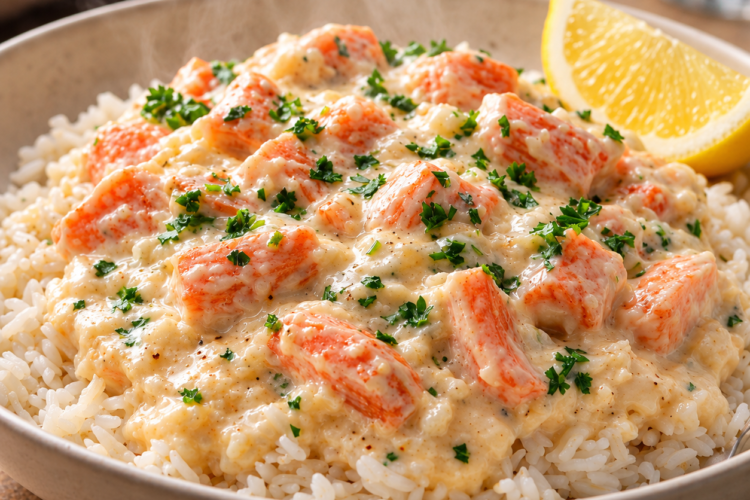
Slow Cooker Imitation Crab: The 4-Ingredient Creamy Seafood Dinner That Feels Way Fancier Than It Is
Toss a whole block of imitation crab in the crock with three simple ingredients and you'll get a dinner so rich and comforting, your husband will be begging for it on repeat. This slow cooker imitation crab is the kind of low-effort, high-comfort meal that earns a permanent place in a weeknight rotation, because you literally nestle a whole vacuum-packed block into the bottom of the slow cooker, pour three things over the top, and let gentle heat do the rest. No chopping, no pre-cooking, no fuss — just a rich, creamy, buttery sauce slowly wrapping itself around every strand. Imitation crab, or surimi, has its roots in Japanese seafood processing, where mild white fish is seasoned, sweetened, and shaped to mimic crab. I want to be upfront about what it is, because it isn't real crab and I'd rather you know: it's a processed white-fish product, usually with added starch, sugar, and salt, which is exactly why it's inexpensive and why it holds together so well in a creamy sauce. Here we lean into its naturally sweet, briny flavor and surround it with cream of mushroom soup, heavy cream, and butter, so it turns into something silky and spoonable that feels indulgent enough to have everyone asking for seconds. The whole approach is almost absurdly hands-off. You keep that block of imitation crab intact, lay it flat in the slow cooker, whisk the soup and cream together, pour it over, dot the top with butter, and walk away for two or three hours. Then you gently break the softened block into big, bite-sized chunks right in the pot and fold them into the sauce. That's it. It's the sort of dish that feels like a cheat code, and honestly it is one — a creamy, buttery seafood dinner that costs about two dollars a serving and asks almost nothing of you. Now the honest notes, and there are a few. This is not a health food or a low-sodium dish: imitation crab is a genuinely salty product, and with the condensed soup and cream this lands around 1,150 milligrams of sodium per serving, so it's a treat, not an everyday staple. It's also a major-allergen dish — surimi typically contains fish and egg white, and some brands contain wheat and soy, while the soup brings wheat and milk — so please read labels if you're cooking for anyone with allergies. It's lower-carb but not keto, since the surimi itself carries added starch and sugar, and it brings about 16 grams of protein per serving, which I state as a number rather than a claim. And one useful fact: surimi is already cooked, so this is really about heating it through to steaming hot rather than cooking it from raw. Let's make it.Why You'll Love This Slow Cooker Imitation Crab
- Only four ingredients, and one of them is the whole block of crab.
- Five minutes of prep — no chopping, no pre-cooking, no fuss.
- The slow cooker does everything while you get on with your day.
- A rich, creamy, buttery sauce that soaks into every strand.
- Feels like a restaurant seafood dish for about two dollars a serving.
- Spoon it over rice, noodles, or toast and let the sauce do the rest.
- A new, budget-friendly seafood dinner for your weeknight rotation.
- Genuinely comfort food, and genuinely quick to put together.
Why This Slow Cooker Imitation Crab Recipe Works
This recipe works because of gentle, moist heat and a fat-rich sauce. Imitation crab is essentially a pressed block of mild fish, starch, and seasoning, which means it's already cooked and fairly delicate — it doesn't want high heat or a long aggressive cook, just enough warmth to get tender and absorb flavor. Two to three hours on low is exactly right for that: it heats the block all the way through, softens its texture so it separates into strands beautifully, and lets the creamy sauce work its way down around it without the fish turning tough or rubbery. Going low and slow is what keeps the texture silky rather than rubbery or mushy. The sauce is built for richness and cling, and each of the three ingredients has a job. Condensed cream of mushroom soup brings the savory, mushroomy base and enough body to coat everything, heavy cream adds silkiness and takes the edge off the soup's processed tang, and butter — dotted over the top rather than stirred in — melts slowly down through the mixture, enrich the sauce further and helping it taste far more luxurious than three pantry items have any right to. Put together, they form a sauce that's thick enough to cling to the crab but loose enough to spoon over rice or noodles, which is exactly the texture you want. The order of operations matters more than you'd think. Keeping the block intact and letting it warm in the sauce means the crab stays tender and doesn't dry out, and only breaking it up at the end, after it's heated through, gives you those big, loose, appetizing strands rather than a pot of mush. Then the ten-to-fifteen-minute rest on warm is the quiet finishing move: it lets the flavors meld and the sauce thicken slightly so it clings instead of pooling. That final rest is the difference between a good dish and one that tastes finished, and it costs you nothing but a little patience.Ingredient Breakdown
| Ingredient | What it does | Notes |
|---|---|---|
| 1 (16–20 oz) solid block vacuum-packed imitation crab | The sweet, briny seafood star | Surimi, already cooked and ready-to-eat — not real crab. Keep it in one block. Very high in sodium; check labels for allergens. |
| 1 (10.5 oz) can condensed cream of mushroom soup | The savory, mushroomy body of the sauce | Contains wheat — not GF as written. Cream of celery or chicken also works. Main allergen source alongside the surimi. |
| 1/2 cup heavy cream | Silkiness and richness that rounds out the soup | Heavy cream holds up better than milk in a warm sauce. Don't use fat-free substitutes, which can separate. |
| 4 Tbsp unsalted butter, cut into pieces | Enrichment that melts down and makes the sauce taste luxurious | Unsalted lets you control the salt, which matters here. Dot, don't stir, so it melts evenly. |
The one thing to get right: keep the block whole until it's heated through, then break it up gently. That's what gives you big, tender strands instead of mush — and it's the single detail that decides the texture of the whole dish.
Kitchen Equipment You Actually Need
- Slow cooker (4-quart or larger) — big enough for the block to lie flat with room around it.
- Medium mixing bowl — for whisking the soup and cream together.
- Whisk — to get the sauce smooth and fully combined.
- Tongs or two forks — for gently breaking up the crab at the end.
- Measuring cups and spoons — for the cream and butter.
- Ladle or large spoon — for serving over rice, noodles, or toast.
- Instant-read thermometer (optional) — to confirm the dish is heated through.
Step-by-Step Instructions
- Set up the insert safely. Make sure the slow cooker insert is dry and clean, and if you've removed it, place it on a stable, heat-safe surface. Ceramic inserts can crack from thermal shock, so never set a hot one on a cold or wet counter.
- Prepare the crab. Remove the solid block of vacuum-packed imitation crab from its packaging and drain off any excess liquid. Do not separate or shred the crab; keep it as a single block.
- Lay it flat. Lay the whole block of imitation crab flat on the bottom of the slow cooker insert so it sits in one solid piece as a base layer.
- Make the sauce. In a medium bowl, whisk together the condensed cream of mushroom soup and heavy cream until smooth and fully combined.
- Pour it over. Pour the soup-and-cream mixture evenly over the block of imitation crab, making sure the top is well coated. It's fine if some of the block is still peeking through; the sauce will settle as it cooks.
- Dot with butter. Dot the top with the pieces of unsalted butter, spacing them out so they melt and enrich the sauce evenly as the mixture warms.
- Cook low and slow. Cover and cook on LOW for 2 to 3 hours, until the imitation crab is heated through and very tender. Avoid lifting the lid frequently so you don't lose heat and moisture.
- Break it up gently. Once heated through, gently use tongs or two forks to break the block into large, bite-sized chunks or loose strands directly in the slow cooker. Fold the pieces into the creamy sauce until everything is well coated, being careful not to overwork it into mush.
- Taste and season. Taste the sauce and add a small pinch of salt or freshly ground black pepper if desired, keeping in mind the crab and soup already carry seasoning.
- Rest on warm. Switch the slow cooker to WARM and let it sit, covered, for 10 to 15 minutes so the flavors meld and the sauce slightly thickens. Serve hot over rice, noodles, or toast, or alongside simple vegetables.
Allergen disclosure, stated plainly. This is a major-allergen dish. Imitation crab (surimi) is typically made with fish and egg white, and many brands also contain wheat and soy; condensed cream of mushroom soup contains wheat and milk; and heavy cream and butter bring milk. If you're cooking for anyone with a fish, egg, wheat, soy, or dairy allergy, read every label carefully before making this — surimi formulations vary a lot by brand. It is not gluten-free as written.
Handling and leftovers, stated plainly. Imitation crab is already cooked and ready-to-eat, so this dish is about heating it through to steaming hot rather than cooking it from raw — but still aim for 145°F throughout to be safe, and never let the block warm slowly at room temperature. Keep the lid on during cooking to hold heat and moisture. The slow cooker insert and the sauce are very hot, and a ceramic insert can crack from thermal shock, so set it only on a dry heat-safe surface. Cool leftovers within two hours, refrigerate promptly, and eat within 3 to 4 days, reheating until steaming hot. Because this is a seafood-and-dairy dish, don't leave it out at room temperature for more than two hours.
Expert Tips
Keep the block whole until the end. This is the defining technique of the dish. The intact block warms evenly and stays tender, and breaking it up afterward gives you beautiful big strands.
Drain the packaging liquid well. Imitation crab often comes with a fair amount of liquid. Draining it keeps the sauce from getting watery before it has a chance to thicken.
Whisk the soup and cream completely smooth. A lump of condensed soup in the finished sauce is an unpleasant surprise. Whisk until it's uniform and pourable.
Dot the butter, don't stir it in. Pieces scattered across the top melt down into the sauce gradually, which enriches it evenly as it warms. Stirring it in up front does the same job, only less elegantly.
Use unsalted butter and go easy on salt. Surimi and condensed soup are both very salty. Unsalted butter plus a taste-first approach is the only way to keep it from tipping over.
Keep the lid on. Every peek releases heat and moisture and slows the cook. Two to three hours goes quickly if you leave it alone.
Break it gently. Use tongs or two forks and pull large strands apart rather than mashing. Overworking gives you a paste, not a seafood dish.
Taste before seasoning. Give the sauce a taste before adding anything. You'll often find it needs only black pepper, or nothing at all.
Don't skip the warmth rest. Ten to fifteen minutes on warm lets the sauce thicken and the flavors come together — it's a small step with a big payoff.
Brighten it at the end. A squeeze of lemon and a sprinkle of parsley or chives right before serving cuts through the richness and makes the whole plate taste fresher.
Common Mistakes
Shredding the crab before it's hot. Separate it at the start and it overcooks into mush. Keep the block whole until it's heated through.
Cooking it too long or too high. Surimi is already cooked, so more heat just makes it rubbery or mushy. Two to three hours on low is plenty.
Not draining the packaging liquid. Extra liquid makes the finished sauce thin and watery. Drain it thoroughly first.
Adding salt automatically. Surimi and condensed soup are already salty. Taste first, and remember this dish already runs high in sodium.
Overworking the crab at the end. Vigorous stirring turns those lovely strands into a paste. Fold gently.
Opening the lid repeatedly. Each peek loses heat and moisture and stretches the cook time. Trust the pot.
Letting the sauce boil. Heavy cream can separate and turn grainy under hard heat. Keep it on low and warm, never a rolling boil.
Setting a hot ceramic insert on a cold or wet surface. Thermal shock can crack it. Always place it on a dry, heat-safe surface.
Assuming it's gluten-free or allergy-friendly. The soup contains wheat, and surimi often contains fish, egg, wheat, and soy. Read every label if allergies matter.
Leaving it out after serving. Seafood and dairy together are not something to leave at room temperature. Cool and refrigerate within two hours.
Ingredient Substitutions
| If you don't have… | Use… | Watch out for… |
|---|---|---|
| Cream of mushroom soup | Cream of celery or cream of chicken soup | Both keep the same 4-ingredient structure. Celery is lighter, chicken is a bit richer. All contain wheat. |
| Condensed soup (for gluten-free) | A certified gluten-free condensed soup, or a homemade cream sauce thickened with cornstarch | You also need a surimi brand that's wheat-free, so check both labels — this is the trickiest swap here. |
| Imitation crab | Real lump crabmeat, cooked shrimp, or a firm white fish | Real crab and shrimp are already cooked and only need heating. Raw white fish needs to reach 145°F, so cook it longer. |
| Heavy cream | Half-and-half or whole milk with a little extra butter | Lighter dairy can separate more easily, so keep the heat low and stir gently. Avoid fat-free options. |
| Unsalted butter | Salted butter, skipped salt elsewhere | Salted butter adds sodium to an already salty dish — if you use it, don't add any extra salt. |
| Imitation crab flavor base | Add a pinch of Old Bay or seafood seasoning | Boosts the seafood character if you're using real crab or another protein. Go light — these blends are salty. |
Variations
- Brighter finish. Stir in a squeeze of fresh lemon juice and a tablespoon of chopped parsley or chives right before serving — the acidity cuts the richness beautifully.
- Deeper mushroom note. Sauté a handful of sliced fresh mushrooms in a little butter and fold them in during the last 30 minutes.
- Different profile. Swap the cream of mushroom soup for cream of celery or cream of chicken, keeping the same four-ingredient structure.
- Gentle kick. Sprinkle in a pinch of paprika, cayenne, or a few dashes of hot sauce at the end.
- One-pot meal. Stir in a cup of thawed frozen peas or corn during the final 20 minutes just to heat through.
- Crab pasta. Toss the finished crab and sauce with cooked linguine or fettuccine for a creamy seafood pasta.
- Garlic-herb. Add a minced garlic clove and a little dried dill or Old Bay to the sauce for a more seasoned, seafood-shack flavor.
- Lighter version. Use a certified gluten-free low-sodium cream-style soup, half-and-half instead of heavy cream, and less butter, then serve over cauliflower rice or greens.
Make It Healthier
I'll be honest with you, because this dish has real nutritional weaknesses and I'd rather name them than hide them. The biggest issue is sodium — imitation crab is a very salty product, and with condensed soup added this lands around 1,150 milligrams per serving, so it's a treat rather than a regular weeknight staple. The other consideration is that surimi is a processed food, with added starch and sugar, so it's not a whole-food protein like fresh fish. That said, there are real ways to lighten it without losing the creamy comfort. Start with the soup: a low-sodium or reduced-sodium cream of mushroom cuts a meaningful amount of salt, and a certified gluten-free version helps if wheat is a concern. You can also use half-and-half in place of the heavy cream, trim the butter from four tablespoons to two, and skip any added salt entirely — the dish rarely needs it. The biggest lever, though, is what you serve it with and how much of it you eat. Spooned over a pile of steamed vegetables or cauliflower rice instead of a mound of white rice, one serving becomes a far more reasonable plate, and the creamy sauce still makes it feel decadent. Adding peas, mushrooms, or greens also stretches the dish so you get more vegetable volume per serving of crab. And if you want to genuinely improve the nutrition, swapping the surimi for real shrimp or white fish is the most significant upgrade — more protein, less processing, and less sodium, though it costs more and requires cooking through to 145°F. It won't ever be a health dish, and it doesn't need to be; but a lighter, lower-sodium version with a vegetable base still delivers the rich, creamy comfort that made you want to make it.Make-Ahead and Everyday Prep
This is already one of the easiest dinners in the book — five minutes of prep and the slow cooker does the rest — so there isn't much to do ahead. That said, you can whisk the soup and cream together in a bowl the night before and refrigerate it, then just pour it over the block in the morning, which shaves a couple of minutes off an already tiny prep. You can also portion out the butter pieces ahead so they're ready to dot on top. The dish itself doesn't benefit from being assembled far in advance, since the crab is delicate and the sauce is best fresh, but a single overnight assembly is fine. For leftovers and the week ahead, it does reheat well, which makes it a useful lunch. Store the crab in its sauce and reheat gently on the stovetop over low heat with a splash of extra cream or milk to loosen the sauce if it has thickened in the fridge, or microwave it gently in short bursts. Because it's a seafood-and-dairy dish and fairly high in sodium, I wouldn't build a whole week of lunches around it, but a day or two of leftovers is one of the best things about making it. Cool it within two hours, refrigerate promptly, and eat it within three to four days — and if you're serving a crowd, keep it on warm rather than leaving it out on the counter.Storage
Store leftover slow cooker imitation crab in an airtight container in the refrigerator for 3 to 4 days. Because it contains seafood and dairy, cool it within two hours of cooking and refrigerate promptly — don't leave the slow cooker on the counter slowly cooling, which is a common and avoidable risk. Keep the crab in its sauce rather than storing them separately, since the sauce keeps the seafood moist and the flavor deepens overnight. The sauce will thicken considerably when chilled, which is normal; a splash of cream or milk loosens it back to a spoonable consistency when you reheat. If the dish has been out at room temperature for more than two hours, or it's been refrigerated past four days, discard it — seafood and dairy together are not worth gambling on. Reheated gently, it's nearly as good as fresh, though the crab will be a little softer the second time around, so gentle reheating is important. It won't hold up as well as a braised meat dish, so I'd plan to finish it within a few days rather than freezing it long-term, and I'd rather you enjoy it fresh than discover a disappointing container in the back of the fridge a week later.Freezing
I'll be honest here: this isn't the best dish to freeze. Cream-based sauces tend to separate and turn grainy after freezing and thawing, and delicate surimi can go watery and soft when it comes back, so a frozen-and-reheated version is noticeably inferior to fresh. If you do want to freeze it — say you made a double batch and can't finish it — let it cool completely, pack it in an airtight container, and freeze for up to 1 to 2 months, then thaw overnight in the refrigerator and reheat very gently on the stovetop over low heat, stirring often and adding a splash of cream to bring the sauce back together. Expect the texture to be softer and the sauce a little looser than fresh. A better strategy for this particular recipe is to freeze the components separately rather than the finished dish: portion the leftover crab and freeze it on its own, then make a fresh batch of the creamy sauce when you want to serve it. That way the seafood doesn't sit in a sauce that's going to break down in the freezer. Given how little effort the fresh version takes, honestly the simplest approach is to make just what you'll eat and skip the freezer altogether — this is one of those dishes that's best the day it's made and for a day or two after, and it rewards that immediacy.Reheating and Serving Leftovers
The best way to reheat this is gently on the stovetop, so the cream sauce comes back without breaking. Warm it over low heat for about 5 to 8 minutes, stirring often and adding a splash of cream or milk if the sauce has thickened too much in the fridge. Avoid high heat and boiling, which can make the cream grainy and the crab rubbery. The microwave works for a single portion in short bursts at reduced power, stirring once halfway through, and it's the realistic choice for a workday lunch. Taste before serving and add a little fresh lemon or black pepper, since the flavors can flatten after a day in the fridge. Leftovers are genuinely versatile, which softens the blow of a dish that's best fresh. Spooned over fresh rice or noodles with a squeeze of lemon, it tastes nearly like new. It also makes an excellent topping for a baked potato, a rich filling for a toasted roll or slider bun, or a creamy sauce to toss with pasta and a handful of peas. Folded into an omelet with a little parsley, it becomes a very good weekend breakfast. However you serve it, add something fresh and acidic alongside — a lemony salad, pickled vegetables, or a squeeze of citrus — because the dish is rich and benefits from a bright counterpart, and a little green on the plate makes it feel intentional rather than leftover.What to Serve With It
The sauce is rich, creamy, and abundant, so the best sides are ones that catch it and balance it. Hot white rice is the classic and most natural choice — it soaks up the sauce and lets the crab stay the star. Buttered egg noodles and toasted thick-cut bread both work beautifully, and the toast is especially nice because it gives you something to sop up every last bit. A crisp green salad with a tangy vinaigrette or a pile of steamed green beans cuts through the richness perfectly, and if you want to lean fully into comfort food, add roasted vegetables and simple garlic bread. For a complete plate, I like the crab over rice with a sharp, lemony salad alongside and a green vegetable, because the acidity and freshness keep the cream from overwhelming everything. Steamed broccoli, roasted asparagus, or a simple cucumber salad all work. If you're feeding a crowd, set out rice, noodles, and toast together and let everyone build their own bowl — it turns a simple dish into a fun, build-your-own spread. And a final squeeze of lemon and a scatter of parsley over the top before serving brightens the whole plate, which matters a lot with a sauce this rich.Beverage Pairings
A rich, buttery, creamy seafood dish wants a drink with crispness and acidity to reset the palate. A light, citrusy white wine is the obvious match — a Sauvignon Blanc, a dry Riesling, or an Albariño all cut through the cream and echo the briny sweetness of the seafood. If you prefer something a little rounder, an unoaked Chardonnay works without overwhelming the delicate crab flavor. Keep any red very light and low-tannin if you go that route, since tannins and creamy seafood don't get along especially well. For beer, a crisp lager or pilsner is the easy choice, and a wheat beer with a squeeze of lemon is a lovely match for the seafood character. On the nonalcoholic side, iced tea with lemon is a classic pairing for this kind of buttery, savory dish, and sparkling water with lime does the same job of cutting the richness. A dry apple cider or a light lemonade also works nicely. Whatever you pour, keep it cold and crisp — this dish is rich enough that a heavy drink would tip the whole meal over the edge, and a bright, cold glass is exactly what it needs.Frequently Asked Questions
Is imitation crab actually crab?
No, and I'd rather be clear about it. Imitation crab is surimi — a processed product made from mild white fish that's seasoned, sweetened, shaped, and colored to mimic crab. It typically contains fish, water, added starch, sugar, egg white, salt, and often crab or seafood flavoring, and some brands include wheat and soy. It's inexpensive, already cooked, and holds together well in a creamy sauce, which is why it works so nicely here — but it's not real crab, and it's a processed food with more sodium and starch than fresh seafood would have.Can I make this gluten-free?
You can, but it takes two label checks. First, condensed cream of mushroom soup contains wheat, so you need a certified gluten-free condensed soup or a homemade cream sauce thickened with cornstarch. Second, some surimi brands contain wheat starch or wheat-derived flavorings, so you need a brand that's explicitly gluten-free. Do both and the dish is gluten-free. It's the trickiest swap in this recipe, so read carefully if wheat is a genuine concern for you or your guests.Can I use real crab or shrimp instead of imitation crab?
Yes, and it's a nice upgrade if your budget allows. Real lump crabmeat and cooked shrimp are already cooked and just need gentle heating through, so add them near the end rather than cooking them for hours — otherwise they'll toughen. For raw white fish, you'll need to cook it to 145°F, so it takes a bit longer. Real seafood brings more protein and less sodium than surimi, though it costs considerably more, so it's a trade-off between budget and nutrition.Why is this dish so high in sodium, and can I reduce it?
Two ingredients are responsible: imitation crab is a genuinely salty product, and condensed cream of mushroom soup is high in sodium too, so together they land around 1,150 milligrams per serving. You can meaningfully reduce it by using a reduced-sodium or low-sodium cream soup, going easy on the butter by choosing unsalted, and — most importantly — not adding any extra salt without tasting first. A homemade cream sauce made with low-sodium broth gives you the most control of all. Even with these swaps, it's a salty dish, which is why I treat it as an occasional treat rather than an everyday meal.Why did my sauce curdle or separate?
Usually heat. Heavy cream can separate and turn grainy if it's boiled or held at too high a temperature, and the same goes for lower-fat substitutes like half-and-half or milk. Keep the slow cooker on low, avoid stirring aggressively, and never let the sauce come to a rolling boil. If it does start to look grainy, reduce the heat immediately and whisk gently — a splash of fresh cream can sometimes help bring it back. Using full-fat heavy cream rather than a lighter dairy also makes the sauce much more stable.Can I add vegetables or make it a one-pot meal?
Yes, and it's a good idea. Stir in a cup of thawed frozen peas or corn during the final 20 minutes just to heat through, or sauté sliced mushrooms in butter and fold them in during the last 30 minutes for a deeper mushroom flavor. Fresh spinach stirred in at the very end wilts nicely into the sauce. Just add quick-cooking vegetables near the end so they don't turn to mush, and avoid adding anything very watery without draining it well, since excess liquid thins the sauce.Can I make this ahead of time or freeze it?
You can make it a day ahead and reheat it gently, though it's best fresh. Freezing isn't ideal — cream sauces tend to separate and surimi goes watery after freezing and thawing, so the result is noticeably softer and looser than fresh. If you do freeze it, do so for no more than one to two months, thaw overnight in the fridge, and reheat very gently on low heat with a splash of cream. Honestly, given how little effort the fresh version takes, making just what you'll eat is the better plan.Since surimi is already cooked, how do I know when it's done?
Good question, and it's a useful thing to know about this recipe. Imitation crab is fully cooked during processing, so you're not cooking it from raw — you're heating it through and letting it absorb the sauce. Aim for steaming hot throughout, around 145°F if you want to check with a thermometer, which typically takes two to three hours on low. Once it's hot and tender and the sauce is bubbling gently at the edges, it's ready. Then break it up gently, rest it on warm for 10 to 15 minutes, and serve — cooking it much longer just makes the texture softer and less appealing.Nutrition Facts (Estimated)
| Per serving (1 of 4) | Amount |
|---|---|
| Calories | ~375 |
| Total Fat | ~27 g |
| Saturated Fat | ~16 g |
| Carbohydrates | ~23 g |
| Fiber | ~1 g |
| Sugars | ~6 g |
| Protein | ~16 g |
| Sodium | ~1,150 mg |
Final Thoughts
Slow cooker imitation crab is exactly the kind of low-effort, high-comfort dinner that earns a permanent spot in the rotation — one whole block of surimi, three simple ingredients, and a slow cooker doing the work while you get on with your day. The result is a silky, buttery, spoonable dish that tastes far more indulgent than it has any right to, and it costs about two dollars a serving. Spoon it over rice, noodles, or thick-cut toast, add something crisp and green on the side, and it's a full, comforting plate with almost no effort at all. I'll leave you with the honest summary, because it matters for a dish this rich and salty. It's a treat, not an everyday staple — about 1,150 milligrams of sodium per serving and a processed surimi base — and it's a serious allergen dish with fish, egg, wheat, milk, and often soy, so read those labels if anyone at your table has allergies. It's also best fresh and doesn't love the freezer. Within those limits, though, it genuinely delivers: creamy, buttery, sweet-savory seafood comfort for very little money. Keep the block whole until the end, break it up gently, taste before salting, and finish with a squeeze of lemon and a little parsley. Do that, and your husband will be begging for it on repeat — and honestly, so will you.Slow Cooker Imitation Crab
Four ingredients and five minutes of prep for a rich, creamy, buttery seafood dinner spooned over rice or noodles — about $2.00 a servingIngredients
Directions
- Make sure the slow cooker insert is dry and clean, and set it on a stable, heat-safe surface.
- Remove the block of imitation crab from its packaging and drain off any excess liquid. Keep it as a single block — don't separate or shred it.
- Lay the whole block flat on the bottom of the slow cooker insert as a base layer.
- In a medium bowl, whisk together the condensed cream of mushroom soup and heavy cream until smooth and fully combined.
- Pour the mixture evenly over the block of crab, making sure the top is well coated. It's fine if some peeks through; the sauce will settle as it cooks.
- Dot the top with the pieces of unsalted butter, spacing them out so they melt and enrich the sauce evenly.
- Cover and cook on LOW for 2 to 3 hours, until the imitation crab is heated through and very tender. Avoid lifting the lid frequently.
- Gently use tongs or two forks to break the block into large, bite-sized chunks or loose strands directly in the slow cooker, and fold into the sauce without overworking it into mush.
- Taste the sauce and add a small pinch of salt or black pepper if desired — the crab and soup already carry seasoning.
- Switch to WARM and let it sit, covered, for 10 to 15 minutes so the flavors meld and the sauce thickens slightly. Serve hot.
Cost: about $8.00 per batch — roughly $2.00 per serving (4 servings).
Keyword tips: targets "slow cooker imitation crab," "crockpot imitation crab," and "creamy imitation crab recipe." Lean into budget-seafood comfort and the 4-ingredient dump-and-go angle in the intro.
Don't-skip steps: keep the block whole until it's heated through, then break it up gently — that's what gives you tender strands instead of mush. Also rest it on warm 10–15 minutes to thicken the sauce.
Safety: surimi is already cooked, so heat it through to steaming hot (~145°F). Cool leftovers within 2 hours; refrigerate and use in 3–4 days. Don't set a hot ceramic insert on a cold or wet surface.
Allergens: fish, egg, wheat, milk, and often soy — this is a major-allergen dish. Not gluten-free as written (GF soup + wheat-free surimi required).
Honest numbers: ~1,150 mg sodium per serving — high, from the surimi and condensed soup. A treat, not an everyday dish. Lower-carb but not keto (surimi has added starch/sugar). ~16 g protein — not a high-protein dish.
Nutrition (estimated per serving)
375Calories
16 gProtein
27 gFat
23 gCarbs
6 gSugar
1,150 mgSodium
Estimates only — not medical or dietary advice. Based on 4 servings; varies widely by surimi brand. High sodium — a treat. Not gluten-free as written. Major allergens: fish, egg, wheat, milk, possibly soy.