WANT TO SAVE THIS RECIPE ?
Slow Cooker Pork Loin: The 4-Ingredient Supper I Make When the Day Gets Away From Me
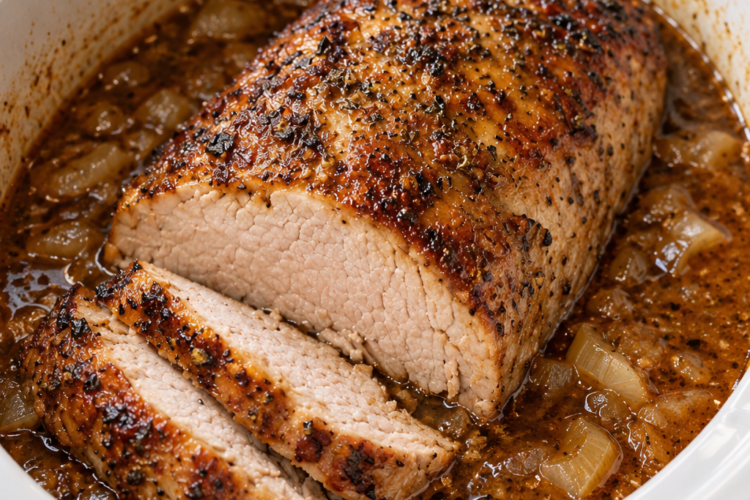
There is a certain kind of Tuesday in October — the kind where the calendar has more in it than the daylight does — when the only sane answer in my kitchen is a slow cooker pork loin. Four things go into the pot. Four. No searing, no trussing, no kitchen thermometer gymnastics at 4:55 in the afternoon while somebody is asking me where their shin guards are. You set it down, you walk away, and eight hours later there is meat that falls into soft slices under its own weight and a pot of glossy, oniony, sweet-smoky sauce that I would honestly drink from a mug if my family weren't watching.
My mother had one of those harvest-gold slow cookers with the little glass lid and a dial that went from Off to Low to High to "probably fine." She worked second shift for years, and the smell of pork and onion meeting you at the back door was the closest thing we had to a welcome-home banner. I used to sit on the kitchen floor with my homework and lift that lid every twenty minutes to look, which — spoiler — is exactly the wrong thing to do, and it took me until roughly age thirty-four to figure out why her roast was juicy and mine was not.
I have made this badly. I have made it with a three-pound loin in a two-quart cooker and wondered why the sauce boiled over. I have made it with the sauce dumped underneath the meat instead of spooned over the top, and I have made it with a cheap bottled barbecue sauce that tasted like sweetened ketchup and regret. What I have landed on is this version: a center-cut loin, a packet of onion soup mix, a cup of broth, a cup of whatever barbecue sauce your people actually like, and a hard rule about not opening the lid.
What you get for that five minutes of effort is a supper that feeds six for about the price of one pizza delivery. The sauce reduces down around the pork into something that tastes like you stood at the stove stirring for an hour, and if you spoon it over mashed potatoes the way I do, it turns into gravy by accident. This is not a showstopper. It is better than a showstopper. It is the meal that gets made on the night everything else fell apart, and those are the recipes I actually keep.
Why You'll Love This Slow Cooker Pork Loin
First, the arithmetic. Four ingredients, one of which is the roast. If you keep an onion soup packet and a bottle of barbecue sauce in the pantry — and if you don't, they cost less than four dollars together — you can make this on a Wednesday with nothing but a trip to the meat case.
Second, the hands-off part is genuinely hands-off. There is no browning step, no deglazing, no pan to scrub. I know every recipe on the internet says "brown the meat first for depth of flavor," and they're right in a perfect world. But the onion soup mix does the heavy lifting here, and on a night when you're choosing between this and a drive-thru, the version that gets made wins. I have never once regretted skipping the sear. I have frequently regretted not making this at all.
Third, it's a lean cut behaving like a forgiving one. Center-cut pork loin is one of the cheapest proteins in the store per pound — routinely under three dollars, sometimes under two on a weekend sale — and it's lean enough that nobody feels weighed down afterward. That same leanness is the thing you have to respect, and I'll walk you through exactly how below.
Fourth, the sauce is the real prize. Barbecue sauce plus onion soup mix plus pork drippings plus a little broth simmers into something sweet, savory, tangy and faintly smoky all at once. It's the kind of sauce that makes people butter a second roll without being asked. Every single person who has eaten this at my table has reached for the pot with a spoon.
Why This Recipe Works
The mechanics are simple and they're worth understanding, because once you get them you can improvise forever.
The onion soup mix is a seasoning system, not just onions. A packet of dry onion soup mix is dehydrated onion, beef bouillon, onion powder, celery seed, parsley, paprika, and a fair amount of salt. That's a whole spice drawer in one envelope. It seasons the meat directly on top, where it can dissolve into the sauce and cling, instead of getting lost in the liquid.
The broth keeps the pot from scorching. A slow cooker needs liquid to build steam, and steam is what actually cooks the top of the roast. One cup is enough to get things going without turning the whole thing into soup, and it thins the barbecue sauce so it can penetrate instead of sitting on top like paint.
The barbecue sauce does double duty. It brings sugar, acid, and smoke. The sugar caramelizes slightly against the hot sides of the insert and deepens the color of the liquid; the acid cuts the richness of the pork; the smoke flavor stands in for the grill you're not using in the middle of the week.
Low, covered heat breaks down connective tissue without a rolling boil. A slow cooker on Low holds roughly 190–200°F, which is exactly the range where collagen turns to gelatin and lean muscle stays tender instead of seizing up. That's why this works with a cheap cut and a five-minute prep, and why the same roast in a 400°F oven would be shoe leather.
Ingredient Breakdown
Center-Cut Pork Loin Roast, 3 to 4 Pounds
Look for a boneless center-cut loin roast, sometimes labeled "pork loin roast" or "center-cut pork roast." You want one that's roughly uniform in thickness so it cooks evenly — a tapered, pointy end will be done long before the thick middle. If your roast came tied, leave the twine on; it holds the shape and slices cleaner. Bone-in works, but it takes longer and you'll need to cook it to a higher internal temperature to get the meat near the bone up to safety, so I stick with boneless for a weeknight.
One note on naming, because pork labels are chaos: pork loin is not pork tenderloin and it is not pork shoulder. Tenderloin is a thin, skinny muscle that would turn to chalk in six hours. Shoulder (also sold as Boston butt or pork butt) is fattier and marbled and is the right choice if you want pulled pork instead of slices — see the substitutions section.
Dry Onion Soup Mix, 1 Packet (About 1 Ounce)
The little envelope your grandmother kept in the cupboard next to the bouillon. It brings salt, dried onion, and a beefy backbone that makes the pork taste like it cooked all day in something more complicated. If you're watching sodium, this is the ingredient to swap — a low-sodium version exists, and a homemade blend of dried minced onion, onion powder, beef bouillon, celery seed, paprika and black pepper works beautifully (recipe in the substitutions section).
It is also the reason this dish is not gluten-free as written. Most dry onion soup mixes contain wheat-based ingredients. Don't gloss over that if someone at your table has celiac disease.
Chicken Broth, 1 Cup
Low-sodium or regular, boxed or homemade. Water plus a bouillon cube works in a pinch and I've done it plenty of times. The broth's job is moisture and a little savory depth; it's not the star, so don't overthink it. If you're using a full-salt soup mix and full-salt broth, expect a salty finished sauce — that's a real thing here and I'd rather tell you than have you find out.
Barbecue Sauce, 1 Cup
Use a sauce you'd actually eat off a spoon. Sweet Baby Ray's, Stubb's, Bull's-Eye, a local bottle from the farmers market — all fine. What you're choosing is the personality of the finished dish: a sweet honey-style sauce gives you a stickier, glossier glaze; a vinegar-forward Carolina-style sauce gives you something sharper and looser; a smoky chipotle sauce gives you heat. One cup is enough to coat a four-pound roast generously without drowning it. If your sauce is very thick, thin it with a splash of the broth before spooning it on.
Kitchen Equipment
- A 5- to 6-quart slow cooker. This matters more than people think. A four-pound roast in a two-quart insert will push the lid up and simmer unevenly. You want the insert filled somewhere between half and two-thirds.
- An instant-read thermometer. Non-negotiable for me. Pork loin is lean, and the difference between 145°F and 165°F is the difference between dinner and a cautionary tale.
- A cutting board with a groove. There will be juice. There is always juice.
- A long carving knife or a good chef's knife. Sharp, please. You're slicing against the grain and a dull knife will shred what you're trying to keep intact.
- Tongs or two big forks for lifting the roast out of the hot insert without losing it into the sauce.
- A small saucepan and a whisk if you want to thicken the juices into gravy. Optional but highly recommended.
- A glass measuring cup for the broth and sauce. Or a coffee mug, honestly. I'm not the police.
Step-by-Step Instructions
Step 1: Load the Pot
Set the pork loin in the bottom of the slow cooker. Fat side up if there's a distinct fat cap — it will baste the meat as it renders. Don't trim off every bit of fat; a thin cap keeps the outside from drying out.
Step 2: Season the Top
Sprinkle the entire packet of dry onion soup mix evenly over the top of the roast. Use your hand to press it gently into the surface so it stays put instead of sliding off into the liquid. If some lands in the pot, that's fine — it'll season the sauce.
Step 3: Add the Liquid and the Sauce
Pour the chicken broth around the roast, down the side of the insert, not over the top — you don't want to wash the soup mix off. Then spoon the barbecue sauce over the top of the roast, letting it drape down the sides. Resist the urge to stir everything together. The layered arrangement is what gives you that seasoned crust on top and a cleaner sauce underneath.
Step 4: Cook It Low and Leave It Alone
Cover and cook on Low. Here's where I have to be honest with you, because the original timing on this style of recipe and the reality of a lean loin don't quite agree.
If you want sliceable pork — the kind you carve on a board and fan out on a platter — start checking at 4 hours and pull it when the thickest part reads 145°F on an instant-read thermometer. For a 3-pound roast that's usually 4 to 5 hours on Low.
If you want fall-apart, shred-with-a-fork pork for sandwiches, let it go the full 6 to 8 hours. It will blow past 145°F and climb toward 200°F, the muscle fibers will give up, and you'll get something closer to pulled pork. That's a perfectly good outcome — it's just a different dish, and you should pick which one you're making on purpose rather than by accident.
Whatever you choose, keep the lid down. Every time you lift it you dump heat out of the pot and add twenty minutes to your cook time. I know. I was that person.
Step 5: Rest, Slice, and Sauce
Lift the roast out onto a cutting board and let it rest 10 minutes. This is not fussy chef theater — resting lets the juices redistribute so they stay in the meat instead of running out onto the board. Then slice across the grain into half-inch slices and lay them on a platter. Spoon the juices from the pot generously over the top, and pass the rest at the table in a small pitcher.
Expert Tips
Size your cooker to your roast. Half to two-thirds full is the sweet spot. Too empty and the liquid scorches; too full and it never comes to temperature properly.
Cook it by temperature, not by the clock. Slow cookers vary wildly. The one I grew up with runs hot; the one in my current kitchen runs cool by a good twenty degrees. A thermometer is the only honest answer.
Skip the sear on a weeknight, but know what you're giving up. A hard sear in a cast iron pan before it goes in the pot gives you a deeper, meatier sauce. If you have ten spare minutes, do it. If you don't, you're still going to have a very good supper.
Thicken the juices into gravy. Pour the cooking liquid into a saucepan, bring it to a simmer, and whisk in a slurry of one tablespoon cornstarch to two tablespoons cold water. Simmer two minutes until it coats a spoon. This is the single highest-return upgrade to the whole recipe.
Slice against the grain. Look at the direction the muscle fibers run and cut across them, not along them. Short fibers chew tender; long fibers chew tough, no matter how long they cooked.
Taste the sauce before you salt anything. Between the soup mix, the broth and the barbecue sauce there is a lot of sodium in that pot. I have salted this sauce exactly once and I regret it to this day.
Common Mistakes
Overcooking a lean loin and calling it a bad recipe. Pork loin has very little intramuscular fat. Once it passes about 160°F with no fat to lubricate it, it goes dry and stringy. If you want slices, respect 145°F. If you want shreds, commit fully to 200°F. The miserable middle is where dry pork lives.
Starting from frozen. Do not put a solid frozen roast into a slow cooker and walk away. A slow cooker brings food through the unsafe temperature range far too slowly, and a four-pound block of ice can sit in the danger zone for hours. Thaw it in the refrigerator first, always.
Cooking it in a pot that's too small. If the lid doesn't sit flat, you're not really slow cooking — you're steaming unevenly and losing heat the whole time.
Dumping the sauce under the meat. It seems efficient. It isn't. The sauce needs to be on top so it glazes the roast and the soup mix stays where you put it.
Skipping the rest. Ten minutes. That's all it asks. Slice too early and you'll watch a third of your juices pool on the board.
Forgetting that the sauce is salty. Between the three packaged ingredients, this is a savory, salty dish. Serve it with plain mashed potatoes or rice, not heavily seasoned ones, and don't add salt at the table until you've tasted.
Ingredient Substitutions
No chicken broth? Use water plus a bouillon cube, or a cup of the pasta water you were going to dump anyway. Vegetable broth works and makes it taste a little lighter.
No onion soup mix? Whisk together 3 tablespoons dried minced onion, 2 tablespoons beef bouillon powder, 1 teaspoon onion powder, ½ teaspoon celery seed, ½ teaspoon paprika, ¼ teaspoon black pepper, and a pinch of dried parsley. That's your envelope. It'll be a touch less salty, which most people prefer.
Different sauce, different supper. Salsa plus a tablespoon of brown sugar makes a bright, taco-ish pot. A cup of teriyaki plus a teaspoon of grated ginger goes Asian. A packet of ranch seasoning plus the broth, with the barbecue sauce left out, gives you a creamy-adjacent, herby pork that's excellent over rice. A jar of pepperoncini with a splash of its brine plus Italian dressing mix makes a Mississippi-style roast that will make your eyes roll back.
Want pulled pork instead of slices? Swap the loin for a 4- to 5-pound pork shoulder (Boston butt) and cook 8 to 10 hours on Low until it shreds with no resistance. Same four ingredients, completely different destination, and honestly the more forgiving version of this recipe.
Gluten-free? Use a certified gluten-free onion soup mix (or the homemade blend above with GF bouillon), gluten-free chicken broth, and a barbecue sauce you've verified is GF. Most standard onion soup mixes and many barbecue sauces contain wheat, so read the labels — this is not a "probably fine" situation.
Variations
Honey Barbecue. Swap half the barbecue sauce for a honey-style sauce and add a tablespoon of honey. Stickier glaze, sweeter finish, unreasonably good with corn on the cob.
Apple Cider Pork. Replace the chicken broth with apple cider and add a sliced onion and a chopped apple to the pot. The cider reduces into something tangy and autumnal that tastes like a farm stand smells.
Ranch Onion Pork. Use a packet of ranch seasoning instead of onion soup mix, keep the broth, cut the barbecue sauce to half a cup. Cooler, herbier, and my youngest eats this version without negotiating.
Salsa Verde Pork. One cup of salsa verde instead of barbecue sauce, plus a teaspoon of cumin. Shred it, pile it into warm tortillas with shredded cabbage and lime, and call it taco night.
Pepperoncini Mississippi Loin. A stick of butter, a jar of pepperoncini with a quarter cup of the brine, and a packet of au jus or Italian dressing mix. No barbecue sauce at all. Rich, tangy, and dangerous over mashed potatoes.
Smoky Chipotle. Add one minced chipotle in adobo to the barbecue sauce. Start with one. I'm serious. One.
Make It Healthier
I want to be straight with you: this is not a diet recipe. It's a budget recipe that happens to be high in protein and relatively lean, and those are different things. Here's how to nudge it lighter without wrecking it.
Trim the visible fat cap to about an eighth of an inch rather than removing it entirely — you need some, but you don't need all of it. Choose a low-sodium onion soup mix and low-sodium broth, which together can cut the sodium by several hundred milligrams a serving. Pick a barbecue sauce with less added sugar, or simply use three-quarters of a cup instead of a full cup; the sauce is doing flavor work, not volume work, so a little less is not a tragedy.
After cooking, skim the fat off the surface of the juices with a spoon or a gravy separator before you spoon them over the meat. Chill the leftovers and the fat will solidify on top, which makes it trivially easy to lift off the next day. And bulk out the plate: half the plate vegetables, a quarter of the plate starch, a quarter of the plate pork. That single habit does more for you than any ingredient swap.
What you'll get is roughly 52 grams of protein per serving from a lean cut, which is genuinely substantial. What you won't get is a low-carb dish — the barbecue sauce alone puts paid to that idea, and I'm not going to pretend otherwise.
Meal Prep
This is a Sunday-cooker in disguise. Make it on the weekend, cool it fully, and portion it into containers with plenty of the juices spooned over the top — the juices are what keep reheated pork from turning to sawdust. Cook a big pot of rice or mash a pot of potatoes at the same time and you've built three lunches and two dinners in about fifteen minutes of actual work.
If you're prepping for the week, keep the sauce separate from the meat until you reheat. Stored together for five days, the pork drinks up every bit of liquid and the whole thing turns dry and salty. Stored separately, it reheats like it was made that morning.
One more prep-ahead move I love: cook the roast on Sunday, then on Tuesday turn the leftovers into sandwiches on soft buns with coleslaw and a spoonful of the reserved sauce. Two dinners, one pot, no repeat-feeling.
Storage
Cool the pork and the juices separately, then refrigerate both in airtight containers. Sliced pork keeps 3 to 4 days in the refrigerator; the juices keep about the same. Store the meat with a few spoonfuls of juice even if you're keeping the rest separate — a little moisture goes a long way.
If you cooked it to shredding tenderness, it keeps slightly better than sliced, because there's more surface area to absorb moisture and less structural integrity to lose. Either way, use the sniff test and your judgment. Four days is my limit and I don't push it.
Freezing
This freezes well, which is one of the reasons it's in my regular rotation. Let everything cool completely, then pack the pork and juices together in freezer bags or containers, pressing out as much air as you can. It keeps about 3 months before the texture starts to slide.
Freeze in portions you'll actually eat, not one giant block — a four-pound roast frozen whole is a commitment you'll resent on a Thursday night. Flat freezer bags thaw in a few hours in a bowl of cool water and reheat in minutes. Label them with the date, because I promise you will not remember.
Reheating
Gentle heat, always. Pork loin that survived eight hours in a slow cooker can still be ruined in ninety seconds in a hot pan.
Oven: 300°F, covered, with a few spoonfuls of the reserved juices, 15 to 20 minutes until heated through. This is the best method for slices.
Skillet: Low heat, a splash of juice or broth in the pan, lid on, 5 to 7 minutes, turning once. Good for a couple of servings.
Microwave: 50 percent power, 60 to 90 seconds at a time, covered, with a spoonful of juice. Full power will toughen the edges before the middle is warm.
From frozen: Thaw overnight in the refrigerator first. Don't reheat from frozen — you'll overcook the outside waiting for the inside.
What to Serve With
Mashed potatoes, obviously. That's the default for a reason: the sauce soaks into the top layer and turns the whole pile into something that tastes like a holiday side dish. Buttered egg noodles are the sleeper hit in my house — they catch the sauce even better than potatoes do, and they take eight minutes.
White rice if you want it to stretch further. Green beans with a little butter and pepper. Sweet corn in the summer, frozen corn with a pat of butter in January. Glazed carrots, roasted with a drizzle of honey and a pinch of salt. A pile of coleslaw for crunch and acid against all that richness. Baked beans if you're feeding a crowd and want the plate to look like a church supper. Warm dinner rolls, always. Cornbread if you're feeling Southern about it.
And if you're the kind of person who wants a vegetable that isn't a starch, a simple cucumber and onion salad in vinegar does the job beautifully and takes five minutes.
Beverage Pairings
Unsweetened iced tea is the one I reach for — the tannins cut through the sweet sauce and it's what my grandmother would have poured. Sweet tea if you're from a place where that's the only tea. A cold lager or a pilsner works with the smoke and the salt. Dry hard cider is lovely with the pork and the onion together, especially in the fall. For wine, a fruity Zinfandel or a lighter Pinot Noir handles the sugar in the sauce better than a big tannic red will.
Non-alcoholic and just as good: lemonade with plenty of ice, a root beer if you're leaning into the barbecue, or sparkling water with a squeeze of lime and a sprig of mint. Whatever you pick, serve it cold — this is a rich, savory plate and cold and fizzy is the right counterweight.
Frequently Asked Questions
How long should I cook a 3- to 4-pound pork loin in the slow cooker?
For sliceable pork, plan on 4 to 5 hours on Low and pull it at 145°F. For shreddable, pulled-style pork, 6 to 8 hours on Low. This slow cooker pork loin is genuinely two recipes in one pot, and which one you get depends entirely on when you stop the clock.
What internal temperature should pork loin reach?
145°F measured in the thickest part, followed by a 3-minute rest, is the USDA's guidance for whole cuts of pork. That gives you slightly blush-pink, juicy meat. If you're cooking it to shredding tenderness you'll blow well past that, and that's fine — it's a different texture, not an unsafe one.
Why did my pork loin come out dry?
Almost always one of three things: it was cooked too long past 145°F, the lid came off too many times, or the roast was in a cooker that was too small and never held steady heat. Lean cuts have no fat margin for error. Use a thermometer and keep the lid down.
Can I use pork shoulder instead of pork loin?
Yes, and it's the more forgiving choice if you want pulled pork. Use a 4- to 5-pound bone-in or boneless shoulder and cook 8 to 10 hours on Low until it shreds easily. Keep the same four ingredients. Just don't expect slices.
Can I put a frozen pork loin in the slow cooker?
No. A solid frozen roast spends too long in the unsafe temperature range in a slow cooker, and the outside will overcook before the center thaws. Thaw it in the refrigerator overnight first. This is one of the few food-safety rules I won't bend on.
Can I cook this on High instead of Low?
You can — 3 to 4 hours on High for a 3-pound loin — but Low gives you a more even cook and a better texture. High is fine in a pinch. I'd only use it if I got home late and needed dinner by seven.
Can I make gravy from the cooking juices?
Absolutely, and you should. Pour the juices into a saucepan, simmer, and whisk in a cornstarch slurry (1 tablespoon cornstarch to 2 tablespoons cold water) and cook 2 minutes until thickened. Taste before you salt it — it's already a savory liquid.
Is this slow cooker pork loin gluten-free?
Not as written. Most dry onion soup mixes contain wheat, and many barbecue sauces do too. To make it gluten-free, use a certified GF onion soup mix or the homemade blend in the substitutions section, GF broth, and a verified GF barbecue sauce. Read every label.
Nutrition
Estimated per serving, based on 6 servings from a 3½-pound boneless loin with the sauce spooned over. Values will vary with your specific barbecue sauce, broth and soup mix.
- Calories: ~420
- Protein: ~52 g
- Carbohydrates: ~20 g
- Sugars: ~15 g
- Fat: ~14 g
- Saturated fat: ~5 g
- Sodium: ~850 mg
- Cholesterol: ~130 mg
One honest note on that sodium number: it's high, and it comes almost entirely from the three packaged ingredients. If you use a low-sodium soup mix and low-sodium broth and go easy on the sauce, you can pull it down by a few hundred milligrams. If you're on a sodium-restricted diet, this is a dish to make with the homemade seasoning blend rather than the envelope.
Final Thoughts
The recipes I actually keep aren't the ones that impressed anybody. They're the ones that showed up. This slow cooker pork loin has shown up for me on the night of a school concert, on the night I got home at seven with nothing defrosted, and on a Sunday when I wanted the house to smell like my mother's kitchen for no particular reason at all.
Four ingredients. Five minutes. A pot that does the work while you do everything else. If you make it once, I think you'll find the same thing I did — that the version you'll love most isn't the one with the extra steps, it's the one you actually had time to make.
And if you do make it, tell me which version you ended up with: the slices or the shreds. Around here it's a coin flip, and I've never once been disappointed by either.