WANT TO SAVE THIS RECIPE ?
Slow Cooker Onion and Potato Soup: The 3-Ingredient Depression-Era Supper My Grandpa Swore By
My grandpa had a lot of opinions, and most of them were about food being too fancy. He grew up in the kind of household where the pantry was three things deep and the pot on the stove had to feed whoever showed up, and he carried that with him for the rest of his life. This slow cooker onion and potato soup is the closest thing I have to his handwriting. Three ingredients. No browning, no roux, no bouillon cubes wrapped in foil and hidden in a drawer. Just onions, potatoes, and broth left alone long enough that they turn into something that tastes like it took all day, because it did.
He called it "the lean-years soup," which I always thought was a strange name for something so good. Then I got older and did the math and understood: three onions, four potatoes, and a carton of broth is under eight dollars, and it feeds four people until they push their bowls away. During the Depression, that arithmetic was the whole point. A sack of potatoes and a few onions could carry a family through a winter, and the broth was sometimes the only meat on the table. What strikes me now is that nobody in that generation described it as deprivation. They described it as supper.
I have made this badly, for the record. I have cut the potatoes too small and ended up with something closer to a purée than a soup. I have dumped in a whole box of broth plus an extra two cups "for later" and gotten onion water. I once served it to guests without tasting it, and it turned out the broth I'd grabbed was unsalted and the whole pot tasted like a warm memory of soup. Now I taste at the end, always, and I keep a second carton in the pantry in case I need to correct course.
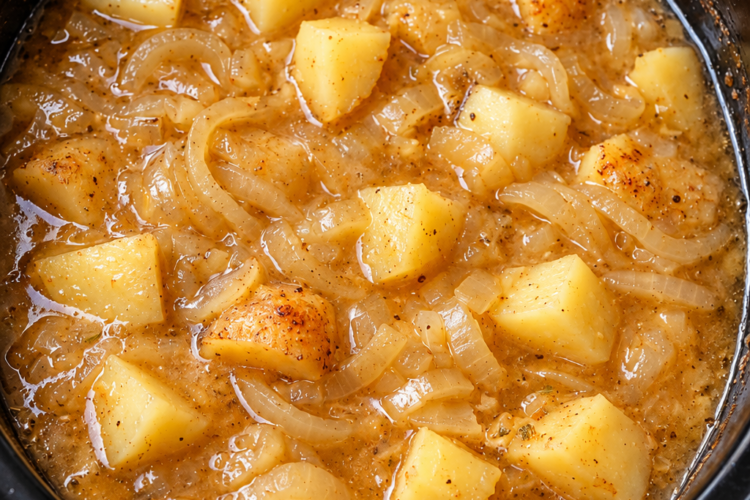
What you get when you do it right is a golden, faintly beefy broth with soft ribbons of onion and big yielding chunks of potato, some of which slump into the liquid when you stir and thicken it just enough to feel like a meal instead of a broth. It's vegan if you use vegetable broth. It's naturally gluten-free if you read the carton. It costs less than a coffee. And on a cold night, with a slab of buttered toast going soft at the edge of the bowl, it does the thing that no complicated recipe has ever quite managed: it makes the house feel taken care of.
Why You'll Love This Slow Cooker Onion and Potato Soup
Three ingredients. I keep saying it because it's the entire pitch, and because most recipes that claim three ingredients are quietly counting salt, oil, and "optional garnish" as free. This one is honest. Onions, potatoes, broth. Everything else is a choice you make at the table.
The hands-on time is about fifteen minutes, and most of that is peeling potatoes while something plays in the background. After that the pot takes over for eight hours. You can go to work. You can go to a kid's basketball game. You can forget about it entirely until the smell reaches you in the other room, which is my favorite way to be reminded that dinner exists.
It's a pantry dish in the truest sense. Onions and potatoes are the two cheapest things in the produce section and they keep for weeks, which means this is the meal you can make on the night before payday without a trip to the store. That was the whole genius of my grandpa's generation, and it's still the whole genius now.
And it genuinely fills you up. Potato soup has a reputation for being thin and sad, and that reputation comes from recipes that are mostly broth with a few potato cubes floating in it like regrets. This one is dense with vegetables. Between the onions and four large russets, there's real substance in the bowl, and the starch that escapes from the potatoes does the work that cream would do in a fancier recipe.
Why This Recipe Works
Thin-sliced onions give up their sweetness slowly. Cut an onion from root to tip into long, thin ribbons and you expose a huge amount of surface area to gentle heat. Over eight hours in a covered pot, the sharp sulfur compounds that make you cry at the cutting board break down and drift off, and what's left is sweet and soft and almost jammy. It's not the same as skillet caramelization — more on that in a moment — but it's the slow-cooker version of the same idea.
Big potato chunks hold their shape and thicken the broth. One- to one-and-a-half-inch chunks are the sweet spot. Small dice dissolves into paste; whole potatoes never get tender in the middle. At that size, the outside softens enough to shed starch into the broth while the center stays intact, which is exactly the texture you want when you stir the pot at the end and a few pieces collapse.
Beef broth gives it a depth that chicken broth can't. This is the one place where I'll defend the source recipe's choice. Beef broth is darker, rounder, and slightly roasted-tasting, and it reads as "simmered for hours" even though nothing was browned. Chicken broth makes a lighter, prettier, more delicate soup. Vegetable broth makes it vegan and a little brighter. All three work, but beef is the one that tastes like a farmhouse kitchen.
Time replaces technique. There's no roux, no blender, no cream, no finishing butter. The body comes from potato starch and the flavor comes from onion, and both of those things just need hours. That's the entire engineering of this recipe, and it's the reason it's survived a century.
An Honest Word About "Caramelized" Onions
You'll see a lot of slow cooker onion recipes claim the onions caramelize in the pot. They don't, and I'd rather tell you than have you wonder why yours came out pale. True caramelization is a dry-heat reaction that needs surface temperatures well above the boiling point of water — a skillet does it, an oven does it, a slow cooker full of broth cannot. What you get here is something arguably better for soup: onions that have gone completely soft, lost their bite, and turned deeply savory and sweet. Call it jammy. Call it mellow. Just don't expect the mahogany tangle you'd get from forty minutes at a stove, and you won't be disappointed by a very good pot of soup.
Ingredient Breakdown
3 Large Yellow Onions
Yellow onions are the workhorse — sweeter than white, more assertive than sweet Vidalias, and cheap year-round. Slice them thinly from root to tip, which means cutting along the lines that run from the stem end to the root end. That gives you long, even ribbons that soften into silky strands instead of stubby dice that disappear.
If your onions are especially sharp or you're using ones that have been sitting in the pantry since spring, slice them a little thicker. A thicker slice holds its shape longer and gives the sulfur compounds more time to mellow out. If they're sweet onions, slice them thin and don't worry about it.
4 Large Russet Potatoes
Russets are the right choice here despite what you might expect. They're high-starch, which is exactly what you want for a soup that thickens itself, and they break down at the edges in a way that waxy potatoes simply won't. Yukon Golds work and give you a butterier color and flavor, but the broth will be less velvety. Red potatoes will hold their shape beautifully and thicken the soup not at all.
Peel them if you want the classic smooth result. Leave the skins on if you don't mind a more rustic bowl and a little extra fiber — I do it about half the time, depending on whether I'm feeding people who notice. Scrub well either way, and cut out any eyes or green spots.
6 Cups Beef Broth
This is where the salt in the recipe lives, so it matters more than the ingredient list suggests. Regular canned or boxed beef broth runs roughly 800 to 900 milligrams of sodium per cup, which means six cups carries somewhere around five thousand milligrams into the pot. That is not a typo, and it's the reason the recipe doesn't call for added salt.
Low-sodium broth brings that down enormously and lets you season the bowl yourself, which I recommend. Homemade beef broth is the dream scenario if you have it in the freezer. And if you want this vegan, use vegetable broth — it changes the character of the soup but not the spirit, and it's genuinely excellent.
One more note: six cups is a lot of liquid for four servings. That's what makes this a brothy soup rather than a thick one. If you want something closer to a chowder, use five cups and mash a few potatoes at the end.
Kitchen Equipment
- A 6-quart slow cooker. This is not a small-batch recipe. Six cups of broth plus two pounds of onions and three pounds of potatoes needs real room. A 4-quart cooker will be filled to the lid and will simmer unevenly.
- A chef's knife you actually keep sharp. Three onions is a lot of slicing. A dull knife turns this into a chore and makes you cut thicker, less even slices.
- A large cutting board. You'll need the room.
- A vegetable peeler. The fast kind with the swivel blade, not the one that came free with a can opener in 1998.
- A potato masher. For crushing a few potatoes at the end to thicken the broth. Optional, but it's the single best texture upgrade.
- A ladle. Obvious, but people forget, and then they use a measuring cup and it goes badly.
- An immersion blender. Only if you want a smooth soup. I usually don't — the chunks are half the pleasure — but it's nice to have the option.
Step-by-Step Instructions
Step 1: Slice the Onions
Peel the onions and slice them thinly from root to tip, so you end up with long, even ribbons rather than dice. Aim for about an eighth of an inch. This is the only part of the recipe that takes real attention, and it's worth doing properly — thick, uneven slices stay crunchy in places and dissolve in others.
Step 2: Peel and Cut the Potatoes
Peel the russets and cut them into hearty rustic chunks, roughly one to one-and-a-half inches. Big enough to hold their shape through eight hours, small enough to get tender all the way through. If you're leaving the skins on, scrub them well and cut out any green spots.
Step 3: Layer, Don't Stir
Scatter the sliced onions evenly across the bottom of the slow cooker. They'll form the soft, sweet base and give the potatoes something to sit on besides bare ceramic. Then layer the potato chunks on top in an even layer, without packing them down too tightly. You want the broth to be able to move between them.
Step 4: Add the Broth
Pour the beef broth over everything, making sure the vegetables are mostly submerged. Press down gently with the back of a spoon to settle everything into the liquid. Don't stir vigorously — you're not making a stew, and you don't want to break up the potatoes before they've had a chance to cook.
Step 5: Cook It Low
Cover and cook on Low for 8 to 10 hours, or on High for 4 to 5 hours. You're looking for onions that are completely soft and golden-tinged, and potatoes that give no resistance when you pierce them with a fork. If a potato still has a firm center at eight hours, give it another hour — slow cookers vary a lot more than their dials suggest.
Step 6: Stir and Finish
Stir the soup gently from the bottom up, lifting the soft onions through the broth. A few potatoes will break apart as you do, and that's the point — that's your thickener. If you want it thicker still, press a potato masher down into the pot three or four times, just enough to crush some of the chunks.
Now taste it. This is the step people skip and then regret. Depending on your broth, the soup may need a pinch of salt, a few grinds of black pepper, or nothing at all. Ladle into bowls and make sure every serving gets plenty of both onions and potato along with the golden broth.
Expert Tips
Taste before you salt. Every time. The sodium in this soup is entirely determined by your broth, and it ranges from "needs a pinch" to "already at the limit." There's no way to know which pot you have without a spoon.
Cut the potatoes bigger than you think. Eight hours is a long time. Chunks that look generous on the cutting board will look correct in the bowl, and chunks that look correct on the board will be gone.
Use a broth you'd drink on its own. The broth is two-thirds of this recipe by volume. If it tastes tinny or flat out of the carton, it will taste tinny and flat in the soup, and no amount of onion will save it.
Mash, don't blend. A few strokes with a potato masher gives you body and keeps the character. An immersion blender turns the whole pot into a uniform purée, which is fine but is a different dish entirely.
Add a finishing knob of butter or a drizzle of olive oil at the table. It breaks the three-ingredient rule, technically, but a teaspoon of good butter stirred into a hot bowl makes this taste like it cost three times as much. My grandpa would have used whatever was in the crock.
Let it sit overnight if you can. This is one of those rare soups that is materially better on day two. The onion flavor deepens and the starch settles into the broth. Make it Sunday, eat it Tuesday.
Common Mistakes
Dicing the potatoes too small. This is the number one way to end up with potato paste. One-inch minimum, and don't be tempted to "help them cook faster" by cutting them down.
Using a cooker that's too small. If the broth is within an inch of the rim, you've overfilled it. It'll bubble over, make a mess, and cook unevenly.
Adding salt at the start. You cannot un-salt a pot of soup, and with six cups of commercial broth you may not need any at all. Wait until the end, taste, then decide.
Expecting browned, caramelized onions. As covered above, that's not a thing that happens in a slow cooker full of liquid. Soft, sweet and golden from the broth is the goal, and it's a good goal.
Lifting the lid to check. Every peek dumps heat and adds time. Use the window if your lid has one, or just trust the clock.
Serving it too thin and calling it done. If your soup tastes like onion tea, mash a few potatoes, simmer uncovered on High for twenty minutes, or stir in a slurry of one tablespoon cornstarch and two tablespoons cold water. It's a five-minute fix that changes the whole bowl.
Ingredient Substitutions
Different broth, different soup. Chicken broth makes it lighter and more delicate. Vegetable broth makes it vegan and slightly brighter. Mushroom broth gives it an almost beefy savor without any meat. Ham broth, if you happen to have a ham bone, is spectacular and very much in the spirit of the original.
Different potatoes. Yukon Golds for a butterier color and flavor with slightly less thickening power. Red potatoes if you want the chunks to hold their shape perfectly — accept that the broth will stay thin. Baby potatoes halved work in a pinch and need no peeling.
Different onions. Sweet onions (Vidalia, Walla Walla) make a milder, sweeter soup and need less time. White onions make it sharper and more old-fashioned. A mix of yellow and leek is lovely if you have leeks going soft in the drawer.
If you're willing to break the three-ingredient rule — and my grandpa would understand — a few cloves of smashed garlic, a bay leaf, a teaspoon of dried thyme, or a parmesan rind dropped in for the last hour all take this somewhere better. So does a tablespoon of soy sauce or miso for depth.
No slow cooker? Use a Dutch oven at 300°F for 2½ to 3 hours, or simmer covered on the stovetop over low heat for about 90 minutes. An Instant Pot runs 15 minutes high pressure with a 10-minute natural release, though the onions won't get quite as soft and sweet.
Variations
French Onion Style. Ladle into oven-safe crocks, float a slice of toasted baguette on top, pile on Gruyère, and broil until bubbling. This technically makes it French onion soup with potatoes, which is not a real category, and I don't care.
Creamy Potato Onion Soup. Mash aggressively, then stir in half a cup of heavy cream or whole milk at the end and warm through without boiling. This is the version my cousin makes, and it's the version the kids ask for.
Loaded. Crisp four slices of bacon, crumble them over the top with shredded sharp cheddar and sliced scallions. Now it's a baked potato in soup form and everyone at the table is happy.
Herbed. Add a bay leaf, a teaspoon of dried thyme, and a handful of chopped parsley at the end. Simple, and it makes the pot smell like a Sunday.
Curried. Stir in a tablespoon of curry powder with the broth and finish with a squeeze of lime and a swirl of coconut milk. Completely different soup, same three-ingredient skeleton.
Greens and Beans. Add a can of drained white beans and two big handfuls of chopped kale in the last thirty minutes. It stretches the pot for a bigger crowd and turns it into a more complete meal.
Make It Healthier
This soup is already doing a lot of things right, and I want to be accurate about what those are rather than dressing it up. With vegetable broth it's vegan. It has no added fat at all — not a drop of oil or butter in the pot. It's naturally gluten-free if your broth is. And it's built almost entirely from whole vegetables.
The one genuine problem is sodium. Six cups of regular beef broth carries roughly five thousand milligrams into the pot, and that's before anyone reaches for the salt shaker. Switching to low-sodium broth drops the per-bowl number from around 1,350 milligrams to somewhere near 350. That's the single most effective change you can make, and it costs about forty cents more.
Second, leave the potato skins on. You lose fiber and a little potassium when you peel them, and the rustic look suits the soup. Third, if you want to bulk out the bowl without adding calories, stir in a few handfuls of spinach or kale at the very end and let the residual heat wilt them.
What this soup is not: low-carb. Four russet potatoes and three onions come to roughly 76 grams of carbohydrate per serving, and no amount of wishful thinking changes that. It's a potato soup. If you're eating low-carb, this is not your bowl, and I'd rather say so plainly than pretend otherwise.
Meal Prep
This is a Sunday recipe that quietly feeds your whole week. Make a full pot, cool it completely, and portion it into containers — it holds five days in the refrigerator and gets better every one of them.
Store it in single-serving containers if you're taking it to work, and pack the bread separately so it doesn't go soggy in transit. If the soup thickens too much in the fridge overnight — and it will, because potato starch keeps setting — thin it with a splash of broth or water when you reheat. Don't panic and add a lot at once. Two tablespoons at a time until it pours the way you want.
For a faster weeknight version, do the slicing and peeling on Sunday and store the raw onions and potatoes together in a sealed container in the fridge. Monday morning you dump and go, and the fifteen minutes of prep is already behind you.
Storage
Cool the soup to room temperature within about two hours, then refrigerate in airtight containers. It keeps 4 to 5 days, and the flavor genuinely improves for the first two. Beyond that the potatoes start to taste a little flat and the broth loses its edge.
Reheat only what you're going to eat. Reheating the whole pot repeatedly is how soup goes from good to tired in three days. And if you left it out on the counter overnight, throw it out — this is a low-acid, vegetable-heavy soup and it's not worth the risk.
Freezing
You can freeze this, and it's fine, but I want to set expectations honestly: chunky potato soup does not come back from the freezer exactly as it went in. The potatoes take on a slightly mealy texture and can go a bit grainy. It's still perfectly good soup, just not quite the same soup.
If you know you're going to freeze it, purée it first or mash it smooth, and it holds up much better — smooth potato soups freeze beautifully for up to 3 months. Freeze in portions, leave an inch of headspace, and thaw overnight in the refrigerator. Reheat gently on the stove, stirring often, and add a splash of broth to loosen it.
Reheating
Stovetop: the best method. Medium-low heat, a splash of broth or water, stir occasionally, 8 to 10 minutes. Don't let it boil hard — the potatoes will break down and the soup will go gluey.
Slow cooker: back on Low for an hour or two, with a little extra liquid. Good if you're reheating a big batch for a crowd.
Microwave: covered, 2 minutes, stir, then 1-minute bursts. It heats unevenly because it's thick, so stirring between bursts matters more than the total time.
From frozen: thaw overnight in the refrigerator. Reheating from frozen on the stovetop scorches the bottom before the middle is warm.
What to Serve With
Thick slices of crusty bread, torn and buttered, is the answer my grandpa would have given and it's still the right one. Buttered toast works just as well and is what I actually make on a weeknight, because a loaf of crusty bread requires a trip to a bakery and toast requires a toaster.
A grilled cheese sandwich turns this into a full supper, and I don't think I need to argue that case. Cornbread, slightly warm and cut into wedges, is the more Southern answer and it's a good one. Oyster crackers if you're feeling like a diner. A sharp cheddar and a few apple slices on the side make it feel like a proper farmhouse lunch.
For something green, a simple side salad of whatever's in the crisper with a mustard vinaigrette cuts through the starch nicely. Roasted broccoli or green beans work too. And a dish of black pepper at the table, as the recipe suggests, is not a throwaway instruction — a few fresh grinds over a hot bowl of this soup changes the whole thing.
Beverage Pairings
Cold, unsweetened iced tea is my default here, and it's what would have been on the table in my grandpa's kitchen in July. In January, hot tea with milk. A dry hard cider is lovely with the sweetness of the onions, especially in the fall. A crisp pilsner or a light lager handles the salt and the starch without competing. For wine, a dry Riesling or an unoaked Chardonnay has the acidity to cut through the potato, and a light Beaujolais works if you're in a red mood.
Non-alcoholic and genuinely good: sparkling water with a squeeze of lemon, plain cold milk (a farmhouse classic and I stand by it), or a mug of hot broth with black pepper while the rest of the pot finishes. Nothing sweet — sugar fights the savory here.
Frequently Asked Questions
Is this really only three ingredients?
Yes, as written: onions, potatoes, and broth. Salt and pepper are offered at the table rather than cooked in, which is deliberate — the broth is salty enough that adding more at the start is a mistake. Anything else you add is a variation, and there are plenty of good ones below.
How long does slow cooker onion and potato soup take?
Low for 8 to 10 hours, or High for 4 to 5 hours. You're waiting for onions that are completely soft and potatoes that give no resistance to a fork. Slow cookers vary a lot in actual temperature, so the fork is a more reliable judge than the dial.
Why didn't my onions caramelize?
Because they can't, in a slow cooker full of broth. Caramelization is a dry-heat reaction that needs temperatures well above boiling, and a covered pot of liquid never gets there. What you get instead is onions that turn very soft, sweet and mellow — which is exactly what this soup needs. The golden color comes from the beef broth.
Can I use chicken or vegetable broth instead of beef?
Absolutely. Chicken broth makes a lighter, paler, more delicate soup. Vegetable broth makes it fully vegan and slightly brighter. Beef gives the deepest, most old-fashioned flavor. Use whichever fits your table, and taste for salt at the end because the sodium varies enormously between them.
Can I make it creamy?
Yes, three ways. Mash some of the cooked potatoes right in the pot for a velvety, dairy-free body. Stir in half a cup of heavy cream or whole milk at the end for a classic creamy potato soup. Or blend it smooth with an immersion blender, though you'll lose the chunky texture that makes this version special.
Can I make this without a slow cooker?
Yes. A Dutch oven at 300°F for 2½ to 3 hours works beautifully, and stovetop over low heat, covered, takes about 90 minutes. An Instant Pot needs 15 minutes at high pressure with a 10-minute natural release, though the onions won't get quite as sweet and silky.
Is this soup gluten-free and vegan?
It's vegan if you use vegetable broth — with beef broth it is not. It's gluten-free only if your broth is; most cartons are, but some contain yeast extract or barley, so read the label. Everything else in the recipe is naturally free of both.
Can I freeze leftover onion and potato soup?
You can, for up to 3 months, but the potatoes will come back slightly mealy. If freezing is the plan, mash or purée the soup first — smooth potato soup freezes much better than chunky. Thaw overnight in the refrigerator and reheat gently with a splash of broth.
Nutrition
Estimated per serving, based on 4 generous bowls made with regular beef broth. Values shift significantly with the broth you choose.
- Calories: ~360
- Protein: ~11 g
- Carbohydrates: ~76 g
- Fiber: ~4 g
- Sugars: ~10 g
- Fat: ~1 g
- Saturated fat: 0 g
- Sodium: ~1,350 mg
- Cholesterol: 0 mg
That sodium number is the one to pay attention to, and it's almost entirely from the broth. Swap in low-sodium beef broth and it drops to roughly 350 milligrams a bowl without changing anything else about the recipe. The carbohydrate number is high because this is, fundamentally, a bowl of potatoes and onions — it's filling, fiber-containing, and genuinely good food, but it is not a low-carb dish and I won't pretend it is.
Final Thoughts
My grandpa never wrote this recipe down. He didn't write anything down. He'd stand at the counter, slice onions until the pile looked right, cut potatoes until the pot looked full, and pour broth until it looked like soup. That's how that generation cooked, and it's why so many of their dishes died with them.
What I've tried to do here is put numbers to something he did by feel, so it survives. Three onions. Four potatoes. Six cups of broth. Eight hours. Taste at the end. That's it. That's the whole inheritance, and it costs less than eight dollars to make.
If you make it, I hope you do what he would have done: tear off a piece of bread, dunk it in the bowl, and eat standing up at the counter before you even sit down. And if you add something — bacon, thyme, a swirl of cream — I think he'd have forgiven you. He was a practical man. He'd have said the point was that it got made.