WANT TO SAVE THIS RECIPE ?
Slow Cooker Sticky Spareribs: The 4-Ingredient Rack My Pickiest Eater Actually Asks For
I want to tell you about the one dinner that made my middle child stop negotiating. For about two years, every meal in our house came with a side of cross-examination — is there sauce on it, is the sauce touching the other food, why is there a green thing. Then I made these slow cooker sticky spareribs, and he ate four ribs, licked his fingers, and asked when we were having them again. I have been chasing that energy ever since, and I have not once gotten it from a plate of roasted vegetables.
The recipe is almost embarrassing to write down. A rack of spareribs. Ketchup. Brown sugar. Apple cider vinegar. That's it — the whole thing. No rub, no mop sauce, no smoker running at 225°F while you check the thermometer every twenty minutes like a nervous new parent. You curl the rack into the pot, whisk three things together in a bowl, pour, cover, and walk away for seven hours. The result tastes like you spent the afternoon tending a grill and possibly wearing an apron with a saying on it.
This is not a new recipe, and I don't pretend it is. My mother-in-law has a version of it written on an index card in handwriting I can barely read, filed in a box alongside eleven other sauces that all start with ketchup. That's where this comes from — church basement cookbooks, funeral luncheons, family reunions where somebody's aunt brings a roaster of ribs and everyone asks for the recipe and the aunt says "oh, it's just ketchup and brown sugar" and nobody believes her. I believe her now.
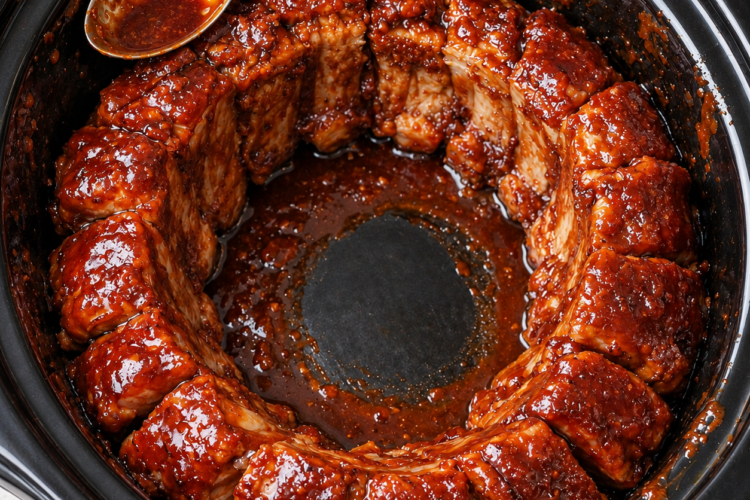
What you get is a rack of ribs so tender the meat surrenders when you look at it, glazed in a sauce that is sticky and sweet with a vinegar bite at the very end that keeps it from being cloying. It's messy. It's meant to be eaten with your hands. And it costs about three dollars and fifty cents a serving, which is the part I still can't quite get over, because it tastes like a restaurant appetizer that would cost more than the entire rack.
Why You'll Love These Slow Cooker Sticky Spareribs
Four ingredients, and three of them are things you almost certainly already own. If you've got a bottle of ketchup in the door of the fridge and a bag of brown sugar that's gone slightly hard in the pantry, you're one rack of ribs away from dinner. The vinegar is the only thing people sometimes don't have, and it's three dollars and lasts a year.
There is no technique here. I mean that sincerely, not as marketing. You don't need to know how to make a rub or maintain a fire or wrap anything in foil. You need to be able to whisk and to close a lid. If you can make a batch of brownies from a box, you can make this.
The five-minute prep is the entire reason this works on a weeknight. In the morning, before anyone is awake enough to need anything from you, you curl a rack of ribs into the slow cooker, dump a bowl of sauce on top, and put the lid on. Then you go live your life. When you come back, dinner is done and the house smells like a barbecue joint, which is a genuinely unfair advantage to have when guests walk in.
And it feeds people. A full rack is a real dinner for four, especially with potatoes and something green alongside. Kids eat it because it's sweet and sticky and comes apart in their hands. Adults eat it because it's sweet and sticky and comes apart in their hands, and also because there's a vinegar tang that makes it taste like more than just sugar. Everyone at the table is happy at the same time, which as far as I can tell is the rarest thing in home cooking.
Why This Recipe Works
Spareribs are forgiving in a way that loin and chops are not. This is the mechanical heart of it. Pork loin is lean and dries out the instant you overshoot the mark. Spareribs are laced with fat and connective tissue, and long moist heat turns that connective tissue into gelatin, which is what gives you that sticky, lip-smacking, fall-off-the-bone texture. You almost cannot overcook them in a slow cooker. You can only cook them longer.
The sauce is a three-part balancing act. Ketchup brings tomato, sugar, salt and acid. Brown sugar brings body, color and a deep caramel note as it cooks down. Cider vinegar brings the sharpness that keeps the whole thing from tasting like candy. Pull any one of those legs out and the stool falls over — which is why the substitutions section below is more careful than you'd expect for a recipe this simple.
Curl, don't stack. Curling the rack around the inside wall of the insert means the ribs cook in a loose spiral with hot liquid and steam able to reach most surfaces. Lay them flat and stacked and you get uneven cooking, with the middle of the pile wanting another two hours. It looks fussy. It takes ten seconds.
Covered heat keeps everything moist while the sauce reduces. The slow cooker traps steam, so the exposed top of the rack stays wet while the sauce underneath concentrates into something thick and glossy. That concentration is the whole "vintage sticky" thing — you're essentially reducing a barbecue sauce in place for seven hours, with the ribs sitting in it the entire time.
And the fat does the basting for you. Spareribs render a startling amount of fat. That fat rises to the surface of the sauce and bastes everything it touches, which is why the meat ends up silky rather than stewed. Skim most of it off before you serve, but appreciate it on the way in.
Ingredient Breakdown
1 Full Rack Bone-In Pork Spareribs, 3 to 4 Pounds
Spareribs, not baby backs. Spareribs come from the belly side of the pig, they're fattier and meatier and chewier, and they are the right choice for a long slow braise because they have more connective tissue to break down into that sticky texture. Baby backs are leaner and cook faster — they work here, but reduce the time by an hour to ninety minutes and expect a firmer bite.
Look for a rack that's roughly uniform in thickness, with meat that covers most of the bone. A little extra fat on top is a good thing. If your store only sells ribs already cut into sections, that's fine — the curling trick is just for fitting a whole rack in the pot.
On the membrane: the thin silverskin on the bone side is chewy if you leave it, but it also holds the rack together and it renders soft enough in a seven-hour braise that most people never notice. If it peels easily, take it off. If it fights you, leave it and don't feel bad. That's a real opinion, and it's the opposite of what the grill crowd will tell you.
1 Cup Ketchup
Plain old ketchup. Not fancy, not artisanal, not a "tomato jam." Heinz is the flavor most of these church-cookbook recipes were built around, and the specific balance of sugar, vinegar and salt in commercial ketchup is part of why the recipe works with only two other ingredients. A fancier ketchup with less sugar will give you a thinner, sharper sauce — not bad, just different.
Ketchup is also where most of the sodium in this dish comes from, and it's also the ingredient to check if gluten is a concern. Heinz is labeled gluten-free. Some store brands and specialty ketchups use barley malt vinegar, so read the label if it matters.
½ Cup Firmly Packed Brown Sugar
Light or dark, either works. Dark brown sugar has more molasses and gives you a deeper, almost rummy flavor and a darker glaze. Light brown sugar is sweeter and cleaner. I use light most of the time because that's what's in the pantry, and dark when I want the sauce to look like it came off a grill.
"Firmly packed" is not a suggestion. Loosely scooped brown sugar can be twenty percent less than a packed half cup, and that variance is enough to change how sweet and how thick the sauce gets. Press it down into the measuring cup until it holds the shape when you turn it out.
Half a cup is a lot of sugar for four servings. I'm not going to pretend otherwise — it's the reason these ribs are so good, and it's the reason the nutrition panel below looks the way it does.
¼ Cup Apple Cider Vinegar
Cider vinegar is fruitier and softer than white vinegar, and it's the ingredient that makes people say "huh, what's in this?" It cuts the sugar, brightens the tomato, and leaves a tang on the back end that keeps you reaching for another rib. White vinegar works in a pinch but is harsher. Rice vinegar is too mild to do the job. Balsamic would be a completely different and much sweeter sauce — not what we're after.
Kitchen Equipment
- A 5- to 6-quart slow cooker. A full 3- to 4-pound rack curled into a spiral needs the room. A 4-quart will force you to cut the rack down and stack it, which works but cooks less evenly.
- A medium mixing bowl and a whisk. For the sauce. A fork is fine. A jar with a lid also works and is easier to shake.
- Paper towels. Pat the rack dry before it goes in. Wet meat makes a watery sauce.
- Kitchen shears or a sharp knife. For cutting between the bones at the end. Shears are faster and I use them every time.
- A rimmed baking sheet and aluminum foil. Only if you're doing the optional broiler finish. Do not put your slow cooker's ceramic insert under the broiler — it will crack.
- A spoon or a fat separator. For skimming the rendered fat off the sauce before serving. A spoon works; a separator is nicer.
- Tongs. That rack is hot and slippery and you will not move it gracefully with a fork.
Step-by-Step Instructions
Step 1: Dry the Rack
Pat the rack of ribs dry on all sides with paper towels. This matters more than it sounds like it does — surface moisture dilutes the sauce and steams instead of glazing. If there's a silverskin membrane on the bone side that peels away easily, pull it off now. If it doesn't cooperate, leave it.
Step 2: Curl It Into the Pot
Set the rack into the slow cooker with the bone side facing inward and curl it around the inside wall so it forms a loose circle or spiral. Tuck the ends in so the lid sits down flush. The ribs will overlap somewhere, and that's completely fine — the overlap point just gets extra tender.
If your rack is too long to curl comfortably, cut it into two or three sections with kitchen shears and arrange them around the insert. Nobody will know, and nothing about the finished dish changes.
Step 3: Whisk the Sauce
In a medium bowl, whisk together the ketchup, packed brown sugar, and cider vinegar until smooth. It should be thick, glossy, and pourable — like a slightly loose barbecue sauce. If it looks grainy, keep whisking; the sugar needs to dissolve.
Step 4: Pour It Over
Pour the sauce evenly over the curled rack, trying to coat as much surface as you can. Use a spoon or spatula to spread it over any dry patches. Some of it will run down to the bottom of the insert, and that's exactly what you want — that pool of sauce is what keeps the lower half of the rack moist while the top glazes.
Step 5: Cook It Low
Cover and cook on Low for 7 to 8 hours, or on High for 3½ to 4 hours. You're looking for meat that has visibly pulled back from the ends of the bones and a rack that flexes when you lift one end. Keep the lid down for at least the first five hours on Low. Every peek costs you heat and time.
One important correction to the usual advice: pork is safe at 145°F, but ribs at 145°F are safe and completely unchewable. You want them up around 195–203°F, where the collagen has melted. In a slow cooker the meat usually goes right past 145°F in the first two hours and keeps climbing, so don't pull them early just because a thermometer says "done." Judge by the bones and the flex.
Step 6: Skim, Baste, and Serve
Spoon some of the sauce from the bottom of the pot over the top of the rack to make it extra sticky. Let the rack rest a few minutes so it's easier to handle — this is the difference between cutting clean portions and chasing ribs around a cutting board.
Cut between the bones into single or double portions with shears or a sharp knife. Spoon the warm sauce over the top, and if you want to be kind to your guests, skim the fat off that sauce first.
Optional Step 7: The Broiler Finish
If you want a caramelized, lightly charred edge, line a baking sheet with foil, transfer the cooked rack to it, brush generously with sauce, and broil on the top rack for 3 to 5 minutes. Watch it the entire time. The sugar in that glaze goes from "nicely browned" to "kitchen incident" in about thirty seconds. This step is not required, but it's the one that makes people say "wait, these came out of a slow cooker?"
Expert Tips
Buy the meatiest rack you can find. Sparerib quality varies wildly. A rack with a thick, even layer of meat over the bones will always beat a bony one, even at a higher price per pound, because you're paying for bone weight otherwise.
Packed brown sugar, every time. Loosely measured sugar makes a thin, sharp sauce. Press it into the cup.
Don't skip the fat skim. Spareribs render a lot. If you spoon the sauce straight from the pot without skimming, you'll get a glossy pool of liquid fat on the plate and the sauce will taste flatter than it should.
Taste the sauce at hour six. If it's too sweet for your family, whisk a teaspoon more vinegar into the pot. If it's too sharp, a teaspoon of brown sugar. You can adjust the balance right up until you serve, which is a luxury you don't get with a grill.
Use a liner if you hate scrubbing. Slow cooker liners feel wasteful until you've spent nine minutes chiseling caramelized sugar off a ceramic insert. I use them for this recipe specifically.
Make more than you need. These reheat beautifully and the leftovers make a genuinely great sandwich on a soft roll with coleslaw. I have never once regretted buying two racks.
Common Mistakes
Using baby back ribs and the sparerib timing. Baby backs are leaner and smaller. Seven to eight hours will turn them to mush. Drop to 5½ to 6½ hours on Low if that's what you bought.
Stacking the rack flat. A flat, layered pile cooks unevenly and the middle never gets as tender as the outside. Curl it.
Pulling them at 145°F. Safe is not the same as tender. Wait for the bones to show and the rack to flex.
Pouring off the sauce before serving. That liquid at the bottom is the best part. Skim the fat, keep the sauce, spoon it over everything.
Walking away from the broiler. Three to five minutes means three to five minutes. Sugar burns.
Forgetting that the sauce reduces and concentrates. A sauce that tastes aggressively sweet and salty before cooking will taste even more so after seven hours of reduction. If you're sensitive to that, cut the brown sugar to a third of a cup and add an extra splash of vinegar from the start.
Setting the cooker to Warm. Warm does not cook food safely. It holds food that's already hot. This is the single most common slow cooker mistake and it's a food safety issue, not just a dinner-ruining one.
Ingredient Substitutions
No ketchup? Use 1 cup of tomato sauce plus 2 tablespoons of brown sugar and ½ teaspoon of salt. The flavor will be a little less rich and a little more tomato-forward, but it works. Tomato paste thinned with water is a last resort — use ⅔ cup paste plus ⅓ cup water.
No apple cider vinegar? White vinegar works, use slightly less (3 tablespoons) because it's sharper. Rice vinegar is too mild. Red wine vinegar is a good middle ground.
Different sugar. Dark brown for a deeper molasses note. Turbinado or raw sugar for a cleaner sweetness with a bit of crunch if you broil. Honey works but browns faster under the broiler — watch it closely.
Baby back ribs instead of spareribs. Yes, and they're excellent. Reduce the cook time by 1 to 1½ hours on Low.
Country-style ribs. These are actually shoulder meat, not ribs, and they're great here. They'll take the full 8 hours and shred rather than slice. Different dish, still delicious.
Pork shoulder for a crowd. A 5-pound bone-in shoulder with the same sauce, 9 to 10 hours on Low, shredded at the end, makes excellent pulled pork sandwiches. It's the same recipe wearing a different hat.
Variations
Smoky. Stir 1 to 2 teaspoons of liquid smoke into the sauce before pouring. Start with one — it's potent, and there's no removing it once it's in.
Spicy. Add 1 to 2 teaspoons of hot sauce to the ketchup mixture, or a big pinch of crushed red pepper flakes. For real heat, add a minced chipotle in adobo and a spoonful of its sauce.
Tangier, less sweet. Drop the brown sugar to ⅓ cup and raise the cider vinegar to ⅓ cup. This is the version I make when I'm feeding adults who claim they don't like sweet sauces, and it's genuinely better with a vinegary coleslaw.
Bourbon. Replace 2 tablespoons of the vinegar with bourbon. The alcohol cooks off and leaves a warm, oaky note that makes the sauce taste like it took more effort than it did.
Honey Garlic. Swap the brown sugar for ⅓ cup honey and add 3 minced cloves of garlic. Sweeter, stickier, and a totally different flavor profile from the same skeleton.
Korean-ish. Add 2 tablespoons of gochujang and a tablespoon of soy sauce to the sauce, and finish with toasted sesame seeds and sliced scallions. Not authentic anything, but extremely good over rice.
Grill finish instead of broiler. Once tender, move the rack carefully to a medium-hot grill and brush with sauce, a few minutes per side, until sticky and lightly charred. Best version of this recipe, if the weather cooperates.
Make It Healthier
Let me be direct with you: this is not a health food, and any version of this post that tells you otherwise is lying to you. Spareribs are a fatty cut and the sauce is nearly half sugar by volume. What I can do is tell you honestly where the numbers come from and where you can actually move them.
The sugar is the biggest lever. Cutting the brown sugar from ½ cup to ⅓ cup and raising the vinegar to ⅓ cup takes roughly 8 grams of sugar off each serving and makes a sharper, more grown-up sauce. I make it that way half the time and nobody at my table has ever complained.
Skim the fat. A startling amount of fat renders out of spareribs. Skimming the sauce before serving removes a few hundred calories from the pot without touching the flavor of the meat. Chill the leftovers and the fat solidifies on top — lift it off in one piece.
Control the portion, not the recipe. One rack feeds four generously, but if you serve it as part of a plate that's half vegetables, you can stretch it to six smaller portions and everyone still gets ribs. That's a better strategy than trying to make ribs into something they're not.
Buy baby backs if you want leaner. They have less fat than spareribs and cook faster. You trade some of the sticky unctuousness for a firmer, meatier bite. It's a real trade, not a free lunch.
What this dish is not: low-carb, keto, or gluten-free by default. It can be gluten-free if your ketchup and vinegar are — check the labels. It cannot be made low-carb without turning it into a completely different recipe, and I'm not going to invent one to fill a content gap.
Meal Prep
This is one of the best make-ahead dinners in my rotation, because ribs genuinely improve overnight. Cook the rack on Sunday, cool it completely in the sauce, and refrigerate. On Monday the fat has solidified into a disk you can lift off with a spoon, and the meat has absorbed more of the glaze.
For weekly lunches, cut the rack into single-bone portions and pack them with the skimmed sauce in separate small containers so nothing gets soggy. A portion of ribs plus a container of coleslaw plus a baked potato is a lunch that makes people at work jealous, which is a small but real pleasure.
If you're prepping for a party, cook two racks a day apart, refrigerate both, then reheat together in a 325°F oven covered with foil for 25 minutes and finish under the broiler. It's far less stressful than trying to time two slow cookers on the same afternoon.
Storage
Refrigerate leftovers within two hours in a shallow container — this is the one food safety rule I won't soften. Keep the ribs in their sauce; the fat and glaze protect the meat from drying out. They keep 3 to 4 days.
If you made the full rack and only two people ate, you'll have a lot left. Pull the meat off the bones before storing it if you want it to go further — a container of pulled rib meat in sauce is the start of tacos, nachos, a baked potato topping, or a very good sandwich.
Freezing
These freeze well. Cool completely, then pack the ribs and skimmed sauce together in freezer bags or containers, pressing out the air. They keep about 3 months.
Freeze in portions you'll actually eat — single-bone portions thaw faster and reheat more evenly than a whole rack. Thaw overnight in the refrigerator, then reheat gently. The texture holds up well because the meat is already falling apart; freezing and thawing just nudges it a little further in that direction.
Reheating
Oven: the best method. 325°F, covered with foil, with a spoonful of sauce, 20 to 25 minutes. Uncover for the last five minutes if you want the glaze to tighten up.
Broiler: 3 to 4 minutes from refrigerated, brushed with sauce. Fast and gives you a fresh caramelized edge. Watch it.
Microwave: covered, 90 seconds, then 30-second bursts. Fine for a single serving, and the meat is forgiving enough that it won't punish you.
Slow cooker: back on Low with a splash of water for an hour. Good for reheating a large batch for a crowd without dirtying another pan.
From frozen: thaw overnight first. Reheating from frozen will dry out the outside before the middle is hot.
What to Serve With
Mashed potatoes, obviously, and I mean real ones with butter and a lot of salt. The sauce wants starch. Baked potatoes work too, split open and spooned with a little of the rib sauce, which is a move I stole from a barbecue joint and have never regretted. Buttered egg noodles are underrated here.
Coleslaw is not optional in my house. You need the cold crunch and the vinegar against all that sweet and fat. A creamy deli-style slaw is the classic pairing, but a vinegar slaw is better if you made the tangier version of the sauce.
Green beans with butter and pepper. Peas, if you have children who will eat peas. Corn on the cob in summer, frozen corn with a knob of butter in January. Pickles on the side, straight from the jar, because the acid does the same job the vinegar in the sauce does.
And bread. White bread, dinner rolls, or a hunk of cornbread — something to wipe the plate with. My mother-in-law serves hers with sliced white bread and margarine and I have stopped pretending I'm above it.
Beverage Pairings
Sweet tea, unsweetened iced tea, or lemonade, all with a lot of ice. There's a reason every barbecue joint in America serves those three things. A cold lager or a pilsner handles the sugar and fat beautifully. Dry hard cider is my favorite pairing with sticky ribs — the apple notes echo the cider vinegar. For wine, an off-dry Riesling or a fruity Zinfandel works; a big tannic Cabernet will fight the sweetness and lose.
Non-alcoholic and just as good: root beer, which sounds like a joke until you try it, or sparkling water with lime to cut through the glaze. Whatever you choose, make it cold and make it fizzy. This is a rich plate and it wants contrast.
Frequently Asked Questions
How long do spareribs take in a slow cooker?
Low for 7 to 8 hours, or High for 3½ to 4 hours. This slow cooker sticky spareribs recipe is forgiving on the long end — an extra hour won't hurt them, which is more than I can say for most pork recipes. Look for meat pulling back from the bone ends and a rack that flexes when you lift one side.
What internal temperature should ribs reach?
Pork is safe at 145°F, but ribs at 145°F are tough and chewy. For that fall-off-the-bone texture you want 195–203°F, where the collagen and connective tissue have melted. In a slow cooker they'll sail past 145°F early and keep climbing, so judge doneness by the bones and the flex rather than pulling them early.
Do I have to remove the membrane from the back of the ribs?
No. It's chewier if left on, but a seven-hour braise softens it considerably and it holds the rack together while you curl it. If it peels off easily, take it off. If it fights you, leave it and move on with your day.
Can I use baby back ribs instead of spareribs?
Yes. Baby backs are leaner, smaller and cook faster — reduce the time to about 5½ to 6½ hours on Low, or 3 hours on High. The sauce quantities stay the same, and you may have a little more sauce left in the pot at the end.
Can I double this recipe in one slow cooker?
Not comfortably. Two full racks in a 6-quart cooker means crowding, which causes uneven cooking and a pot that never gets properly hot. Cook one rack at a time, or use two cookers, or cut the racks into sections and accept that you'll need to rotate them halfway through.
Can I finish these on the grill instead of under the broiler?
Yes, and it's the best version. Once the ribs are tender, move them carefully to a medium-hot grill, brush with sauce, and cook a few minutes per side until sticky and lightly charred. Have a spray bottle or a cool zone ready — the sugar in the glaze flares.
Are these sticky spareribs gluten-free?
They can be. Pork, brown sugar and cider vinegar are naturally gluten-free. Ketchup is usually gluten-free — Heinz is labeled as such — but some store brands and specialty ketchups use barley malt vinegar, so read the label. Check your hot sauce too if you're adding it.
How do I make the sauce less sweet?
Drop the brown sugar to ⅓ cup and raise the cider vinegar to ⅓ cup. That's the easiest fix and it makes a sharper, more balanced sauce. You can also whisk in an extra teaspoon of vinegar at the end of cooking, right before serving, which brightens the whole pot without changing the recipe.
Nutrition
Estimated per serving, based on 4 servings from a 3½-pound rack with the skimmed pan sauce. Sparerib yields vary a lot with bone weight, so treat these as a rough guide.
- Calories: ~840
- Protein: ~50 g
- Carbohydrates: ~45 g
- Sugars: ~40 g
- Fat: ~55 g
- Saturated fat: ~20 g
- Sodium: ~420 mg
- Cholesterol: ~185 mg
Two things worth saying plainly. First, that sugar number is real — half a cup of brown sugar plus a cup of ketchup across four servings is a lot of sweetness, and this is a treat, not a Tuesday staple in the health sense. Second, the sodium is genuinely modest for a barbecue-style dish, because there's no soup mix, no soy sauce and no rub in the recipe. If you're watching sodium, this is one of the better ribs you can make. If you're watching sugar, cut it to a third of a cup and nobody will notice.
Final Thoughts
I have a whole folder of recipes that impress people, and almost none of them get made on a regular basis. This one does. It gets made on the nights when I've got nothing left, when the kids have been loud all day and the kitchen is already a disaster and the idea of standing at a stove browning anything makes me want to lie down on the floor. It takes five minutes and it always works, and there's something deeply comforting about a dinner you don't have to be at your best to pull off.
My mother-in-law's index card doesn't have a title on it. It just says "ribs" at the top in blue ballpoint, and then the three sauce ingredients, and then "low all day." That's the entire recipe, and it's been feeding her family for thirty years. I've added times and temperatures and a broiler step because that's what a recipe needs to survive on the internet, but the soul of it is still three ingredients and a lid.
If you make these, do me a favor and eat one standing at the counter before you call anyone to the table. That's the cook's portion. You've earned it.