
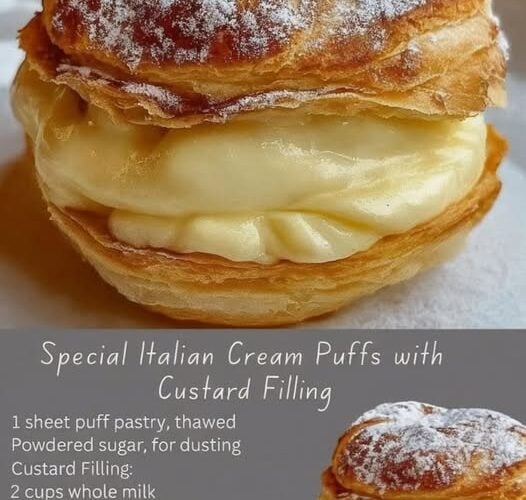
Italian Cream Puffs with Vanilla Custard – The Sunday Morning Treat That Still Feels Like Home
There are smells that live in your bones. Not the ones you notice once and forget, but the ones that open a door inside you the second they hit the air. For me it is the quiet warmth of milk and vanilla thickening on the stove, the soft hiss of a wooden spoon against the bottom of a saucepan, the way the whole kitchen seems to hold its breath while the custard turns from thin liquid into something silky and pale yellow. My nonna made these cream puffs every Sunday morning when I was little. She never announced it. She simply appeared at the stove in her house dress, and within an hour the table would be set with a plate of golden, sugar-dusted squares that shattered at the first bite and gave way to cool, thick vanilla cream.
Last weekend I finally made them myself. I stood at the counter dusting powdered sugar over the finished puffs the way she used to, and for a second I was seven years old again, swinging my legs under her kitchen table, waiting for permission to take the first one. I got a little emotional. Not in a dramatic way. Just that quiet swell in the chest that happens when something simple and good reconnects you to the people who taught you what care tastes like.
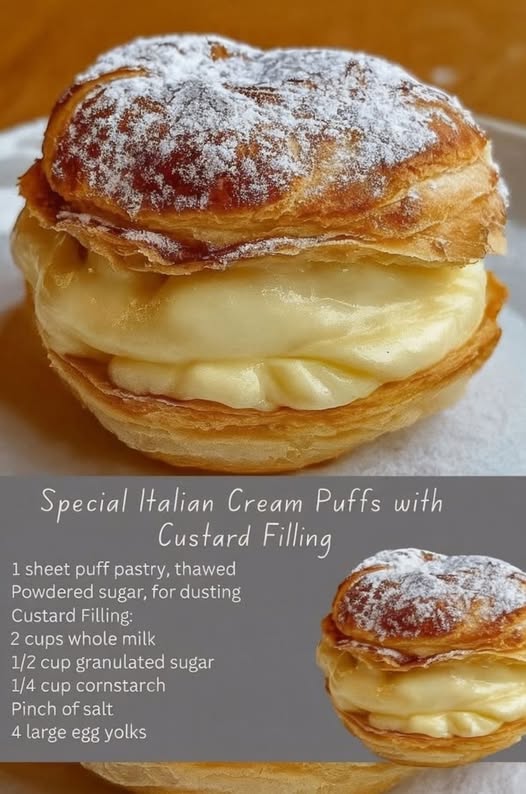
These Italian cream puffs are dangerously good. The store-bought puff pastry bakes up flaky and deeply golden, shattering into delicate layers when you bite down. Then you reach the filling: a classic vanilla custard so rich and velvety it coats your tongue and makes everything else in the room go quiet for a moment. The tops caramelize just enough in the hot oven to give them that bakery-window sheen, and the final dusting of powdered sugar makes them look like they traveled straight from a little pastry shop in the old neighborhood. I brought a batch to family dinner and they disappeared before I even sat down. My cousin asked if I had bought them from the Italian bakery downtown. That is still the best compliment I have ever received in a kitchen.
This recipe is the kind of dessert that feels special without asking for hours of work. The pastry is ready-made, the custard comes together in one pan, and the assembly is pure satisfaction. It is perfect for Sunday mornings, for unexpected company, for the days when you want to feed the people you love something that tastes like memory. And once you taste that first crisp-and-cream bite, you will understand why my nonna never needed a recipe card. Some things just live in your hands.
Why You’ll Love This Recipe
You will love these Italian cream puffs because they deliver bakery-level results with home-kitchen ease. There is no laminated dough to fold, no choux pastry to pipe, and no temperamental oven drama. A single sheet of thawed puff pastry becomes eight golden squares that puff dramatically in the heat. The custard is a straightforward pastry cream that thickens on the stove in minutes and chills into something thick enough to pipe or spoon without running.
You will love the contrast of textures. The pastry shatters into hundreds of delicate layers. The custard is cool, dense, and luxurious. Powdered sugar softens on the warm pastry just enough to cling without turning gummy. Every bite is both light and rich at the same time.
You will love how forgiving the process is. The pastry can sit for a few minutes after baking. The custard can chill for hours or even overnight. Assembly takes only a few minutes once both components are ready. These puffs travel well to potlucks, look impressive on a dessert table, and disappear faster than almost any other homemade pastry I have ever made.
Most of all, you will love the way they make people feel. This is the dessert that makes adults close their eyes for a second. It is the one that sends kids back for seconds before the first plate is empty. It tastes like someone stood at the stove and paid attention. In a world that moves quickly, that kind of quiet care is worth returning to again and again.
Why This Recipe Works
The success of these cream puffs rests on two reliable techniques that happen to taste extraordinary together. First, commercial puff pastry is already laminated with many thin layers of butter and dough. When it hits the hot oven, the water in the butter turns to steam and forces those layers apart, creating the dramatic rise and shatteringly crisp texture. Baking at 400°F is hot enough to drive that steam expansion quickly while allowing the exterior to set and brown before the interior collapses. Parchment paper prevents sticking and helps the bottoms crisp evenly.
The custard is a classic pastry cream, or crema pasticcera. Cornstarch is the primary thickener. As the mixture heats, the starch granules absorb liquid, swell, and eventually burst, releasing long chains of molecules that tangle and create a stable gel. Egg yolks add richness, color, and additional thickening power through their proteins. Tempering the yolks—slowly whisking in a little hot milk before returning everything to the pan—raises their temperature gradually so the proteins set gently instead of scrambling. Constant whisking keeps the starch from settling and scorching on the bottom of the pan. Once the mixture reaches a temperature where it thickens and coats the back of a spoon (usually around 170–180°F), the starch has done its work and the yolks have set. Vanilla is stirred in off the heat so its volatile aromatics stay bright. Pressing plastic wrap directly onto the surface prevents a skin from forming while the custard cools and the starch network fully sets.
The final assembly works because the pastry is completely cool and the custard is thoroughly chilled. Warm pastry would soften the filling; warm filling would soften the pastry. Keeping both components at the right temperature preserves the contrast that makes every bite memorable. The powdered sugar is added at the last possible moment so it stays dry and snowy rather than melting into the surface.
These small scientific details are why the recipe feels almost foolproof once you understand them. The oven does the heavy lifting with the pastry. The stove and a bit of patience do the same for the custard. Everything else is simply attention and timing.
Ingredient Breakdown
Puff Pastry (1 sheet, thawed) Store-bought puff pastry is the practical heart of this recipe. It arrives already laminated with dozens of butter layers, so the dramatic rise and flaky texture are essentially guaranteed. Look for an all-butter version when possible; the flavor is noticeably richer than versions made with shortening. Thaw the sheet slowly in the refrigerator overnight or on the counter for about 30–40 minutes until it is pliable but still cold. Cold pastry puffs higher because the butter stays solid longer and creates more steam. Once thawed, keep it covered so it does not dry out. Leftover scraps can be rerolled for smaller treats or frozen for another day.
Powdered Sugar (for dusting) Powdered sugar is pure presentation and a touch of extra sweetness. It softens the visual edges of the puffs and adds a delicate melt-in-the-mouth finish. A fine mesh sieve or a small shaker gives the most even, bakery-style dusting. Store powdered sugar in an airtight container so it does not clump. A little goes a long way; too much can overwhelm the custard.
Whole Milk (2 cups) Whole milk provides the liquid base and the fat that makes the custard luxurious. The proteins and lactose also contribute to browning and flavor development as the mixture cooks. Lower-fat milks will work in a pinch but produce a thinner, less rich result. Use milk that is fresh and preferably cold when you begin. From a nutrition standpoint, whole milk contributes calcium, vitamin D (if fortified), and high-quality protein.
Granulated Sugar (½ cup) Sugar sweetens the custard and helps it achieve a smooth, glossy texture. It also interferes slightly with protein coagulation, which keeps the custard from becoming rubbery. Pure cane sugar dissolves cleanly and leaves no aftertaste. Store it in a sealed container away from moisture.
Cornstarch (¼ cup) Cornstarch is the primary thickener. It creates a clean, stable gel that holds its shape when the puffs are filled and sliced. Unlike flour, it produces a translucent, silky finish rather than a cloudy one. Measure it carefully; too little and the custard will be loose, too much and it can taste starchy. Cornstarch is naturally gluten-free, which is useful for anyone avoiding wheat in the filling.
Salt (pinch) A small pinch of salt sharpens the sweetness and rounds out the vanilla. Without it the custard can taste flat. Use fine sea salt or table salt so it dissolves instantly.
Egg Yolks (4 large) Egg yolks supply richness, color, and secondary thickening. Their emulsifying properties help the custard stay smooth and stable. Large yolks are standard; if your eggs are smaller, use an extra yolk. Fresh eggs give the best flavor and color. From a nutrition perspective, yolks contribute choline, fat-soluble vitamins, and high-quality protein.
Vanilla Extract (1 teaspoon) Pure vanilla extract is the aromatic soul of the custard. It softens any eggy notes and ties the milk and sugar together into something that tastes complete. Real vanilla is worth the cost; imitation can leave a harsh finish. Vanilla bean paste can be substituted for a more intense flavor and pretty speckles. Store the bottle tightly closed away from heat and light.
Kitchen Equipment
You will need a baking sheet, parchment paper, a sharp knife or pizza cutter for dividing the pastry, a medium heavy-bottomed saucepan for the custard, a whisk, a heatproof bowl for tempering the yolks, a spatula, plastic wrap, and a fine-mesh sieve or powdered-sugar shaker. A piping bag fitted with a large round tip is helpful for neat filling but not required; a spoon works perfectly well. An instant-read thermometer is useful if you want precise control over the custard temperature, though visual cues are reliable once you have made it a few times. That is the entire list. No specialty tools, no stand mixer, no pastry bags unless you prefer them.
Step-by-Step Instructions
Preheat the oven to 400°F and line a baking sheet with parchment paper. Take the thawed puff pastry sheet out of the refrigerator. It should feel cold but flexible. On a lightly floured surface or right on the parchment, unfold the sheet and gently roll it just enough to even out any creases. Using a sharp knife or pizza cutter, cut the sheet into eight equal squares. Transfer the squares to the prepared baking sheet, leaving a little space between them so they can expand.
Bake for 15 to 18 minutes. You will hear the pastry begin to crackle after about ten minutes. The squares will rise dramatically and turn a deep, even golden brown. The bottoms should sound hollow when tapped. Remove the sheet from the oven and let the pastry cool completely on the pan or on a wire rack. Warm pastry will soften the custard, so patience here is important. The kitchen will smell like toasted butter and pastry by this point.
While the pastry bakes, make the custard. In a medium saucepan, whisk together the whole milk, granulated sugar, cornstarch, and salt until no lumps of starch remain. Place the pan over medium heat and cook, whisking frequently, until the mixture is hot and just beginning to steam. Do not let it boil yet.
In a separate bowl, whisk the egg yolks until they are smooth and slightly lightened in color. This takes only about thirty seconds. Slowly pour about half a cup of the hot milk mixture into the yolks while whisking constantly. This tempering step raises the temperature of the yolks gradually so they do not scramble. Once the yolks are warmed, pour the entire yolk mixture back into the saucepan.
Return the pan to medium heat and cook, whisking constantly and thoroughly, scraping the bottom and corners. The mixture will begin to thicken after two to three minutes. Continue cooking until it is noticeably thick, coats the back of a spoon, and leaves a clear trail when you run your finger through it. This usually takes three to four minutes total once the yolks are added. Do not walk away; the bottom can scorch quickly.
Remove the pan from the heat and stir in the vanilla extract. The aroma will bloom immediately. Pour the custard into a clean bowl. Press a piece of plastic wrap directly onto the surface so no air can form a skin. Refrigerate until completely cold, at least one hour and preferably two. The custard will continue to thicken as it chills.
When both components are fully cool, assemble the puffs. Using a serrated knife, carefully slice each pastry square in half horizontally. The interior should look like many thin, dry layers. Spoon or pipe a generous amount of chilled custard onto each bottom half. You want the filling to be thick enough that it does not squeeze out the sides when the top is replaced. Gently set the pastry lids back in place.
Just before serving, dust the tops generously with powdered sugar. The contrast of the white sugar against the golden pastry is part of the charm. Serve immediately while the pastry is still crisp and the custard is cold and silky.
Expert Tips
- Keep the puff pastry cold until it goes into the oven. Warm pastry loses its lift.
- Do not skip the parchment paper. It prevents sticking and helps the bottoms crisp.
- Bake the pastry until it is deeply golden. Pale pastry will be soft and underdone inside.
- Whisk the cornstarch into the cold milk thoroughly before heating so no lumps form later.
- Temper the egg yolks carefully. Adding hot liquid too quickly can scramble them.
- Whisk the custard constantly once the yolks are added. Cornstarch settles and burns easily.
- Cook the custard until it is thick enough to mound slightly on a spoon. It will firm more as it chills.
- Press plastic wrap directly onto the surface of the warm custard. This is the only reliable way to prevent a skin.
- Chill the custard completely before filling. Warm filling softens the pastry.
- Use a serrated knife to split the cooled pastry. A smooth blade can compress the layers.
- Fill the puffs generously but not so much that the tops slide off.
- Dust with powdered sugar at the very last moment so it stays dry and pretty.
- If the pastry squares bake unevenly, rotate the baking sheet halfway through.
- For the cleanest look, pipe the custard with a large round tip rather than spooning it.
Common Mistakes to Avoid
- Using puff pastry that is still frozen or fully warm. Both extremes prevent proper rise.
- Underbaking the pastry. It must be deep golden and fully expanded or the center will be doughy.
- Adding the egg yolks directly to the hot milk without tempering. This produces scrambled eggs instead of smooth custard.
- Walking away while the custard thickens. It can go from perfect to scorched in under a minute.
- Under-cooking the custard. If it is not thick enough on the stove, it will never set properly in the refrigerator.
- Skipping the plastic wrap on the custard surface. A thick skin will form and create lumps when stirred.
- Filling the puffs while either component is still warm. The pastry loses its crispness immediately.
- Using low-fat milk. The custard will be thinner and less luxurious.
- Measuring the cornstarch inaccurately. Too little and the filling runs; too much and it tastes pasty.
- Cutting the pastry with a dull knife. Compressed edges do not rise as well.
- Storing assembled puffs for hours before serving. The pastry softens as it sits against the moist filling.
- Dusting with powdered sugar too early. It melts into the surface and looks patchy.
- Overfilling the puffs so the tops will not sit flat.
- Trying to rush the chilling step. Warm custard will not hold its shape.
Ingredient Substitutions
All-butter puff pastry can be replaced with a high-quality brand made with vegetable fat if that is what you have, though the flavor will be less rich.
Whole milk can be swapped for 2% milk in a pinch, but the custard will be slightly less creamy. For a dairy-free version, full-fat oat milk or canned coconut milk works, though the flavor profile changes.
Cornstarch can be replaced with an equal amount of arrowroot or potato starch. Flour can be used in a pinch (increase to about ⅓ cup), but the texture will be less silky.
Granulated sugar can be replaced with an equal weight of superfine sugar for slightly faster dissolving. Avoid brown sugar; it will muddy the color and flavor.
Vanilla extract can be replaced with vanilla bean paste (same amount) or the seeds of one vanilla bean for a more intense result.
If you need to avoid eggs, a cornstarch-only version is possible by increasing the cornstarch slightly and cooking longer, but the richness will be missing.
Recipe Variations
- Chocolate Custard Cream Puffs – Replace 2 tablespoons of the cornstarch with unsweetened cocoa powder and add an extra tablespoon of sugar.
- Lemon Cream Puffs – Add the zest of one lemon to the milk and a teaspoon of lemon juice off the heat.
- Coffee Cream Puffs – Dissolve 1 tablespoon of instant espresso powder in the warm milk before adding the yolks.
- Almond Cream Puffs – Replace the vanilla with ½ teaspoon almond extract and top with sliced almonds before the final dusting of sugar.
- Berry Cream Puffs – Fold a handful of fresh raspberries or chopped strawberries into the cooled custard.
- Chocolate-Dipped Cream Puffs – Dip the tops of the assembled puffs in melted dark chocolate and let set.
- Mini Cream Puffs – Cut the pastry into 16 smaller squares and reduce baking time by a few minutes.
- Orange Blossom Cream Puffs – Add ½ teaspoon orange blossom water with the vanilla.
- Cinnamon Cream Puffs – Stir ½ teaspoon ground cinnamon into the dry ingredients for the custard.
- Coconut Cream Puffs – Replace half the milk with coconut milk and top with toasted coconut.
- Pistachio Cream Puffs – Fold finely chopped toasted pistachios into the cooled custard and sprinkle more on top.
- Caramel Cream Puffs – Drizzle the finished puffs with a simple salted caramel sauce.
- Espresso Powdered Sugar – Mix a little instant espresso into the powdered sugar for dusting.
Make It Healthier
These are still a special-occasion treat, and they should taste like one. That said, a few adjustments can lighten them without losing the spirit. Use a reduced-fat puff pastry if available. Replace half the whole milk with low-fat milk and accept a slightly less rich custard. Reduce the sugar in the custard to ⅓ cup; the powdered sugar on top will still provide sweetness. Fill the puffs a little less generously and serve them alongside fresh berries for added volume, fiber, and brightness. Enjoy one slowly rather than two quickly. Pair the dessert with a protein-rich meal earlier in the day so it feels like a balanced ending. These small shifts keep the pleasure intact while making the puffs easier to fit into a mindful way of eating.
Meal Prep Guide
The components lend themselves well to advance preparation. The custard can be made up to two days ahead and kept tightly covered in the refrigerator. The puff pastry squares can be baked the morning of serving or even the night before and stored in an airtight container at room temperature. Assemble the puffs no more than an hour or two before you plan to serve them so the pastry stays crisp. For a brunch or dinner party, bake the pastry and chill the custard the day before, then put everything together just before guests arrive. The recipe doubles easily if you are feeding a crowd; simply use two sheets of pastry and double the custard.
Storage
Unfilled baked pastry squares keep well in an airtight container at room temperature for one day. The custard keeps in the refrigerator, with plastic wrap pressed onto the surface, for up to three days. Once the puffs are assembled, they are best eaten within a few hours. If you must store filled puffs, place them in a single layer in an airtight container in the refrigerator for up to one day, knowing the pastry will soften. Always use clean utensils when scooping custard to maintain freshness.
Freezing
Baked, unfilled pastry squares freeze beautifully. Cool them completely, then freeze in a single layer before transferring to a freezer bag. They will keep for up to one month. Re-crisp in a 350°F oven for 5–7 minutes before filling. The custard does not freeze well; the texture becomes grainy after thawing. Assembled puffs are not recommended for freezing because the pastry turns soggy.
Reheating
These cream puffs are meant to be served with cool custard and crisp pastry, so traditional reheating is rarely needed. If the pastry has softened, you can place unfilled squares in a 350°F oven for a few minutes to restore some crispness, then cool before filling. Avoid microwaving filled puffs; the custard can separate and the pastry turns tough. If the custard has been refrigerated for several days and seems too thick, whisk in a teaspoon of cold milk to loosen it before using.
What to Serve With It
These cream puffs shine on their own, but they also play well with other simple elements. A handful of fresh berries on the side adds color and a bright contrast to the rich custard. A small scoop of vanilla gelato or a dollop of lightly sweetened whipped cream turns them into a more elaborate plated dessert. At brunch they sit beautifully next to a fruit salad or a simple frittata. For an afternoon coffee gathering they need nothing more than good company. Leftover custard is delicious spooned over fresh fruit or layered in a quick trifle with crumbled pastry and berries.
Beverage Pairings
A strong espresso or a creamy cappuccino is the classic Italian partner; the bitterness cuts the sweetness of the custard perfectly. Hot black tea or a delicate Earl Grey also works well. For a cold option, a glass of cold milk is pure comfort, especially for children. Sparkling water with a twist of lemon cleanses the palate between bites. If you prefer something special, a small glass of Vin Santo or a lightly sweet Moscato complements the vanilla and pastry without overwhelming them. In warmer months, iced coffee or a simple mint infusion is refreshing.
Frequently Asked Questions
Can I make the custard ahead of time? Yes. It keeps well in the refrigerator for up to three days with plastic wrap pressed onto the surface.
Do I have to use whole milk? Whole milk gives the richest result, but 2% will work. The custard will be slightly less creamy.
Can I use frozen puff pastry? Yes, as long as it is fully thawed but still cold before cutting and baking.
Why did my custard turn out lumpy? Either the cornstarch was not fully dissolved at the beginning or the mixture was not whisked constantly while thickening.
Why is my pastry not rising? The pastry may have been too warm, the oven not hot enough, or the pastry old and the butter layers compromised.
Can I make these the day before a party? Bake the pastry and make the custard a day ahead. Assemble no more than a couple of hours before serving.
How do I keep the powdered sugar from melting? Dust it on at the very last moment, just before the puffs leave the kitchen.
Is this the same as a traditional Italian bigne? Traditional bigne are made with choux pastry. This version uses puff pastry for simplicity and a different kind of flakiness, but the spirit of a cream-filled Italian pastry remains.
Can I freeze the filled puffs? It is not recommended. The pastry becomes soggy. Freeze the unfilled baked squares instead.
What if my custard is too thick after chilling? Whisk in a teaspoon or two of cold milk until it reaches a pipeable or spoonable consistency.
Can I use a different extract? Almond, orange, or lemon extract can replace the vanilla for variation. Start with a little less because some are stronger.
How many puffs does one sheet make? Eight generous squares. You can cut smaller pieces for more servings.
Do I need a piping bag? No. A spoon works perfectly well for filling.
Why did my custard taste eggy? It may not have been cooked long enough after the yolks were added, or the vanilla was omitted.
Can I add fruit to the custard? Yes. Fold in fresh berries or a spoonful of jam after the custard is fully chilled.
Nutrition Information
Estimated nutrition per cream puff (based on 8 servings): approximately 280–320 calories, 16–18 g fat, 30–34 g carbohydrates, 5–6 g protein. Values vary depending on the brand of puff pastry, exact portion size, and any additional toppings. These figures are estimates only and are not a substitute for professional nutritional advice. Enjoy these cream puffs as part of a varied and balanced way of eating.
Final Thoughts
Every time I make these cream puffs I think of my nonna standing at the stove on Sunday morning, the wooden spoon moving in slow circles, the whole house smelling like vanilla and possibility. She never measured much. She simply knew when the custard was ready by the way it coated the spoon and when the pastry was done by the color of the edges. I am still learning that kind of quiet confidence, but every batch brings me a little closer.
I hope you make these on a morning when you have a little extra time, or on an afternoon when you want to give the people around your table something that feels like care made visible. I hope the pastry shatters the way it should and the custard is thick and cold and perfect. And I hope, when you take that first bite, you feel even a small echo of the comfort I still find in this simple combination of flour, butter, milk, and vanilla. If you try them, I would love to know whether they disappeared as quickly at your house as they did at mine. Happy baking.
Italian Cream Puffs with Vanilla Custard – The Sunday Morning Treat That Still Feels Like Home
Ingredients
Equipment
Method
- Preheat oven to 400°F. Cut thawed puff pastry into 8 squares and place on a parchment-lined baking sheet.
- Bake 15–18 minutes until deeply golden and fully puffed. Cool completely.
- In a saucepan, whisk milk, sugar, cornstarch, and salt over medium heat until hot.
- Whisk egg yolks in a bowl. Temper with a little hot milk mixture, then return everything to the pan.
- Cook, whisking constantly, until thickened, 3–4 minutes. Stir in vanilla.
- Transfer to a bowl, press plastic wrap onto the surface, and chill until cold.
- Slice cooled pastry squares in half. Fill with chilled custard and replace tops.
- Dust with powdered sugar just before serving.
Notes