
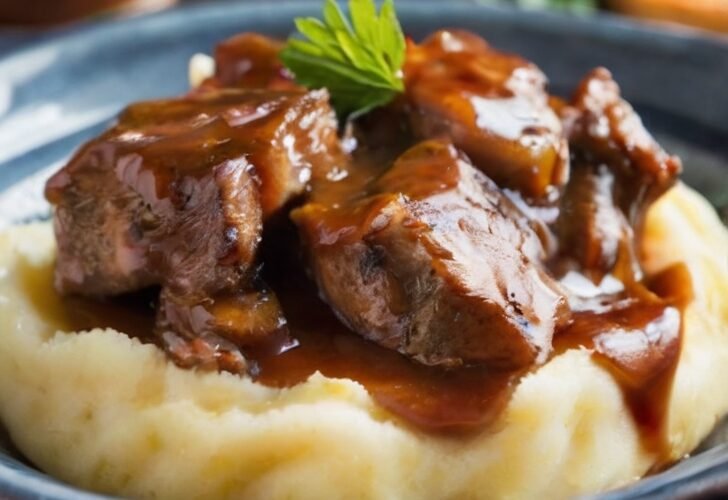
No Peek Beef Tips: Fork-Tender Beef and Gravy, Oven or Slow Cooker
No Peek Beef Tips is the dinner I make when I want the house to smell like something has been cooking all day, without having actually spent all day on it. Five ingredients, one bowl, and a choice: oven or slow cooker, whichever one your day allows. Chuck stew meat goes into a dish, a gravy mixture gets poured over the top, a lid goes on, and two hours later — or six, if you left for work — the beef is fork-tender and swimming in a glossy brown gravy that belongs over rice, over egg noodles, or over mashed potatoes in quantities I will not describe in polite company. The name is the technique, and it is worth understanding before you start. "No peek" means exactly what it says: once that lid or foil goes on, it stays on. Every time you lift it, you release steam that's doing the braising, and the trapped moisture is the entire engine of this recipe. The meat isn't searing or sautéing — it's slowly relaxing in a sealed, steamy environment until the collagen in the chuck breaks into gelatin and the tough little cubes turn spoon-soft. Lift the lid to "check" and you're venting the thing that's cooking your dinner. Trust the time, trust the sealed dish, and peek once at the end when it's time to eat. I love this one because it forgives almost everything. It works on low for a full workday or in the oven before dinner. It's built from pantry shelf-stable ingredients you probably have right now — gravy mix, condensed soup, dry soup mix — so there's no special shopping. It costs about fourteen dollars and fifty cents for six servings, which works out to two dollars and forty cents a plate for beef dinner in this economy, and it's a make-ahead dream because the gravy only improves overnight. Make it this weekend. And before anyone asks: yes, the sodium is high — two seasoning packets and a can of condensed soup say so — the full numbers are below, stated plainly.Why You'll Love No Peek Beef Tips
- Five ingredients and ten minutes of hands-on work — the oven or slow cooker does everything else.
- Two cooking methods, one recipe: slow cooker for a workday, oven for a 2-hour dinner, same result.
- Fork-tender beef with real gravy made in the dish — no separate saucepan, no roux, no stirring.
- About $2.40 per serving for a beef main, which is comfort food your wallet also loves.
- Makes six generous servings, and leftovers are genuinely better the next day.
- Freezes and reheats beautifully, so a double batch is basically future-dinner insurance.
Why This Recipe Works
Chuck stew meat is the right cut and it isn't close. Chuck comes from the shoulder, a working muscle packed with collagen — the tough connective tissue that makes raw beef chewy and, when given long moist heat, makes cooked beef unctuous. Collagen converts to gelatin somewhere north of 160°F over time, and that conversion is what turns a cube of beef into something that falls apart at the touch of a fork. Lean cuts like sirloin have nothing to convert; they go from tender to dry. This recipe is engineered around patience breaking down the one cut that rewards it. The sealed dish is the second mechanism. Water plus cream of mushroom soup plus the gravy mixture creates a braising liquid that hovers just below a simmer inside a covered casserole or a lidded slow cooker — a wet, gently circulating, essentially constant-temperature environment. Because the lid never comes off, nothing reduces away: the steam stays in the vessel, keeps the meat submerged in moisture, and the gravy concentrates only slightly as the starch from the gravy mix does its thickening work. That's the physics of the no-peek rule. The vessel is a miniature braising chamber, and opening it resets the temperature and costs you liquid you can't get back. Why do the flavor packets work together instead of tasting like a spice aisle? Because they're engineered to. Brown gravy mix brings the dark color, the beefy base notes, and the cornstarch thickener. Cream of mushroom soup adds body, a little savoriness, and the fat that rounds everything out. Beefy onion soup mix contributes dried onion, garlic, and a big savory-salt backbone that rehydrates into actual texture in the liquid. Layered together they hit the same flavor profile as a gravy that started with a pan and a whisk — in a fraction of the time, with no lumps possible.Ingredient Breakdown
| Ingredient | What it does | Notes |
|---|---|---|
| 2 lb stew meat, bite-sized | The whole dish — chuck's collagen is what becomes tenderness | Cut uneven pieces down so everything cooks at the same rate. |
| 1 packet brown gravy mix | Beefy flavor, dark color, and the thickener | Standard 0.8–1 oz packet. Most contain wheat — check the label for gluten-free needs. |
| 1 can cream of mushroom soup | Body, richness, and the silky texture in the gravy | Condensed, not "ready to serve." Cream of celery works if you dislike mushroom. |
| 1 cup water | Thins the concentrate into a proper braising liquid | Don't skip or halve it — the sealed vessel needs liquid to generate steam. |
| 1 packet beefy onion soup mix | Savory depth, dried onion, the salt backbone | Beefy onion, not plain onion — it's beef-flavored for a reason. |
| Oil or spray, for the dish | Keeps the bottom layer from sticking during a long bake | A quick film of any oil. Butter works too. |
Kitchen Equipment You Actually Need
- Slow cooker (5–6 qt) OR an oven-safe casserole dish with a lid — either one finishes the whole recipe.
- Aluminum foil — the tight seal for a lidless casserole dish. "Sealing tightly" is the whole recipe.
- One medium bowl and a whisk or fork — the gravy mixture is the only mixing involved.
- Sharp knife and cutting board — for trimming the stew meat into even bite-sized pieces.
- Instant-read thermometer — optional but the honest way to confirm doneness beyond "it looks fork-tender."
- Serving spoon and warm platter — the gravy waits for no one once the lid comes off.
Step-by-Step Instructions
Slow Cooker Method
- Mix the gravy. In a bowl, whisk together the brown gravy mix, cream of mushroom soup, water, and beefy onion soup mix until thoroughly combined and no dry pockets remain.
- Load the cooker. Place the stew meat in a greased slow cooker, spreading it into an even layer.
- Pour over. Pour the prepared mixture evenly over the meat so every piece is coated.
- Cover and cook. Lid on, low for 6–8 hours or high for 3–4 hours, until the beef is fork-tender. Don't lift the lid to check.
- Finish and serve. Stir gently to combine the gravy with the meat juices, and serve hot over rice, noodles, or mashed potatoes.
Oven Method
- Heat and mix. Heat oven to 325°F. Whisk together the brown gravy mix, cream of mushroom soup, water, and beefy onion soup mix until smooth.
- Load the dish. Place the stew meat in a greased oven-safe casserole dish and pour the mixture over it evenly.
- Seal it. Cover with a lid or aluminum foil, sealing tightly around every edge. This is the no-peek part — it stays sealed.
- Bake 2 to 2½ hours until the meat is tender throughout. Start checking at 2 hours: a fork should slide into the largest piece and twist out with no resistance.
- Remove carefully. Take the dish out and lift the cover away from your face — the steam underneath is genuinely hot.
- Stir and serve. Gently stir to blend the gravy and meat juices, then serve hot over rice, noodles, or mashed potatoes.
Doneness, stated plainly: the beef must reach a safe internal temperature of 145°F, but for fork-tender texture you're aiming higher — around 195–205°F, where the collagen actually converts. The honest test: pierce the largest piece with a fork and it should give with zero effort. If it resists, cover it back up and give it another 20–30 minutes. And because this dish uses condensed soup and seasoning packets, expect roughly 900 mg of sodium per serving — that figure is in the nutrition panel too, no hiding it.
Expert Tips
Cut the meat even. Chunks that are twice the size of their neighbors will be tough when the small ones are perfect. Spend the extra minute at the cutting board — it's the difference between uniform tenderness and a mixed bag.
Whisk the gravy mixture until no dry specks remain. The gravy mix and soup want to clump at the bottom of the bowl. Thirty extra seconds of whisking means a smooth gravy instead of one with flour pockets.
Seal like you mean it. In the oven, press the foil tightly around the rim — a loose cover vents steam and you'll get partially cooked, drying meat. If the dish has a lid, use it, and make sure it seats properly.
No peeking, seriously. Every lid-lift drops the temperature, costs steam, and adds fifteen minutes. The recipe is named after this rule for a reason.
Oven at 325°F, not 350°F. Low and slow keeps the braise gentle. hotter and the liquid at the edges can boil rather than simmer, which toughens the meat's outer layer.
Rest the dish five minutes before stirring. The gravy tightens as it sits those few minutes, and stirring then distributes the meat juices instead of washing them off. Stirring immediately makes a thinner gravy.
Common Mistakes
Lifting the lid to check. The most common violation, and the reason for the name. Trust the clock and the seal.
Using lean stew meat. Sirloin or round has little collagen and turns dry and chewy in a long braise. Chuck, specifically labeled chuck stew, is the cut.
Skipping the water. The liquid generates the steam that cooks the meat. Halving it means a thick, scorched bottom layer and undercooked pieces above it.
Oven too hot. Above 325°F the dish goes from a braise to a boil at the edges. Tender is a low-temperature achievement.
Opening the foil to "peek" at hour one. You'll think you're being careful. You're venting the engine. Check once, at 2 hours, and be ready to give it more time if needed.
Not greasing the dish. Two hours of starchy gravy on dry glass equals a scrubbing session. A film of oil takes five seconds and saves you ten minutes.
Thickening in a panic. If the gravy is thinner than you like after cooking, see the tip below — but don't thicken before the meat is done, because the liquid needs to be loose while it braises.
Ingredient Substitutions
| If you don't have… | Use… | Watch out for… |
|---|---|---|
| Beefy onion soup mix | Plain onion soup mix + 1/2 teaspoon beef bouillon | Near-identical result. Check salt — bouillon plus the gravy mix can over-salt if generous. |
| Cream of mushroom soup | Cream of celery or golden mushroom soup | Cream of celery is the mildest swap; golden mushroom deepens the beef flavor considerably. |
| Brown gravy mix | Mushroom gravy mix, or 3 tablespoons cornstarch + 2 tablespoons cocoa-free beef bouillon | Homemade needs whisking smooth before pouring. Most packets contain wheat. |
| Stew meat (chuck) | Chuck roast, cut into 1-inch cubes yourself | Better, actually — pre-cut stew meat sits in the case longer. Trim the exterior fat cap. |
| Stew meat | Cube steak or beef chuck tenders | Cook shorter: 1½–2 hours oven, 4–5 hours low. They're more tender to start. |
| Gluten-free version | GF-labeled brown gravy mix + GF cream of mushroom soup + GF soup mix | The only way to call this gluten-free. Standard packets and condensed soup usually contain wheat — read all three labels. |
| Slow cooker or casserole | Dutch oven on the stovetop, lowest heat, 2–2½ hours | Lowest setting only — a real simmer, not a bubble. Lid stays on the same way. |
Variations
- Mushroom-heavy. Add 8 oz sliced fresh mushrooms over the meat before pouring. They shrink into the gravy and make it taste far less like a packet recipe.
- Onion-boosted. One sliced yellow onion layered with the beef. The dried onion in the mix gets backup, and the fresh version melts into sweetness.
- Pepper steak style. Add a sliced bell pepper and 1/2 teaspoon black pepper with the meat. This is the weeknight beef-pepper route from the same base.
- Garlic butter finish. Stir in 2 tablespoons butter and 2 minced garlic cloves when you uncover the dish. Two ingredients, noticeably more luxurious gravy.
- Herb sprig. A sprig of fresh thyme or rosemary laid on top before sealing. Pull it out before serving — it makes the gravy taste slow-cooked rather than assembled.
- Beer braised. Replace the cup of water with a cup of amber beer. The malts play with the gravy mix beautifully and it deepens the whole pot.
Make It Healthier
I'll be honest about where this recipe stands: it's a comfort dish built on seasoning packets, and the sodium is the real consideration. Two packets plus condensed soup land around 900 mg per serving, which is a substantial chunk of a daily limit in one plate. The honest levers here are specific. Using low-sodium cream of mushroom soup plus a reduced-sodium beefy onion mix cuts the total meaningfully — I've done it, and with a full teaspoon of black pepper and a sliced fresh onion added, you won't miss the salt. Draining and trimming as much visible fat as you can from the chuck before it goes in reduces the saturated fat without changing the dish's character. On the positive side, this plate is genuinely filling protein — about 29 grams per serving from the beef alone, and the portion of gravy over rice or noodles keeps it modest at roughly 420 calories. Served over cauliflower rice rather than mashed potatoes, or over a pile of steamed green beans instead of egg noodles, it becomes a reasonable weeknight dinner instead of a plate-of-something-heavy one. What I won't pretend: there's no version of this that's low-sodium, high-fiber, or diet-friendly. It's beef and gravy, and its job is comfort. Eat it with a vegetable, drink some water, enjoy it.Meal Prep
This is one of the best meal-prep recipes in the whole rotation, because it is assembly-only and everything involved is shelf-stable. The full dish can be assembled in the slow cooker crock or casserole the night before — meat in, gravy mixture poured over, cover on — and refrigerated. In the morning, move the crock to the base (or the dish straight to a cold oven, then heat) and cook as directed; add about 30 minutes to the slow-cooker low time since you're starting cold. The dry gravy mixture itself can also be pre-mixed in a jar: combine both packets and keep it airtight, turning the recipe into meat-plus-liquid-plus-shake on a busy day. Batch-cooking math: double everything and you'll need a 6–7 quart slow cooker or two casserole dishes — crowding one dish past its capacity extends the cook time unpredictably and can leave the top layer underdone. The doubled batch cooks about the same amount of time in the slow cooker (the thermal mass helps, if anything) but in the oven, use two dishes rather than one deeper one. Sunday-night assembly, Monday-night dinner: that's the ideal workflow here.Storage
Cool the beef tips within two hours, then store in an airtight container in the refrigerator for 3 to 4 days. Keep them in their gravy rather than draining it — the meat stays tender in the liquid and dries out noticeably sitting exposed. Reheat gently (below), and note the gravy thickens considerably as it chills; that's the gravy mix doing what it does, and a splash of water or beef broth as it warms brings it right back to pouring consistency. This is one of those dishes that genuinely tastes better on day two. The gravy settles into the meat overnight, the flavors round off, and the beef absorbs more of the sauce as everything sits together. If you're cooking specifically for leftovers, I'd almost rather you did — plan Monday's dinner around Sunday's batch and you'll understand why this recipe has stuck around in family kitchens for generations.Freezing
Excellent freezer food, and one of the few sauced beef dishes where the texture survives the trip intact — the gravy protects the meat from freezer burn and the braised chuck reheats without going mealy. Cool completely, then portion into freezer bags or containers, leaving a little headspace for expansion. Freeze up to 3 months. Thaw overnight in the refrigerator, then reheat on the stovetop over medium-low — or in the microwave in 90-second intervals, stirring between — adding a splash of water or broth to loosen the gravy, which will have set to almost solid in the cold. Don't thaw on the counter or reheat at high power; bacterial safety aside, aggressive reheating tightens the meat. If you want a true future-dinner, freeze it in meal-sized portions with the rice already separate and wait to cook the starch until the beef is hot.Reheating
The stovetop is the best method: empty the portion into a saucepan over medium-low heat, add a tablespoon or two of water or beef broth to loosen the set gravy, and warm gently, stirring now and then, for about 8–10 minutes until everything is hot through. Cover the pan — you're braising again, and trapped steam keeps the beef tender instead of tightening it further. Microwave works fine for a single serving: cover the bowl loosely, 60–90 seconds, stir, then another 30–45 if needed. Low and slow is the rule even in the microwave; blasting it makes the gravy separate and the meat chewy. What you should not do is reheat this in a hot oven or on high heat on the stove — the beef is already perfectly tender, and aggressive heat is the one thing that can undo hours of slow cooking in about four minutes.What to Serve With It
Beef tips and gravy exists to be poured over something, so the starch question comes first. Rice is the classic — long-grain white rice soaks up the gravy without competing, and it's what I default to. Egg noodles turn it into something closer to beef stroganoff's cousin and are my children's unanimous vote. Mashed potatoes are the special-occasion answer: the gravy pools into the ridges and the whole plate becomes the platonic comfort dinner. Buttered egg noodles, baked potatoes, even wide pasta — all correct. For contrast, you want something green and bright against the richness: steamed green beans with lemon, roasted broccoli, a simple peas-and-carrots situation, or a sharp vinegar-based coleslaw whose acidity cuts right through the gravy. Peas are the traditional Southern side here and they're right. Cornbread on the table doesn't hurt, and if you're building a full comfort spread, a bowl of soup or a lighter starter makes sense — this is the hearty main event, not the opening act.Beverage Pairings
Gravy and braised beef want a red with some softness — a Merlot, a Gamay, or a light Côtes-du-Rhône, all of which sit comfortably with the savory packet-gravy profile without fighting it. Skip anything heavily oaked or tannic; the dish is rich but gentle, and an aggressive Cabernet bulldozes it. An amber ale or a crisp lager is the everyday choice and honestly the right one for a Tuesday plate of beef tips over rice — the carbonation scrubs the palate clean between bites. Non-alcoholic: sweet tea is the Southern default and works, as does an iced black tea unsweetened if you prefer the tannin contrast. Milk sounds odd until you've eaten beef gravy over mashed potatoes, at which point it sounds inevitable — kids get milk and grown-ups can quietly pour themselves some too. Coffee doesn't pair well here; the bitterness clashes with the gravy's sweetness. Save it for after, when someone's had seconds and is sitting back from the table.Frequently Asked Questions
Why is it called No Peek Beef Tips?
Because the one rule is not lifting the lid. The dish cooks in its own trapped steam — that's what makes the beef tender — and every peek vents heat and moisture you can't replace. The sealed cover creates a gentle, constant braising environment, and interrupting it means longer cooking and uneven results. Once it's covered, the next time you look is when it's done.Should I brown the beef before cooking?
You don't need to — the recipe is built to work straight into the dish, which is part of its appeal. Browning adds a deeper Maillard flavor on the meat's surface, so if you have ten extra minutes and want it, sear the cubes in a hot skillet with a little oil first, then proceed. It's an upgrade, not a requirement, and skipping it costs you depth rather than tenderness.Can I make No Peek Beef Tips in the slow cooker and the oven?
Yes — the recipe includes both methods because they produce the same dish with different schedules. Slow cooker: low 6–8 hours or high 3–4 hours, ideal for a workday. Oven: 325°F, covered tightly, 2 to 2½ hours, ideal when you're home and want dinner sooner. The oven version's gravy tends to be slightly thicker from the gentle reduction; the slow cooker's is looser. Both are correct.Why is my gravy too thin (or too thick)?
Too thin after cooking: uncover and let it sit 10 minutes — it thickens as it rests — or mix a teaspoon of cornstarch with cold water and stir it in for 5 minutes on the heat. Too thick, which usually happens after refrigeration: thin it with water or beef broth, a tablespoon at a time, while reheating. The gravy mix does its work slowly, so judge thickness hot, not cold.What cut of meat should I use for beef tips?
Chuck stew meat, specifically. Chuck is from the shoulder — a collagen-rich working muscle that turns into gelatin during long moist heat, which is precisely how you get fork-tender results. Avoid sirloin or round stew meat, which are leaner and go dry and chewy in a braise. If your store only sells "stew meat" unlabeled, ask what cut it is; if it's chuck, you're set.Is this recipe gluten-free?
Not as written. Brown gravy mix, condensed cream of mushroom soup, and dry soup mixes commonly contain wheat flour or wheat-based thickeners, so the standard pantry versions of all three make this a gluten-containing dish. To make it gluten-free, buy all three components labeled gluten-free — that substitution is the only basis for calling the finished dish gluten-free. Read every packet and can label; don't assume.How much sodium is in No Peek Beef Tips?
Approximately 900 mg per serving, estimated — the source of it is plain: a gravy packet, a soup packet, and a can of condensed soup, each of them sodium-dense by design. If that's a concern, the meaningful fix is low-sodium soup plus reduced-sodium soup mix, which cuts the total noticeably. Serving it over plain rice or potatoes without added salt also helps offset it. The figure is in the nutrition panel below as well.Can I double or halve this recipe?
Both work. Halving: use 1 pound of meat, half of everything else, an oven-safe dish that fits the meat in roughly one layer, and the same time — the seal does the work, not the volume. Doubling: use a 6–7 quart slow cooker or two casserole dishes rather than overpacking one. In the oven, don't deepen one dish past its usual fill; a deeper mass takes longer to heat through and leaves the top layer underdone.Nutrition Facts (Estimated)
| Per serving (1/6 of batch, beef and gravy only) | Amount |
|---|---|
| Calories | ~420 |
| Total Fat | ~20 g |
| Saturated Fat | ~8 g |
| Carbohydrates | ~14 g |
| Sugars | ~2 g |
| Protein | ~29 g |
| Sodium | ~900 mg |
Final Thoughts
No Peek Beef Tips earns its place in the rotation by being two recipes at once: the slow-cooker dump-and-go that's ready when you walk in the door, and the two-hour oven version for the night you're home and want the house to smell like something wonderful. Five ingredients, one bowl, ten minutes of work, and a sealed lid doing the rest. Fork-tender beef, real gravy made in the dish, and about two dollars forty a serving. That's the whole deal, and it's a good one. Cover it, walk away, and don't lift that lid — the name isn't a suggestion, it's the technique. Serve it over rice, noodles, or mashed potatoes with something green alongside, and make enough for tomorrow, because the gravy settles into the beef overnight and day two might be better than day one. As for the sodium: the numbers are right there, the low-sodium swaps are in the table, and you get to decide. What I'd decide is a double batch, one for tonight and one for the freezer. Comfort food that's ready when you are is worth planning around.No Peek Beef Tips
Five ingredients, one sealed lid — fork-tender beef and gravy, oven or slow cookerIngredients
Directions — Slow Cooker
- Whisk together the brown gravy mix, cream of mushroom soup, water, and beefy onion soup mix until thoroughly combined.
- Place the stew meat in a greased slow cooker.
- Pour the mixture evenly over the meat.
- Cover and cook on low 6–8 hours or high 3–4 hours, without lifting the lid, until fork-tender.
- Stir gently to blend the gravy and serve hot.
Oven method: heat to 325°F. Mix as above, place meat in a greased oven-safe casserole dish, pour over the mixture, and seal tightly with a lid or foil. Bake 2 to 2½ hours without opening, until a fork slides into the largest piece with no resistance. Remove the cover away from your face, stir gently, and serve.
Cost: about $14.50 per batch — roughly $2.40 per serving.
Tip: don't lift the lid. Trapped steam is what makes the beef tender — that's the whole recipe.
Tip: start checking oven version at 2 hours; give it another 20–30 minutes if the fork resists.
Sodium: about 900 mg per serving. Use low-sodium soup and reduced-sodium soup mix to lower it.
Nutrition (estimated per serving)
420Calories
29 gProtein
20 gFat
14 gCarbs
2 gSugar
900 mgSodium
Estimates only — not medical or dietary advice. Values vary by brand. Sodium is high by design: state it on the plate, balance it with an unsalted side.